Grayscale Filed for a HYPE ETF. Here's What It Changes for Perps Traders.
By CMM Team - 27-Mar-2026
Grayscale Filed for a HYPE ETF. Here's What It Changes for Perps Traders.
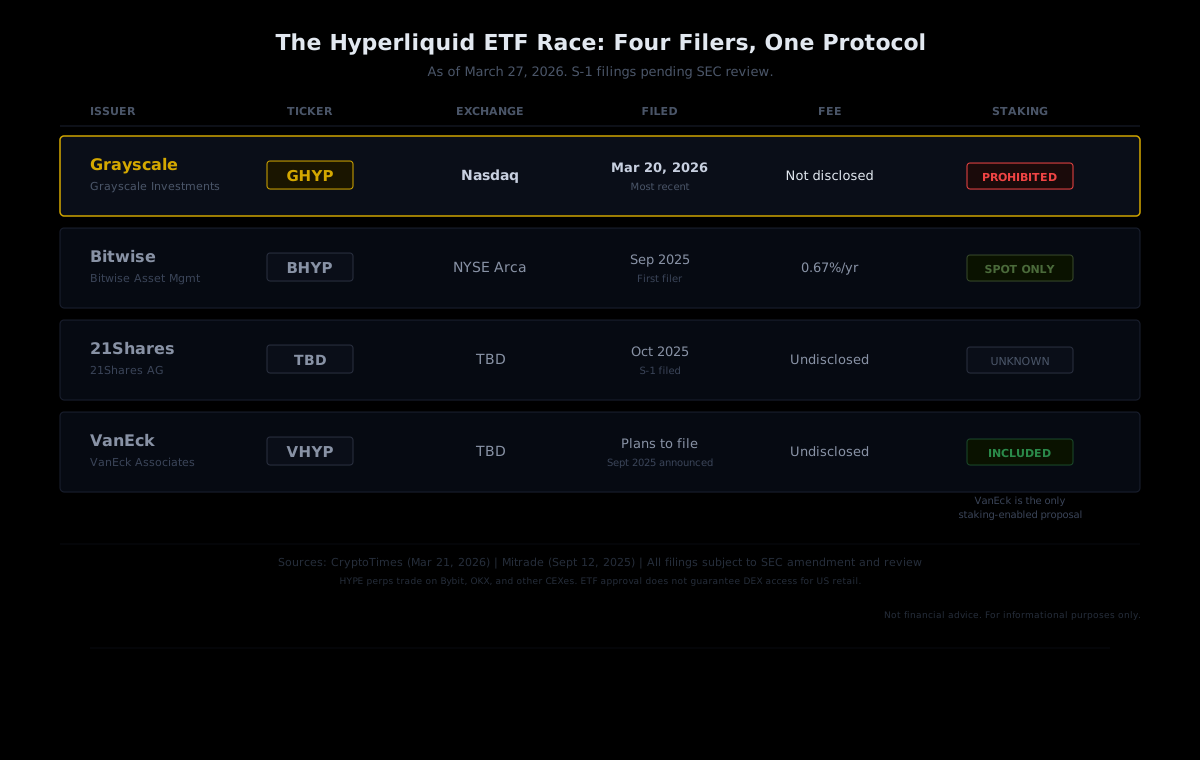
On March 20, 2026, Grayscale filed a Form S-1 with the SEC to list the Grayscale HYPE Trust on Nasdaq under the ticker GHYP. It's the latest entry in a Hyperliquid ETF race that's been building since late 2025. Most coverage stopped at the announcement: name of the product, exchange, custodian, and a note that approval isn't guaranteed. That's accurate. It doesn't go very far.
The more interesting question is what happens to Hyperliquid's perps DEX if the ETF actually gets approved. TradFi capital entering via an ETF wrapper behaves differently on-chain than a retail trader opening a long position. The mechanism is different. The second-order effects on funding rates, open interest composition, and liquidity depth are real. They're almost entirely unaddressed by everything written about this filing so far.
This is that analysis.
Inside the Grayscale HYPE Trust: What the S-1 Says
The proposed product is a spot grantor trust. It holds HYPE tokens. Coinbase Custody serves as custodian. The trust would trade on Nasdaq under GHYP, giving brokerage account holders direct HYPE price exposure without needing a crypto wallet or an exchange account.
Two structural constraints matter for traders evaluating this product.
The first is staking. The S-1 specifies that staking is currently prohibited for the fund. Hyperliquid's staking mechanism generates yield on locked HYPE. The trust forfeits that yield entirely. GHYP holders get pure price exposure, and nothing else. Grayscale doesn't disclose a management fee in the filing, which creates its own set of questions for institutional allocators doing cost-of-carry analysis.
The second is perps access. The trust holds HYPE, the governance and fee token. It gives holders no access to Hyperliquid's perpetual futures exchange. A US institutional investor buying GHYP through their brokerage account cannot open a BTC-USDC perpetual position on Hyperliquid. That exchange remains outside the regulatory perimeter for US retail. The gap matters for anyone trying to understand whether this ETF represents "TradFi adopting Hyperliquid" or "TradFi gaining exposure to a token whose value is tied to Hyperliquid's success." Those are different bets.
Three Firms Filed for the Same Protocol
Grayscale was not first. Bitwise filed for a HYPE ETF in September 2025, proposing the ticker BHYP on NYSE Arca with a 0.67% annual management fee. 21Shares followed with its own S-1 in October 2025. VanEck has announced plans to file for a staking-enabled HYPE ETF, reportedly targeting the ticker VHYP. Three asset managers, one protocol, inside six months.
When ETF filings cluster like this, it's a signal. Each S-1 costs real legal and compliance resources. Firms don't file speculatively. The race itself reflects institutional conviction that something is worth owning in a regulated wrapper, and that the regulatory window is opening.
What's different here from the BTC ETF race in 2023 is the underlying asset. Bitcoin is a store of value thesis. A HYPE ETF is a bet on a protocol that generates over $700 million in annual fees and routes approximately 97% of that revenue into a token buyback mechanism. The investment thesis here is cash flow: a protocol generating over $700 million annually and buying back its own token.
The Buyback Flywheel Gets a TradFi Accelerant
Understanding the second-order effects of ETF approval requires understanding the buyback mechanic first.
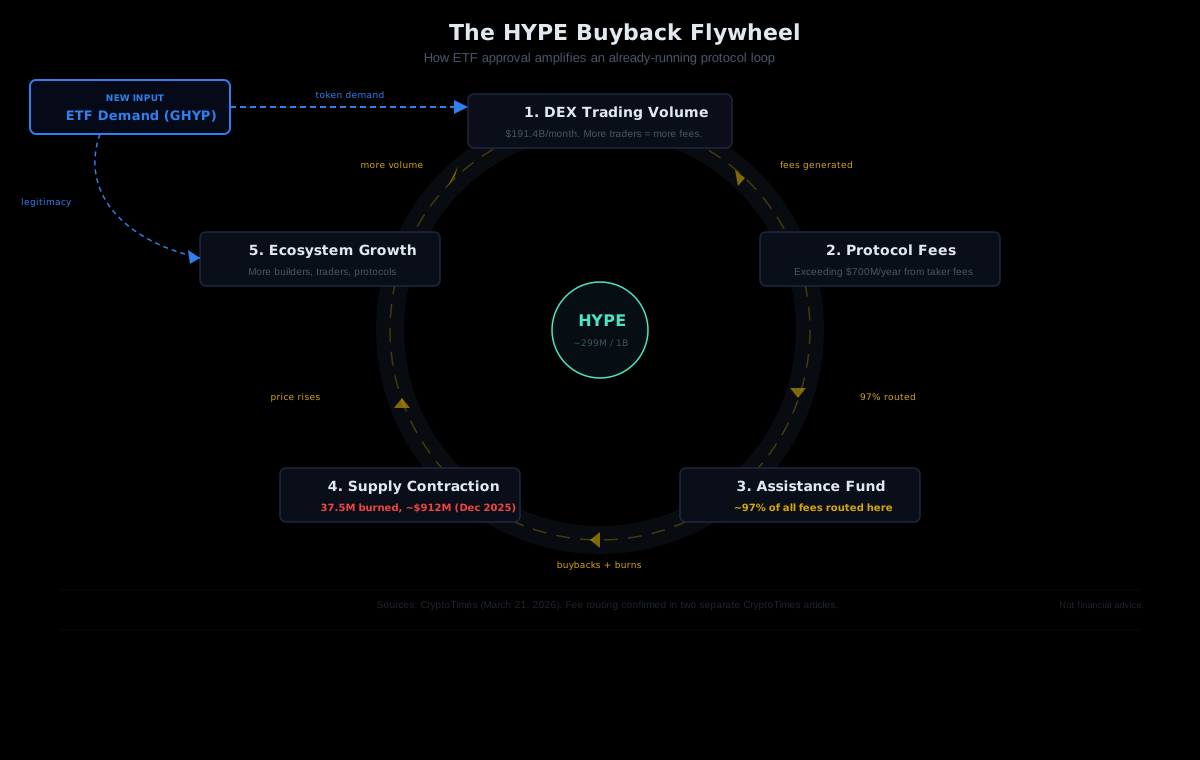
Hyperliquid routes approximately 97% of protocol fees to the Assistance Fund, which uses that capital to buy HYPE from the open market. More trading volume on the DEX means more fees, which means more buy pressure on the token. In December 2025, the protocol burned 37.5 million HYPE tokens worth roughly $912 million. That number scales directly with DEX volume.
An ETF approval introduces a new input to this loop. It doesn't put capital directly into the DEX. But it creates sustained institutional demand for HYPE the token. Rising token demand tightens circulating supply. Against a maximum supply of 1 billion HYPE with approximately 299 million in circulation as of December 31, 2025, the deflationary mechanics become more pronounced under sustained institutional inflows.
The loop compounds further. A rising HYPE price increases perceived protocol value. Higher protocol value draws more builders and traders to Hyperliquid's ecosystem. More trading activity generates more fees. More fees fund more buybacks. The ETF isn't just a price catalyst. It's an accelerant on a flywheel that was already running.
This is the piece that most ETF coverage misses. The framing is usually "HYPE price goes up." The actual mechanism is: ETF approval amplifies the existing protocol feedback loop, which benefits the DEX through legitimacy and liquidity effects, not just through token appreciation.
What TradFi Capital Does and Doesn't Do On-Chain
Here's the part that matters for anyone trading on Hyperliquid directly.
ETF demand is passive. Institutional investors buying GHYP through brokerage accounts add no open interest to Hyperliquid and create no funding rate pressure on the DEX. The ETF's authorized participants hedge their book using spot HYPE, and may use HYPE perps on centralized exchanges like Bybit and OKX where they already trade. But that hedging activity flows through CEX venues. It doesn't automatically route into Hyperliquid DEX order flow.
What changes is the composition of who's paying attention to Hyperliquid. ETF approval creates a legitimacy signal that attracts the next tier of institutional participants: quantitative trading firms, proprietary trading desks, and market makers who were watching but waiting for regulatory clarity. Those participants trade actively. And when they arrive, they arrive with scale.
The funding rate environment shifts as that population grows. Hyperliquid uses hourly funding settlement (unlike the 8-hour intervals on Binance or OKX), which means funding extremes resolve faster and create sharper mean-reversion windows for traders positioned correctly. When retail sentiment dominates, those hourly swings get exaggerated. As institutional participation grows, funding dynamics compress: deeper liquidity means fewer one-sided squeezes, slower build-up in extreme readings, and more stable mean-reversion behavior.
Open interest composition shifts as well. Hyperliquid's OI sits near $7 billion as of late March 2026. Institutional participants arriving in size tend toward delta-neutral strategies: market makers running long-spot, short-perp structures, or basis traders arbitraging the CEX-DEX funding rate differential. That structure adds OI without directional bias. It deepens the market and makes it harder for large single-sided positions to push funding to extremes.
For traders whose edge depends on funding rate volatility, watch this carefully. Institutional capital arrival means the mean-reversion signals that work in a retail-dominated market get slower, shallower, and harder to size. The opportunity changes shape even as the market grows.
Hyperliquid's Competitive Position Gets a Legitimacy Boost
Hyperliquid's 30-day perpetual volume sits at $191.4 billion, with cumulative volume exceeding $4.1 trillion since launch. The protocol has processed $9.4 billion in 24-hour volume during recent peak periods.
The market share story is more complicated. According to research from 21Shares, Hyperliquid "commanded around 70% of market share" among perp DEXs for much of its early dominance. By late 2025, that share had "slipped to about 10%" as competitors including Aster surged, at one point reaching "nearly 70% market dominance." The volume competition has been fierce.
An ETF approval reframes the competitive moat question. For smaller competing protocols, reaching the same institutional legitimacy requires the same multi-year regulatory process Hyperliquid is now navigating. That's not impossible, but it's slow. Grayscale chose HYPE specifically: one protocol, with a specific fee structure and buyback mechanic, listed on its own Layer 1. That specificity signals institutional conviction that Hyperliquid's infrastructure is worth validating above any other DEX perps protocol. Being the protocol TradFi validates first is a structural moat that raw volume competitors can't replicate on the same timeline.
The perp DEX volume competition has been about who can run the fastest, cheapest, deepest exchange. The ETF changes the competitive layer to: who has the regulatory legitimacy and institutional recognition to attract the next class of capital. On that layer, Hyperliquid has a meaningful lead.
Watching the Institutional Signal Before the Approval
The ETF approval timeline is uncertain. The S-1 is filed. Amendments will follow. A full SEC approval for a spot HYPE ETF, if it happens, is likely 6 to 12 months out depending on the regulatory environment under Paul Atkins. That's not immediate.
What's trackable right now is the precursor signal: how institutional positioning is shifting on-chain ahead of any approval. Smart-money wallets that expect ETF approval have reason to front-run the event. The cohort-level analytics in HyperTracker's API surface exactly this kind of shift. When large, high-PnL wallets start accumulating net long HYPE exposure, or when the spread between smart-money and retail positioning widens in a sustained way, those are early reads on where conviction is building.
Hyperliquid's 16 behavioral cohorts, segmented by wallet size and all-time PnL, give a granular view of how different participant classes are positioned at any moment. A shift in the large-wallet, high-PnL cohort toward sustained long exposure looks different from a retail-driven squeeze. Our order flow data, refreshed every 5 minutes, makes that distinction legible as institutional positioning shifts. If capital is front-running an approval announcement, it will appear in our cohort data first.
Track the Institutional Signal Before It Moves Price
HyperTracker's cohort analytics show how 16 behavioral segments of Hyperliquid wallets are positioned right now. One API call surfaces smart-money vs. retail divergence, order flow shifts, and OI changes refreshed every 5 minutes.
Explore HyperTracker API
Three Signals That Define the ETF Timeline
Three things define the ETF timeline from here. First: SEC comment letters. The agency typically issues written comments on S-1 filings within 30 days. How the SEC frames its questions will signal whether the path to approval is clear or contested. Second: staking. VanEck's structure, if it includes staking, would be meaningfully different from Grayscale's non-staking product. The first approval sets a template that others follow. Third: Hyperliquid's RWA expansion. With HIP-3 open interest for real-world asset markets crossing $1.3 billion and growing, the protocol's surface area is expanding beyond crypto derivatives. That broadens the institutional interest case before any ETF is approved.
The filing is not an approval. But four asset managers spending legal resources to file S-1s for the same protocol inside six months is itself a form of institutional due diligence. The conclusion they all reached is that Hyperliquid's fee structure, buyback mechanics, and market position are worth owning in a regulated wrapper. Whether approval comes in six months or eighteen, the infrastructure for institutional capital entry is being built now. The on-chain signal for when it arrives will show up in our order flow data before anywhere else.