Hyperliquid Data Providers Compared: Features, Pricing, and Use Cases
By CMM Team - 16-Mar-2026
Hyperliquid moves $8 billion a day. Hundreds of builders are racing to capture that flow with bots, dashboards, and alert systems, many of them shipping in hours with AI-assisted code. When everyone can build fast, the edge isn't the code. It's the data feeding it. The question is whether you're spending weeks building an analytics pipeline from raw chain data, or shipping tomorrow with intelligence that's ready to use.
An entire ecosystem of data providers has emerged around Hyperliquid, and each one approaches the problem differently: some focus on raw infrastructure, others on analytics dashboards, and a few on developer-consumable intelligence APIs. This guide compares the major providers across features, pricing, and ideal use cases, covering Hydromancer, HyperTracker (by CoinMarketManager), ASXN/HyperScreener, Hyperdash (pvp.trade), Nansen, CoinGlass, Arkham, and raw RPC options like HypeRPC.
What Are Hyperliquid Data Providers?
A Hyperliquid data provider is any service that processes, enriches, or delivers data from the Hyperliquid exchange through APIs, dashboards, or streaming feeds. The raw Hyperliquid API gives you the basics: prices, positions, and order states. But turning that raw data into something actionable, whether that means behavioral cohort analytics, whale tracking, orderbook depth visualization, or historical backtesting datasets, requires significant infrastructure.
These providers fall into roughly four categories:
- Raw infrastructure providers that offer optimized RPC endpoints and orderbook streaming (Hydromancer, HypeRPC)
- Analytics dashboards that visualize trading data through a UI (ASXN/HyperScreener, Hyperdash)
- Intelligence APIs that deliver pre-computed analytics programmatically (HyperTracker)
- Cross-exchange platforms that cover Hyperliquid alongside other exchanges (CoinGlass, Nansen, Arkham)
The differences matter more than they look at first glance, because each category solves a fundamentally different problem. A quant fund building an execution engine needs sub-second orderbook data. A builder shipping a Telegram bot needs pre-computed smart money signals with a clean REST endpoint. A retail trader just wants a dashboard that shows who is buying.
Provider-by-Provider Breakdown
Hydromancer: Raw Data Plumbing for Builders
Hydromancer is purpose-built infrastructure for Hyperliquid builders. It excels at one thing: delivering raw market data faster and more reliably than the native Hyperliquid API. Their L2/L4 orderbook streaming, which includes trigger orders like stop-losses and take-profits that are invisible in standard snapshots, is genuinely impressive and unique in the ecosystem.
The platform reports 2x faster data delivery than native APIs, with orderbook streaming averaging 135ms latency compared to Hyperliquid's native 280ms. They also provide builder-specific endpoints like builderFills and builderLiquidations that do not exist natively, developed through feedback from over 30 production teams.
What Hydromancer is not is an analytics layer. You get the raw plumbing, the pipes and the pressure. What you do with the water is up to you. There are no pre-computed cohorts, no behavioral classifications, no smart money aggregates. If you need those, you build them yourself on top of Hydromancer's feeds, which is exactly what some of the most sophisticated trading teams do.
- Strengths: L2/L4 orderbook streaming with trigger order visibility, no rate limits, HIP-3/HIP-4 support, historical Parquet data for backtesting, validator-peered infrastructure
- Best for: Market makers, HFT firms, and teams that need raw, low-latency data and have engineering resources to build their own analytics
- Pricing: Starter $300/mo, Growth $1,200/mo, Scale $2,500/mo, Enterprise custom
HyperTracker (CoinMarketManager): Pre-Computed Cohort Intelligence
HyperTracker takes the opposite approach from raw infrastructure. Instead of delivering unprocessed data and leaving the analytics to you, it classifies every wallet on Hyperliquid into 16 behavioral cohorts, eight by position size and eight by all-time PnL, then makes those classifications queryable through a REST API with WebSocket and Webhook delivery.
The core insight behind HyperTracker is that knowing what happened on-chain is less valuable than knowing who did it and what category of trader they represent. When the "Profitable Large" cohort starts accumulating a position, that signal means something different than when the "Small Loss-Making" cohort does the same thing. Our data segments the entire market this way, automatically, updating every state refresh cycle and delivering rolling 5-minute order snapshots.
Beyond cohort analytics, HyperTracker provides liquidation risk scoring at the asset level, leaderboards ranked by PnL across multiple timeframes, stop/take-profit visibility in trade flow data, and rolling 5-minute order snapshots. The API covers 21 endpoints verified against production, with historical data going back 6+ months for positions and fills.
- Strengths: 16 behavioral cohorts (unique in the ecosystem), pre-computed intelligence via API, dashboard + API + alerts in one product, build-vs-buy value ($179/mo vs $10K+ to replicate), full HIP-3 support
- Best for: Builders shipping trading bots, dashboards, and alert systems who need smart money intelligence without building the analytics pipeline themselves
- Pricing: Free (100 requests/day), Pulse $179/mo (50K requests), Surge $499/mo (100K requests), Flow $1,159/mo (200K requests), Stream $2,399/mo (1M requests + WebSocket)
ASXN / HyperScreener: Free Dashboard and API
ASXN's HyperScreener is one of the most comprehensive free analytics dashboards for Hyperliquid. It aggregates data from ASXN's own node, Hyperliquid's native APIs, Dune, CoinGecko, and Hypurrscan, presenting it through a clean interface that covers whale positions, liquidations, top traders, large trades, funding rates, and open interest.
Their API at api-hyperliquid.asxn.xyz offers whale and liquidation intelligence, and their data updates daily. The dashboard is genuinely useful for market research and quick sentiment checks, and the team has built strong credibility in the Hyperliquid community through products like "Hyperliquid Wrapped" that showcase their data depth.
The tradeoff is refresh frequency and programmatic depth. Daily updates work well for research and analysis, but if you need frequent cohort signals feeding a trading bot, you will need a higher-frequency source. ASXN does not provide behavioral cohort classification or segment-level positioning data.
- Strengths: Free, comprehensive dashboard, solid community reputation, good for research and manual analysis
- Best for: Researchers, analysts, and retail traders who need a free dashboard for Hyperliquid market intelligence
- Pricing: Free
Hyperdash (pvp.trade): Analytics Dashboard with Execution
Hyperdash started as an independent Hyperliquid analytics dashboard and was acquired by pvp.trade, which rebuilt it as a full trading terminal. The V2 version combines analytics with execution tools: chase orders, trailing stops, private TWAP execution, and copy trading alongside the liquidation heatmaps and trader leaderboards.
The Alpha leaderboard surfaces top-performing traders ranked by PnL, equity, win rate, total trades, Sharpe ratio, and maximum drawdown. You can add wallets to a tracking list, counter their positions, or set up copy trading to mirror their moves. For traders who want analytics and execution in the same interface, Hyperdash is a compelling option.
The limitation is that Hyperdash's intelligence is locked inside its UI. There is no public API for programmatic access to the analytics data, which means builders cannot pipe Hyperdash insights into their own applications, bots, or alert systems.
- Strengths: Combined analytics + execution terminal, copy trading, advanced order types (chase, TWAP), strong trader leaderboard
- Best for: Active traders who want analytics and execution in a single interface, and copy traders looking for alpha wallets
- Pricing: Free dashboard (execution fees apply on trades)
Nansen: Smart Money Labels Across Chains
Nansen is a well-established blockchain analytics platform that labels over 500 million wallets across multiple chains, classifying them by behavior: institutions, skilled traders, whales, and other entity types. Their strength is individual wallet identification, figuring out who a specific address belongs to and tracking that entity's moves across the entire on-chain ecosystem.
For Hyperliquid specifically, Nansen helps traders observe whale behavior, funding shifts, and address-level activity. The platform dramatically reduced its pricing in 2025, dropping from $1,299/mo to $49/mo for the Pro plan, making it far more accessible.
The difference between Nansen and Hyperliquid-native providers is scope vs. depth. Nansen covers dozens of chains with entity-level labels, while Hyperliquid-specific tools go deeper on exchange-native data like cohort analytics, orderbook structure, and position-level metrics that on-chain analytics cannot capture.
- Strengths: 500M+ labeled wallets, multi-chain coverage, entity-level identification, well-established brand and methodology
- Best for: Cross-chain researchers and traders who need entity-level wallet labels and want Hyperliquid coverage as part of a broader analytics suite
- Pricing: Free tier available, Pro $49/mo (annual) / $69/mo (monthly)
CoinGlass: Multi-Exchange Whale Tracking
CoinGlass is a multi-exchange derivatives data platform that provides whale monitoring, liquidation maps, open interest analysis, and funding rate tracking across dozens of exchanges including Hyperliquid. Their Hyperliquid-specific features include real-time whale alerts for positions over $1M in notional value, whale position rankings, PnL distribution tracking, and wallet-level analytics covering 350K+ addresses.
The API is structured in tiers from Hobbyist ($29/mo) through Professional ($699/mo), with rate limits scaling from 30 to 1,200 requests per minute. CoinGlass's advantage is breadth: if you trade across Binance, Bybit, OKX, and Hyperliquid, you can monitor whale activity across all of them from a single platform.
The tradeoff is Hyperliquid-specific depth. CoinGlass tracks individual whales by position size, but does not classify wallets into behavioral cohorts or provide segment-level analytics. It tells you what the biggest wallets are doing, but it does not tell you what category of trader is accumulating or distributing as a group.
- Strengths: Multi-exchange coverage, real-time whale alerts ($1M+ positions), liquidation heatmaps, established data provider
- Best for: Traders who operate across multiple exchanges and want unified whale/liquidation monitoring including Hyperliquid
- Pricing: Hobbyist $29/mo, Startup $79/mo, Standard $299/mo, Professional $699/mo, Enterprise custom
Arkham: Entity Intelligence Across Chains
Arkham Intelligence is a blockchain analytics platform focused on "deanonymizing" the people and companies behind blockchain wallets and transactions. Their AI-powered labeling engine identifies entities across Bitcoin, Ethereum, Solana, Avalanche, Tron, and other chains, and tracks chronological fund flows between them.
Arkham's core analytics features remain free, with API access available through an application process for production use cases. Their strength is investigative intelligence: following money trails, identifying counterparties, and mapping entity relationships. For Hyperliquid specifically, Arkham provides entity-level wallet tracking, though with less depth on exchange-native metrics like orderbook structure or cohort behavior.
- Strengths: Entity identification across chains, free core analytics, fund flow tracing, KOL wallet tagging
- Best for: Researchers, investigators, and traders who need entity-level intelligence and fund flow analysis across multiple chains
- Pricing: Core analytics free, API access by application
Raw RPC (HypeRPC and Others): Build Everything Yourself
At the infrastructure layer, providers like HypeRPC, Chainstack, QuickNode, and Alchemy offer raw RPC endpoints for Hyperliquid. These give you the fundamental building blocks: EVM-compatible JSON-RPC calls, and in some cases, HyperCore-specific endpoints for the native L1 order book.
HypeRPC specializes exclusively in Hyperliquid, with infrastructure deployed in Japan for minimal latency and full compatibility with Hyperliquid's official API plus higher rate limits. Chainstack offers cost-effective RPC access with straightforward per-request pricing. QuickNode provides the broadest protocol support with gRPC streaming capabilities.
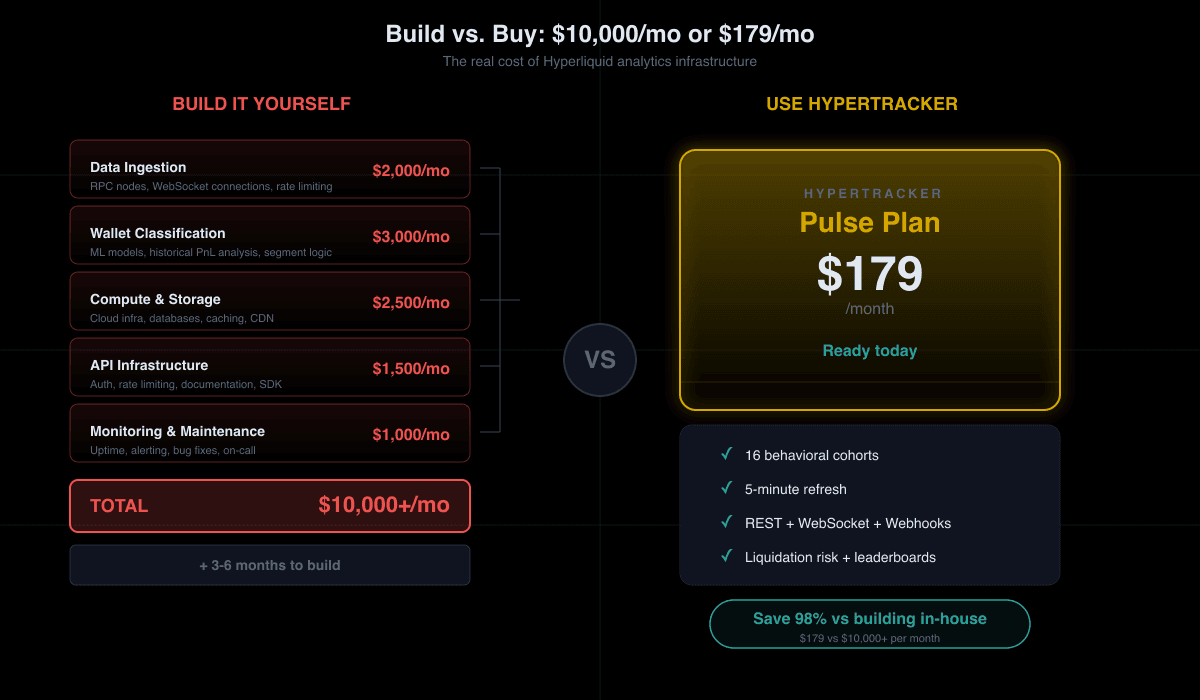
The challenge with raw RPC is what comes after you get the data. Processing raw blockchain data into useful trading intelligence requires significant infrastructure: data normalization, storage, computation of derived metrics, and serving layers. Teams that go this route typically invest $10,000 or more per month in engineering time and cloud resources to build what higher-level providers deliver out of the box.
- Strengths: Maximum flexibility, lowest-level access, no vendor lock-in on analytics
- Best for: Teams with dedicated engineering resources who need full control over their data pipeline and are willing to invest in building analytics from scratch
- Pricing: HypeRPC usage-based (from ~$12.25/M requests), Chainstack from ~$4.95/M requests, QuickNode included on paid plans
Feature Comparison: Side by Side
This table compares core capabilities across all major Hyperliquid data providers. Use it to quickly identify which providers cover the features your project needs.
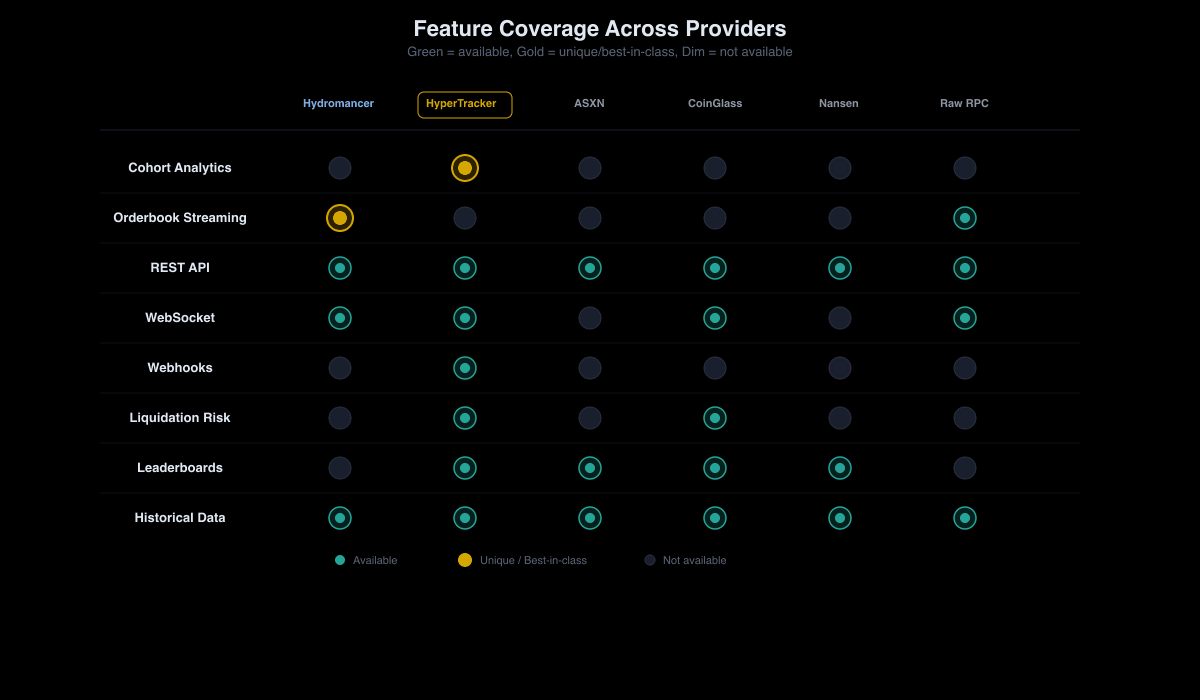
| Feature | Hydromancer | HyperTracker | ASXN | Hyperdash | Nansen | CoinGlass | Arkham | | --- | --- | --- | --- | --- | --- | --- | --- | | REST API | Yes | Yes | Yes | No | Yes | Yes | Yes | | WebSocket Streaming | Yes | Yes (Stream tier) | No | No | No | No | No | | Webhooks | No | Yes (Surge+) | No | No | No | No | No | | L2/L4 Orderbook | Yes | No | No | No | No | No | No | | Behavioral Cohorts | No | 16 cohorts | No | No | No | No | No | | Wallet Labels/Entities | No | Cohort-level | No | No | 500M+ wallets | Whale-level | Multi-chain | | Whale Alerts | No | Yes | Yes | Yes | Yes | $1M+ positions | Yes | | Liquidation Risk Scoring | No | Yes | No | Heatmap only | No | Heatmap only | No | | Leaderboards | No | Yes (multi-timeframe) | Yes | Yes (Alpha board) | No | No | No | | Order Flow Analytics | Raw fills only | Yes (stop/TP visible) | Basic | Basic | No | Basic | No | | Historical Data | Parquet, 1-sec | 6+ months | Limited | No | Multi-chain | Varies by plan | Yes | | HIP-3 Support | Full stack | Yes | No | No | No | No | No | | Copy Trading | No | No | No | Yes | No | No | No | | Multi-Exchange | HL only | HL only | HL only | HL only | Yes | Yes | Yes | | Dashboard UI | Stats pages | Yes | Yes | Yes | Yes | Yes | Yes | | Refresh Rate | Real-time streaming | 5-min snapshots, 15-20 min state | Daily | Near real-time | Varies | ≤1 minute | Near real-time |
Pricing Comparison
Pricing varies dramatically, but comparing raw numbers is misleading. A $49/mo wallet labeling service and a $179/mo cohort intelligence API solve completely different problems. The table below groups providers by what you are actually buying.
Free Dashboards and Research Tools
| Provider | Price | What You Get | | --- | --- | --- | | ASXN / HyperScreener | Free | Dashboard + basic API, daily updates, whale/liquidation data | | Arkham | Free (API by application) | Entity analytics dashboard, fund flow tracing, multi-chain | | Hyperdash (pvp.trade) | Free (execution fees on trades) | Analytics dashboard + execution terminal, copy trading |
Cross-Exchange Data Platforms
| Provider | Entry Price | Top Tier | What You Get | | --- | --- | --- | --- | | CoinGlass | $29/mo | $699/mo | Whale tracking + liquidation maps across dozens of exchanges | | Nansen | $49/mo | $69/mo | 500M+ wallet labels across chains (entity-level, not cohort-level) |
Hyperliquid-Native Intelligence and Infrastructure
| Provider | Entry Price | Top Tier | What You Get | | --- | --- | --- | --- | | HyperTracker | Free / $179/mo | $2,399/mo | 16 behavioral cohorts, 50K requests, REST + WebSocket + Webhooks, rolling order snapshots, liquidation risk, leaderboards | | Hydromancer | $300/mo | $2,500/mo | L2/L4 orderbook streaming, builder APIs, no rate limits, raw data plumbing | | Raw RPC (HypeRPC) | Usage-based (~$12/M req) | Usage-based | Raw RPC endpoints. You build everything else ($10,000+/mo infra cost). |
The build-vs-buy math: HyperTracker's Pulse plan at $179/mo delivers pre-computed cohort analytics, liquidation risk scoring, and multi-timeframe leaderboards. Building equivalent intelligence from raw RPC or exchange data requires $10,000+/mo in engineering time, cloud infrastructure, and maintenance. That is a 98% cost reduction for the same analytical output.
Which Hyperliquid Data Provider Should You Choose?
The right provider depends on your role, your technical resources, and what you are actually trying to build. Here is a framework for making the decision.
If You Are Building a Trading Bot or Dashboard
You need an API that delivers pre-computed intelligence, because rebuilding analytics from raw data will consume weeks of engineering time before you ship anything. HyperTracker's cohort analytics give you "who is buying and who is selling" segmented by trader size and profitability in a single API call, which means your bot can react to smart money signals without you building the classification system. ASXN's free API works for prototyping, but the daily refresh rate limits production use cases that need timelier data.
If You Are a Market Maker or HFT Firm
Latency and orderbook depth are everything. Hydromancer is the clear choice here: L2/L4 orderbook streaming with trigger order visibility, 135ms average latency, no rate limits, and validator-peered infrastructure. The $300/mo starting price is a rounding error for any professional market-making operation. You are paying for plumbing, and Hydromancer's plumbing is the best in the Hyperliquid ecosystem.
If You Are a Quant Fund or Research Team
You likely need a combination of providers. Hydromancer's historical Parquet data at 1-second resolution is excellent for backtesting execution strategies, while HyperTracker's cohort analytics provide the behavioral signals that feed alpha models. Nansen adds entity-level intelligence across chains. CoinGlass gives you the cross-exchange derivatives view for macro positioning. The most sophisticated teams use multiple providers, each for its specific strength.
If You Are a Retail Trader
Start with the free options. ASXN/HyperScreener gives you a comprehensive dashboard at zero cost. Hyperdash (pvp.trade) combines analytics with execution if you want to trade from the same interface. Arkham is free for entity-level intelligence. If you want to track what smart money cohorts are doing with more granularity and frequency, HyperTracker's free tier gives you 100 API requests per day to test the cohort data before committing to a paid plan.
If You Are an Institutional Team (MetaMask, Phantom, etc.)
You need a pre-built analytics layer that you can embed into your product without building from scratch. HyperTracker's higher tiers (Flow at $1,159/mo, Stream at $2,399/mo) deliver WebSocket streaming and webhook push delivery, which means you can pipe cohort intelligence and liquidation risk data directly into your application's backend. The build-vs-buy math is straightforward: $179/mo for Pulse versus $10,000+/mo in engineering time and infrastructure costs to replicate the same analytics.
| Use Case | Primary Provider | Complementary Provider | | --- | --- | --- | | Trading bot / Telegram bot | HyperTracker (cohort signals) | ASXN (free prototyping) | | Market making / HFT | Hydromancer (orderbook) | HyperTracker (smart money context) | | Quant research | Hydromancer (historical) + HyperTracker (cohorts) | CoinGlass (cross-exchange) | | Retail trading | ASXN / Hyperdash (free dashboards) | HyperTracker Free tier | | Cross-chain analysis | Nansen or Arkham | CoinGlass (derivatives focus) | | Institutional integration | HyperTracker (Flow/Stream) | Hydromancer (raw data layer) |
How Do These Providers Handle Hyperliquid-Specific Features?
Hyperliquid has several unique characteristics that matter for data providers: hourly funding rate payments (compared to 8-hour cycles on most exchanges), HIP-3 and HIP-4 token standards for native asset listings, and full on-chain transparency of every trade and position. Not every provider takes advantage of these.
Hydromancer and HyperTracker both offer full HIP-3 support, which is critical if you are building tools around newly listed Hyperliquid-native assets. ASXN covers HIP-3 tokens in their dashboard but does not provide dedicated HIP-3 endpoints. The cross-exchange platforms (CoinGlass, Nansen, Arkham) generally do not differentiate between HIP-3 assets and standard perpetuals, because their architectures are designed for exchange-agnostic coverage.
For funding rate analytics, Hyperliquid's hourly settlement cycle creates more granular data than other exchanges. HyperTracker captures funding in its position metrics, refreshing with every state update. CoinGlass tracks funding across exchanges. The raw RPC approach requires you to poll and store funding snapshots yourself.
What About Combining Multiple Providers?
Most serious teams use more than one provider, because no single platform covers every need. A common production stack looks like this:
- Real-time execution layer: Hydromancer for orderbook data and low-latency fills
- Intelligence layer: HyperTracker for cohort analytics, smart money signals, and liquidation risk
- Monitoring layer: CoinGlass for cross-exchange whale alerts, or Nansen for entity-level tracking
- Research layer: ASXN for free dashboard exploration and hypothesis generation
This layered approach gives you depth where it matters (orderbook and cohort analytics) and breadth where breadth is valuable (cross-exchange monitoring and entity intelligence). The total cost of a Hydromancer Starter + HyperTracker Pulse + CoinGlass Startup stack is around $558/mo, which is still a fraction of what it would cost to build equivalent infrastructure in-house.
Key Takeaways
- Hydromancer is the clear leader for raw data infrastructure, especially L2/L4 orderbook streaming with trigger order visibility. Best for market makers and teams that build their own analytics.
- HyperTracker is the only provider shipping pre-computed behavioral cohort analytics as a developer-consumable API. Best for builders who need smart money intelligence without building the classification pipeline.
- ASXN/HyperScreener is the best free option for dashboard-based Hyperliquid research and whale monitoring.
- Hyperdash (pvp.trade) uniquely combines analytics with an execution terminal, including copy trading. Best for active traders.
- Nansen and Arkham provide entity-level intelligence across chains, with Hyperliquid as one of many supported networks. Best for cross-chain analysis.
- CoinGlass offers the strongest multi-exchange derivatives monitoring, including Hyperliquid whale tracking alongside Binance, Bybit, and OKX.
- Raw RPC gives maximum flexibility at the cost of significant engineering investment. Only choose this if you have the team and budget to build from scratch.
The tools are all here. The difference between the next breakout product on Hyperliquid and another abandoned repo is the data stack behind it. Pick yours.