Real World Assets on Hyperliquid: How RWA Perps Are Changing Crypto Derivatives
By CMM Team - 12-Mar-2026
Real World Assets on Hyperliquid: How RWA Perps Are Changing Crypto Derivatives
Hyperliquid has become one of the most dominant venues in perpetual futures. Traders know it for memecoins, altcoins, and majors like Bitcoin, Ethereum, and Solana, with tighter spreads than Binance and more open interest than every other perp DEX combined. But something has shifted. Today, 23 of the top 30 markets by volume on Hyperliquid are not crypto at all. They're gold, silver, crude oil, the S&P 500, and individual stocks, all trading as perpetual futures on the same onchain orderbook that powers BTC. Cumulative RWA volume has surpassed $95 billion, open interest recently crossed $1.3 billion, and during the March oil crisis, crude futures posted $1.62 billion in a single day while CME sat closed for the weekend. Real-world assets aren't just listed on Hyperliquid. They're reshaping it.
The broader tokenized RWA market climbed to $23.6 billion in early March, up 66% year-to-date, and the global CFD market moves $30 trillion per month. Onchain perps are starting to capture a real slice of that. Here's how it happened, what's trading, and how to read the positioning data behind it.
$95B+
Cumulative RWA Volume
$1.3B
Record Open Interest
23/30
Top Markets Are RWA
$23.6B
Total RWA Market
What Is Hyperliquid?
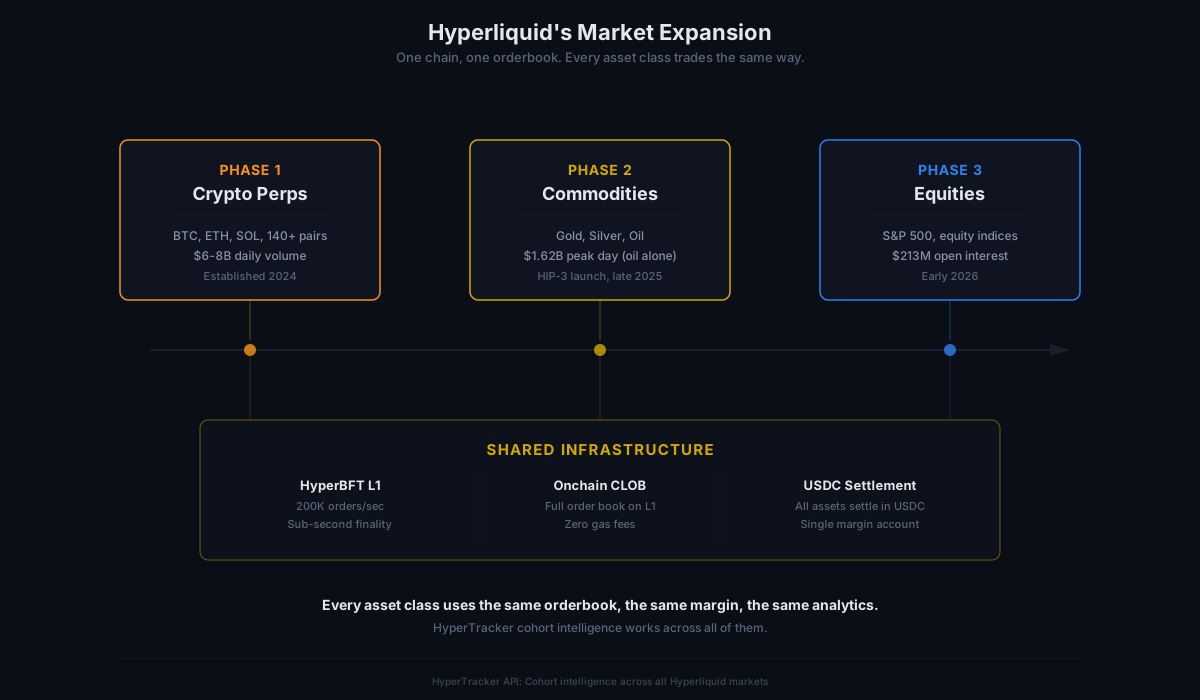
Hyperliquid is a decentralized exchange built on its own Layer 1 blockchain, purpose-built for perpetual futures trading. Unlike most DEXs that run on Ethereum or another general-purpose chain, Hyperliquid operates its own network with sub-second finality and the capacity to process up to 200,000 orders per second. Every trade settles onchain, but traders pay zero gas fees. The result is a trading experience that matches centralized exchanges on speed while preserving the self-custody and transparency that define DeFi.
The platform lists nearly 200 perpetual markets with leverage up to 50x, and anyone with a funded wallet can start trading Bitcoin, Ethereum, gold, oil, or equities in under two minutes with no KYC required. In January 2026, Hyperliquid surpassed Binance in BTC perpetual liquidity, posting tighter spreads ($1 versus $5.50) and deeper order books. It now handles roughly $9.57 billion in open interest across all markets, more than every other perpetual DEX combined.
Hyperliquid's architecture separates it from older DEXs that rely on automated market makers (AMMs) or external liquidity. It uses a fully onchain central limit order book (CLOB), which means every bid and ask is visible, every fill is recorded, and every wallet's activity can be analyzed. That transparency is what makes cohort-level positioning analytics possible.
How HIP-3 Opened the Door to Real World Assets
HIP-3 (Hyperliquid Improvement Proposal 3) is the protocol upgrade that transformed Hyperliquid from a crypto derivatives exchange into a permissionless market factory. Launched on October 13, 2025, HIP-3 allows anyone who stakes at least 500,000 HYPE tokens to deploy a new perpetual futures market. The first three markets are free; additional ones go through a Dutch auction starting at 500 HYPE.
The mechanism is straightforward. A deployer puts up their stake, defines the oracle feed and risk parameters, and launches a market. If the market behaves maliciously or the deployer mismanages it, their stake gets slashed. Fees split 50/50 between the deployer and the protocol, with initial maker/taker rates at 3/9 basis points. This creates a direct economic incentive for builders to launch and maintain high-quality markets.
The growth has been staggering. Within 66 days of launch, HIP-3 daily volume expanded from $378 million to $4.8 billion. Cumulative volume has now surpassed $95 billion, with open interest representing roughly 20% of the total platform. And here's what nobody predicted: the asset mix flipped. Commodities, equities, and indices now dominate the very trading activity that a crypto-native protocol enabled.
The RWA Perps Lineup: Gold, Silver, Oil, and Beyond
Precious metals, energy, and equity indices have driven most of the RWA volume on Hyperliquid, and each one has its own story.
Gold (XAU-USDC)
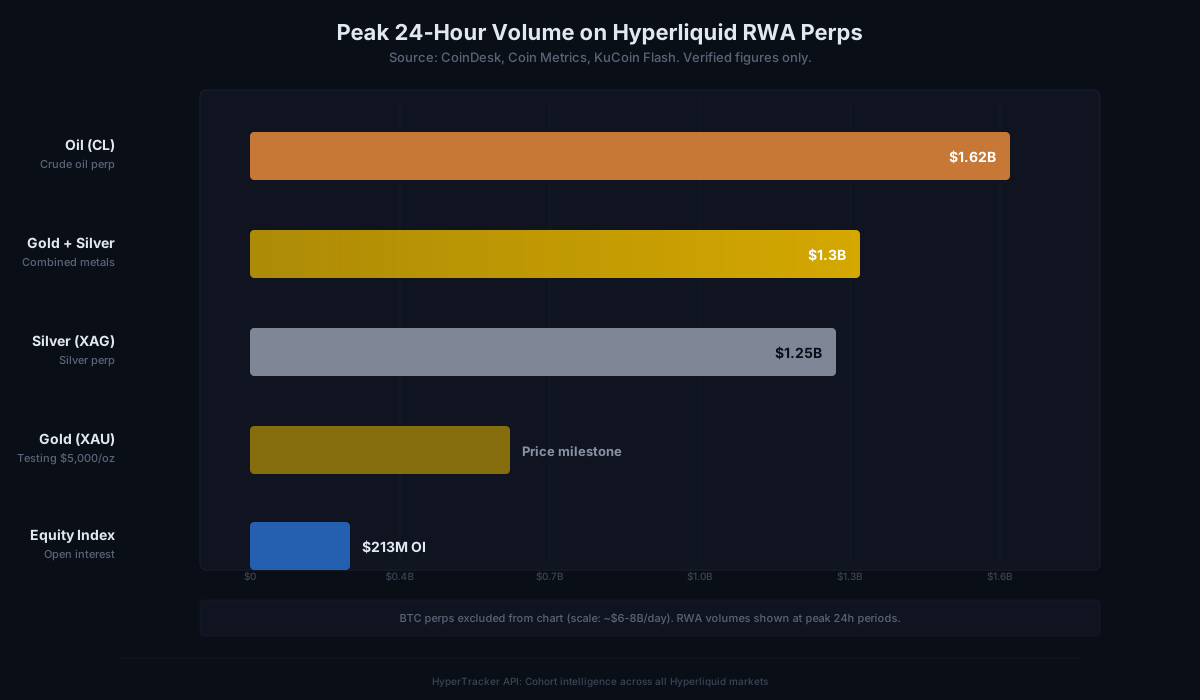
Physical gold broke $5,000 per ounce for the first time on January 26, 2026, driven by persistent inflation, geopolitical uncertainty, and Federal Reserve rate cuts. On Hyperliquid, gold perpetual contracts tested the $5,000 mark with the same momentum, and combined gold and silver contracts surpassed $1.3 billion in 24-hour volume during peak sessions. The tokenized gold and commodities market now sits at roughly $6.5 billion.
What makes Hyperliquid's gold perps different from owning tokenized gold (like PAXG or XAUT) is leverage and directionality. Combined tokenized gold spot trading volumes crossed over $1.8 billion on centralized exchanges in early February, but those are long-only products. Hyperliquid's gold perps let traders go short with up to 50x leverage, hedge existing precious metals exposure, and trade around the clock with no contract expiration.
Silver (XAG-USDC)
Silver has been Hyperliquid's breakout RWA story. In late January, silver futures hit $1.25 billion in 24-hour volume with $155 million in open interest, making silver the third most active market on the platform behind only Bitcoin and Ethereum. Silver climbed above $110 per ounce, propelled by the same safe-haven demand driving gold plus industrial demand from AI hardware and electric vehicle manufacturing.
During a recent price swing, liquidation totals on Hyperliquid's silver contract were second only to Bitcoin. That says something about how quickly a traditionally quiet commodity can become one of the most volatile instruments on a crypto exchange when the right conditions align.
Crude Oil (CL-USDC)
Oil became Hyperliquid's most dramatic RWA market in March 2026, when geopolitical conflict drove crude to $114.77 on the platform while traditional exchanges sat closed for the weekend. CL-USDC posted $1.62 billion in 24-hour trading volume and carried $169.8 million in open interest. For a deeper analysis of the oil story specifically, including smart money positioning and the Iran conflict catalyst, see our detailed oil futures breakdown.
Equity Indices and Stocks
Beyond commodities, HIP-3 has enabled perpetual futures on equity indices. The XYZ100-USDC contract (tracking a major equity index) led all HIP-3 markets in open interest at $213 million. Tokenized equities as a category have surpassed $4 billion market-wide, though this includes products across multiple platforms.
What Are Real World Assets (RWA) in Crypto?
Real world assets in crypto are tokenized representations of traditional financial instruments: commodities, government bonds, equities, real estate, and currencies. The RWA sector has become one of the fastest-growing categories in DeFi, climbing from $14.1 billion to $23.6 billion in the first ten weeks of 2026 alone. The breakdown tells you where the momentum is: tokenized private credit leads at roughly $12.6 billion, followed by U.S. Treasuries at $5.1 billion, tokenized gold and commodities at $6.5 billion, and tokenized equities approaching $4 billion.
The biggest players building RWA infrastructure span both TradFi and DeFi. BlackRock launched its BUIDL tokenized treasury fund (now over $1 billion in AUM). Ondo Finance and Securitize are tokenizing fixed-income products. Paxos and Tether Gold handle tokenized precious metals on the spot side. And on the derivatives side, Hyperliquid and Ostium are leading the charge with perpetual futures that let traders go long or short on these assets with leverage, 24/7, from a wallet.
Where does it go? Boston Consulting Group projects the tokenized asset market could reach $16 trillion by 2030. McKinsey, more conservatively, estimates $2 trillion. The range is wide, but the direction is unanimous: real-world assets on blockchain are moving from pilot programs to production infrastructure, and the pace is accelerating.
RWA Perps: Trading Gold, Oil, and Equities Without the Constraints
Crypto perpetual futures for real-world assets solve three problems that have constrained commodity and equity trading for decades.
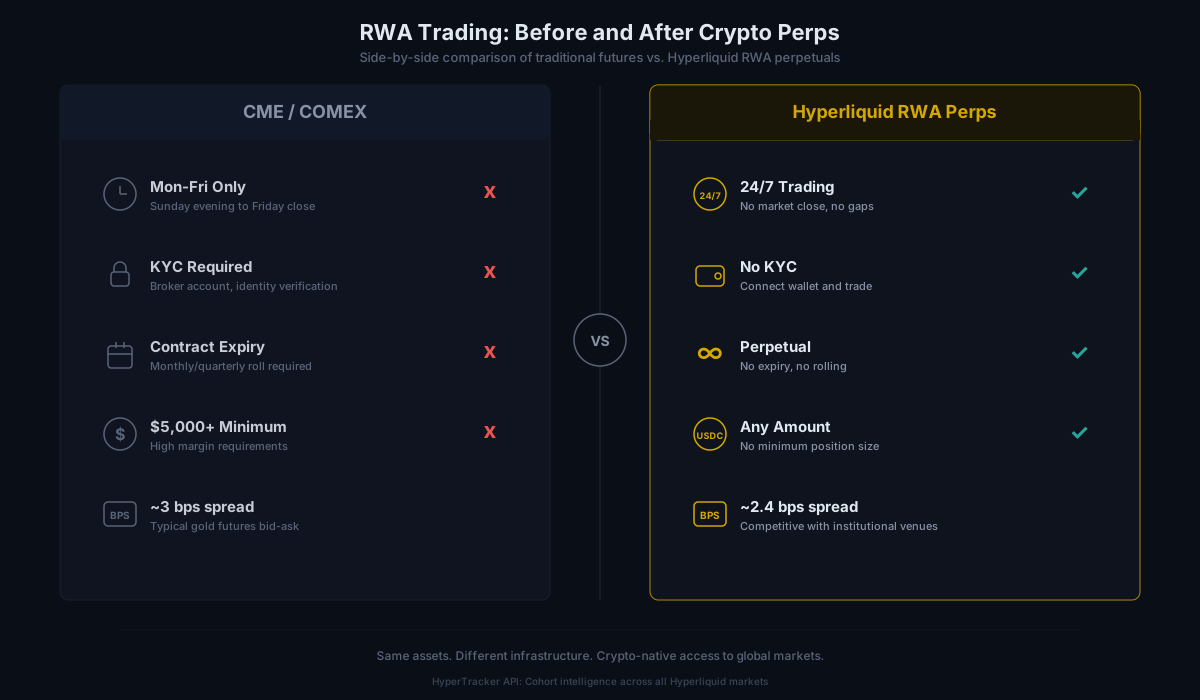
1. Access. Trading gold futures on CME requires a brokerage account, KYC verification, a minimum deposit (often $5,000+), and understanding of contract specifications, expiry dates, and margin calls. On Hyperliquid, you fund a wallet and trade. No brokerage, no expiry, no rolling contracts. The barrier to entry is a USDC balance.
2. Hours. CME crude oil futures trade Sunday evening through Friday with a daily maintenance break. Gold and silver have similar constraints. When geopolitical events break on Saturday afternoon, traditional markets are closed. Hyperliquid's commodity perps run 24/7/365, which means price discovery continues through weekends, holidays, and crises. The median spread on Hyperliquid's gold contract is 2.4 basis points, versus COMEX's 3 basis points. Competitive liquidity, always on.
3. Composability. Because every trade settles onchain, RWA perps data is transparent and programmable. Builders can pipe gold or oil positioning data into automated strategies, risk dashboards, or alert systems. Traditional commodity data is siloed, expensive, and delayed. Onchain commodity data is open, real-time, and free to read.
| Feature | CME / COMEX | Hyperliquid RWA Perps | | --- | --- | --- | | Trading hours | Sunday-Friday with breaks | 24/7/365 | | Account setup | Brokerage, KYC, min deposit | Wallet + USDC | | Contract expiry | Monthly/quarterly rolls | Perpetual (no expiry) | | Margin currency | USD, multiple currencies | USDC | | Max leverage | Varies (10-20x typical) | Up to 50x | | Data transparency | Delayed, paid feeds | Onchain, real-time, open | | Settlement | Clearinghouse | Onchain, self-custody | | Gold spread | ~3 bps (COMEX) | ~2.4 bps |
The Competitive Landscape for RWA Perps
Hyperliquid is the largest venue for onchain RWA perpetual futures, but it is not the only one. Ostium, a Harvard-alumni founded protocol, raised $24 million in fresh funding (including a $20 million Series A co-led by General Catalyst and Jump Crypto) to scale onchain perps specifically for real-world assets. During the recent gold rally, Ostium accounted for more than 50% of total onchain gold perpetuals open interest.
The key difference is scope. Ostium focuses exclusively on RWA markets. Hyperliquid is a full-spectrum derivatives exchange that added RWA through its permissionless HIP-3 layer, which means it benefits from the same liquidity pool, matching engine, and infrastructure that powers its crypto markets. For traders, that means deeper liquidity and tighter spreads, because Hyperliquid's CLOB doesn't silo RWA activity from the rest of the platform.
Put it in perspective: the global CFD market moves $30 trillion per month. Onchain RWA perps are still a fraction of that, but they're the fastest-growing fraction, and the gap between "experiment" and "infrastructure" is closing faster than most people realize.
Tracking RWA Positioning with Cohort Analytics
Volume and open interest tell you what's happening, but cohort analytics tell you who's behind it. Every wallet on Hyperliquid is visible onchain, and that transparency is powerful, but raw wallet data is noise without classification. The question that matters is whether a position was opened by a profitable whale or a retail trader chasing momentum, and answering it requires behavioral segmentation.
HyperTracker classifies every wallet on Hyperliquid into 16 behavioral cohorts: eight based on position size (from micro traders to whales) and eight based on all-time PnL (from consistent losers to elite performers). When gold spikes on a geopolitical event or silver liquidations cascade through the market, our data shows which cohorts were positioned before the move and which ones got caught on the wrong side.
A single API call returns the positioning breakdown for any Hyperliquid contract. That includes gold (XAU), silver (XAG), crude oil (CL), and every other HIP-3 market. You can see whether the top PnL cohort is net long or short, how their conviction compares to the rest of the market, and whether they're adding risk or reducing it. With webhook alerts, you can get notified the moment smart money repositions on a commodity contract.
Average trade sizes on Hyperliquid's commodity perps tell an interesting story by themselves: gold perps average around $2,700, silver roughly $3,400, and crude oil about $2,800. These are accessible position sizes that bring retail into markets traditionally dominated by institutional capital. But within that retail flow, our cohort data reveals the sharp traders who consistently extract value, and knowing their positioning in real time is the edge that raw price charts can't provide.
Build vs. buy: Ingesting raw Hyperliquid data, classifying wallets by size and PnL, computing rolling cohort metrics, and serving it through an API costs $10,000+ per month to build from scratch. HyperTracker delivers it for $179/mo with a 5-minute refresh cycle. One endpoint. Every cohort. Every contract: BTC, ETH, gold, silver, oil, and the full HIP-3 lineup.
Where RWA Perps Go from Here
Onchain derivatives volume for commodities and equities is growing faster than crypto-native volume on the same platforms. Institutional capital is flowing in from every direction: direct trading, infrastructure investment (like Ostium's $24M raise), enterprise integrations, and tokenized fund products from BlackRock and others. The RWA market nearly doubled in ten weeks. That's not a trend. That's a migration.
Hyperliquid's HIP-3 model turns that migration into a flywheel. More markets attract more traders, more volume generates more fees, and those fees flow back to HYPE buybacks through the protocol's Assistance Fund (97% of protocol fees are routed to buybacks). As HYPE appreciates, the cost of staking 500,000 tokens to launch a market rises, which naturally filters for higher-quality deployers. HYPE itself reflects the momentum: up over 25% in the past month and more than 80% from its January lows. The token's performance is a direct function of the volume flowing through the markets it enables.
A year ago, trading gold on a decentralized exchange was a thought experiment. Today it's a billion-dollar market. Crude oil perps are outpacing CME on weekends. Silver is the third most-traded instrument on a platform built for crypto. The lines between traditional finance and DeFi are not blurring. They're disappearing. And the positioning data that tells you who's on which side of these trades is sitting onchain, in real time, waiting to be read.