S&P 500 Perpetual Futures: How HIP-3 Brings Equities to Hyperliquid
By CMM Team - 23-Mar-2026
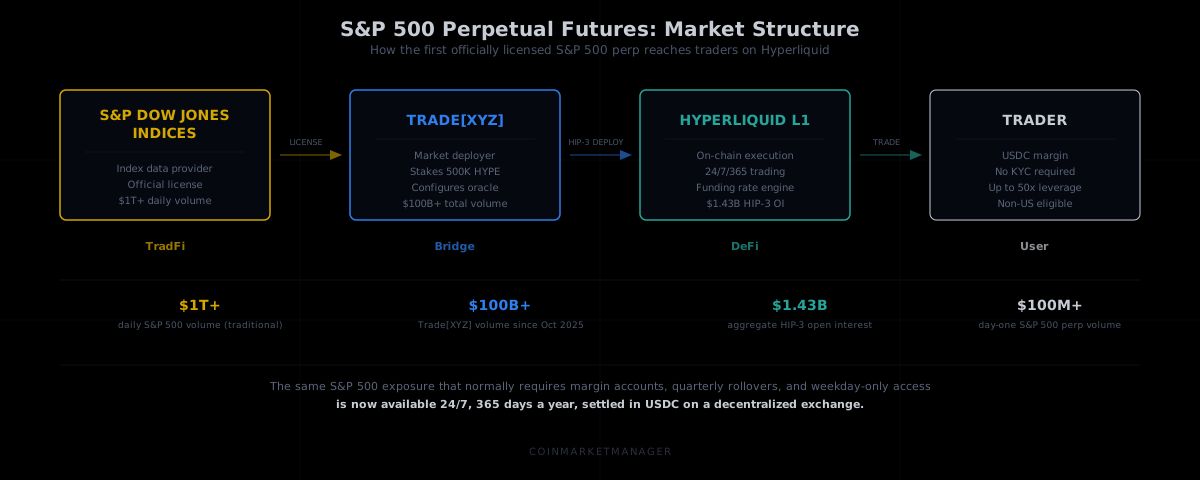
On March 18, 2026, S&P Dow Jones Indices announced a licensing agreement with Trade[XYZ] for what it called the "first and only officially licensed S&P 500 perpetual derivative product," deployed on the Hyperliquid blockchain. Within days, the contract cleared over $100 million in 24-hour trading volume and became one of Hyperliquid's ten largest markets.
For anyone who has traded E-mini futures through a brokerage account, this is a significant shift. The same S&P 500 exposure that normally requires margin accounts, quarterly rollovers, and weekday-only access is now available 24/7, 365 days a year, settled in USDC on a decentralized exchange.
This article breaks down how S&P 500 perpetual futures work on Hyperliquid, what HIP-3 is and why it matters, how these contracts compare to CME E-mini futures and SPY options, and what the early trading data looks like.
The S&P 500 Goes 24/7
The licensing deal is between S&P Dow Jones Indices and Trade[XYZ], a firm that has processed over $100 billion in volume since October 2025 across its Hyperliquid-based markets, with an annualized run rate exceeding $600 billion. Trade[XYZ] deployed the S&P 500 contract on Hyperliquid using HIP-3, the protocol's permissionless market creation framework.
Collins Belton, Trade[XYZ]'s COO and General Counsel, framed the choice clearly: "The S&P 500 is a natural starting point. It represents the most widely tracked equity index on earth."
The contract uses real-time S&P 500 index data as its oracle, keeping prices accurate even when traditional equity markets are closed. Settlement is in USDC. Access is available to eligible non-US investors.
Over $1 trillion changes hands daily across S&P 500-linked exposures in traditional markets. This contract brings a fraction of that activity on-chain, with different mechanics, different hours, and a very different type of trader.
HIP-3: Permissionless Market Creation
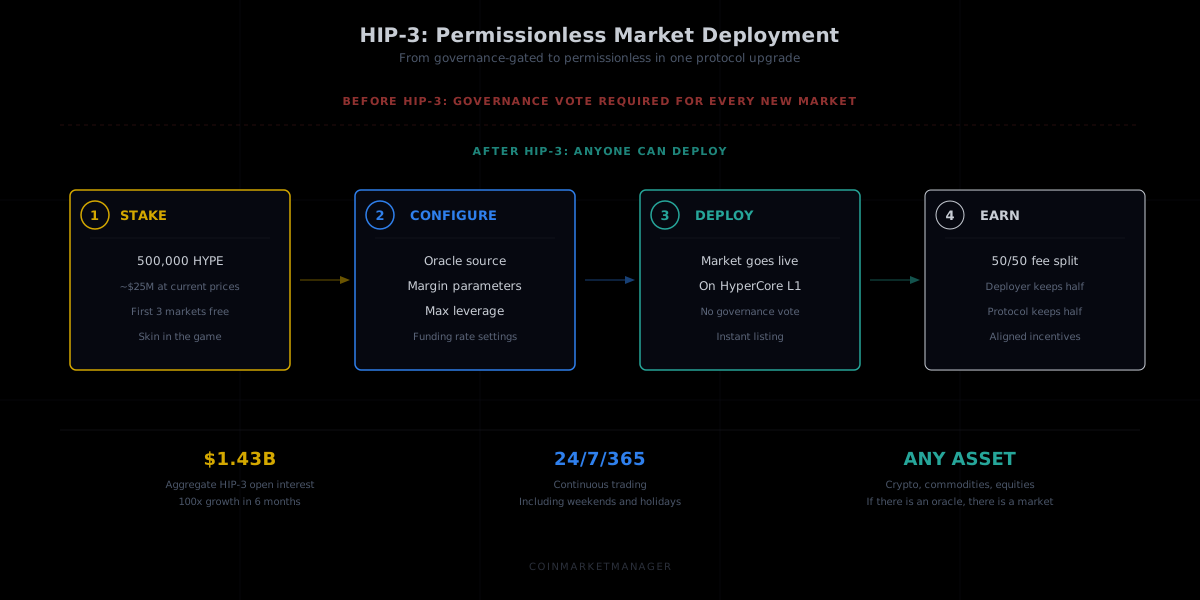
HIP-3 (Hyperliquid Improvement Proposal 3) is the protocol upgrade that turned Hyperliquid from a crypto-only perps exchange into a platform where anyone can launch perpetual futures on any asset. Before HIP-3, new markets required governance approval. After HIP-3, market creation became permissionless.
The mechanics: any entity that stakes at least 500,000 HYPE tokens (roughly $25 million at recent prices) can deploy a new perpetual market on Hyperliquid's core infrastructure. The deployer controls parameters like oracle configuration, leverage limits, and risk settings. The first three markets per deployer are free to launch. Subsequent markets go through a Dutch auction process starting at twice the previous successful auction price, with a floor of 500 HYPE.
Fees split 50/50 between the deployer and the Hyperliquid protocol, starting at 3/9 basis points for maker/taker before volume discounts. Deployers face slashing risk on their staked HYPE if their markets cause network degradation.
The result: Trade[XYZ] used HIP-3 to deploy not just the S&P 500 contract, but an entire suite of equity, commodity, and macro perpetuals. Aggregate open interest across all HIP-3 markets has reached $1.43 billion, a figure that is roughly 100x higher than six months prior.
This matters because HIP-3 is what makes the S&P 500 perp possible without a centralized exchange listing committee, without a futures commission merchant, and without the infrastructure overhead of traditional derivatives clearing. The deployer puts up capital, configures the market, and earns half the fees. The protocol handles matching, settlement, and risk.
S&P 500 Perps: Mechanics for TradFi Traders
If you have traded CME futures or SPY options, the mechanics will feel familiar in some ways and alien in others.
No Expiration, No Rollover
Traditional futures expire quarterly. E-mini S&P 500 contracts roll in March, June, September, and December. Each roll costs slippage and requires active management. S&P 500 perps on Hyperliquid have no expiration date. You can hold a position indefinitely as long as your margin covers the funding payments.
Funding Rates Replace Expiration
Without an expiration date, what keeps the perp price anchored to the actual S&P 500 index? Funding rates. When the perpetual trades above the index value, long holders pay short holders. When it trades below, shorts pay longs. These payments occur at regular intervals and create a continuous incentive for arbitrageurs to close any gap between the perp price and the underlying index.
This is fundamentally different from CME futures, where convergence happens mechanically at expiry. With perps, convergence is economically incentivized rather than structurally enforced. The tradeoff: funding costs are ongoing, which means long holds during periods of heavy directional bias can be expensive.
USDC Settlement, Isolated Margin
All margin and settlement is in USDC, Circle's dollar-pegged stablecoin. No USD wire transfers, no brokerage account, no T+1 settlement. Margin is isolated per market, meaning a liquidation in your S&P 500 position does not affect other positions.
24/7 Trading with Discovery Bounds
The contract trades around the clock, including weekends and holidays. To manage price stability when traditional equity markets are closed (and the underlying index is not updating in real time), Trade[XYZ] uses a "Discovery Bounds framework" that limits extreme off-hours price swings.
This is where it gets interesting for traders who have been stuck watching Sunday night futures gaps. When the Iranian missile strikes happened on a weekend, crypto traders were already accessing oil futures on Hyperliquid while traditional oil markets were dark. S&P 500 perps now offer the same kind of continuous access to equity index exposure.
S&P 500 Perps vs. CME E-Mini Futures vs. SPY Options
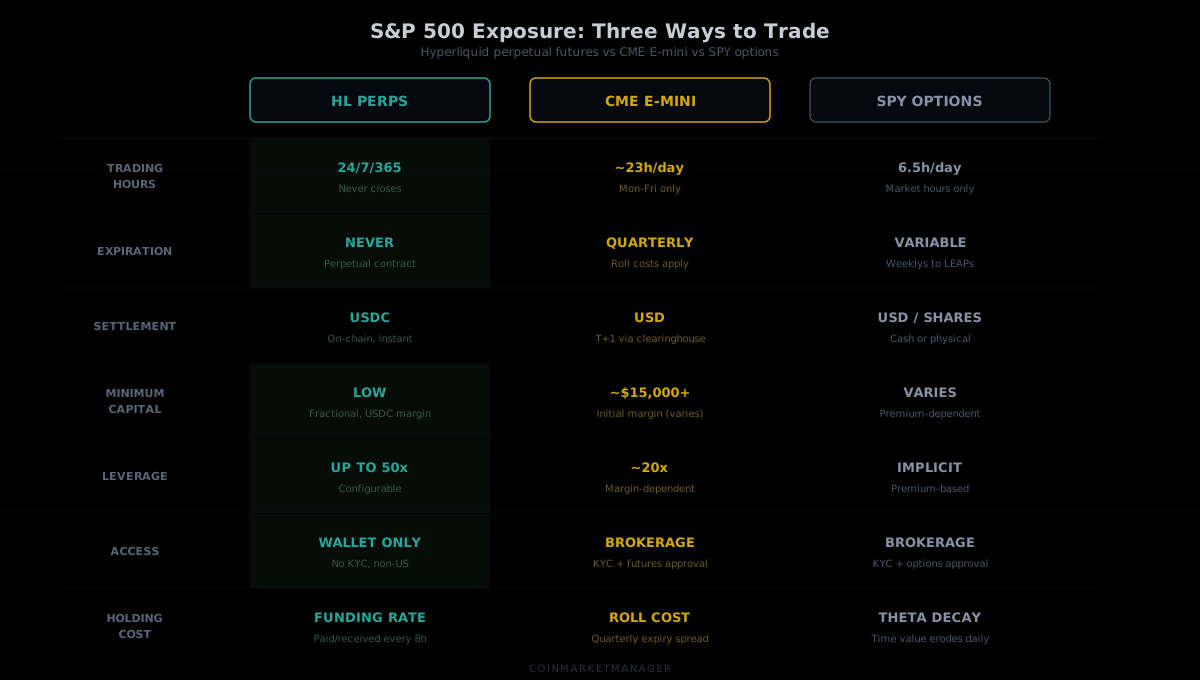
This is the comparison most TradFi traders will want. Here is how these three instruments stack up across the dimensions that matter for execution.
| Feature | S&P 500 Perps (Hyperliquid) | CME E-Mini S&P 500 | SPY Options | |---|---|---|---| | Trading Hours | 24/7, 365 days | ~23 hrs/day, Mon-Fri (closed weekends) | Market hours + some extended (Mon-Fri) | | Expiration | None (perpetual) | Quarterly (Mar, Jun, Sep, Dec) | Daily, weekly, monthly, quarterly | | Rollover Cost | None (funding rates instead) | Spread + slippage each quarter | N/A (but theta decay) | | Settlement | USDC (stablecoin) | USD (cash settled) | USD or shares (SPY) | | Contract Size | Fractional (any size) | $50 x S&P 500 Index (~$265,000) | 100 shares of SPY (~$53,000) | | Minimum Capital | Low (fractional positions, USDC margin) | ~$15,000+ initial margin (varies by broker) | Varies by strike/expiry | | Account Requirements | Crypto wallet (no KYC for non-US) | Futures brokerage account, KYC, regulatory approval | Options-approved brokerage, KYC | | Ongoing Cost | Funding rate (variable, continuous) | Quarterly roll + carry cost | Theta decay + bid-ask spread | | Leverage | Up to 50x | ~20x (margin-dependent) | Implicit (premium-based) | | Liquidity | Growing ($100M+ daily, early stage) | Deep ($200B+ daily notional) | Very deep (most liquid options market) | | US Access | No (non-US only) | Yes | Yes | | Weekend Access | Yes (with Discovery Bounds) | No | No |
The clearest advantage of S&P 500 perps is accessibility and continuity. No brokerage application, no quarterly rolls, no weekend blackouts. The clearest advantage of CME E-minis is liquidity depth and regulatory certainty. SPY options offer the most flexibility in risk structuring (defined risk, spreads, straddles) but carry theta decay.
For traders already operating in DeFi, S&P 500 perps add equity index exposure to a portfolio that previously could only hold crypto. For TradFi traders, the product offers weekend gap protection and the ability to hedge around the clock. The tradeoff is liquidity: the S&P 500 perp market is days old, and the CME has decades of institutional depth.
First Week Trading Data
The launch numbers tell a story of immediate adoption.
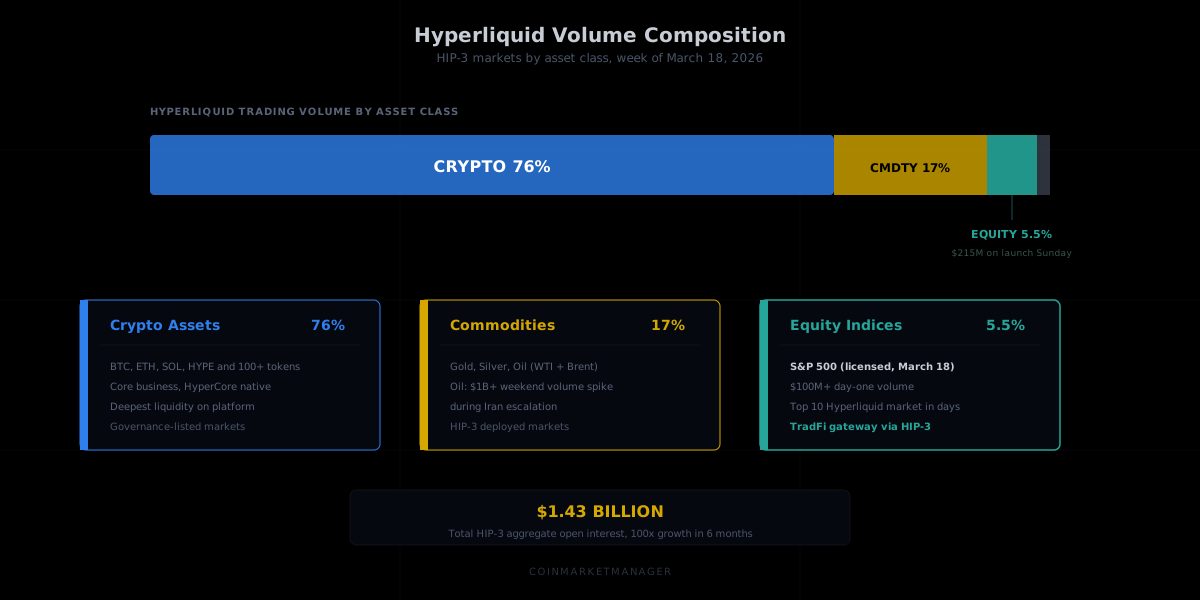
Within days of going live, the S&P 500 perpetual cleared $100 million in 24-hour trading volume. On the Sunday following launch, index and ETF perpetual futures (including the S&P 500 contract) accounted for 5.5% of all Hyperliquid trading volume, translating to $215 million across that category.
For context: crypto assets still dominate Hyperliquid at 76% of volume. Commodities (gold, silver, oil) command 17%. Equity indices are at 5.5% and growing. Six months ago, the entire HIP-3 ecosystem barely existed. Now it carries $1.43 billion in aggregate open interest.
The velocity matters. Oil perps on Hyperliquid pulled over $1 billion in weekend volume during the Iranian missile strike episode. The S&P 500 contract is positioned to capture similar spikes whenever geopolitical or macroeconomic events break outside of CME trading hours.
Growth Trajectory vs. Absolute Volume
$100 million in daily volume is modest by CME standards. E-mini S&P 500 futures routinely process billions in daily notional. But the growth trajectory matters more than the absolute number. HIP-3 markets went from near-zero to $1.43 billion in open interest within six months. If equity index perps follow the same adoption curve that commodity perps established (oil went from launch to over $1 billion in weekend volume within months), the S&P 500 contract could become one of Hyperliquid's largest markets by volume.
The question is whether institutional flow follows. Cameron Drinkwater of S&P Dow Jones Indices noted that the collaboration "expands access and utility of our flagship benchmarks within digital trading environments." That is careful language, but the fact that S&P DJI is licensing at all signals a level of institutional comfort with on-chain derivatives that did not exist a year ago.
Funding Rates, Volume Trends, and Institutional Signals
Funding Rate Dynamics
Funding rates on the S&P 500 perp will reveal trader sentiment in real time. When funding is consistently positive (longs paying shorts), the market is crowded long. When it flips negative, shorts are dominant. Unlike crypto perps where funding can swing wildly on speculative fervor, equity index perps may develop more structured funding patterns that track macro sentiment (Fed policy expectations, earnings cycles, risk-on/risk-off flows).
Watch for divergences between the S&P 500 perp funding rate and the CME E-mini basis (the spread between futures and spot). If the on-chain market develops a persistent premium or discount to CME pricing, that gap becomes an arbitrage opportunity for sophisticated traders.
Weekend and Off-Hours Volume
The unique value proposition of 24/7 trading gets tested during events. The oil perps proved this during geopolitical escalation. For S&P 500 perps, the test will come on a weekend when macro news breaks: an unexpected rate decision, a geopolitical shock, a major corporate event. If volume spikes during those windows, it validates the 24/7 thesis. If it stays flat, the market may remain primarily a crypto-native tool rather than a TradFi crossover product.
Cohort Composition
Who is trading S&P 500 perps on Hyperliquid? Early adopters are likely crypto-native traders adding macro exposure to their portfolios. The interesting shift happens if and when TradFi-oriented traders start using Hyperliquid specifically for equity index access. Our proprietary cohort analytics track behavioral segments across Hyperliquid, classifying every trader by size and profitability. As the S&P 500 market matures, cohort data will reveal whether the trader base diversifies beyond crypto natives or stays concentrated.
Beyond the S&P 500: The HIP-3 Scaling Thesis
The S&P 500 licensing deal is a proof point for a much larger trend. TD Securities, in a research note titled "Perpetual Futures: The Missing Link in Tokenized Equities," described how derivatives represent approximately 75% of crypto market trading, with over 90% occurring offshore. The infrastructure for on-chain derivatives is mature. What was missing was the licensing bridge to traditional assets.
That bridge now exists. And HIP-3 means it can scale. Any asset with a reliable oracle can theoretically become a perpetual futures market on Hyperliquid: individual stocks, sector indices, interest rate benchmarks, forex pairs. The S&P 500 is, as Belton said, the "natural starting point." It will likely be followed by others.
For builders and data-driven traders, this expansion creates opportunities. More markets mean more data. More data means more edges for systematic strategies. Tracking how different cohorts position across crypto, commodities, and now equity index perps gives a view of cross-asset flow that simply did not exist six months ago.
If you're interested in how RWA perps work more broadly (gold, silver, oil, and the HIP-3 ecosystem), our earlier deep dive covers the full landscape: Real World Assets on Hyperliquid: How RWA Perps Are Changing Crypto Derivatives.
Frequently Asked Questions
What are S&P 500 perpetual futures on Hyperliquid?
S&P 500 perpetual futures on Hyperliquid are the first officially licensed S&P 500 perpetual derivative contracts, launched March 18, 2026 through a licensing deal between S&P Dow Jones Indices and Trade[XYZ]. They allow traders to go long or short the S&P 500 index 24/7, 365 days a year, settled in USDC on the Hyperliquid blockchain. Unlike CME E-mini futures, these contracts never expire and require no rollovers.
How do S&P 500 perps compare to CME E-mini futures?
S&P 500 perps on Hyperliquid trade 24/7 including weekends, have no expiration or rollover costs, settle in USDC, and require no brokerage account. CME E-mini futures trade roughly 23 hours on weekdays only (closed weekends), expire quarterly, settle in USD, and require a futures brokerage account with significant initial margin. CME contracts have deeper institutional liquidity, while Hyperliquid perps offer accessibility and continuous trading.
What is HIP-3 and how does it enable S&P 500 trading?
HIP-3 (Hyperliquid Improvement Proposal 3) is a protocol upgrade enabling permissionless perpetual futures market creation. Anyone who stakes at least 500,000 HYPE tokens can deploy a new market. Trade[XYZ] used HIP-3 to deploy the officially licensed S&P 500 contract with institutional-grade index data from S&P DJI. Fees are split 50/50 between the deployer and the protocol.
Can US residents trade S&P 500 perps on Hyperliquid?
No. The official S&P Dow Jones Indices announcement states the product is available to "eligible, non-US investors." US residents are currently restricted from accessing these contracts.
How do funding rates work on S&P 500 perpetual futures?
Funding rates keep the perpetual contract price anchored to the real S&P 500 index value. When the perp trades above the index, long holders pay short holders. When it trades below, shorts pay longs. These payments occur at regular intervals and incentivize arbitrageurs to close any price gap, replacing the expiration-based convergence used by traditional futures.