
Bitcoin Short Squeezes and the Copy Trading Signals Most Traders Miss
By CMM Team - 08-Jun-2026
Bitcoin Short Squeezes and the Copy Trading Signals Most Traders Miss
In mid-April 2026, roughly $440 million in short positions evaporated from crypto exchanges in a single wave. Bitcoin climbed to $74,679, and over 169,000 traders got liquidated. A handful of large wallets had already rotated long days before the squeeze hit. Most copy traders never saw the signal because they were watching the wrong data.
Individual wallet tracking, the foundation of most copy trading strategies, has a structural blind spot. It shows you what one wallet is doing. It does not show you what an entire class of profitable traders is doing at once. When a short squeeze is brewing, the difference between those two views determines whether you catch the entry or become exit liquidity. This guide breaks down the mechanics of short squeezes, why cohort-level signals outperform individual wallet alerts, and how to read the positioning data that precedes these cascading moves.
The Anatomy of a Crypto Short Squeeze
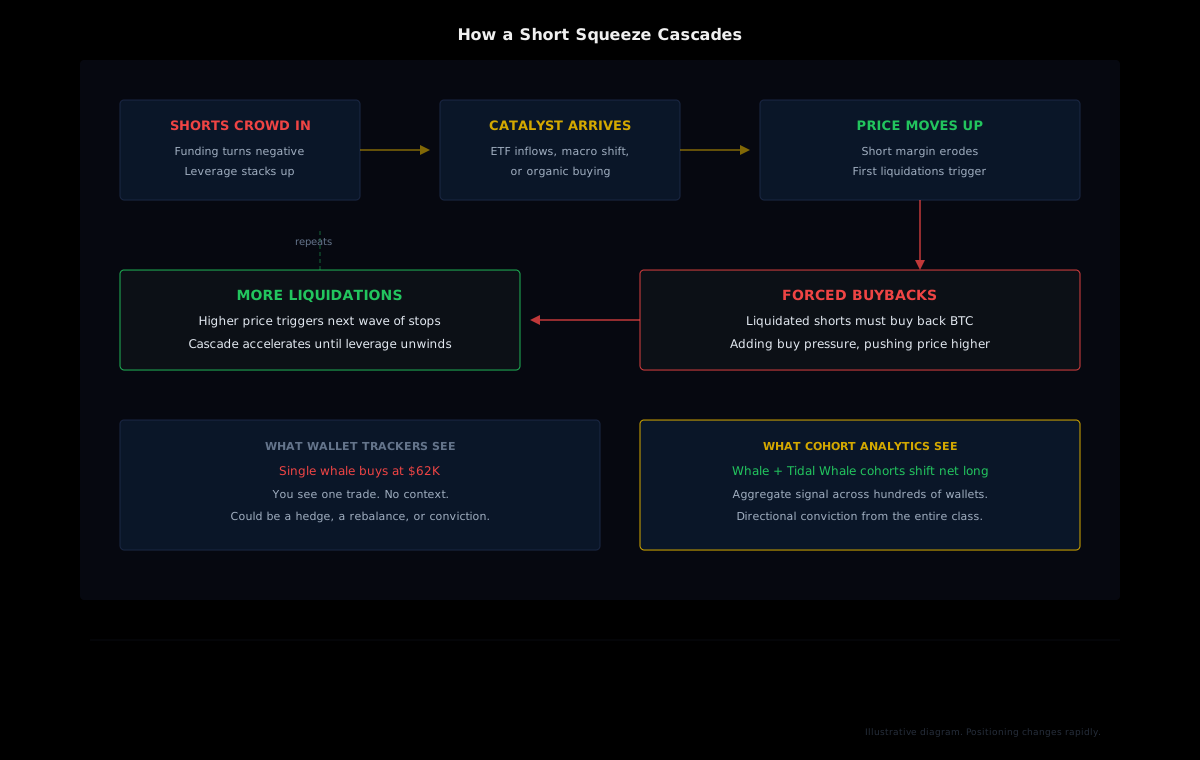
A short squeeze starts when leveraged short positions get forced into closure as price moves against them. The mechanics are straightforward: a trader borrows an asset, sells it, and plans to buy it back cheaper. When price rises instead, the exchange eventually forces the position closed through liquidation to protect its margin system. That forced buyback adds buy pressure, which pushes price higher, which triggers more liquidations.
The result is a feedback loop that can move price faster than any organic buying would. In February 2026, Bitcoin's perpetual funding rate dropped to -6%, signaling that short sellers were paying steep rates to hold their positions. By April, the resulting squeeze pushed roughly $200 million in short positions toward forced liquidation above the $75,500 level.
Three conditions reliably precede these events:
- Extreme funding rates: When perpetual funding turns deeply negative, shorts are paying longs to stay in their trades. This crowding creates fragile positioning.
- Concentrated liquidation clusters: Coinglass data showed nearly $26 billion in short liquidation leverage above Bitcoin's $62,000 level in early June 2026. Long liquidation exposure below that level sat well under $2 billion.
- Divergence between whale positioning and crowd sentiment: While retail piles into shorts, large wallets quietly build opposing positions. This is the signal most traders miss.
Why Individual Wallet Tracking Falls Short
The standard copy trading playbook goes like this: find a profitable wallet, set up alerts, mirror its entries. In theory, you ride the coattails of someone who knows what they are doing. In practice, several problems undermine the approach.
First, the execution gap. When a whale enters a position, their order itself moves the price. By the time you see the alert, open your app, and submit a trade, the entry that looked good at $62,000 might already be at $62,800. On a 10x leveraged position, that 1.3% slippage translates to a 13% drag on returns from day one.
Second, single-wallet tracking is noisy. A large wallet might be hedging another portfolio, rebalancing collateral across protocols, or testing a new strategy with a fraction of their capital. You see the trade. You do not see the context. And that context often determines whether the trade was conviction or housekeeping.
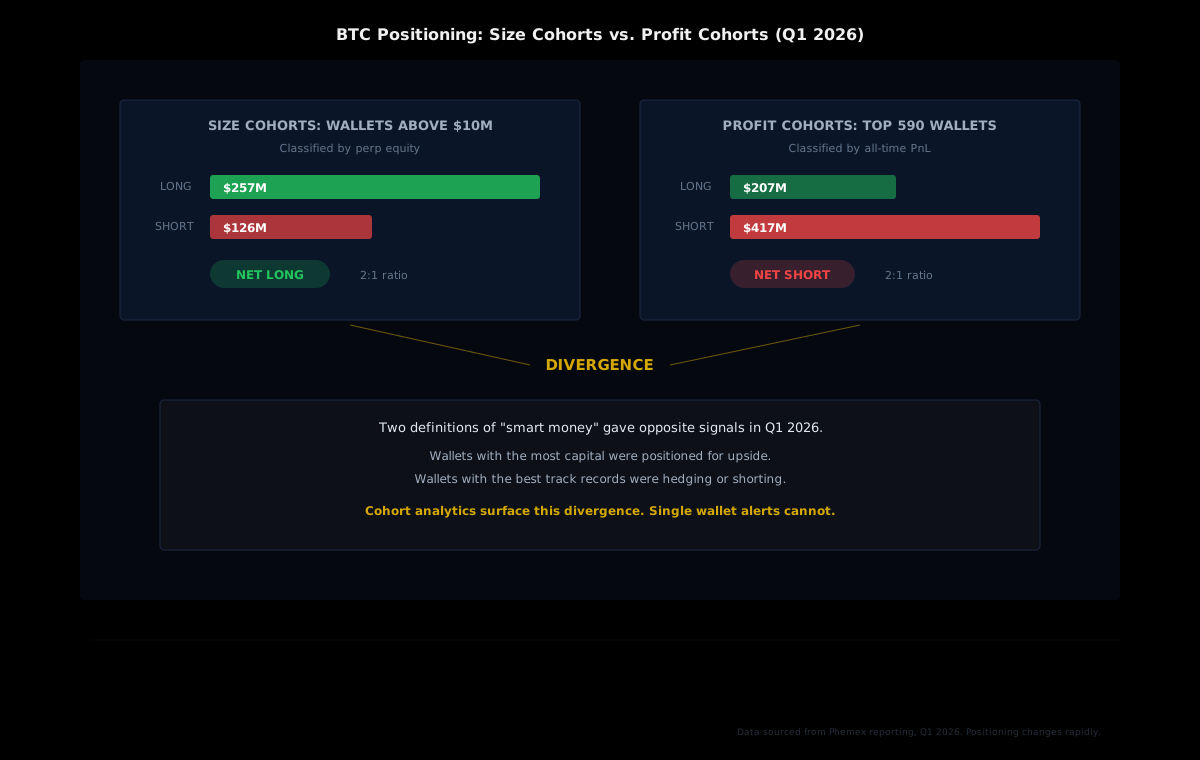
Third, and this is the critical one: smart money is not monolithic. On Hyperliquid, the 590 highest-profit wallets were actually net short in Q1 2026, holding $417 million in BTC shorts against $207 million in longs. Meanwhile, wallets running positions above $10 million held roughly $257 million in BTC longs against $126 million in shorts. Two different definitions of "smart money." Two completely opposite directional bets. If you were blindly copying one group, you would be betting against the other.
Cohort-Level Signals: A Better Lens
Instead of tracking individual wallets, cohort analytics classify every wallet into behavioral segments and then aggregate their positioning. This is the difference between monitoring a single temperature reading and watching an entire weather system.
HyperTracker's API segments Hyperliquid wallets into 16 behavioral cohorts: eight based on position size (from Shrimp at $0-$250 to Leviathan at $5M+) and eight based on all-time profitability (from Giga-Rekt below -$1M to Money Printer above +$1M). When you query the cohort metrics endpoint, you see aggregate positioning for each segment, refreshed every 5 minutes.
Here is why this matters for copy trading around short squeezes:
Signal 1: Cohort Divergence Before the Squeeze
Before the April squeeze, the Whale and Tidal Whale cohorts (wallets with $100K-$5M in perp equity) were shifting net long while smaller cohorts remained heavily short. This divergence showed up in cohort bias data days before the liquidation cascade. A single wallet alert would not have captured this aggregate pattern.
Signal 2: Profitability Cohorts as Contrarian Confirmation
When Money Printer wallets (all-time PnL above +$1M) begin increasing long exposure during a period of deeply negative funding, it suggests that the most historically successful traders are positioning against the crowd. This is a stronger signal than any individual wallet trade because it represents the consensus of hundreds of proven performers.
Signal 3: Cohort Velocity Tells You Urgency
Cohort metrics shift gradually during normal markets. When aggregate positioning for a given cohort changes rapidly over consecutive 5-minute intervals, that acceleration signals conviction. A slow drift into longs over a week carries different weight than a sharp rotation over a few hours. The speed of the shift encodes information that point-in-time wallet snapshots miss.
Reading the Setup: What Preceded April's Cascade
The April 2026 short squeeze was not a surprise to those watching the right data. Let us trace the sequence.
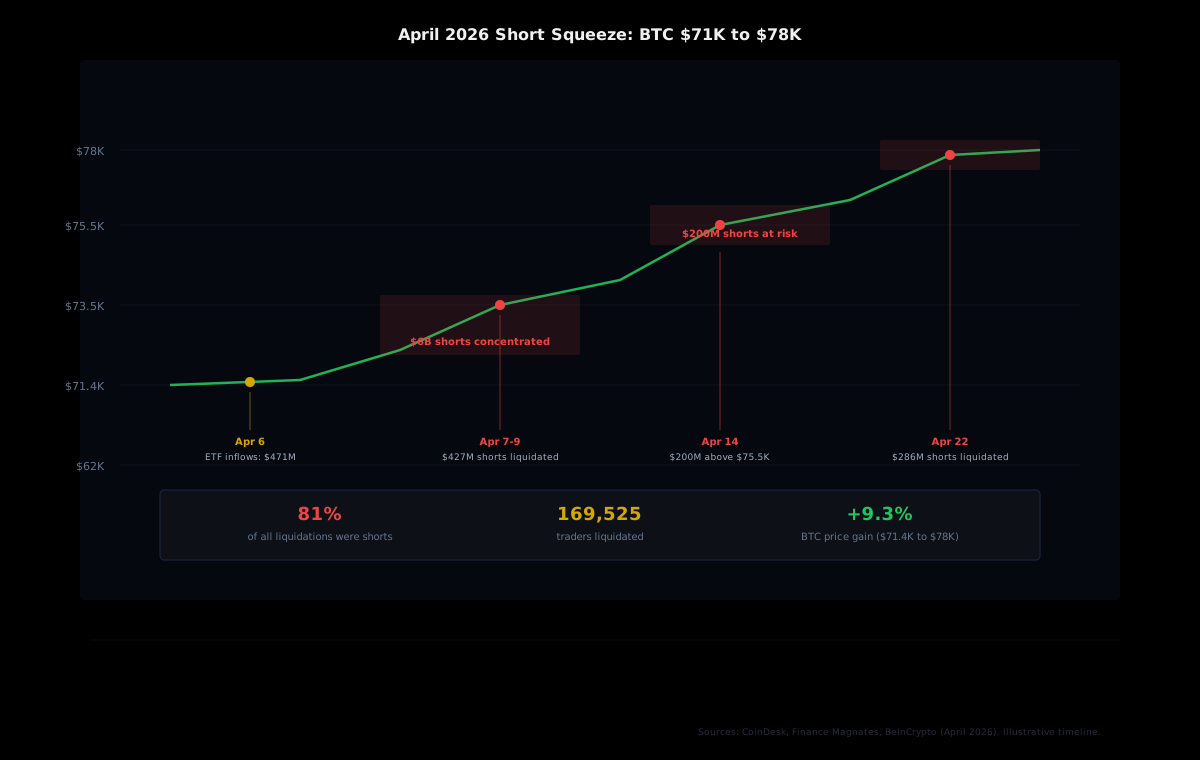
In early April, Bitcoin traded around $71,362 after a period of range-bound trading. Funding rates had been negative for weeks, which meant short sellers were paying a premium to hold their positions. Open interest across crypto futures had climbed to $126 billion, with Bitcoin open interest hitting a record 767,000 BTC.
The leverage was lopsided. Derivatives heatmaps showed roughly $6 billion in leveraged shorts concentrated between $72,200 and $73,500. When a modest catalyst appeared (ETF inflows hit $471 million on April 6, the strongest day since late February), the resulting price move triggered the first wave of liquidations. Those forced buybacks pushed price higher, triggering the next wave. Within 48 hours, $427 million in shorts were liquidated, the largest flush since late February.
The cascade did not stop there. By mid-April, Bitcoin pressed against $75,000, where another $200 million in shorts faced liquidation above $75,500. When it broke through, $286 million in marketwide short liquidations followed. By the time BTC hit $78,000, shorts accounted for roughly 81% of all liquidations.
Building a Copy Trading Framework with Cohort Data
Here is a practical framework for using cohort-level data to time entries around short squeeze setups. This is an illustrative approach, and you should adapt position sizing and risk parameters to your own strategy and risk tolerance.
Step 1: Monitor Funding and Leverage Imbalance
Watch for periods when perpetual funding rates turn deeply negative across major exchanges. Combine this with liquidation heatmap data to identify where short positions are concentrated. When you see a large cluster of short liquidation levels stacked above the current price, the setup is forming.
Step 2: Check Cohort Divergence
Query HyperTracker's cohort metrics to see how different wallet segments are positioned. The key signal is divergence: when larger, more profitable cohorts shift long while smaller, less profitable cohorts remain short. This suggests that the wallets with the strongest track records are positioning against the crowded trade.
Step 3: Watch for Velocity Changes
Cohort positioning that shifts slowly is less actionable than positioning that shifts rapidly. When you see the Whale or Money Printer cohorts rotating into long positions at an accelerating rate, it suggests growing conviction among experienced traders.
Step 4: Size According to Conviction Layers
An illustrative approach might layer entries based on how many cohort signals align. If only one large cohort is shifting, that is a smaller position. If multiple profitability and size cohorts converge on the same directional bet while funding is deeply negative and liquidation clusters are stacked overhead, that convergence warrants heavier allocation. The exact sizing depends on your risk tolerance and capital base.
Hyperliquid as the Short Squeeze Laboratory
Hyperliquid processed $619 billion in trading volume in Q1 2026 alone, capturing nearly 60% of decentralized perp market share. With roughly $7.35 billion in total open interest across all assets, it has become the primary venue where these squeeze dynamics play out.
What makes Hyperliquid particularly suited for cohort-based analysis is that every position, every fill, and every liquidation happens on-chain. Unlike centralized exchanges where you see aggregated data feeds, Hyperliquid's transparency means the positioning data is verifiable. When our data shows the Leviathan cohort rotating long, that signal is backed by actual on-chain positions, not self-reported exchange figures.
This transparency also means the squeeze dynamics are more visible in advance. You can see the leverage building up. You can see where the liquidation clusters are forming. And with cohort analytics, you can see which groups of traders are positioning themselves on the other side of the crowded trade before the cascade begins.
See Cohort Positioning Before the Next Squeeze
HyperTracker's API classifies every Hyperliquid wallet into 16 behavioral cohorts, refreshed every 5 minutes. Query aggregate positioning for any size or profitability segment through a single REST endpoint. Free tier available.
The Signals That Mattered in June 2026
The same pattern is playing out right now. Bitcoin fell to a 2026 low near $59,100 in early June, and the leverage picture looks familiar. Coinglass data shows nearly $26 billion in short liquidation leverage above the $62,000 level, while long exposure below sits well under $2 billion. Open interest climbed 3% to $103 billion despite lower volume.
In a single 24-hour window in early June, shorts accounted for $218 million out of $332 million in total crypto liquidations. A single short position on OKX was wiped out for $82 million.
The question is not whether a squeeze will happen. With this much leveraged short exposure stacked above current prices, the question is when and what the catalyst will be. Traders watching individual whale wallets will see the move after it starts. Traders watching cohort-level positioning will see the rotation happening before the first liquidation triggers.
That is the edge cohort analytics provide. You stop reacting and start anticipating. You stop copying one wallet and start reading the aggregate behavior of every wallet class on the exchange. In a market where hundreds of millions of dollars can liquidate in minutes, the quality of your signal source is the difference between catching the squeeze and becoming part of it.