
Hyperliquid's Zero-Fee Bet Against Kalshi's Prediction Market Monopoly
By CMM Team - 19-Jun-2026
Hyperliquid's Zero-Fee Bet Against Kalshi's Prediction Market Monopoly
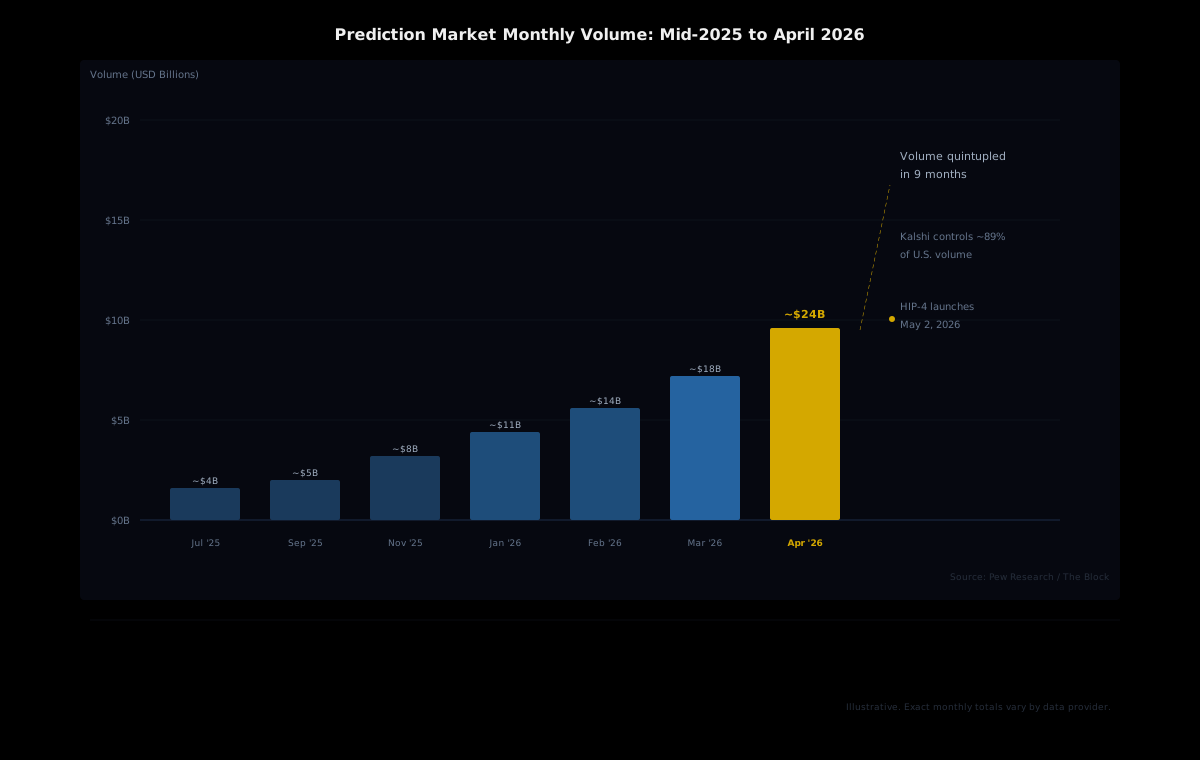
Prediction markets just had their biggest month ever. Combined global trading volume hit nearly $24 billion in April 2026, up from under $5 billion just nine months earlier. One company controls most of it: Kalshi, a CFTC-regulated exchange now valued at $22 billion after raising $1 billion in a single funding round. With roughly 89% of U.S. prediction market volume, Kalshi looks untouchable.
Then Hyperliquid launched HIP-4 on May 2, 2026, bringing prediction markets to the same L1 that already handles billions in perp volume daily. Zero fees to open. Validator-based settlement instead of external oracles. And a merged order book that shares liquidity with existing perp markets rather than fragmenting it across separate pools.
The bet is clear: prediction markets should not be a separate platform with its own fee structure and fragmented liquidity. They should be a native feature of the exchange infrastructure traders already use. The structural differences between HIP-4, Kalshi, and Polymarket come down to three things: how liquidity works, who settles outcomes, and where the economics flow. Each one matters for traders and builders watching this space.
Kalshi's Prediction Machine: How $22B Gets Built in 18 Months
To understand what Hyperliquid is competing against, you need to understand how fast Kalshi moved. In mid-2025, the company completed a $185 million round at a $2 billion valuation. By August 2025, another $300 million pushed that to $5 billion. By late 2025, it hit $11 billion. And in May 2026, a $1 billion Series F led by Coatue valued the company at $22 billion.
Three rounds in seven months, each roughly doubling the prior valuation. That kind of trajectory only happens when the numbers underneath are accelerating just as fast.
And they are. Kalshi's institutional trading volume surged 800% in six months. The platform controls roughly 89% of measured U.S. prediction market volume, with Polymarket holding about 7% and Crypto.com at 4%.
Kalshi's moat is regulatory. CFTC approval, granted in November 2020, means U.S. retail and institutional traders can participate legally. Sports betting platforms like DraftKings and FanDuel launched their own prediction exchanges in late 2025, but Kalshi's head start and regulatory clarity keep it dominant. When Bank of America publishes reports citing your market share, you have crossed from startup to infrastructure.
HIP-4: Prediction Markets as a Protocol Feature
Hyperliquid's approach is architecturally different. HIP-4 does not build a separate prediction market platform. It adds binary outcome contracts as a native asset type on the same L1 that already processes perp trades, spot orders, and HIP-3 tokenized equities.
Each HIP-4 contract is priced between 0.001 and 0.999, representing the market's probability estimate for a given outcome. If the event happens, the contract settles at 1. If it does not, it settles at 0. Fully collateralized, no funding rates, no liquidation risk.
Validator Settlement Instead of Oracles
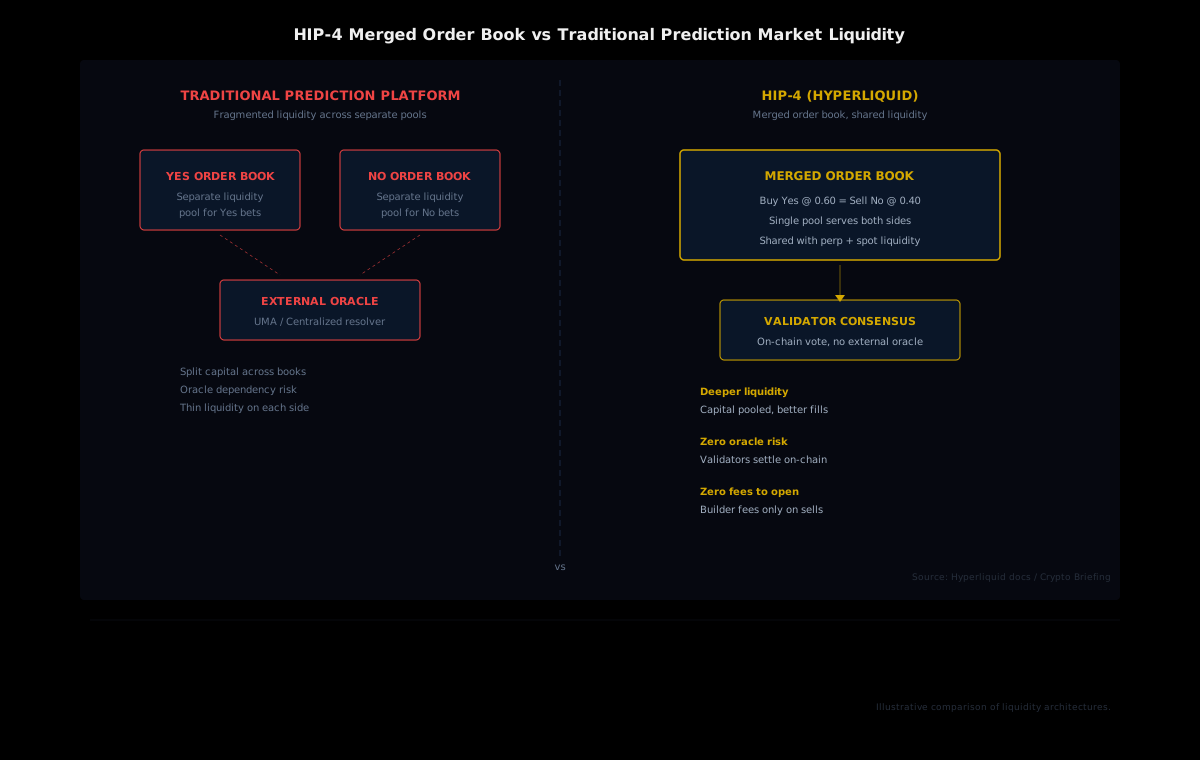
Most prediction platforms use external oracles or centralized resolution mechanisms. Polymarket relies on UMA's optimistic oracle. Kalshi resolves markets internally based on authoritative data sources.
HIP-4 uses Hyperliquid's own validator set. Validators evaluate outcomes based on "unambiguous rules, correctness, and subjective quality of the market" and vote on-chain. No external oracle dependency, no single point of failure. The trade-off is that the validator set needs to be trusted and decentralized enough to resist manipulation, something the protocol will be tested on as market stakes increase.
Merged Order Books
This is the structural advantage that matters most for liquidity. On standalone prediction platforms, Yes and No tokens each need their own liquidity pool or order book. HIP-4 merges them: buying Yes at 0.60 is mechanically equivalent to selling No at 0.40, and the protocol handles the matching natively. Crypto Briefing described this as "a structural advantage over standalone prediction platforms that need to bootstrap liquidity from scratch."
For builders and market makers, this means you are not splitting capital across fragmented books. The same liquidity infrastructure that supports Hyperliquid's perp markets can be shared with outcome markets.
Day One Numbers and the Scale Gap
HIP-4's debut market was a daily Bitcoin price prediction. Over 6 million contracts changed hands on launch day, with roughly 4,000 unique traders participating.
Those numbers are encouraging for a day-one launch, but context matters. Kalshi processes billions in weekly volume. For the week of June 8, Kalshi's notional volume hit $6.38 billion, up 43% from the prior week. HIP-4 is not competing at that scale yet.
The gap is not surprising. Kalshi has regulatory legitimacy that brings in institutional capital. It has years of market-making relationships. It has sports contracts that drive massive retail volume. HIP-4 launched seven weeks ago with a Bitcoin binary and a CPI prediction. The product is in phase one of a multi-phase rollout.
What matters is not where HIP-4 starts but whether its structural advantages compound over time. Zero fees attract market makers. Merged order books improve fill quality. And the existing Hyperliquid user base, which already processes trillions in cumulative perp volume, provides a built-in demand pool that standalone platforms need years to build.
The Fee Equation: Who Pays What
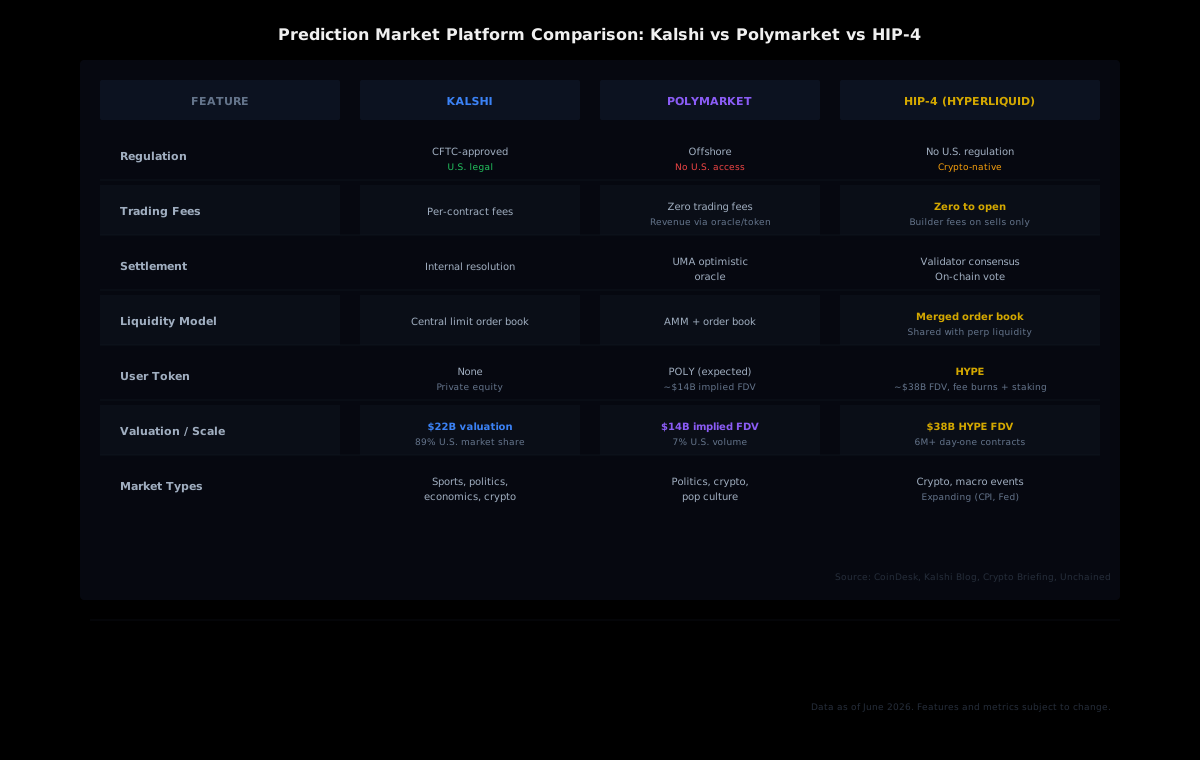
Kalshi charges trading fees on every contract. Polymarket charges no trading fees but extracts value through its oracle system and planned token (premarket trading implies a roughly $14 billion fully diluted valuation for the expected POLY token). HIP-4 charges zero fees to open positions, with builder fees applying only to sell orders during the current testing phase.
For active traders, the fee difference is meaningful. On a platform like Kalshi, fees compound across hundreds of trades. On HIP-4, the current fee structure makes it essentially free to take a position. The question is whether zero fees are sustainable or just a growth-phase subsidy, something every trader should evaluate with open eyes.
| Feature | Kalshi | Polymarket | HIP-4 (Hyperliquid) | | --- | --- | --- | --- | | Regulation | CFTC-approved | Offshore (no U.S. access) | No U.S. regulation | | Trading fees | Per-contract fees | Zero (revenue via oracle/token) | Zero to open, builder fees on sells | | Settlement | Internal resolution | UMA optimistic oracle | Validator consensus | | Liquidity model | Central limit order book | AMM + order book hybrid | Merged order book (Yes/No shared) | | Market types | Sports, politics, economics, crypto | Politics, crypto, pop culture | Crypto, macro (expanding) | | Collateral | USD | USDC | USDC (fully collateralized) | | User token | None (private equity) | POLY (expected) | HYPE |
The HYPE Token Advantage
Arthur Hayes made an argument in April that crystallizes Hyperliquid's competitive angle. "HIP-4 will quickly become a dominant prediction market because of Hyperliquid's large user base, much cheaper trading fees, and very robust tech infrastructure," he wrote. But the deeper point was about token economics: "Users who own the $HYPE token can directly profit from their usage of HIP-4."
Kalshi has no public token. Polymarket's expected POLY token trades at an implied $14 billion FDV versus HYPE's roughly $38 billion. The difference is that HYPE holders already participate in the protocol's economics through fee burns and staking yield, which means prediction market activity directly accrues value to existing token holders.
Whether that value accrual creates a genuine competitive moat or just a speculative premium is an open question. But the alignment of incentives is structurally different from platforms where users generate revenue for private equity investors with no direct benefit flowing back.
Macro Markets and the CPI Expansion
HIP-4 expanded beyond crypto-native markets on May 26, 2026, when Hyperliquid launched its first off-chain outcome market: a bet on the May 2026 CPI year-over-year print, settling June 10 based on Bureau of Labor Statistics data.
This is where the validator settlement model gets interesting. For a CPI market, the outcome is unambiguous: the BLS publishes a number, and validators resolve the contract based on that number. No oracle needed. No room for dispute.
The playbook appears to be: start with objectively verifiable events (BTC price, CPI prints, Fed decisions) where validator resolution is straightforward, then gradually expand into more subjective territory. A later phase will enable permissionless market deployment, letting any builder create new outcome markets by staking 1,000,000 HYPE, with slashable stakes burned if rules are violated.
For traders who already use Hyperliquid for perps, the ability to hedge macro views with binary contracts on the same platform reduces friction significantly. Instead of opening a Kalshi account, completing KYC, and funding a separate balance, you can express a CPI view from the same wallet and the same margin pool you already use for BTC perps.
What Prediction Markets Mean for Cohort Analysis
Prediction markets introduce a new behavioral layer for on-chain analytics. When thousands of traders take positions on a binary outcome, the aggregate positioning reveals something that price action alone cannot: directional conviction segmented by trader behavior.
Consider a CPI prediction market. If traders in the highest-PnL cohorts are buying "CPI above consensus" while lower-performing cohorts are selling, that divergence is a signal. It tells you something about how experienced, consistently profitable traders are positioning for macro events, separate from their perp positioning on the same exchange.
Our data already classifies every Hyperliquid wallet into 16 behavioral cohorts, eight by size (Shrimp through Leviathan) and eight by all-time PnL (Giga-Rekt through Money Printer). As HIP-4 markets expand, tracking how these cohorts position across prediction contracts adds a new dimension to the intelligence layer. One API call gives you cohort-level positioning across perps, HIP-3 equities, and now binary outcome markets, all on the same chain.
Track How Smart Money Trades Prediction Markets
HyperTracker's API classifies every Hyperliquid wallet into 16 behavioral cohorts by size and PnL. As HIP-4 prediction markets grow, see how Money Printers, Leviathans, and every segment in between are positioning, all through a single API.
The Road Ahead
Prediction markets are not a zero-sum game between platforms. The sector is growing fast enough that multiple winners can coexist. Combined monthly volume quintupled in nine months. Institutional adoption is accelerating. The 2026 World Cup alone could drive billions in prediction trading activity.
Kalshi will likely keep its dominance in U.S.-regulated prediction trading. Its CFTC approval, institutional integrations, and sports contracts create a defensible position that on-chain platforms cannot replicate without their own regulatory frameworks.
Hyperliquid's opportunity is different. It targets crypto-native traders who already live on the protocol, who value composability over regulatory comfort, and who see prediction markets as another expression type alongside perps and tokenized equities. If HIP-4's merged order books deliver better execution than standalone prediction platforms, and if validator-based settlement proves robust at scale, the zero-fee model could absorb a meaningful share of crypto-adjacent prediction volume.
The prediction market sector just crossed $24 billion in monthly volume. That number was under $5 billion nine months ago. Whether you trade on Kalshi, Polymarket, or Hyperliquid, the underlying signal is the same: this category is growing faster than anyone expected, and the competition for how prediction markets should work is just getting started.