A $36M Hack Just Proved Your Smart Money Labels Are Wrong
By CMM Team - 09-Jun-2026
A $36M Hack Just Proved Your Smart Money Labels Are Wrong
On June 8, 2026, attackers drained over $36 million from Humanity Protocol by compromising private keys stored on a single laptop. The H token collapsed roughly 89% within hours, falling from about $0.73 to under $0.08. Every wallet tracking tool flagged the project's treasury wallets as "smart money" right up until the moment they were emptied.
That is the core problem with wallet-level labels. They describe the past, and they describe it in isolation. A wallet that accumulated millions in tokens over six months looks indistinguishable from a wallet that is about to be drained by an attacker who already has the private keys. This article examines what the Humanity Protocol exploit reveals about the limits of individual wallet tracking, why the 2026 DeFi hack pattern demands a different approach to "smart money" identification, and how cohort-level analytics solve for the structural blind spots that wallet labels create.
What Happened at Humanity Protocol
Humanity Protocol is a decentralized identity project that raised $50 million from investors including Jump Crypto and Kingsway Capital, reaching a reported $1.1 billion valuation. The project uses palm-scan biometrics as a proof-of-humanity alternative to Worldcoin's iris scanning.
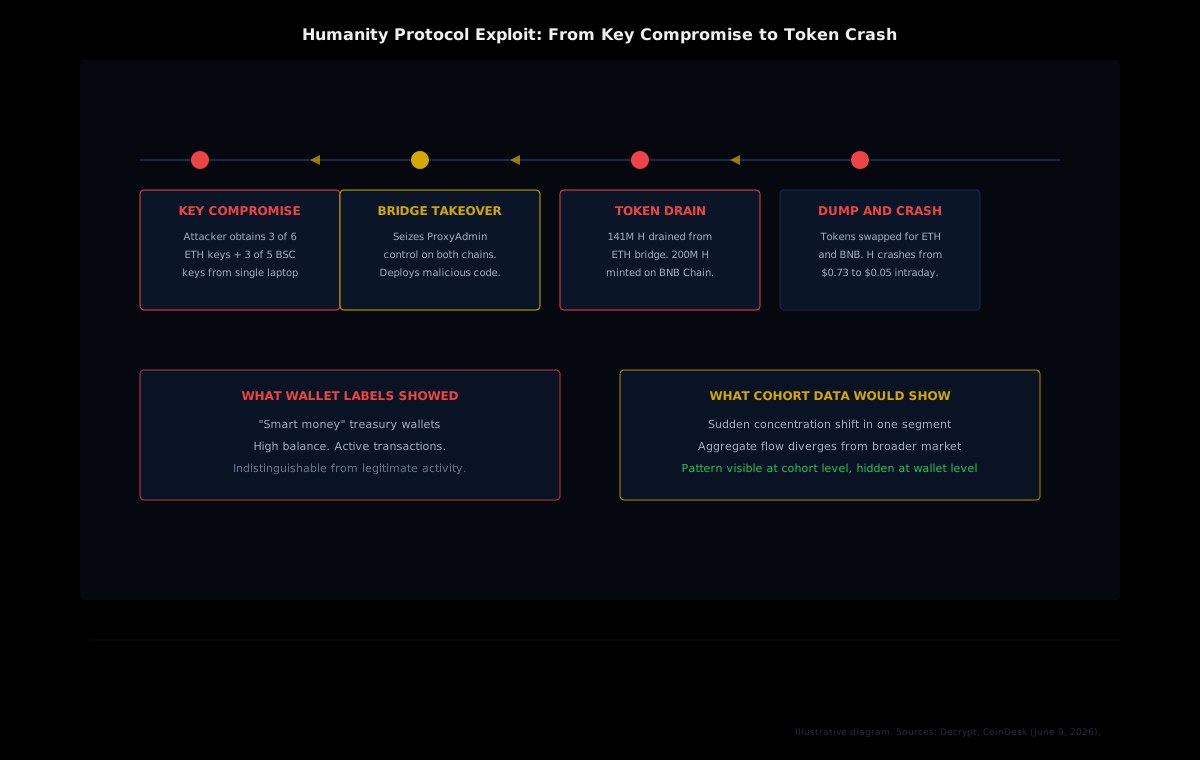
The exploit was not a smart contract bug. Attackers compromised three of six Gnosis Safe keys on Ethereum and three of five on BNB Chain, all stored on the same device. With ProxyAdmin control, they drained roughly 141 million H tokens from the Ethereum bridge and minted another 200 million H on BNB Chain through a malicious contract upgrade that included an unlimited mint function.
Meir Dolev, CTO at blockchain security firm Cyvers, described it plainly: "an operational security failure, not a smart-contract bug." The H token fell from about 70 cents to 5 cents during the attack before recovering slightly to around 20 cents.
On-chain analyst ZachXBT initially called the incident "possibly staged," suggesting it offered "a convenient way for the active MM to have exited." He later walked back that framing after concluding the key compromise and market-making irregularities appeared to be unrelated events. The ambiguity itself illustrates the problem: when a wallet's on-chain behavior looks identical whether it is a legitimate treasury, a compromised key, or a planned exit, labels built on past transactions tell you nothing about present intent.
2026: The Year Stolen Keys Replaced Smart Contract Bugs
Humanity Protocol is not an anomaly. It fits the dominant pattern of DeFi exploits in 2026, where the largest losses have come from compromised keys and operational failures rather than code vulnerabilities.
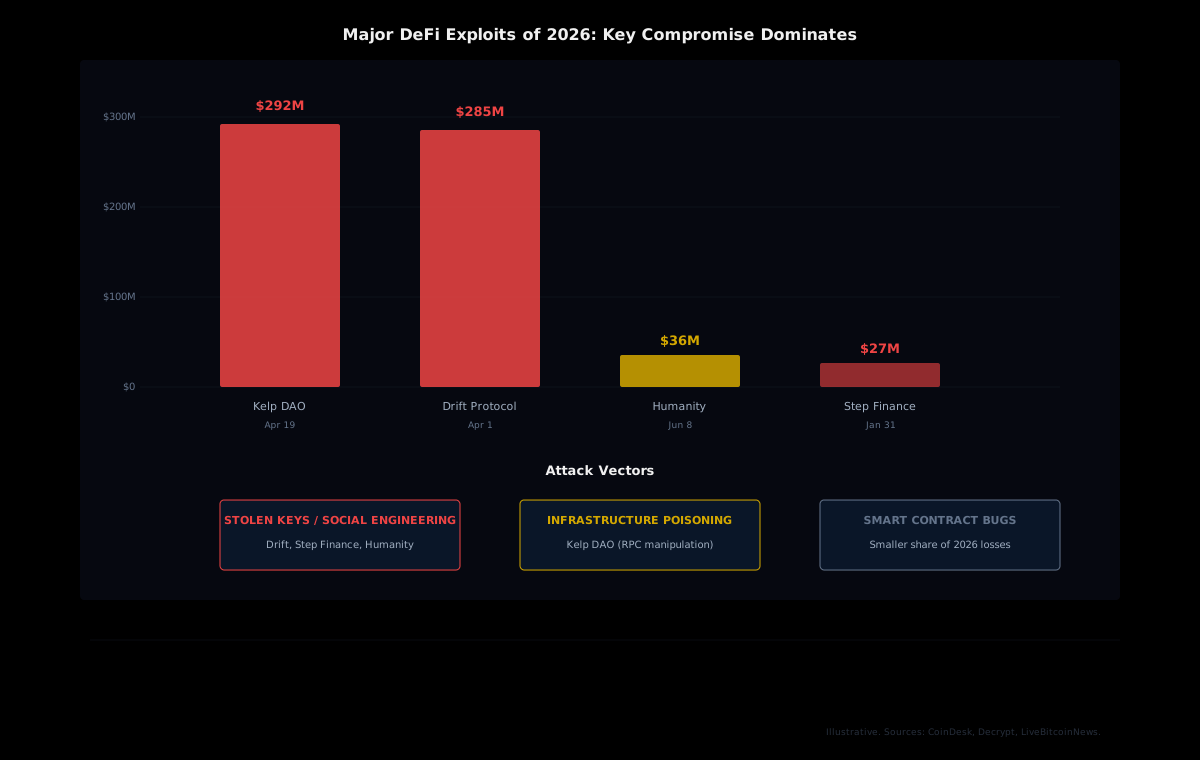
Through April alone, DeFi protocols lost roughly $770 million to hacks. April was the single worst month, with about $606 million stolen across 12 incidents, which is 3.7 times the entire Q1 total. Two attacks accounted for 95% of the April damage:
- Drift Protocol ($285 million): North Korean state actors spent six months socially engineering their way into administrative keys at the Solana-based DEX. Once inside, they whitelisted worthless collateral and drained the treasury. No code was exploited.
- Kelp DAO ($292 million): Attackers poisoned the RPC infrastructure feeding Kelp's single-verifier bridge, tricking it into authorizing a cross-chain message that released 116,500 rsETH across 20 chains.
In all three cases, wallet tracking tools would have flagged the project treasuries as high-value, active, legitimate wallets. Right up until they were drained. The labels were technically accurate and practically useless, because they measured what a wallet held, not how securely it was operated or whether its keys were still under the original owner's control.
Why Wallet Labels Break Down
Most wallet tracking platforms assign labels based on observable on-chain history: transaction volume, token holdings, historical PnL, interaction with known protocols. A wallet that has held $10 million for six months and transacted with blue-chip DeFi gets flagged as "smart money" or "whale." The label sticks until something changes.
This creates three structural blind spots that the 2026 hack pattern exposes:
Blind Spot 1: Labels Cannot Detect Key Compromise
When an attacker obtains private keys, the wallet's on-chain fingerprint remains identical. There is no transaction that distinguishes "the original owner moved funds" from "an attacker with stolen keys moved funds." The Humanity exploit drained 17 wallets tied to the project. None of those wallets looked abnormal until the drain was already complete.
Blind Spot 2: Labels Snapshot the Past
A wallet that was profitable for 18 months can become catastrophic exposure overnight if its operational security degrades. Drift Protocol's admin keys were compromised for six months before the $285 million drain. During that entire period, the wallets looked normal to every tracking tool. Past behavior is not a security guarantee.
Blind Spot 3: Labels Conflate Different Types of "Smart"
A treasury wallet holding $50 million in protocol tokens is not the same kind of "smart money" as a trader who generated $50 million in PnL from active positions. They share a balance threshold but occupy completely different risk profiles. Wallet labels flatten this distinction. In the Humanity case, the project's bridge wallets and the attacker's fresh wallets were both moving large amounts of H tokens simultaneously. One was a theft. The other was a fire sale. On-chain, they looked like the same type of activity.
Cohort Analytics: Behavioral Classification Over Wallet Labels
The alternative to labeling individual wallets is classifying the entire market into behavioral segments based on measurable criteria that update continuously. This is what cohort analytics does.
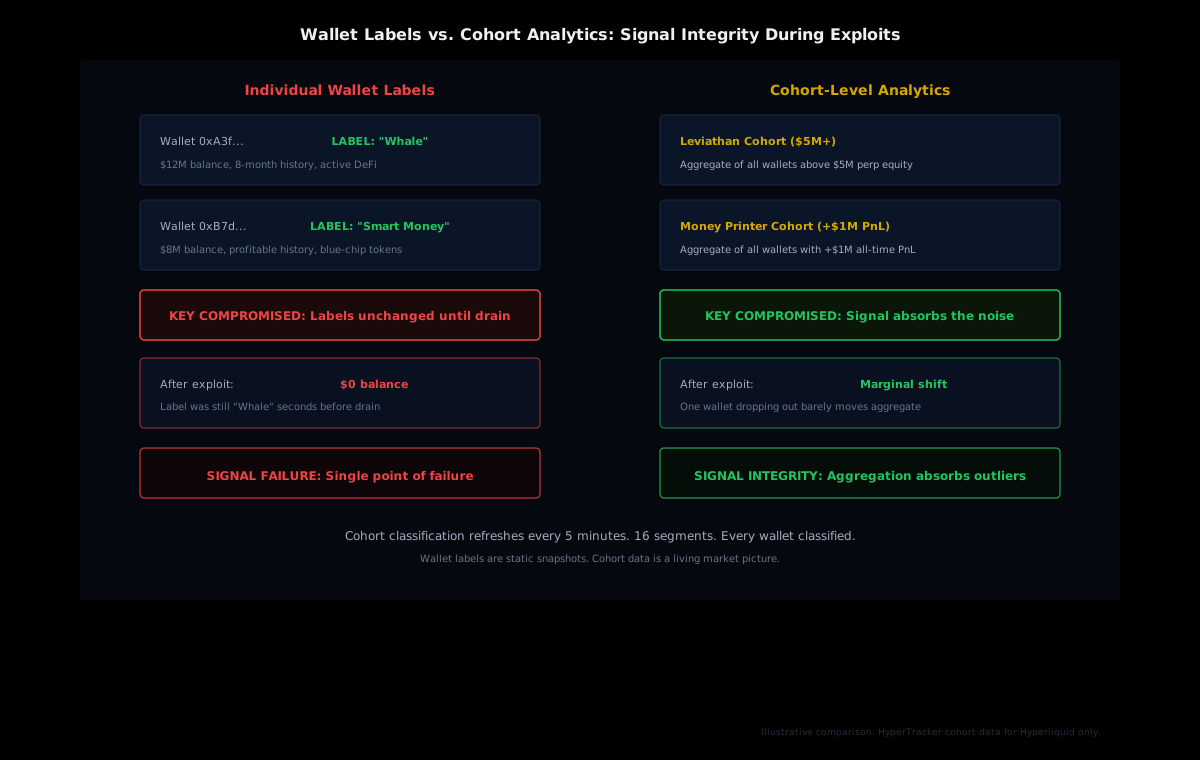
HyperTracker's API segments every Hyperliquid wallet into 16 behavioral cohorts: eight based on position size (from Shrimp at $0-$250 to Leviathan at $5M+) and eight based on all-time realized profitability (from Giga-Rekt below -$1M to Money Printer above +$1M). These classifications refresh every 5 minutes and aggregate positioning data across each segment.
The fundamental difference from wallet labeling is that cohort classification is based on verifiable, continuous metrics rather than static historical snapshots. A wallet moves between cohorts as its behavior changes. If a Leviathan wallet suddenly liquidates its entire position and goes to zero, it drops out of the Leviathan cohort within the next refresh cycle. There is no stale label lingering for weeks or months.
How Cohorts Handle the Key-Compromise Problem
Cohort analytics do not solve key compromise directly, because no analytics layer can detect an off-chain security failure. But they mitigate the downstream damage to copy traders and signal consumers in two important ways:
First, aggregate signals dilute individual wallet noise. If one wallet in the Whale cohort (wallets with $500K-$1M in perp equity) gets compromised and dumps its position, the aggregate cohort signal shifts only marginally because it reflects hundreds of wallets, not one. Copy traders who follow cohort-level positioning rather than individual wallets are insulated from single-wallet blowups.
Second, sudden divergences between cohort segments become visible signals in themselves. When a project token collapses, you can see whether the sell-off is concentrated in one segment (consistent with a targeted exploit) or distributed across all segments (consistent with organic panic). That distinction helps traders assess whether an event is a systemic risk or an isolated incident.
What Traders Should Actually Monitor
The Humanity exploit, combined with the Drift and Kelp attacks earlier this year, suggests a practical shift in how traders evaluate "smart money" signals. Instead of asking "which wallets are smart?" the better question is "what is each behavioral segment doing right now?"
Watch Cohort-Level Positioning Shifts
On Hyperliquid, our data shows aggregate positioning for each of the 16 cohorts across every listed asset. When the Money Printer cohort (wallets with +$1M all-time PnL) shifts net long on an asset while the Exit Liquidity cohort (wallets with -$10K to $0 all-time PnL) stays short, that divergence carries more signal than any individual wallet move. It reflects the aggregate behavior of every wallet in each segment, which makes it resistant to single-wallet manipulation or compromise.
Track Segment Migration, Not Balance Snapshots
Cohort classification is dynamic. A wallet that was a Whale last week might be a Dolphin today if it closed positions. Tracking how wallets migrate between segments over time reveals whether "smart money" is actually reducing exposure or just rebalancing. During the April hack wave, builders using HyperTracker's cohort metrics could see whether larger segments were pulling back from DeFi exposure before events hit the headlines.
Use Order Flow for Conviction Signals
Beyond positioning, order flow data reveals whether large entries come with stop-losses and take-profit orders or are unhedged directional bets. Our API exposes stop/TP visibility and rolling 5-minute order snapshots, which let builders distinguish conviction entries from speculative swings without needing to identify the specific wallet behind each trade.
Build With Cohort Intelligence
HyperTracker's API gives you aggregate positioning for 16 behavioral cohorts, refreshed every 5 minutes. Stop relying on wallet labels that break when keys get compromised. Start building with segment-level intelligence that reflects what the entire market is doing.
The Bigger Picture: Intelligence Over Labels
The 2026 DeFi security crisis has exposed a structural flaw in how the industry thinks about "smart money." Wallet labels are built on the assumption that past behavior predicts future reliability. Key compromises, social engineering, and insider exploits all break that assumption.
Cohort analytics do not eliminate risk. But they shift the signal source from individual wallets (which can be compromised, manipulated, or misidentified) to behavioral segments (which aggregate hundreds or thousands of wallets into a statistical picture). That aggregation is inherently more resistant to single-point failures.
For traders and builders, the practical takeaway is straightforward: if your smart money strategy depends on tracking specific wallets, the Humanity Protocol exploit is a reminder that those wallets are only as reliable as their operational security. You cannot verify that from on-chain data alone. What you can verify is how an entire segment of traders is positioned, how that positioning is changing, and whether conviction signals (order flow, stop placement, leverage ratios) support the directional bias.
The wallets you are tracking might be smart. They might also be compromised. Cohort data does not care which, because it measures the market, not the individual.