
Cohort Migration Patterns: When Hyperliquid Wallets Cross Performance Tiers
By CMM Team - 23-May-2026
Cohort Migration Patterns: When Hyperliquid Wallets Cross Performance Tiers
Most analytics platforms treat wallet classification as a static label. You query a wallet today, get back "Smart Money," and that's the answer. The implicit assumption is that the label captures something durable — that a Smart Money wallet last week is still a Smart Money wallet this week, and probably next month too.
That assumption is wrong. Behavioral cohorts on Hyperliquid are moving averages, not nameplates. A wallet's classification updates as new trades close and PnL is realized. A trader who's been compounding steadily for six months can cross into Money Printer territory after one breakout month. A wallet that was a confident Smart Money long can fall into Exit Liquidity after a single oversized leveraged loss. The classification doesn't lie — it reflects the wallet's current realized track record on the platform. But the migrations between cohorts carry signal that the snapshot itself doesn't.
This article unpacks why cohort migrations are a leading indicator most traders ignore, what the four main migration patterns mean, and how to use migration data to filter wallets before the rest of the market catches on.
The static-label fallacy
The wallet labeling paradigm in crypto analytics — pioneered by Nansen, scaled by Arkham, copied widely — treats labels as identity. The label is applied once based on observed behavior, and updated only when something major changes. "Smart Money," "Institutional," "DEX power user" — these are nameplates that imply stability.
On a perp DEX, that assumption breaks fast. A wallet's behavioral characteristics on Hyperliquid update on every closed trade. Each fill changes the wallet's realized PnL, which can push it across a tier boundary. A Smart Money wallet sitting at +$950K cumulative PnL needs just one more profitable trade to cross into Money Printer. A Money Printer at +$1.05M who takes a $200K loss falls back to Smart Money.
These crossings happen constantly. On any given day, thousands of wallets on Hyperliquid migrate between tiers as their trades close. Most analytics tools never surface this — they either don't track classification over time, or they smooth it heavily to keep labels stable. Both choices throw away the signal.
The signal is in the migration itself. Not where a wallet is right now, but where it just came from, and what direction it's moving.
Four migration patterns worth tracking
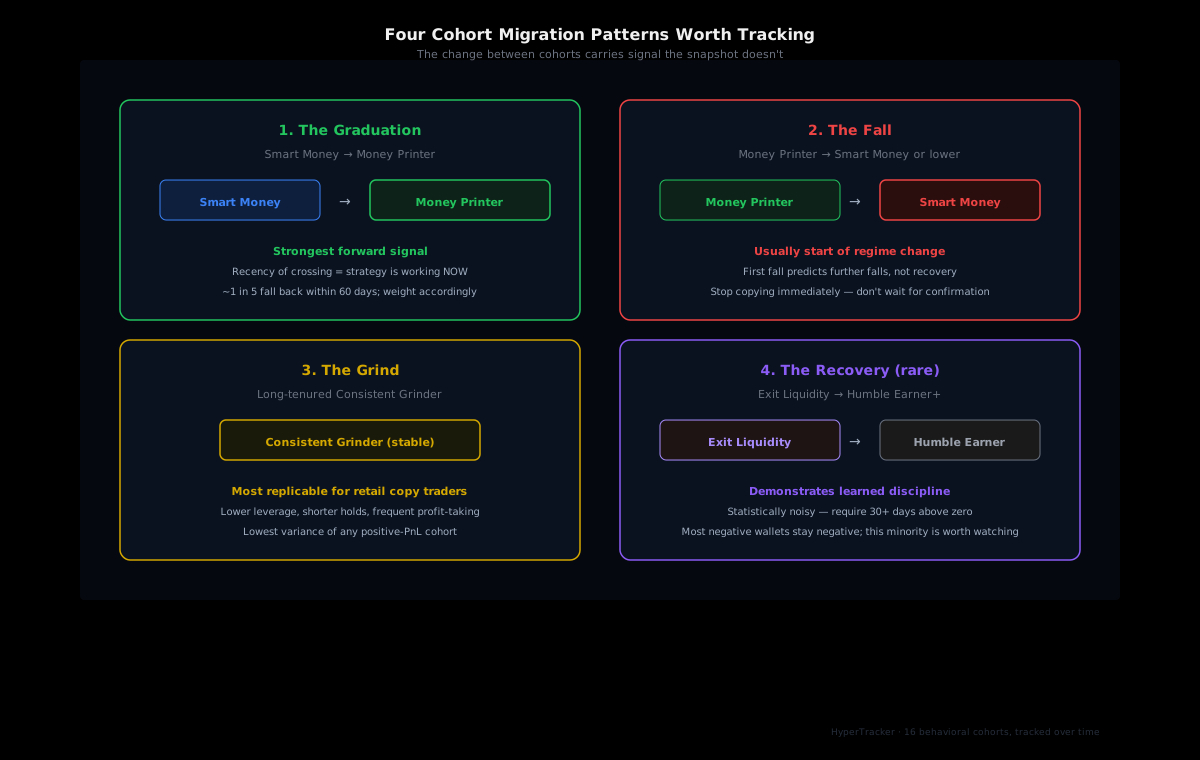
After watching cohort transitions across thousands of wallets over months, four patterns show up reliably enough to act on:
1. The graduation: Smart Money → Money Printer
This is the migration with the strongest forward signal. When a wallet crosses from Smart Money into Money Printer — from the $100K-$1M PnL band into the $1M+ band — it has demonstrated sustained profitability across enough volume to be unlikely as luck. The graduation point itself is a milestone. The wallet has just proven it can compound consistently at scale.
Two practical implications:
Higher trust weighting. A wallet that's been a Money Printer for months is established. A wallet that just graduated from Smart Money is demonstrating the persistence of its edge in real time. For copy trading purposes, fresh graduates are often worth a heavier weight than long-tenured Money Printers because the recency of their crossing means their current strategy is what's working.
Watch the next 60 days. Roughly one in five fresh graduates falls back to Smart Money within two months. The cross was real but the next leg of growth doesn't always materialize. Treat the first 60 days post-graduation as a confirmation window rather than a final verdict.
2. The fall: Money Printer → Smart Money (or lower)
The reverse migration is the one most copy-trading systems handle poorly. When a Money Printer falls back to Smart Money, it means the wallet has surrendered enough cumulative profit to cross the threshold. That's not a small thing — going from $1M+ to under $1M means realizing at least $100K in losses (and often much more, since the fall usually doesn't stop exactly at the boundary).
The signal:
Most falls are followed by more falls. Wallets that fall from Money Printer to Smart Money have a higher probability of falling further (to Consistent Grinder or below) than they do of recovering back to Money Printer in the next quarter. The first crossing is usually the start of a regime change, not a noise event.
Stop copying ASAP. Most copy traders find out their lead wallet was deteriorating only after the deterioration shows up in their own portfolio. Migration tracking catches it earlier — the moment the cohort changes is the moment to stop allocating new follower capital.
3. The grind: persistent Consistent Grinder
This isn't a single migration — it's the absence of migration. Wallets that sit in the Consistent Grinder cohort ($10K-$100K all-time PnL) for many consecutive months are an underrated category. They haven't crossed into Smart Money because they take profit consistently and don't run massive leverage. But they're not falling either.
The Consistent Grinder cohort has the lowest variance of any positive-PnL cohort. Wallets here tend to:
- Hold positions for shorter durations
- Use lower leverage
- Take profit more frequently rather than letting winners ride
For retail copy traders, a long-tenured Consistent Grinder is often a more replicable target than a Money Printer running 5x leverage on multi-million-dollar positions. The math scales: a Grinder running 2x on a $20K account behaves similarly enough at $200 follower allocation that you can actually replicate the strategy. A Money Printer running 8x on a $5M account does not.
4. The recovery: Exit Liquidity → Humble Earner (or above)
The fourth pattern is the rarest but the most interesting from a strategic perspective. Wallets that cross back into positive PnL territory after spending time in the negative cohorts (Exit Liquidity, Semi-Rekt) have done something unusual: they've adjusted strategy in response to losing money, and the adjustment worked.
Most negative-PnL wallets stay negative. The base rate is grim — once a wallet crosses into Exit Liquidity, it's more likely to keep slipping than to recover. But the small minority that does recover often demonstrates a kind of learned discipline that's worth watching.
The catch: these recoveries are statistically noisy. A single profitable trade can push an Exit Liquidity wallet back above zero. The recovery is only meaningful if it sticks — if the wallet stays above zero for at least 30 days and the recovery is built on multiple closed trades rather than one outlier win.
Why migration data is hard to find elsewhere
The reason most analytics tools don't expose migration data is operational, not technical. To track migrations, you need:
- Historical PnL data per wallet, computed from raw fills. Most platforms either don't compute lifetime PnL at all, or they recompute it on each query without persisting historical snapshots.
- A consistent cohort boundary definition over time. If the cohort thresholds change, migrations become uninterpretable. Stable boundaries are a commitment.
- A way to surface "wallet just crossed" events efficiently. Pulling current cohort for every wallet daily and diffing is expensive.
HyperTracker's API solves all three because the cohort framework is built into our core data model. Every closed trade triggers a re-evaluation of the wallet's cohort assignment, and we persist the transition history. The result: you can query a wallet's full cohort timeline, or pull all wallets that crossed into a given cohort in the last N days.
A practical query:
# Wallets that crossed INTO Money Printer in the last 7 days
graduations = api.get(
    "/cohorts/migrations",
    params={"target_cohort": "money_printer", "lookback_days": 7}
)

# For each, pull recent activity to evaluate continuation odds
for w in graduations:
    recent_trades = api.get(f"/wallets/{w['address']}/trades/recent")
    # ... your filtering logic
The shape of the data is more useful than the snapshot. You can filter graduates by capital tier (small accounts that just hit Money Printer are different bets than large accounts that just did), by time spent in the previous cohort (slow climbers versus fast burners), and by the volatility of their PnL accumulation (smooth growth versus lumpy wins).
Building a migration-aware copy trading framework
The combination of migration data and current cohort positioning forms the basis of a more disciplined copy trading approach than wallet-label intelligence can provide.
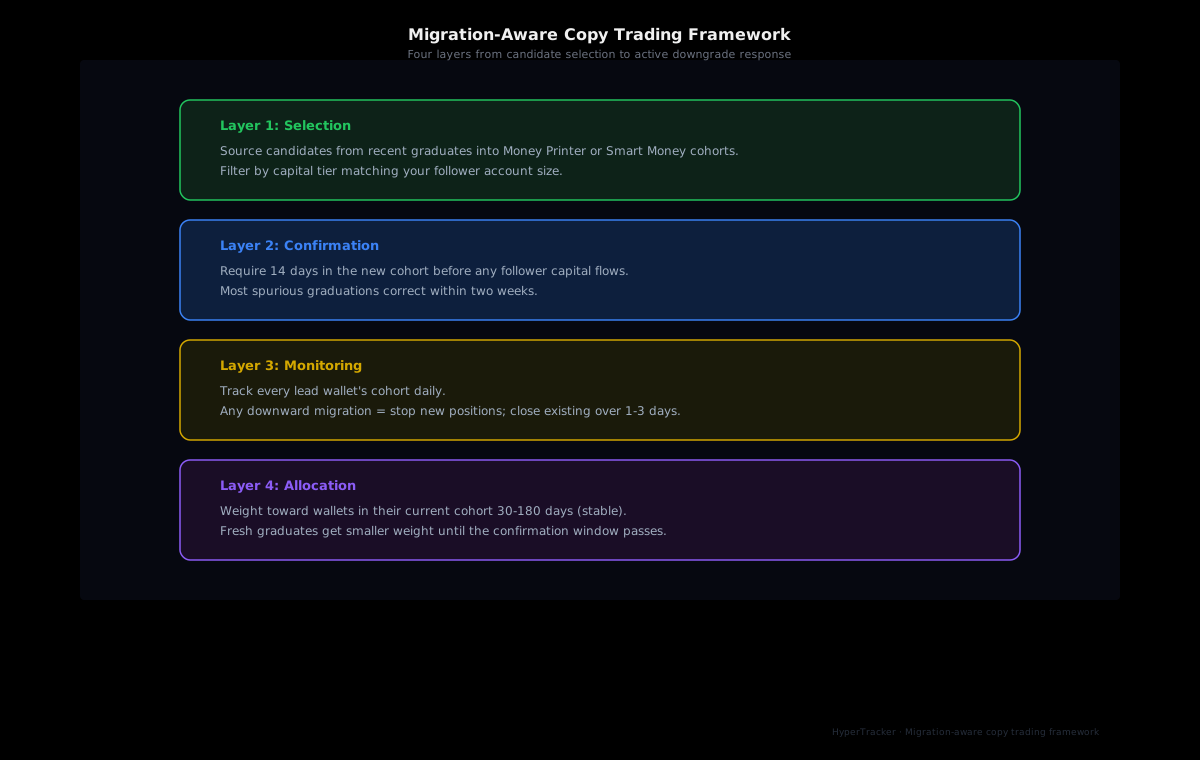
A framework that holds up across market regimes:
Selection layer: Source candidates from recent graduates into Money Printer or Smart Money cohorts. Filter for capital tier matching your follower account size. Exclude wallets that have crossed boundaries more than twice in 90 days (high volatility, hard to size around).
Confirmation layer: Before allocating follower capital, require the candidate to spend at least 14 days in their new cohort. Most spurious graduations correct within two weeks. The wait costs you the very best entries but filters out the noise.
Monitoring layer: Track every lead wallet's cohort daily. The moment a lead wallet migrates downward — Money Printer to Smart Money, Smart Money to Consistent Grinder, anything to Exit Liquidity — stop opening new positions copied from that wallet. Close existing positions over the next 1-3 days depending on the magnitude of the migration.
Allocation layer: Weight follower capital toward wallets that have been in their current cohort for 30-180 days. Fresh graduates get smaller allocations until the confirmation window passes. Long-tenured wallets in stable cohorts get the largest allocations.
This isn't a strategy — it's a framework. The specific position sizes, the exact wait period, the threshold for downgrade response, are all parameters you tune to your own risk tolerance. But the structure is right: classify by behavior, track migrations, weight by tenure, downgrade fast.
API access
HyperTracker's API exposes both current cohort assignment and cohort migration history for every Hyperliquid wallet. The free tier (100 requests/day) covers exploratory analysis. Paid tiers unlock bulk migration queries and historical timeline access for backtesting.
Start tracking cohort migrations on Hyperliquid →
The bigger framing
Static wallet labels assume identity predicts behavior. Behavioral cohorts assume current behavior predicts near-future behavior. Migration data does something different: it treats the change in behavior as the most important signal, because changes are usually the first observable evidence that something has shifted in a trader's edge.
Most market participants are still reading the label. The ones who learn to read the migration are doing more sophisticated trader-level intelligence than what's been available before. That's the structural opportunity — not in the snapshot, but in the trajectory.
Wallet labels tell you a wallet's name. Cohorts tell you a wallet's current behavioral class. Migrations tell you which way it's heading. Those are three different questions, and only the third one captures momentum.