Polymarket Lost $660K Today. HIP-4 Makes That Impossible.
By CMM Team - 22-May-2026
Polymarket Lost $660K Today. HIP-4 Makes That Impossible.
Polymarket just got drained. Again. On May 22, an attacker exploited a compromised private key tied to the platform's UMA CTF Adapter on Polygon, siphoning more than $660,000 in automated 5,000-token batches every 20 to 30 seconds. The exploit targeted an internal operations wallet used for reward payouts, and while Polymarket insists user funds are safe, the pattern by now is familiar: a centralized choke point, a single compromised key, and hundreds of thousands of dollars walking out the door before anyone notices.
This is the latest in a string of incidents that have shadowed Polymarket's rise. And it raises a structural question that builders and traders should be paying attention to: is prediction market security fundamentally a design problem, or just an execution failure? Hyperliquid's answer, shipped three weeks ago as HIP-4, suggests it is the former.
What Happened to Polymarket on May 22
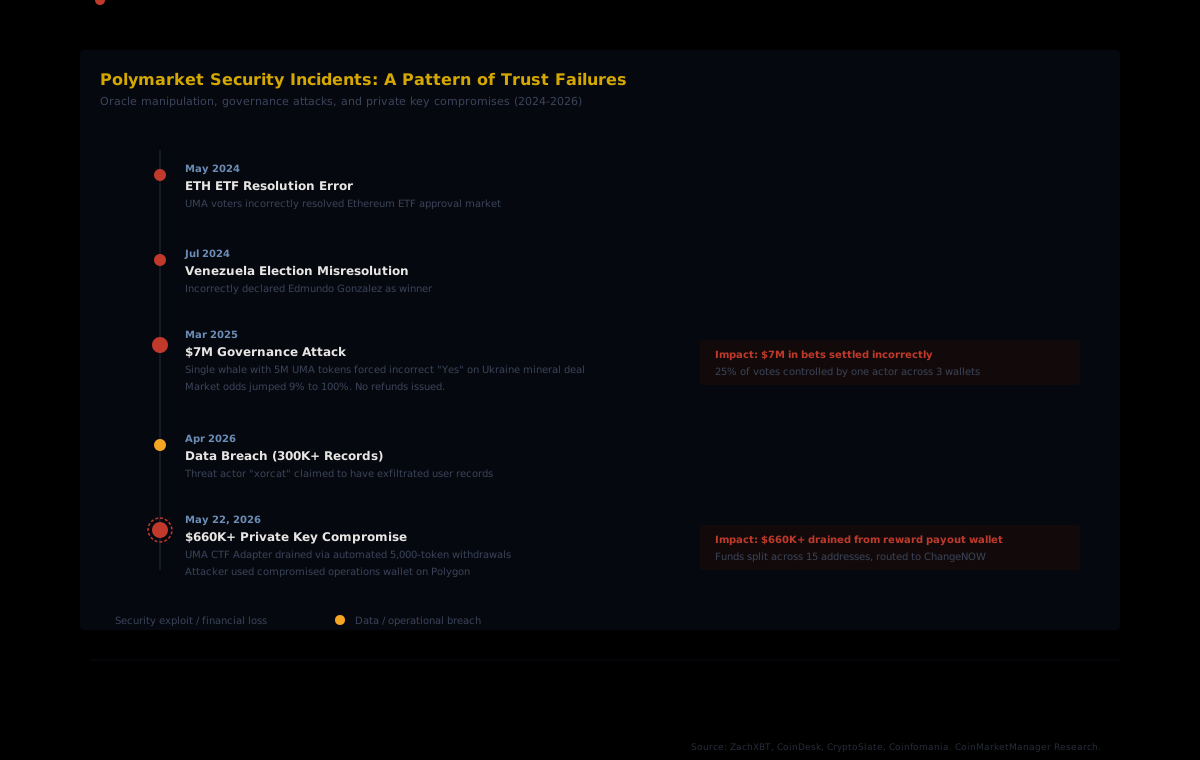
Onchain investigator ZachXBT flagged the breach first, identifying over $520,000 drained from two smart contracts on Polygon. Later analysis from Lookonchain and other trackers put the total above $660,000. The attacker's wallet, tagged as 0x8F98...B91, received funds split across multiple addresses before routing a portion through ChangeNOW, a non-custodial exchange that requires no KYC for smaller swaps.
Polymarket's post-mortem pointed to a private key compromise of an internal operations wallet. Polygon Labs CTO Mudit Gupta confirmed the scope was limited: "Polymarket contracts are safe. User funds are safe. Looks like their market initializer was compromised." The compromised wallet handled reward distribution for oracle proposers who participate in market resolution. So while no trader lost USDC from their positions, the breach reveals something about the architectural surface area of platforms that depend on off-chain custody and administrative wallets.
Polymarket's Growing List of Trust Failures
Today's exploit is not an isolated event. It fits into a pattern that should concern anyone building on or trading with Polymarket's infrastructure.
The Ukraine Mineral Deal Governance Attack (March 2025)
A single whale wielding 5 million UMA tokens across three wallets, representing roughly 25% of total votes, forced through a premature "Yes" resolution on a $7 million market about whether Ukraine would agree to Trump's mineral deal. The market swung from 9% to 100% with no underlying agreement in place. Polymarket acknowledged the outcome was incorrect but declined to issue refunds, stating "this wasn't a market failure."
The structural vulnerability was clear: 51% of UMA's market cap stood at just $63 million, while Polymarket held $120 million in total value locked. An attacker's cost of manipulation was a fraction of the funds at risk.
Repeated Oracle Misfires
The Ukraine incident was not the first oracle failure. Previous markets incorrectly declared Edmundo González the winner of Venezuela's presidential election and wrongly concluded that an Ethereum ETF would be approved before May 31, 2024. Each time, UMA token holders voted on outcomes where their financial incentives did not align with accurate resolution.
Why These Exploits Keep Happening
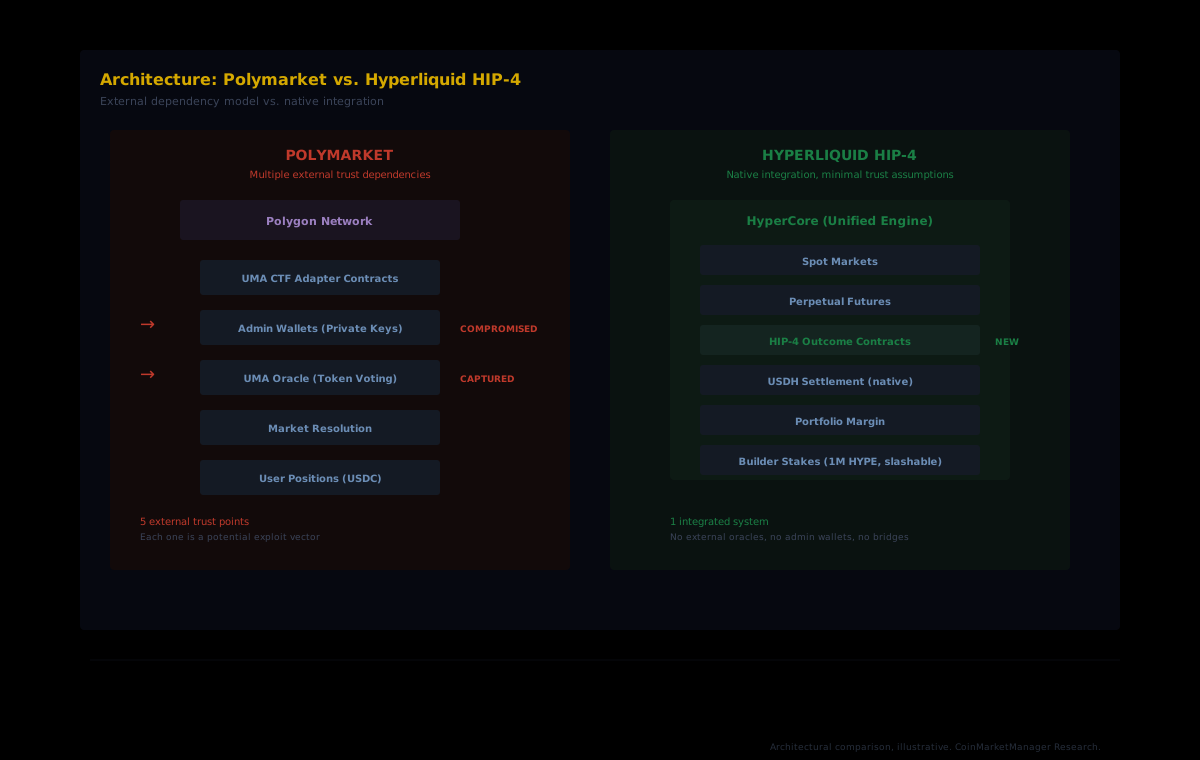
Polymarket's architecture relies on two external systems that introduce concentrated risk: an oracle network (UMA) for market resolution, and administrative wallets for operational functions like reward distribution. Both are points of centralized trust layered onto what is marketed as a decentralized prediction market.
The UMA oracle settles outcomes through token-weighted voting. Any proposer can stake 750 USDC.e to submit a resolution. If disputed, UMA token holders vote on the outcome. The problem is concentration: a Wall Street Journal analysis found that the 10 largest wallets controlled more than half the votes in most disputes, and at least one voter held a financial stake in the outcome in nearly one in five disputes.
Administrative wallets present a different vector. A private key compromise is not a smart contract bug. It is an access control failure at the operational layer, the kind of vulnerability that exists whenever a platform stores keys for wallets that control meaningful amounts of capital. The reward payout wallet drained today held POL tokens used to incentivize oracle proposers. A compromised key meant the attacker could automate withdrawals with no onchain check to stop them.
How HIP-4 Eliminates These Attack Vectors
Hyperliquid launched HIP-4 on mainnet around May 2, introducing outcome contracts as a native primitive inside HyperCore. The design choices directly address the failure modes that have plagued Polymarket.
No External Oracle Token
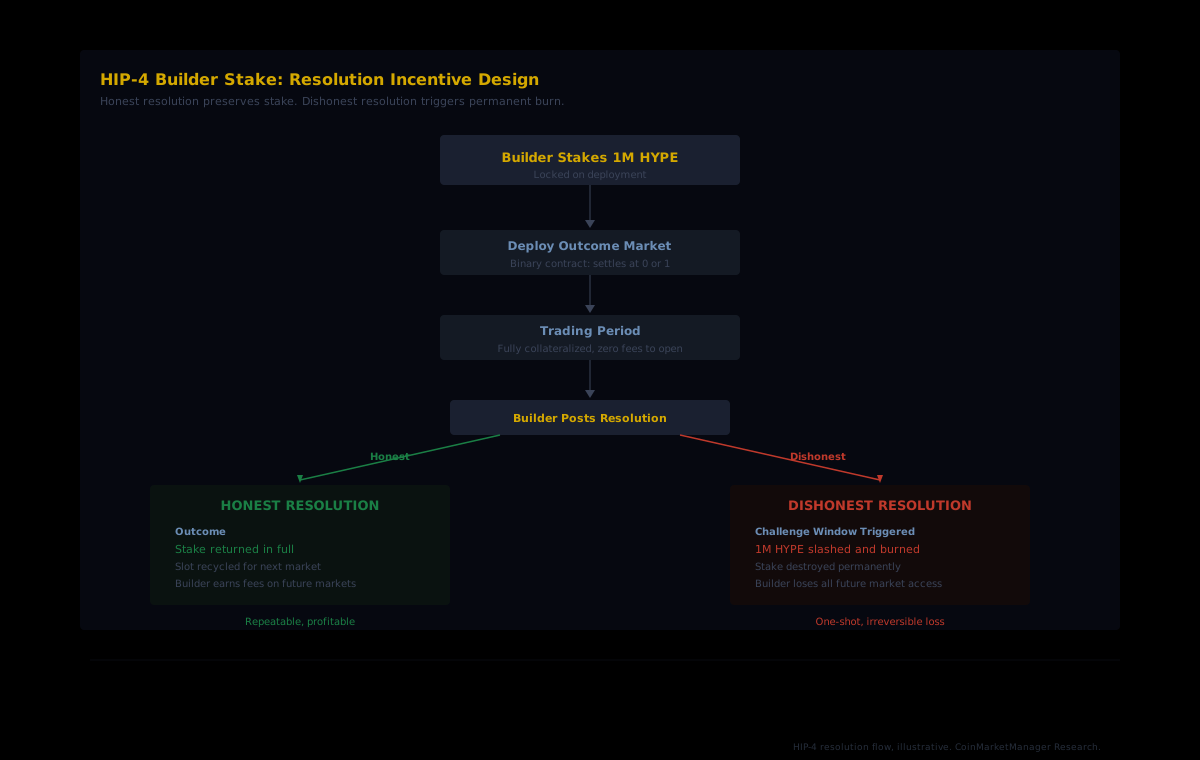
HIP-4 does not depend on an external governance token for market resolution. There is no UMA-equivalent where a whale accumulating tokens can force an outcome. Resolution happens through the builder who deploys the market, backed by a staked commitment of 1,000,000 HYPE tokens that can be slashed for manipulation. The slashed tokens are burned, creating a direct and permanent financial penalty. Compare that to UMA, where a whale's tokens remain intact even after a disputed vote.
Fully Collateralized, No Leverage
Every HIP-4 position is fully collateralized in USDH, Hyperliquid's native stablecoin. Contracts trade between 0 and 1, with no leverage and no liquidation risk. When a market resolves, trading halts, open orders cancel, and all positions settle automatically to their final PnL in USDH. There is no custody gap, no administrative wallet sitting between the outcome and the payout.
Same Engine, Same Security Model
HIP-4 contracts run natively inside HyperCore, sharing the same matching engine and order types as Hyperliquid's spot and perpetual futures markets. There is no separate Polygon-based adapter contract that can be drained independently. No bridged tokens sitting in a multisig. The outcome contracts live in the same infrastructure that already handles roughly 200,000 orders per second across spot and perps.
| Attack Vector | Polymarket | Hyperliquid HIP-4 | | --- | --- | --- | | Oracle manipulation | UMA token-weighted voting. One whale forced a $7M incorrect resolution. | Builder-deployed with 1M HYPE slashable stake. Burned on violation. | | Private key compromise | Admin wallets on Polygon hold operational funds. Key compromise drained $660K+. | No external admin wallets. Positions settle natively inside HyperCore. | | Settlement custody | Funds in adapter contracts on Polygon, separate from core infrastructure. | USDH settlement within unified margin. No bridged custody layer. | | Resolution disputes | Token holder vote. 10 largest wallets control >50% of votes in most disputes. | Challenge window for disputes. Slashable builder stake enforces honest resolution. |
The Builder Stake Model: Skin in the Game
HIP-4's resolution mechanism deserves a closer look because it solves the incentive alignment problem that UMA cannot. When a builder deploys an outcome market on Hyperliquid, they stake 1,000,000 HYPE tokens. That stake is slashable if the builder resolves a market dishonestly, and slashed tokens are burned permanently. Markets deploy into slots within a builder's event DEX, and once a market resolves, the slot can be recycled for a new event.
This creates the right incentive structure. An honest builder maintains their stake and can run markets indefinitely. A dishonest builder loses their entire stake, permanently. There is no governance vote where a motivated whale can brute-force an outcome with token accumulation. The cost of manipulation is absolute and irreversible, which is the correct design for a system that settles real money.
The initial rollout follows a two-phase approach: curated canonical markets first, then permissionless builder deployment. The first market launched as a daily recurring binary outcome tied to HyperCore's BTC mark price, settling every day at 06:00 UTC. First-day notional volume reached over $6 million, which is modest compared to Polymarket's scale but meaningful as proof that traders are willing to use the system.
What This Means for Prediction Market Traders
If you trade prediction markets today, the Polymarket exploit raises practical concerns that go beyond this single incident.
Counterparty risk is real. Even when "user funds are safe," an exploit that drains operational infrastructure erodes confidence. The reward wallet funds oracle proposers who resolve markets. If those incentives dry up because the wallet was drained, resolution quality could degrade. Today's exploit targeted the plumbing, and the plumbing matters.
Oracle governance is a known vulnerability. The March 2025 Ukraine deal attack proved that UMA's token-weighted voting can be captured by a single actor with enough capital. UMA raised its voting threshold to 65% after the incident, but the fundamental asymmetry remains: the cost of capturing 65% of UMA votes is still a fraction of the capital at risk on Polymarket.
Unified infrastructure reduces attack surface. Polymarket runs on Polygon with adapter contracts, bridged tokens, and administrative wallets. Each layer is a potential failure point. HIP-4 runs inside HyperCore alongside spot and perps, using the same margin account and the same settlement layer. Fewer moving parts means fewer things that can break.
Tracking Smart Money Across Every Hyperliquid Market
Polymarket's oracle model makes it structurally difficult to see who is voting on outcomes and why. The Wall Street Journal found that at least 60% of active UMA voters could be linked to Polymarket accounts, meaning the people deciding market outcomes also had financial stakes in those outcomes.
On Hyperliquid, the transparency picture is fundamentally different. Every position is onchain. Every trade is visible. And with HyperTracker's cohort analytics, you can see exactly how different trader segments, from Money Printers to Exit Liquidity, are positioning across the entire platform. When outcome contracts mature and volume grows, the same cohort intelligence that currently covers perps and spot will extend to prediction markets, because they all run on the same infrastructure.
Our data already classifies every wallet on Hyperliquid into one of 16 behavioral cohorts based on position size and all-time PnL. That classification does not stop at perps. As HIP-4 markets grow, the same wallet-level intelligence applies, giving builders and traders a way to see whether smart money is loading up on a particular outcome before resolution.
See How Smart Money Moves Across Hyperliquid
HyperTracker's API gives you cohort-level positioning, order flow, and liquidation risk across every Hyperliquid market. One API call, 16 behavioral cohorts, every wallet classified.
The Prediction Market Security Standard Just Changed
Polymarket built the largest prediction market in crypto by volume, and by most accounts, it works well enough for the majority of its users. But "well enough" is a dangerous standard for a platform that holds nine figures in TVL. Three oracle misfires, a governance attack that cost traders $7 million in an incorrectly resolved market, a data breach, a congressional insider trading probe, and now a $660K private key compromise: the cumulative weight of these incidents points to something structural about the architecture itself.
Hyperliquid's HIP-4 is a financial primitive: outcome contracts that settle natively inside the same engine that handles perps and spot. The design choices, full collateralization in USDH, no external oracle token, slashable builder stakes, native settlement with no admin wallets, are not features bolted on after an exploit. They are the architecture itself.
For traders who want prediction market exposure without the oracle roulette, and for builders who want to integrate outcome data alongside perps and spot through a single API, HIP-4 is the bet that infrastructure design is the security model. Today's Polymarket exploit just made that argument louder.