SpaceX Has 18,712 BTC. Hyperliquid Already Has the Perp.
By CMM Team - 21-May-2026
SpaceX Has 18,712 BTC. Hyperliquid Already Has the Perp.
SpaceX filed its S-1 with the SEC yesterday, and the headline number from crypto's perspective is not revenue or valuation. It is 18,712 Bitcoin on the balance sheet, more than double what onchain analytics firms had previously tracked. The gap between what blockchain sleuths thought SpaceX held and what the S-1 actually disclosed tells you something important about the limits of onchain attribution, and about how much corporate Bitcoin is still sitting in wallets nobody has mapped.
But there is a second story running alongside this one. Three days before the S-1 dropped, Trade.xyz launched SPCX-USDC on Hyperliquid: a synthetic pre-IPO perpetual futures contract that lets crypto traders price SpaceX's valuation before Nasdaq opens. Within hours, the contract implied a valuation above $2.5 trillion. For perp traders, the convergence of a corporate Bitcoin treasury reveal and a synthetic equity perp on the same exchange creates a set of signals worth watching closely.
What the S-1 Actually Disclosed
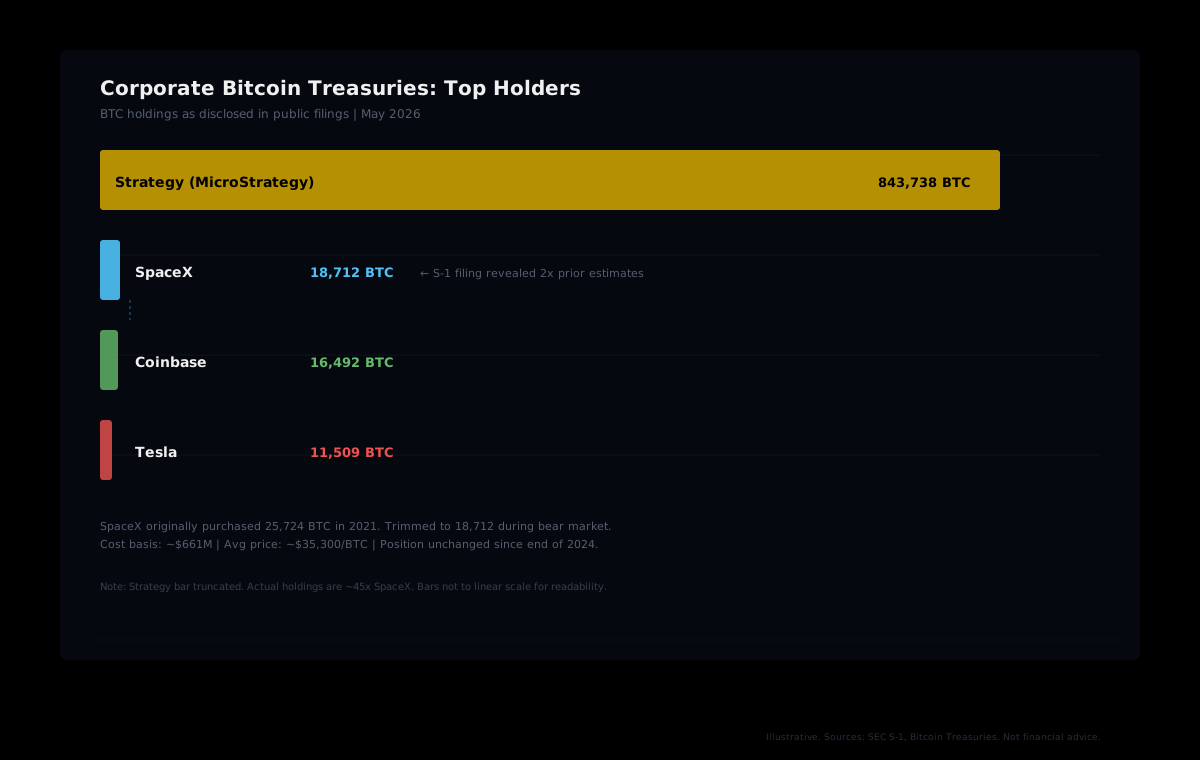
SpaceX held 18,712 BTC as of March 31, 2026, at a fair value of $1.29 billion. The company paid $661 million for those tokens, putting the average acquisition price around $35,300 per coin. At current prices above $77,000, the position is worth closer to $1.45 billion.
The position has not changed since the end of 2024. SpaceX originally accumulated roughly 25,724 BTC during the pandemic-era crypto boom in 2021, then trimmed during the bear market. What remained has sat untouched through three years of volatility, a $5 billion annual loss, and the February 2026 xAI consolidation, because none of those events prompted a sell.
For context, that stack is larger than Tesla's 11,509 BTC and Coinbase's reported 16,492 BTC. Only Michael Saylor's Strategy, with 843,738 BTC, holds meaningfully more among publicly reporting entities.
The Tracker Gap Nobody Expected
Before the S-1, the best public estimates of SpaceX's Bitcoin came from onchain attribution firms and data aggregators like Bitcoin Treasuries. Those estimates fell well short of the 18,712 BTC the filing actually disclosed.
The mismatch matters because it reveals how much corporate Bitcoin lives in custody arrangements that standard blockchain analytics cannot fully map. SpaceX likely custodies through institutional-grade solutions where wallet clusters are deliberately obscured. A significant portion of its holdings went untracked by the most widely cited blockchain attribution models, a meaningful data point for anyone trying to estimate other private companies' undisclosed positions.
Once SpaceX lists on Nasdaq under the ticker SPCX, FASB fair-value accounting rules will require the company to report BTC holdings in quarterly 10-Q filings. That transforms a previously opaque private treasury into a transparent, publicly auditable Bitcoin position, and it creates a recurring disclosure event that derivatives traders can plan around.
SPCX Pre-IPO Perps on Hyperliquid
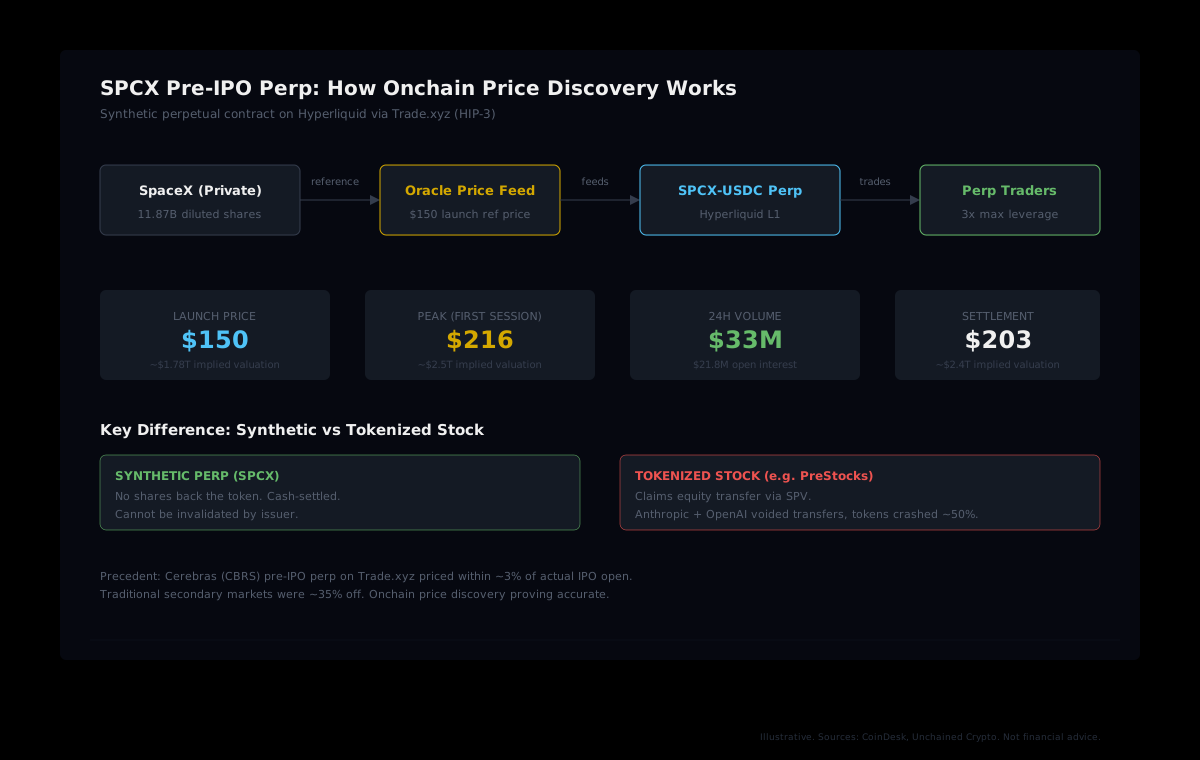
Three days before the S-1 landed, onchain price discovery was already underway. Trade.xyz listed SPCX-USDC on Hyperliquid on May 18 as a synthetic perpetual futures contract built on the HIP-3 standard. The product is cash-settled in USDC, carries a 3x maximum leverage limit, and does not involve any actual SpaceX equity.
The contract opened at a $150 reference price, derived from SpaceX's 11.87 billion fully diluted shares, implying a starting valuation of roughly $1.78 trillion. Within its first session, the price surged to $216 before settling near $203. In its first day, the contract posted $33 million in volume and $21.8 million in open interest.
Synthetic perps vs tokenized stock
The distinction is critical and timely. In mid-May, tokenized stock products tied to Anthropic and OpenAI on PreStocks crashed after both companies declared that share transfers through SPVs or tokenized instruments are void under their corporate bylaws. Those products claimed to represent actual equity. Synthetic perps like SPCX make no such claim. They are cash-settled derivatives that track a reference price, which means the issuing company has no mechanism to invalidate them.
The Cerebras precedent
SPCX is the second pre-IPO perpetual on Trade.xyz, following Cerebras Systems (CBRS) which launched May 1. That earlier contract closely tracked the eventual IPO opening price, while traditional secondary-market platforms diverged significantly. This gives early evidence that onchain price discovery through synthetic perps can be meaningfully accurate, though one data point does not establish a pattern.
Three Signals Perp Traders Should Watch
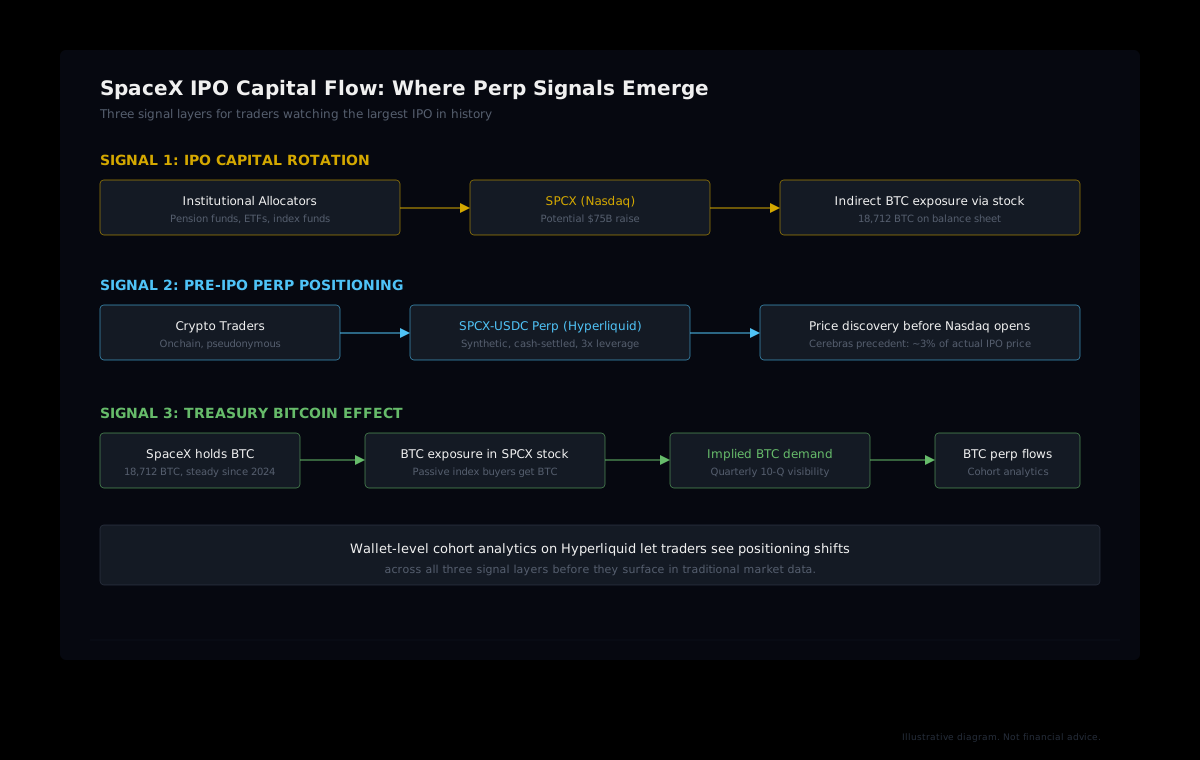
The SpaceX IPO sits at the intersection of three signal layers that perp traders can monitor independently or together.
1. Capital rotation pressure
SpaceX is reportedly seeking to raise roughly $75 billion at a valuation of about $1.75 trillion in what could be the largest IPO in history. Capital that flows into SPCX stock has to come from somewhere. Traditional market analysts have flagged concerns that an IPO of this magnitude could siphon attention and allocation away from other risk assets, including Bitcoin and crypto. Whether that rotation is real or overstated, perp traders should watch BTC funding rates and open interest shifts around the June pricing window.
2. SPCX perp positioning as a sentiment gauge
The SPCX-USDC contract on Hyperliquid is pricing SpaceX's valuation in real time, with no market hours or settlement delays. Funding rates on this contract reveal whether traders are collectively bullish or bearish on the IPO outcome. If SPCX funding goes deeply positive, it signals aggressive long positioning, which means traders are pricing in a valuation well above the $1.75 trillion target. Negative funding would suggest skepticism about the headline valuation.
Because every trade on Hyperliquid settles onchain, the positioning data is transparent. Our data classifies wallets into 16 behavioral cohorts: 8 by position size (Shrimp through Leviathan) and 8 by all-time PnL (Money Printer through Giga-Rekt). If large-wallet cohorts are building SPCX positions while smaller cohorts are short, that divergence is itself a signal.
3. The BTC treasury "Trojan Horse" effect
This is the less obvious signal. When SpaceX lists, every index fund and ETF that adds SPCX to its holdings is passively acquiring exposure to 18,712 BTC on the company's balance sheet. Pension funds allocating to the Nasdaq 100 will own indirect Bitcoin exposure whether they intended to or not. Treasury-strategy analysts have noted this creates a potential structural demand floor for BTC, because index rebalancing forces continuous allocation toward companies that hold it.
For perp traders, the practical implication is that quarterly 10-Q filing dates become BTC volatility catalysts. If SpaceX reports accumulating more Bitcoin, the market will price that in immediately. If they sell, same thing. Either way, those filings create tradeable events visible weeks ahead of traditional fund rebalancing.
Where the Exchanges Are Lining Up
Hyperliquid is not alone in offering SpaceX pre-IPO exposure. Binance launched its own SpaceX pre-IPO perpetual contract on May 21, while OKX and Crypto.com have listed similar products. But the Hyperliquid listing is structurally different because it runs on a fully onchain order book where every position, every fill, and every liquidation is visible.
That transparency matters for analytics. On centralized exchanges, you see aggregate open interest and funding rates. On Hyperliquid, you see which wallets are taking which side of the trade, and those wallets are classifiable by size and historical performance. The same cohort analytics that track BTC and ETH positioning apply to SPCX, because the infrastructure is the same L1 blockchain.
The IPO Timeline and Key Dates
SpaceX is targeting June 11 for IPO pricing on Nasdaq, with trading expected to begin around June 12. The roadshow kicks off the week of June 8. SpaceX generated $18.7 billion in revenue in 2025, up from $14 billion in 2024.
For perp traders, the actionable dates are clear: the SPCX perp is trading now, BTC positioning will likely shift as the June 11 pricing approaches, and the first quarterly 10-Q after listing (likely in late July or August) will be the first public disclosure of whether SpaceX has changed its Bitcoin position.
Reading Corporate Treasuries Through the Perp Lens
SpaceX's S-1 did more than reveal a Bitcoin treasury. It exposed a gap between what onchain trackers could see and what was actually there. For any trader who relies on wallet-level analytics, that gap is a reminder that attribution models have limits, and that regulatory filings can produce data points the blockchain cannot.
Meanwhile, synthetic pre-IPO perps are proving that price discovery does not need to wait for a stock exchange to open. Hyperliquid traders were pricing SpaceX's valuation three days before the S-1 landed, and the Cerebras precedent suggests that pricing was reasonably accurate.
The convergence of these two trends (corporate BTC disclosure through SEC filings and synthetic equity perps on DeFi rails) creates a new class of tradeable signals. The traders who will capture them are the ones watching wallet-level positioning data as it happens, because by the time it shows up in a quarterly report, the trade is already crowded.
Track Wallet-Level Positioning with HyperTracker
Our API classifies every wallet on Hyperliquid into 16 behavioral cohorts, updated every 5 minutes. See how Money Printers, Leviathans, and every other cohort are positioning across BTC, ETH, SPCX, and every other perp on the platform. Plans start at $179/mo.