
Your Trading Bot's Biggest Bottleneck Is the API Layer
By CMM Team - 05-Jul-2026
Your Trading Bot's Biggest Bottleneck Is the API Layer
You spend weeks refining a signal engine. Cohort divergence, liquidation risk scoring, funding rate extremes. The backtest looks sharp. Then you deploy the bot, and within 48 hours it misses three trades because the data polling loop hit a rate limit and silently returned stale data for twenty minutes. The signal was fine. The architecture around it was not.
This is the most common failure pattern in Hyperliquid trading bots, and it has almost nothing to do with alpha generation. The data ingestion layer, the part that connects your bot to the market through API calls, is where most bots break down. Redundant polling, wasteful endpoint selection, no caching, no backoff, no awareness of when data actually refreshes. Builders optimize the signal and treat the API layer as plumbing. But plumbing that leaks will ruin the house, regardless of how good the blueprint looks.
This guide is about designing that layer correctly from the start, specifically for bots consuming HyperTracker's analytics API on Hyperliquid.
Why the data layer matters more than the signal
A signal engine is a pure function. Same inputs, same outputs, every time. If you feed it clean data on a reliable cadence, it produces clean decisions. If you feed it stale data, duplicated data, or data shaped differently than expected because an endpoint errored and your code swallowed the exception, the signal engine cannot recover. It will produce confident-looking decisions based on information that no longer reflects market state.
The data layer sits between your bot and every piece of market intelligence it acts on. On Hyperliquid, our data refreshes on rolling intervals: state snapshots every 15 to 20 minutes and order flow snapshots on 5-minute windows. That means your polling cadence, caching logic, and error handling need to be designed around those specific refresh rhythms. Polling faster than the data refreshes wastes your request quota. Polling slower means you miss signal windows.
Matching your polling cadence to the data refresh
The single most wasteful thing a bot can do is poll an endpoint faster than the underlying data changes. If cohort metrics refresh every 15 to 20 minutes and your bot polls every 60 seconds, fifteen of those sixteen calls return identical data. You burn quota, add latency to your event loop, and gain nothing.
The refresh schedule to design around
HyperTracker's API has different refresh cadences depending on the endpoint category:
| Endpoint category | Refresh cadence | Recommended poll interval |
| --- | --- | --- |
| Cohort metrics (/cohort-metrics) | ~15-20 min | Every 5 min (catches updates promptly) |
| Order flow snapshots (/orders) | Rolling 5-min windows | Every 5 min (aligned to window) |
| Liquidation risk (/liq-risk) | ~15-20 min | Every 5 min |
| Position metrics (/position-metrics) | ~15-20 min | Every 5 min |
| Leaderboards (/leaderboard) | ~15-20 min | Every 15-30 min (less time-sensitive) |
The recommended poll interval of 5 minutes for most endpoints is a balance. You want to catch fresh data promptly after it updates, but you do not know the exact second it will refresh within the 15-to-20-minute window. Polling every 5 minutes means you will pick up a new snapshot within 5 minutes of it being available, which is fast enough for strategies operating on 1-hour or longer timeframes.
Designing the request budget
Every API tier has a monthly request cap and a per-minute rate limit. Your bot's architecture needs to respect both, and the constraints are different depending on which tier you are on.
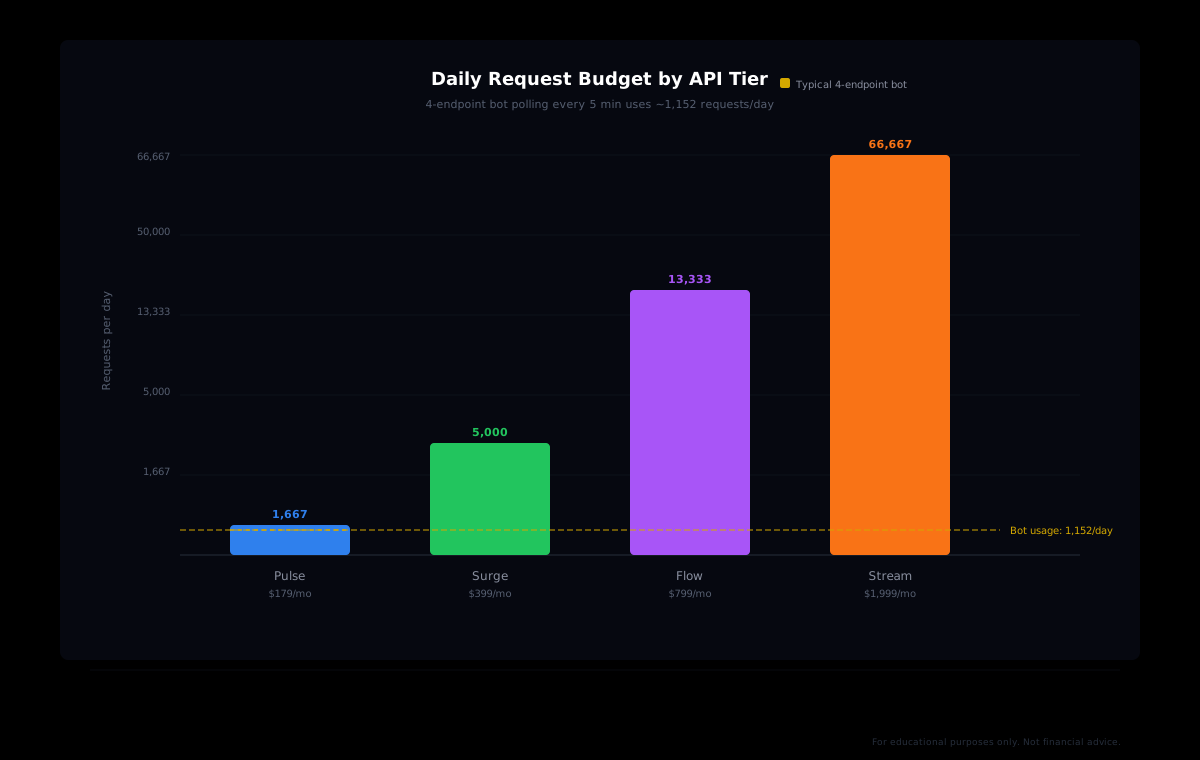
| Tier | Monthly requests | Rate limit | Effective budget per day | | --- | --- | --- | --- | | Pulse ($179/mo) | 50,000 | 60/min | ~1,667 requests | | Surge ($399/mo) | 150,000 | 100/min | ~5,000 requests | | Flow ($799/mo) | 400,000 | 200/min | ~13,333 requests | | Stream ($1,999/mo) | 2,000,000 | 500/min | ~66,667 requests |
A bot on the Pulse tier polling 4 endpoints every 5 minutes uses 4 x 288 = 1,152 requests per day. That leaves 515 requests for ad-hoc queries, backfills, or a second polling loop for additional assets. There is breathing room, but it gets tight if you add more endpoints or more assets without planning.
On the Surge tier, the same 4-endpoint, 5-minute loop uses the same 1,152 requests but your daily budget is ~5,000, so you could monitor multiple assets or add a second faster loop for order flow on your primary asset. The point is: model the budget before you write the polling code, because retrofitting rate-limit awareness into a bot that was built without it is painful.
The request budget spreadsheet pattern
Before writing any polling code, sketch a table like this:
Endpoint           | Assets | Interval | Calls/day
-------------------+--------+----------+----------
/cohort-metrics    |   3    |  5 min   |    864
/orders            |   1    |  5 min   |    288
/liq-risk          |   3    |  5 min   |    864
/position-metrics  |   1    | 15 min   |     96
-------------------+--------+----------+----------
Total              |        |          |  2,112
Budget (Pulse)     |        |          |  1,667   <- OVER

Fix: move /liq-risk to 15-min interval:
/liq-risk          |   3    | 15 min   |    288
New total          |        |          |  1,536   <- OK
This is a simple arithmetic exercise, but most builders skip it and discover they are over budget when the bot starts returning 429 errors in production. Model it first, build second.
Caching: the layer most bots skip
Your bot should maintain a local data store (even a simple dictionary in memory) that holds the most recent response from every endpoint it polls. This serves three purposes.
First, deduplication. If you poll /cohort-metrics every 5 minutes but the data only refreshes every 15 to 20 minutes, three out of four polls will return identical data. Your cache should compare the incoming response to the stored version and only propagate to the signal engine if something actually changed. This prevents your bot from re-evaluating signals on stale data and generating redundant log noise.
Second, staleness detection. Attach a timestamp to every cache entry. If the cache for a given endpoint has not been updated for longer than twice the expected refresh interval (for example, 40 minutes for a 20-minute refresh), something is wrong. Either the API is down, your network is flaky, or your bot's event loop is stuck. A staleness alert triggers investigation before the bot trades on data that might be an hour old.
Third, graceful degradation. If a poll fails (network error, 500, rate limit), the cache still holds the previous good response. Your bot can continue operating on that data with an explicit awareness that it is operating on stale information. That awareness matters: a bot trading on knowingly stale data can reduce position sizes or widen stops. A bot that does not know its data is stale cannot adapt.
class DataCache:
    def __init__(self, stale_threshold_seconds=2400):
        self.store = {}
        self.stale_threshold = stale_threshold_seconds

    def update(self, endpoint, data):
        prev = self.store.get(endpoint)
        changed = prev is None or prev["data"] != data
        self.store[endpoint] = {
            "data": data,
            "fetched_at": time.time(),
            "changed": changed,
        }
        return changed

    def get(self, endpoint):
        entry = self.store.get(endpoint)
        if entry is None:
            return None, True  # no data, considered stale
        age = time.time() - entry["fetched_at"]
        return entry["data"], age > self.stale_threshold

    def is_stale(self, endpoint):
        _, stale = self.get(endpoint)
        return stale
Error handling and backoff
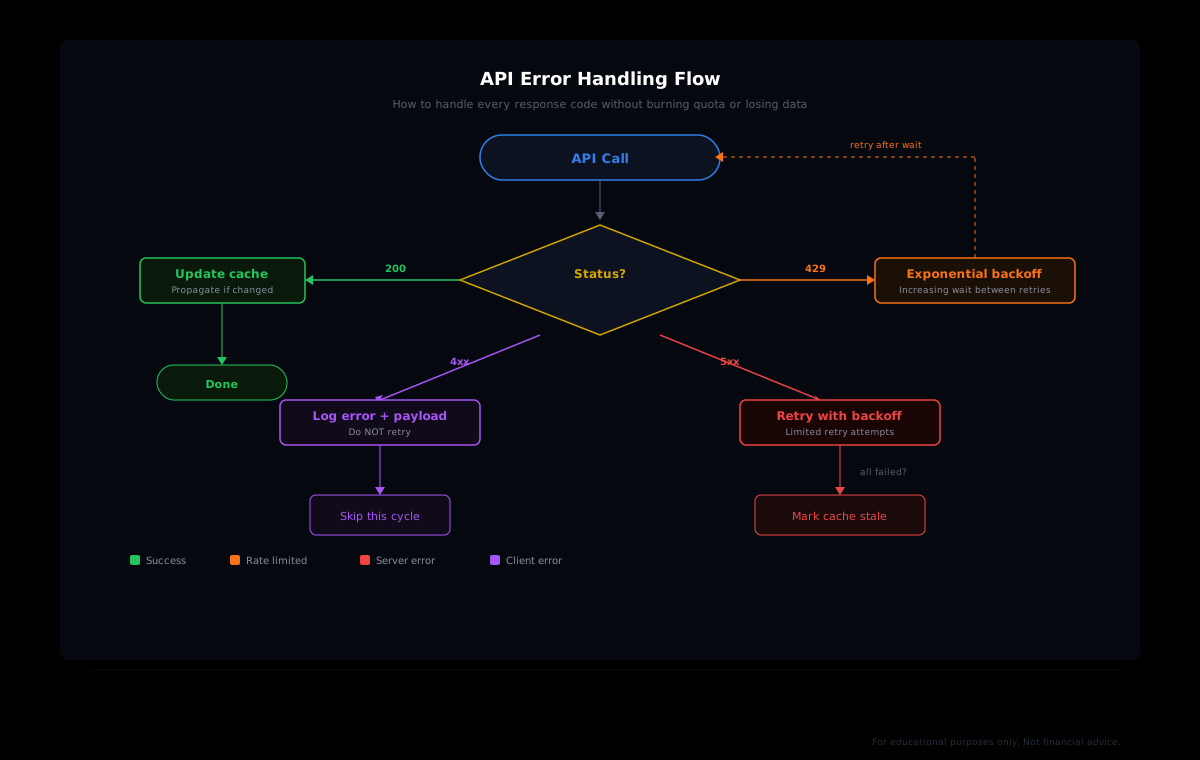
API calls fail. Networks drop. Rate limits get hit. The question is whether your bot handles these failures gracefully or crashes, retries aggressively (burning more quota), or worse, silently proceeds with no data.
The three failure modes
Rate limit (HTTP 429). The API is telling you to slow down. The correct response is exponential backoff: wait 1 second, then 2, then 4, then 8, capping at 60 seconds. Do not retry immediately. Do not retry on a fixed 1-second interval. Each immediate retry when you are already rate-limited digs the hole deeper.
Server error (HTTP 5xx). Something went wrong on the API side. Retry with backoff, up to 3 attempts. If all 3 fail, log the error, mark the cache entry as potentially stale, and move on. Do not block your entire event loop waiting for recovery.
Client error (HTTP 4xx, not 429). Your request is malformed. Retrying will not help. Log the error with the full request payload for debugging, and skip this poll cycle.
async def poll_with_backoff(endpoint, params, max_retries=3):
    for attempt in range(max_retries):
        try:
            response = await fetch(endpoint, params)
            if response.status == 200:
                return response.json()
            elif response.status == 429:
                wait = min(2 ** attempt, 60)
                logger.warning(f"Rate limited on {endpoint}, waiting {wait}s")
                await asyncio.sleep(wait)
            elif response.status >= 500:
                wait = min(2 ** attempt, 30)
                logger.warning(f"Server error {response.status} on {endpoint}")
                await asyncio.sleep(wait)
            else:
                logger.error(f"Client error {response.status} on {endpoint}")
                return None
        except NetworkError as e:
            logger.error(f"Network error on {endpoint}: {e}")
            await asyncio.sleep(min(2 ** attempt, 30))
    logger.error(f"All retries exhausted for {endpoint}")
    return None
Endpoint selection: fetch what you need
HyperTracker exposes 21 endpoints. Your bot probably needs 3 to 5 of them. One of the biggest budget wasters is polling endpoints "just in case" when your signal engine does not actually consume that data.
Start from the signal, not the API. Ask: what data does my signal function require as input? If it uses cohort positioning, poll /cohort-metrics. If it uses liquidation risk, poll /liq-risk. If it does not use leaderboard data, do not poll /leaderboard. Every endpoint you add to the polling loop costs you daily request budget and adds a potential failure point.
Common signal-to-endpoint mappings
| Signal type | Required endpoint(s) | Optional enrichment |
| --- | --- | --- |
| Cohort divergence | /cohort-metrics | /position-metrics (OI context) |
| Liquidation risk fading | /liq-risk | /cohort-metrics (directional confirmation) |
| Order flow imbalance | /orders | /cohort-metrics (who is driving the flow) |
| Funding rate extreme | Hyperliquid native API | /cohort-metrics (smart money stance) |
| Copy trading / wallet following | /positions | /leaderboard (target wallet selection) |
Notice that /cohort-metrics appears in almost every signal type as either the primary or the enrichment source. If you are building around cohort intelligence, this is your workhorse endpoint. Our data classifies every Hyperliquid wallet into one of 16 behavioral cohorts (8 by account size, 8 by all-time PnL), and the cohort-level aggregate is where the signal density lives.
Structuring the polling loop
The polling loop is the heartbeat of your bot. Get it right and the system runs smoothly for weeks. Get it wrong and you will be debugging race conditions and missed polls at 3 AM.
The staggered interval pattern
Do not fire all your endpoint polls at the same second. If you are polling 4 endpoints on a 5-minute cadence, stagger them across the interval. Poll /cohort-metrics at t+0, /orders at t+75s, /liq-risk at t+150s, /position-metrics at t+225s. This smooths out your request rate and avoids bursts that could trigger the per-minute rate limit.
POLL_SCHEDULE = [
    {"endpoint": "/cohort-metrics", "offset_sec": 0,   "interval_sec": 300},
    {"endpoint": "/orders",         "offset_sec": 75,  "interval_sec": 300},
    {"endpoint": "/liq-risk",       "offset_sec": 150, "interval_sec": 300},
    {"endpoint": "/position-metrics","offset_sec": 225, "interval_sec": 900},
]

async def run_polling_loop(cache, signal_engine):
    while True:
        now = time.time()
        for task in POLL_SCHEDULE:
            elapsed = (now - start_time) % task["interval_sec"]
            if abs(elapsed - task["offset_sec"]) < 2:
                data = await poll_with_backoff(task["endpoint"], params)
                if data and cache.update(task["endpoint"], data):
                    signal_engine.evaluate(cache)
        await asyncio.sleep(1)
The key detail: the signal engine only gets called when the cache detects a genuine data change. No redundant evaluations, no wasted compute, and every decision your bot makes is based on fresh information.
Webhook and WebSocket alternatives
On the Flow ($799/mo) and Stream ($1,999/mo) tiers, HyperTracker supports webhooks and WebSocket connections. These invert the polling model entirely: instead of your bot asking for data on a timer, the API pushes data to your bot when it changes.
Webhooks eliminate the entire polling loop for the endpoints they cover. You register a callback URL, and when cohort metrics update, your bot receives a POST with the new data. No polling, no wasted requests, no staleness windows.
WebSocket connections (Stream tier) provide a persistent channel for continuous updates. If you are building a high-frequency system that needs to react within seconds of a data refresh, the WebSocket path removes the latency of periodic polling entirely.
But for most builders starting out, the polling pattern described above is the right foundation. Webhooks and WebSockets are optimizations you graduate into once your bot's strategy is proven and you need lower latency or higher throughput.
Putting it together: a reference architecture
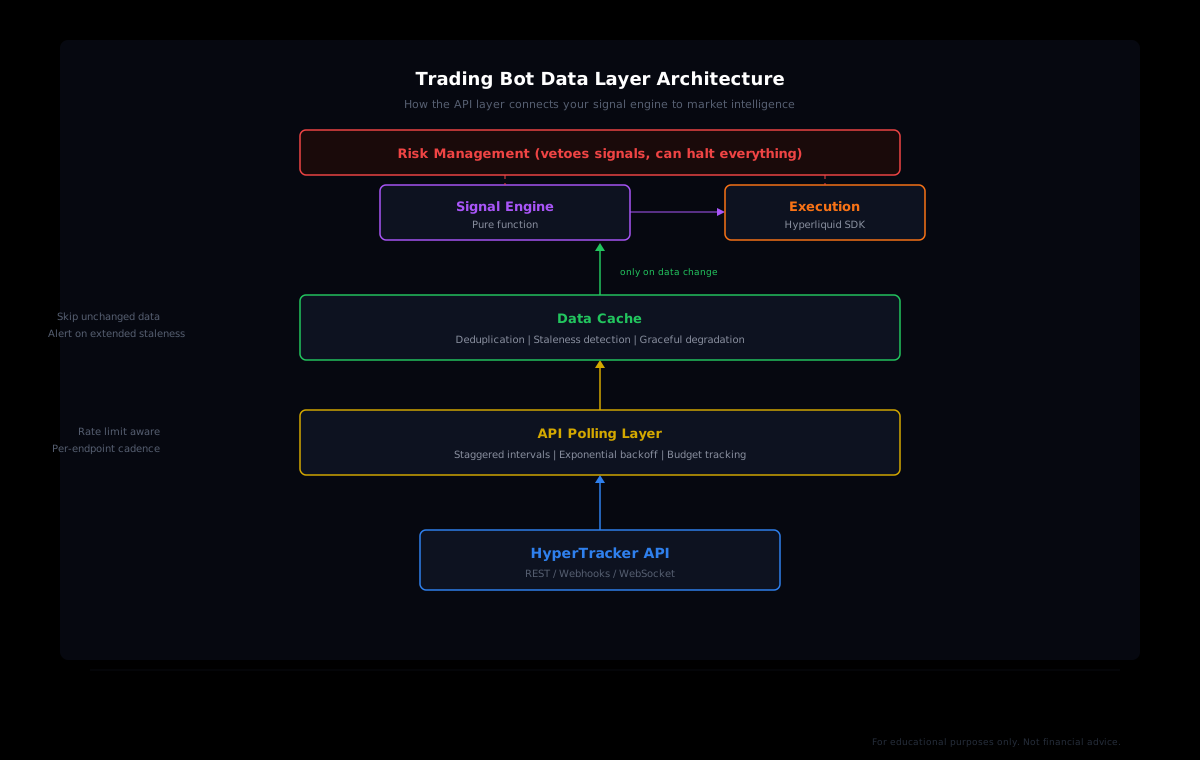
Here is the full stack for a well-designed Hyperliquid trading bot, from API to execution:
+----------------------------------------------------------+
|                    RISK MANAGEMENT                        |
|  (vetoes signals, enforces position limits, can halt)     |
+----------------------------------------------------------+
        |                                    ^
        v                                    |
+------------------+   +------------------+  |
|   SIGNAL ENGINE  |-->|   EXECUTION      |--+
|  (pure function) |   |  (Hyperliquid    |
|                  |   |   Python SDK)    |
+------------------+   +------------------+
        ^
        |  (only on cache change)
+----------------------------------------------------------+
|                    DATA CACHE                             |
|  - deduplication (skip unchanged responses)               |
|  - staleness detection (alert if data > 2x refresh age)   |
|  - graceful degradation (serve last-known-good on error)  |
+----------------------------------------------------------+
        ^
        |  (staggered polling with backoff)
+----------------------------------------------------------+
|                  API POLLING LAYER                         |
|  - staggered intervals per endpoint                       |
|  - exponential backoff on 429/5xx                         |
|  - request budget tracking (daily + per-minute)           |
|  - endpoint selection based on signal requirements        |
+----------------------------------------------------------+
        |
        v
   HyperTracker API
   (REST / Webhooks / WebSocket)
Each layer has a single responsibility. The polling layer handles API communication and error recovery. The cache layer handles data freshness and deduplication. The signal engine handles decision-making. The execution layer handles order management. And risk management sits above everything, with the authority to block any action from any layer.
The data flows up through the stack, and each layer adds a specific guarantee. By the time a signal reaches the execution layer, you know the data is fresh, the signal was evaluated on changed (not repeated) inputs, and the risk layer approved the trade. That is a bot you can leave running overnight.
Build your bot on pre-computed intelligence
HyperTracker's API gives you cohort analytics, liquidation risk scoring, order flow snapshots, and position metrics across all of Hyperliquid. 16 behavioral cohorts, every wallet classified, delivered via REST, webhooks, or WebSocket. Start with the free tier and scale up as your bot matures.
Common mistakes (and how to avoid them)
Polling all endpoints at the same frequency. Leaderboard data does not change as fast as order flow snapshots. Match each endpoint's poll interval to its refresh cadence and your signal's sensitivity to that data. Not every endpoint needs the 5-minute treatment.
Ignoring the monthly cap until it is too late. A bot that runs fine for three weeks and then exhausts its monthly quota in week four is worse than one that is slightly slower but runs all month. Track cumulative requests daily and alert yourself at a threshold (for example, when you have used more than your proportional share of the monthly budget for the day of the month you are on).
Swallowing errors silently. The worst version of this: a try/except block that catches every exception and returns None, which then gets passed to the signal engine as "no data." Your signal engine interprets "no data" differently than "the data says nothing interesting is happening." Distinguish between "API returned empty results" (valid) and "API call failed" (error). They are different states.
Fetching historical data in the hot loop. HyperTracker has historical data going back months for positions and fills. That data is for backtesting and research, and it should be fetched once, stored locally, and never re-fetched in your live polling loop. Historical endpoints have the same rate limits as real-time endpoints, so fetching them repeatedly eats into your budget for no reason.
Building the signal first and the data layer last. The signal is the fun part. Cohort divergence scoring, composite signals, threshold tuning. But if you build the signal without knowing how many API calls you can afford, how often the data refreshes, or how errors propagate, you will retrofit the data layer around constraints you should have designed for from the start. Build the plumbing first. Test it with logging-only (no trading) for a few days. Then plug in the signal.
The takeaway
Your signal is the alpha. Your API layer is the infrastructure that delivers that alpha reliably, day after day, without burning through your request budget or silently degrading. The builders who get this right build bots that run for months. The ones who treat the data layer as an afterthought spend more time debugging infrastructure than improving their edge.
Model your request budget before you write code. Cache aggressively. Handle errors explicitly. Poll at the cadence the data actually refreshes, and stagger your requests so you never burst. Do those five things and the API layer becomes invisible, which is exactly what good infrastructure should be.