CEXes Are Shipping AI Agents. Here's What Perp DEX Builders Should Steal.
By CMM Team - 11-Jul-2026
CEXes Are Shipping AI Agents. Here's What Perp DEX Builders Should Steal.
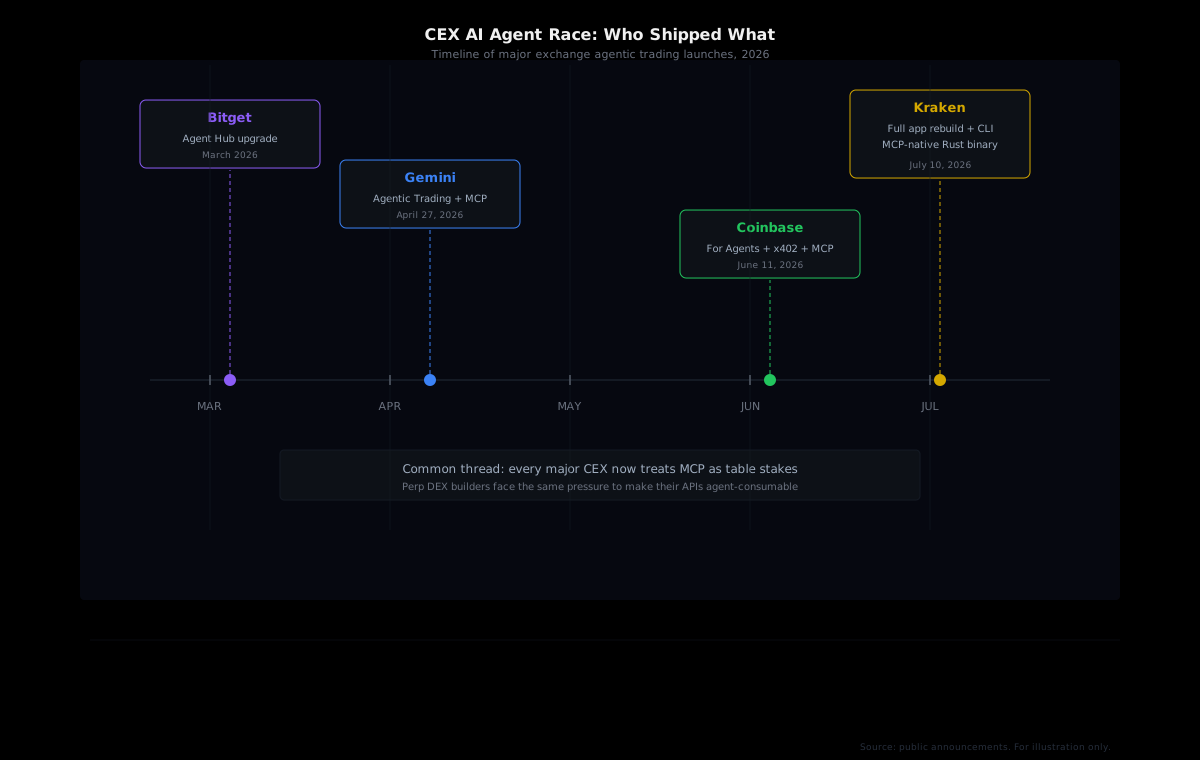
On July 10, Kraken announced it was rebuilding its entire mobile app around AI agents. Not bolting a chatbot onto the sidebar. Rebuilding the whole thing. The AI evaluates your risk preferences at signup, surfaces trade ideas in real time, and executes with your approval.
Kraken is the last of the big three to move. Gemini launched its Agentic Trading feature on April 27, giving MCP-compatible models like Claude and ChatGPT direct API access to place trades. Coinbase followed on June 11 with Coinbase for Agents, a platform that lets AI assistants trade crypto, move funds, and pay for research through its x402 protocol. Bitget upgraded its Agent Hub back in March.
Every major centralized exchange now treats AI agent support as infrastructure, the same way they treated mobile apps a decade ago. That matters for builders on Hyperliquid and other perp DEXes, because the features CEXes are shipping tell you exactly what agents need to trade effectively. And some of those features are easier to build on-chain than off.
The CEX Playbook: MCP, Paper Trading, and Structured Output
Strip away the marketing language and three patterns emerge from the CEX launches.
MCP as the interface standard. Gemini, Coinbase, and Kraken all adopted the Model Context Protocol as their agent gateway. MCP gives AI models a standardized way to discover and call exchange functions, the same way a browser discovers and renders web pages. Kraken's CLI is written entirely in Rust as a zero-dependency binary, which means an agent can run it locally without installing SDKs, managing dependencies, or handling API authentication boilerplate. The agent focuses on trading logic. The CLI handles connectivity.
Paper trading as an agent sandbox. Kraken's CLI ships with a local paper trading engine that simulates balances, executes limit and market orders against live tickers, and calculates unrealized PnL entirely offline. This is important because AI agents make mistakes. Giving them a sandbox where they can test strategies against live prices without risking capital is table stakes for adoption. Coinbase took a different approach with its walled-off agent sandbox, where an agent can operate inside an isolated account with spending caps set by the user.
Machine-readable output. Kraken's CLI returns clean NDJSON that can be piped into jq or fed back into an LLM's context window. This is a small detail that matters a lot. LLMs consume tokens. Every unnecessary HTML tag, every verbose error message, every inconsistent field name in an API response burns context window space that could be used for reasoning. CEXes are optimizing their outputs for machines, because machines are now their users.
Why This Matters for Perp DEX Builders
Here is the uncomfortable truth for the Hyperliquid ecosystem: if a builder can point Claude at Kraken's CLI and start paper trading perpetual futures in five minutes, the bar for what Hyperliquid builders need to ship just went up.
The good news is that perp DEXes have structural advantages CEXes can never match. Every trade on Hyperliquid settles on-chain. Every position is verifiable. There are no withdrawal delays, no KYC gates for agent wallets, no custody risk. An AI agent running on Hyperliquid controls its own keys and can prove every fill.
But infrastructure convenience is where CEXes are pulling ahead. Kraken's CDO Kamo Asatryan framed the goal clearly: "AI is going to help everyday people respond to market conditions the way our most active traders respond." He is describing the democratization of professional tooling. And right now, the tooling gap between CEX agent infrastructure and DEX agent infrastructure is real.
The Intelligence Layer: Where DEXes Can Leapfrog
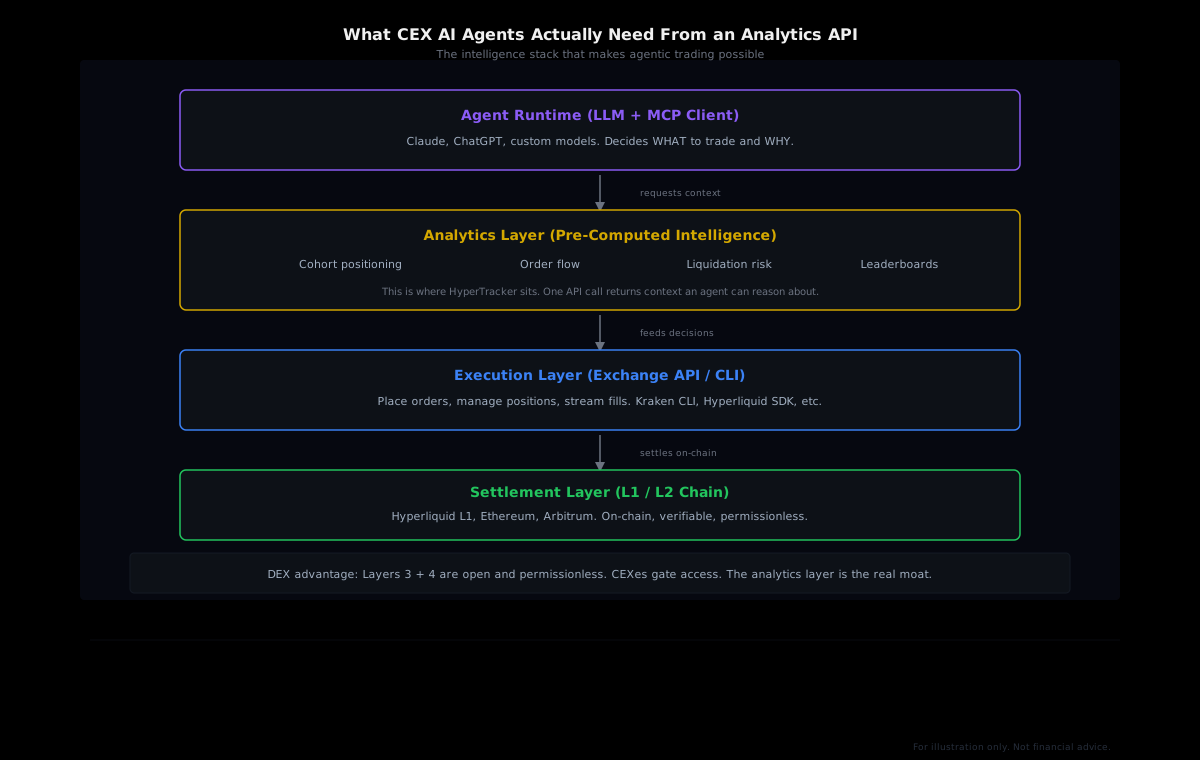
Look at the architecture stack that makes agentic trading work. At the top, you have the LLM runtime: Claude, ChatGPT, or a custom model deciding what to trade. At the bottom, you have the settlement layer: the blockchain where trades finalize. In between sit two layers: execution (placing orders, managing positions) and analytics (understanding what the market is doing before you trade).
CEXes are good at execution. Their APIs are mature, rate limits are documented, and latency is low. But their analytics are a black box. Kraken can tell you the price of ETH and your account balance. It cannot tell you what the profitable wallets on the platform are doing right now, because that data is proprietary and siloed.
On-chain perp DEXes flip that dynamic. On Hyperliquid, every wallet's position history is public. Which means you can classify every trader by size and track record, compute cohort-level signals (what are the profitable wallets doing on aggregate?), and deliver that intelligence to an AI agent through an API.
That is exactly what HyperTracker does. Our API classifies every Hyperliquid wallet into one of 16 behavioral cohorts: eight by perp equity size (Shrimp through Leviathan) and eight by all-time PnL (Money Printer through Giga-Rekt). When an AI agent asks "should I go long on ETH?", the difference between a good answer and a bad answer is context. Cohort positioning, order flow shifts, and liquidation risk data transform a coin flip into an informed decision.
Stealing From the CEX Playbook: A Builder Checklist
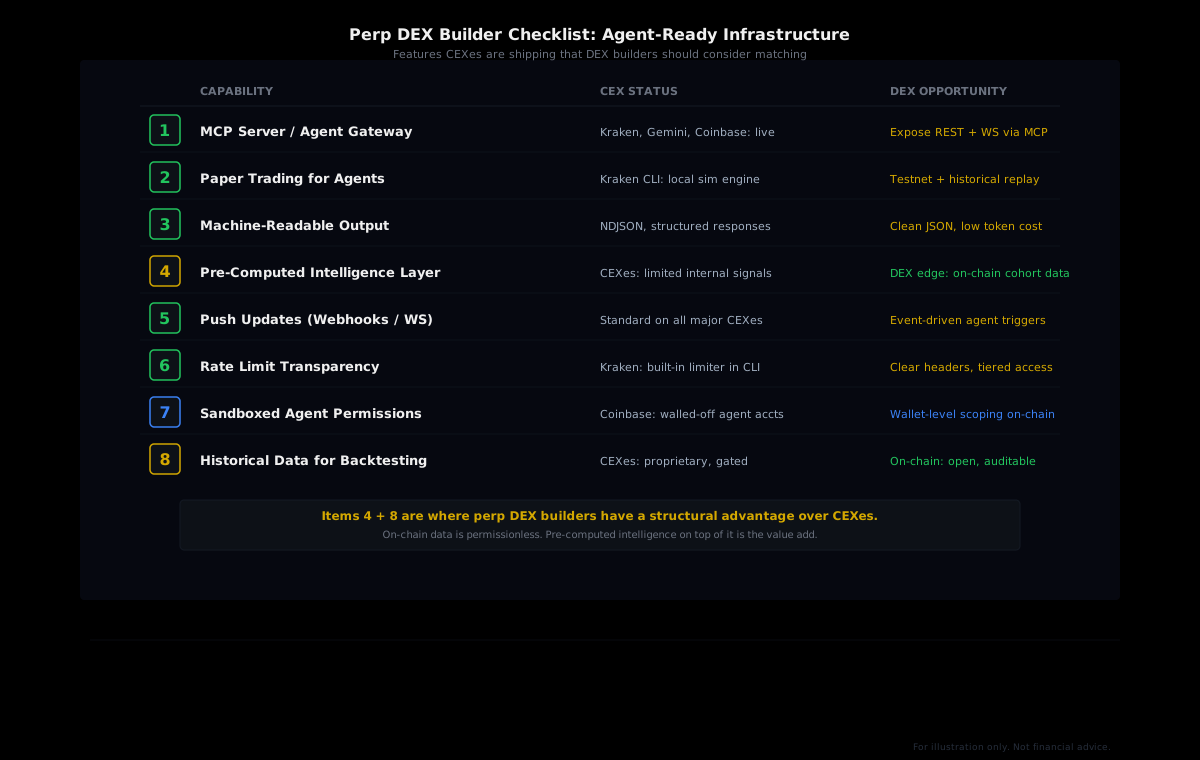
If you are building on Hyperliquid and want your product to be agent-ready, here is what the CEX launches tell you to prioritize.
1. Expose Your API via MCP
MCP is becoming the USB-C of AI agent connectivity. Every major CEX supports it. If your Hyperliquid trading tool or analytics dashboard does not have an MCP server, agents cannot discover your capabilities. The protocol is open, the spec is public, and wrapping an existing REST API takes a weekend.
2. Build a Paper Trading Mode
Agents need to iterate fast without risking capital. Kraken's local simulation engine is the gold standard here: it tracks simulated balances, executes against live tickers, and runs entirely offline. For DEX builders, the equivalent is a testnet integration or a historical replay engine that lets agents backtest strategies against real on-chain data.
3. Optimize for Token Efficiency
Every byte you send to an LLM costs tokens. Clean JSON responses, consistent field names, and compact error messages are competitive advantages when your API consumer is a language model with a finite context window. Strip HTML, remove verbose descriptions, return only what the agent needs to reason.
4. Feed Agents Pre-Computed Intelligence
Raw price feeds are not enough. Agents need answers to questions like "are the profitable traders accumulating or distributing?" and "where are the liquidation clusters?" Pre-computed analytics, cohort signals, and order flow summaries reduce the reasoning burden on the LLM, which means faster decisions and fewer hallucinations.
5. Push Updates Instead of Forcing Polls
Polling burns rate limits and adds latency. Webhooks and WebSocket connections let agents react to market events the moment they happen. If a Leviathan wallet opens a large position, the agent should know within seconds.
The On-Chain Advantage Agents Actually Care About
There is a structural reason AI agents will eventually prefer on-chain perp DEXes over CEXes, and it has nothing to do with decentralization ideology.
Agents need verifiable data. When an AI agent on Kraken gets a fill confirmation, it trusts Kraken's internal systems. When an AI agent on Hyperliquid gets a fill confirmation, it can verify the settlement on-chain. For agents managing capital autonomously, verifiability is a safety mechanism. It is the difference between "the exchange said my trade filled" and "I can cryptographically prove my trade filled."
Coinbase recognized this tension. Its x402 protocol uses EIP-3009 permit-style cryptography for payment authorization, settling agent transactions on-chain through USDC. Even the biggest CEX in North America is routing agent payments through on-chain rails because agents demand settlement guarantees that centralized databases cannot provide.
For Hyperliquid builders, this is a tailwind. Your execution layer is already on-chain. Your trade data is already public. The missing piece is the intelligence layer that sits between the raw chain data and the agent's decision-making process.
What Comes Next
The agentic trading wave is moving fast. Within six months, every major exchange shipped agent support. The competitive frontier is now shifting from "can agents access my exchange?" to "can agents trade intelligently on my exchange?"
That second question is where perp DEX builders have an opening. CEXes will always have proprietary data they refuse to share. On-chain DEXes generate open data by default. The value add is turning that open data into intelligence agents can act on: cohort signals, order flow analysis, liquidation risk scoring, and smart money tracking.
Kraken's Asatryan said the company wants to feel like talking to a "well-informed best friend." For perp DEX builders, the equivalent is making your agent the best-informed trader in the room. The edge comes from reading every wallet on the chain and knowing exactly which cohort is accumulating, which is distributing, and where the liquidation pressure is building.
Build Agent-Ready Analytics on Hyperliquid
HyperTracker's API gives your AI agent what CEX APIs cannot: pre-computed cohort intelligence across 16 behavioral segments, order flow snapshots, and liquidation risk scoring. One API call, full market context. Plans start at $179/mo.
CEXes shipped the playbook in six months. The chain gives you open data they will never have. The intelligence layer is up for grabs.