CoinEx Is Dead. Your Perp Positions Settle in 7 Days.
By CMM Team - 15-Sep-2026
CoinEx Is Dead. Your Perp Positions Settle in 7 Days.
CoinEx announced yesterday that it is shutting down. Nine years of operations, over. Futures markets moved to reduce-only mode this morning. If you hold open perp positions on CoinEx, you cannot add to them anymore. You can only close.
And if you don't close them yourself by September 22, the exchange will force-settle every remaining position at the index price. No negotiation, no extension, no exceptions.
This is the sixth centralized exchange to announce a shutdown in 2026, following AscendEX, BitMEX, BitMart, Bit.com, and ABFinance. The pattern is no longer anecdotal. Mid-tier centralized exchanges are dying, and the perp traders who relied on them are being forced to move. The question is where.
The full CoinEx shutdown timeline
CoinEx founder Haipo Yang broke it down bluntly: "Carrying unlimited risk for limited revenue is no longer a rational choice." The exchange cited a prolonged market downturn, contracting industry volume, and compliance costs that exceeded what the business could sustain.
Here's what happens and when:
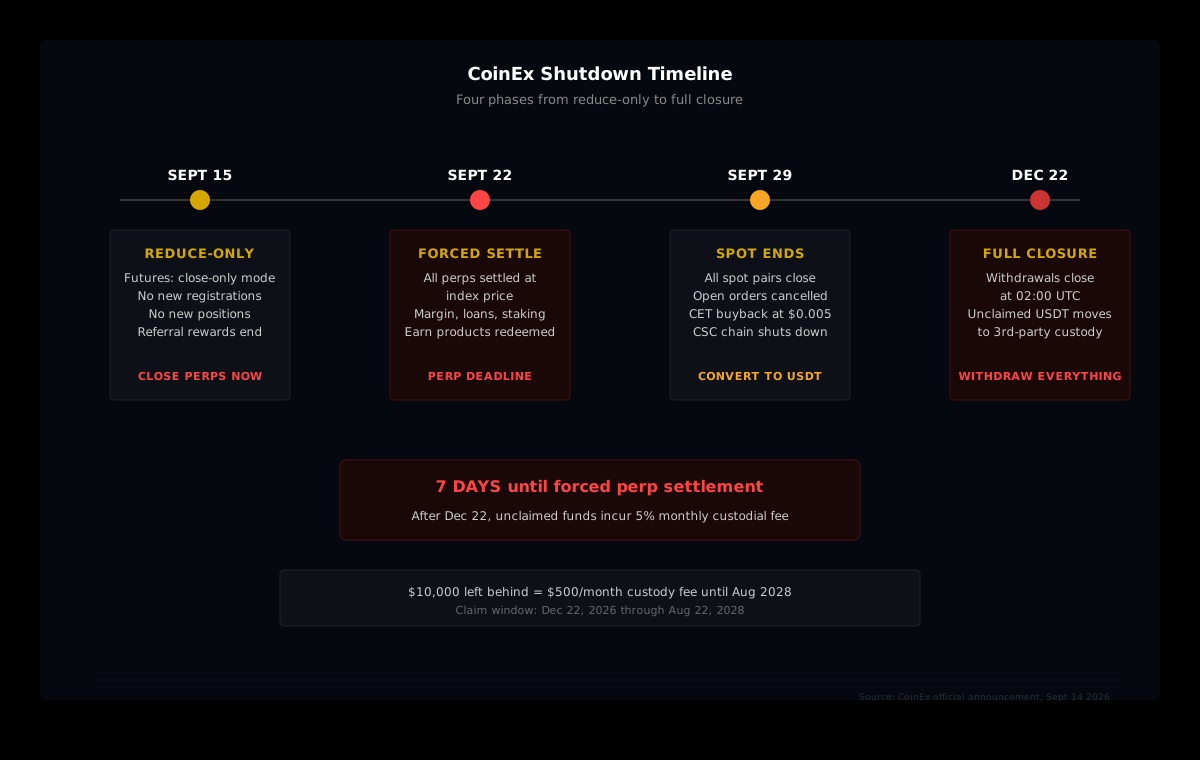
| Date | What Happens | Action Required | | --- | --- | --- | | Sept 15, 2026 | Futures move to reduce-only mode. No new registrations. Referral rewards end. | CLOSE PERPS NOW | | Sept 22, 2026 | All non-spot services cease. Open futures positions are forcibly settled at index price. Margin, loans, staking, and Earn products redeemed. | DEADLINE FOR PERPS | | Sept 29, 2026 | Spot trading ends. All open orders cancelled. CET tokens bought back at $0.005 per token. | CONVERT TO USDT | | Dec 22, 2026 | Withdrawal channels close permanently at 02:00 UTC. | FINAL WITHDRAWAL |
What "forced settlement at index price" actually means
This is the part most traders skim past. When CoinEx says positions will be "forcibly settled using the index price" on September 22, they mean every remaining perp position gets closed at whatever the index quotes at that moment. You have no control over your exit price. No stop loss, no limit order, no negotiation with the matching engine. Your position closes at the mark the exchange assigns.
For traders holding underwater positions, this is especially painful. You might have been planning to hold through a recovery. Instead, the exchange crystallizes your loss on a date it chose, at a price you didn't pick. If the index happens to wick against you in the settlement window, that's your execution.
Reduce-only mode adds another layer. Starting today, you can shrink or close existing positions but cannot open new ones or increase size. So if you want to hedge an existing position with a counter-trade on CoinEx, you can't. Your only option is to close outright or hedge elsewhere.
The practical move
Close your CoinEx perp positions now, while the order book still has liquidity. Don't wait until September 21 and compete with every other procrastinator for the remaining bids and asks. Early movers get cleaner fills.
CoinEx is not an isolated case
CoinEx's shutdown follows a brutal year for mid-tier centralized exchanges. The pattern started accelerating in mid-2026:
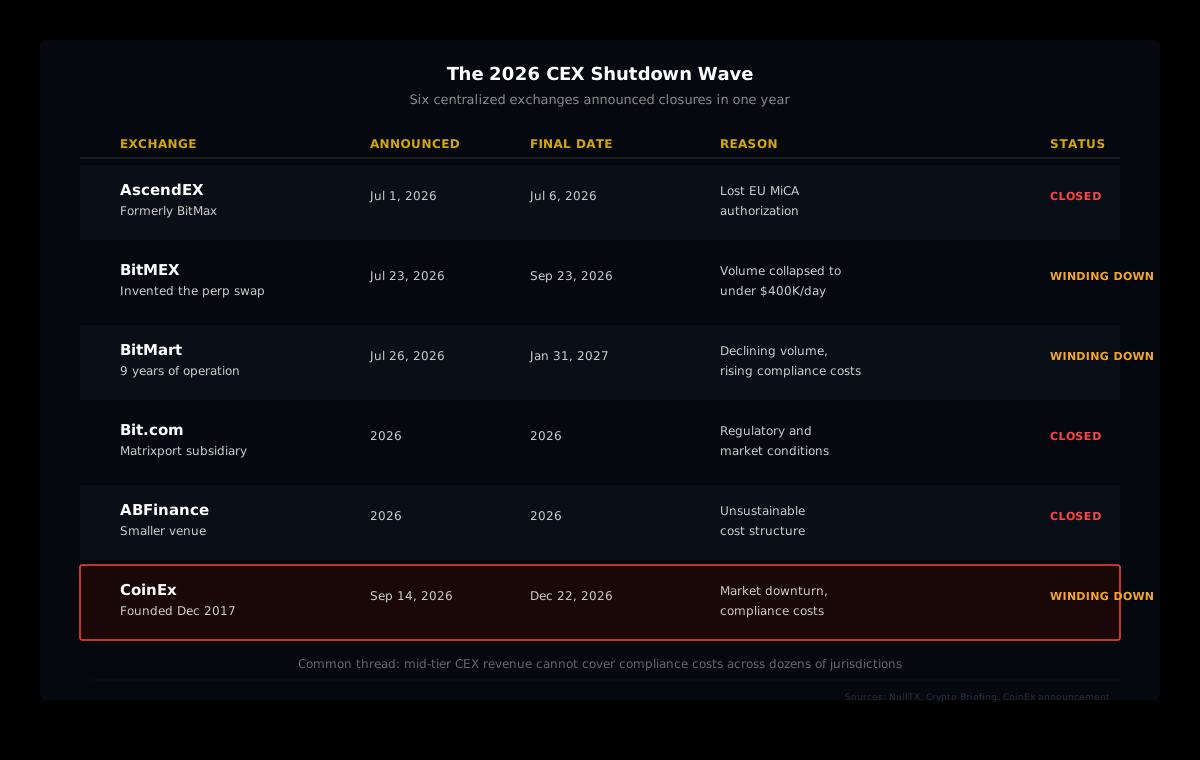
- AscendEX halted operations on July 1 after losing its EU MiCA authorization.
- BitMEX, the exchange that literally invented the perpetual swap, confirmed closure on July 23. An 11-year run ended because daily volume had collapsed to under $400,000, a rounding error compared to its former $8 billion peak.
- BitMart announced its wind-down on July 26, sending its BMX token down sharply.
- CoinEx now joins them, the sixth centralized exchange to fold in 2026 (counting Bit.com and ABFinance).
The common thread is not one bad quarter or one regulatory crackdown. These exchanges all hit the same structural wall: compliance costs kept climbing while trading volume kept draining toward larger venues and onchain alternatives. A mid-tier CEX needs enough volume to cover the cost of licenses, security audits, legal teams, and KYC infrastructure across dozens of jurisdictions. When volume dries up, that math breaks.
CoinEx's own numbers tell the story. The exchange was founded in December 2017 and survived the 2018 crash, the 2020 COVID dump, and the 2022 FTX implosion. But it also suffered a $54 million security breach in 2023 and paid over $1.7 million in a New York regulatory settlement. Those are survivable individually. Stacked on top of declining revenue, they become fatal.
Where traders are migrating
Every exchange shutdown forces the same question: where does the volume go? In 2022, when FTX collapsed, most of the displaced liquidity flowed to Binance and OKX. In 2026, the flow is splitting differently. A significant portion of perp volume is moving onchain.
Hyperliquid is the primary destination for that migration. The protocol has consistently processed the highest volume of any onchain perpetual futures venue throughout 2026, and its cumulative volume has made it the largest decentralized derivatives platform ever built by a wide margin. When BitMEX, the exchange that invented the perpetual swap, shuts down next week, there's a certain symmetry in its former users migrating to the protocol that made perp swaps fully onchain.
The appeal for refugees from shuttered CEXes is straightforward. Onchain perps eliminate the counterparty risk that just burned CoinEx, BitMEX, and AscendEX users. There is no central entity that can decide to shut down and force-settle your positions. The protocol runs on code, positions settle against the vault, and your margin stays in your own wallet until it's deployed.
The tradeoff is real
Onchain perps are not a free lunch. Gas fees matter. Execution latency is different from a colocated matching engine. Slippage on large orders can exceed what a top-tier CEX provides. And the learning curve for wallet management, bridging, and onchain execution is steeper than clicking "deposit" on a CEX.
But the counterargument writes itself: at least Hyperliquid won't send you a "we're shutting down, settle your positions in 7 days" email. Every position is transparent, onchain, and verifiable. No proof-of-reserves claims to trust, because the chain is the proof.
The CET token buyback trap
CoinEx will automatically buy back its native CET token at $0.005 per token on September 29. If you hold CET, this is your exit. The buyback price is fixed, so there's no market dynamics to game. Sell on the open market if you can get a better price before that date. Otherwise, the automatic buyback converts your CET to USDT at the fixed rate.
The broader lesson: exchange tokens are equity-adjacent instruments with zero legal protection. When the exchange dies, the token dies. CET, BMX, BitMEX's BMEX: all followed the same arc. The token works as a discount mechanism during good times and becomes worthless when the exchange closes.
Protecting your capital after a CEX shutdown
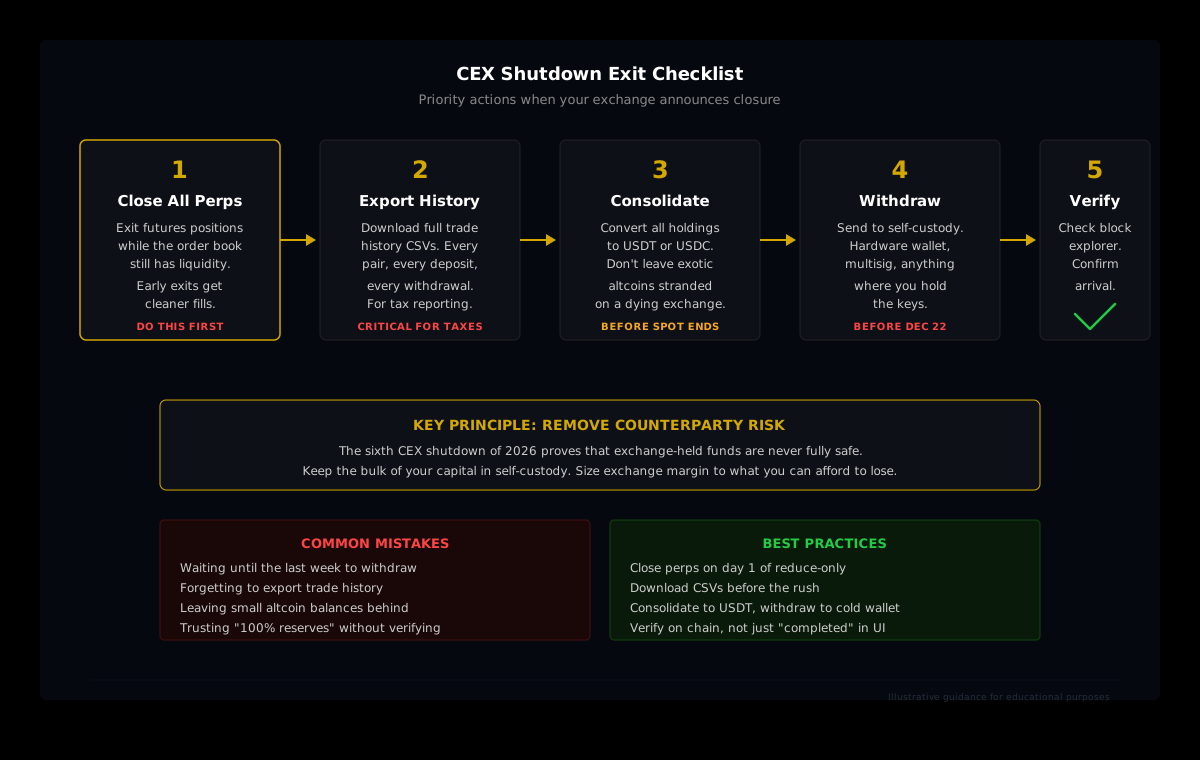
If you still have assets on CoinEx, here is the priority order:
- Close all perp positions today. Reduce-only mode is already live. Close now while the order book has depth.
- Export your full trade history. Once the exchange goes dark, your transaction records go with it. You need those records for tax reporting, cost basis calculations, and proving realized gains and losses. Download CSVs for every trading pair, every deposit, every withdrawal.
- Convert all holdings to a single withdrawable asset. USDT or USDC. Don't leave exotic altcoins on the platform and hope you can withdraw them later. Convert, consolidate, withdraw.
- Withdraw to self-custody. Not to another CEX. To a wallet you control. A hardware wallet, a multisig, anything where you hold the keys. The entire point of this exercise is to remove counterparty risk.
- Verify the withdrawal on chain. Check the block explorer. Confirm the tokens arrived. Don't assume the withdrawal went through because the UI said "processing."
CoinEx claims its reserve ratio exceeds 100% and that all user assets are fully backed. Take that at face value if you want. But the safest interpretation is: withdraw now while the claim is still testable, because after December 22, it becomes irrelevant.
What this means for perp traders in 2026
Six centralized exchange shutdowns in one year is a structural shift, not a coincidence. The mid-tier CEX business model, where an exchange licenses itself across multiple jurisdictions, runs a matching engine, holds customer funds, and tries to compete on fees, is collapsing under its own cost structure.
The winners in this shakeout are the extremes. On one end, the mega-CEXes (Binance, OKX, Coinbase) that have the volume to absorb regulatory costs. On the other end, onchain venues like Hyperliquid that eliminate the regulatory surface area entirely by running as transparent, noncustodial protocols.
For individual traders, the takeaway is risk management at the venue level. Diversify where you trade the same way you diversify what you trade. Keep the bulk of your capital in self-custody. Size your exchange-held margin to an amount you can afford to have locked up for 90 days if the exchange announces a shutdown tomorrow.
Because in 2026, "your exchange is shutting down" is no longer a black swan. It's a Tuesday.
Track where smart money trades next
When traders migrate from shuttered exchanges, our cohort analytics show exactly where the capital flows. 16 behavioral segments, every wallet on Hyperliquid classified by size and track record. See which cohorts are building positions, which are exiting, and what the migration pattern looks like in real time.