Hyperliquid Builder Codes Paid Out $90M. Here's How to Get Yours.
By CMM Team - 14-Sep-2026
Hyperliquid Builder Codes Paid Out $90M. Here's How to Get Yours.
Somewhere between writing your first trading bot and deploying it for real users, you need to answer a question every Hyperliquid builder faces: how do you actually get paid? The answer is builder codes, an on-chain fee attribution system that has quietly distributed over $90 million in revenue to developers since Hyperliquid launched. That figure covers 1,411 registered builders routing trades across wallets, aggregators, copy-trading platforms, and AI agents. Figures as of July 2026, from HyperTracker's builder leaderboard.
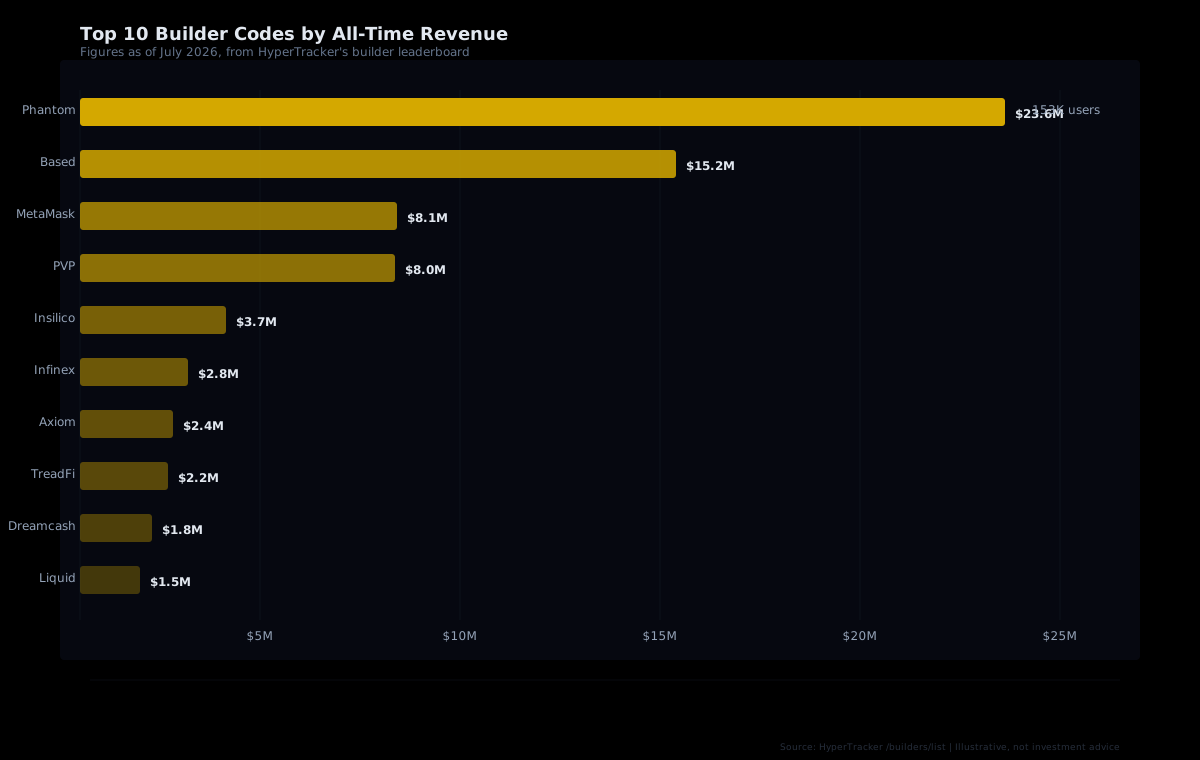
The biggest earner, Phantom, has collected $23.6 million. The second, Based, took in $15.2 million. Neither launched a token. Neither charges a subscription. They just route orders with a builder code attached and collect a percentage of every fill.
This guide walks through exactly how the system works, from the 100 USDC minimum to get started through the EIP-712 approval flow, the API parameter that attaches your fee, and the revenue patterns that separate high-earning builders from everyone else. If you build anything on Hyperliquid, this is how you monetize it.
What Builder Codes Are (And What They Replace)
Builder codes are Hyperliquid's on-chain revenue attribution system. When a user trades through your application, whether it's a React frontend, a Telegram bot, or a Python trading script, you attach a builder parameter to every order. That parameter includes your address and a fee amount. Hyperliquid deducts the fee from each fill and deposits it directly into your account.
The concept replaces what other ecosystems do with partnership agreements, revenue-sharing contracts, or token launches. On Hyperliquid, monetization is permissionless. You don't apply, negotiate, or ask permission. You deposit 100 USDC, set a fee rate, and start earning on every order your app routes.
The fee structure is straightforward:
- Perpetual futures: up to 10 basis points (0.10%) per order
- Spot: up to 100 basis points (1.00%) per order
- Revenue split: 100% of the builder fee goes to the builder. Hyperliquid takes nothing from your portion.
The fee is added on top of Hyperliquid's standard trading fees, so users pay a small premium to trade through your interface. In exchange, your interface presumably offers something they value: a better UI, automated strategies, copy trading, portfolio analytics, or AI-powered trade execution.
Setup in Four Steps
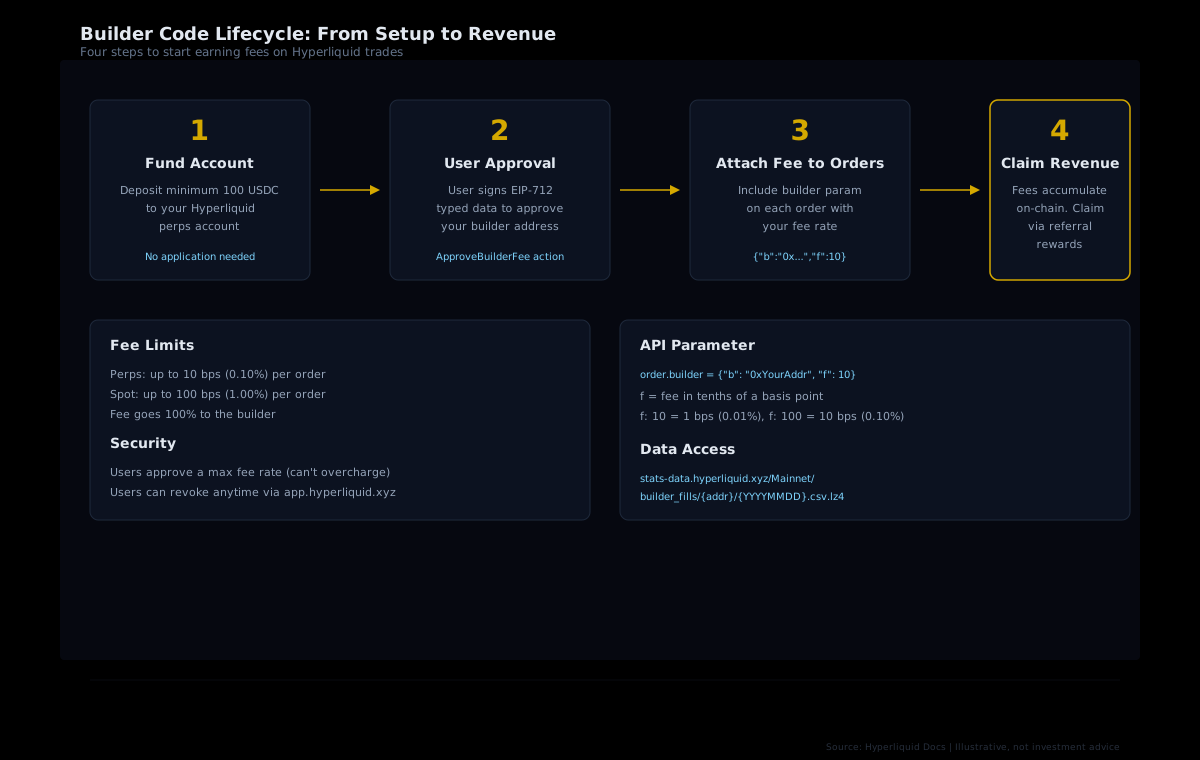
Getting a builder code live takes less than an hour if you already have a Hyperliquid wallet. Here's the exact sequence.
Step 1: Fund your account
Deposit at least 100 USDC into your Hyperliquid perpetuals account. This is the only hard requirement. No application form, no approval committee, no partnership negotiation. The 100 USDC minimum is a sybil-resistance measure, and it remains in your account (it's not a fee you pay to Hyperliquid).
Step 2: Get user approval
Before your application can charge fees, each user must explicitly approve your builder address and a maximum fee rate. The user signs an EIP-712 typed data message, which your app submits to Hyperliquid as an ApproveBuilderFee action. This signature must come from the user's main wallet, not an agent or API key.
The approval is persistent. Once a user approves your builder, they don't need to re-approve on future visits unless they revoke. Your app should check approval status on load and skip this step for returning users. Each user can have up to 10 active builder code approvals simultaneously.
Step 3: Attach the fee to orders
With approval in place, every order your app sends can include an optional builder parameter:
{"b": "0xYourBuilderAddress", "f": 10}
The b field is your builder address. The f field is the fee in tenths of a basis point. So f: 10 equals 1 basis point (0.01%), and f: 100 equals 10 basis points (0.10%), the maximum for perps. You can set the fee per order, which means you could charge different rates for different assets, strategies, or user tiers.
Step 4: Claim your revenue
Fees accumulate on-chain in your builder account. You claim them through the standard referral reward process on Hyperliquid. There's no minimum claim threshold. Daily fill data is published in LZ4-compressed CSV format at stats-data.hyperliquid.xyz/Mainnet/builder_fills/{your_address}/{YYYYMMDD}.csv.lz4 for your own analytics and reconciliation.
Open-source reference: Dwellir maintains an MIT-licensed Next.js demo app that implements the complete builder code lifecycle: approval, deposit, agent activation, order placement with fees, and revocation. It works on both testnet and mainnet. Clone it, swap in your builder address, and you have a working integration in minutes.
Who's Earning What: The Builder Leaderboard
Revenue in the builder ecosystem follows a steep power law. The top two codes (Phantom and Based) have each generated more than $15 million, while most of the 1,411 registered builders earn modest amounts. Here's the top 10 by all-time revenue:
| Rank | Builder | Revenue | Users | Volume Routed | | --- | --- | --- | --- | --- | | 1 | Phantom | $23.6M | 153,128 | $44.8B | | 2 | Based | $15.2M | 42,967 | $44.9B | | 3 | MetaMask | $8.1M | 52,534 | $9.0B | | 4 | PVP | $8.0M | 28,223 | $17.1B | | 5 | Insilico | $3.7M | 3,339 | $36.3B | | 6 | Infinex | $2.8M | 9,283 | $5.2B | | 7 | Axiom | $2.4M | 34,093 | $23.0B | | 8 | TreadFi | $2.2M | 4,835 | $11.1B | | 9 | Dreamcash | $1.8M | 11,215 | $7.6B | | 10 | Liquid | $1.5M | 9,499 | $3.2B |
The Revenue Patterns Worth Understanding
Three patterns emerge from the leaderboard data that matter for anyone building on Hyperliquid.
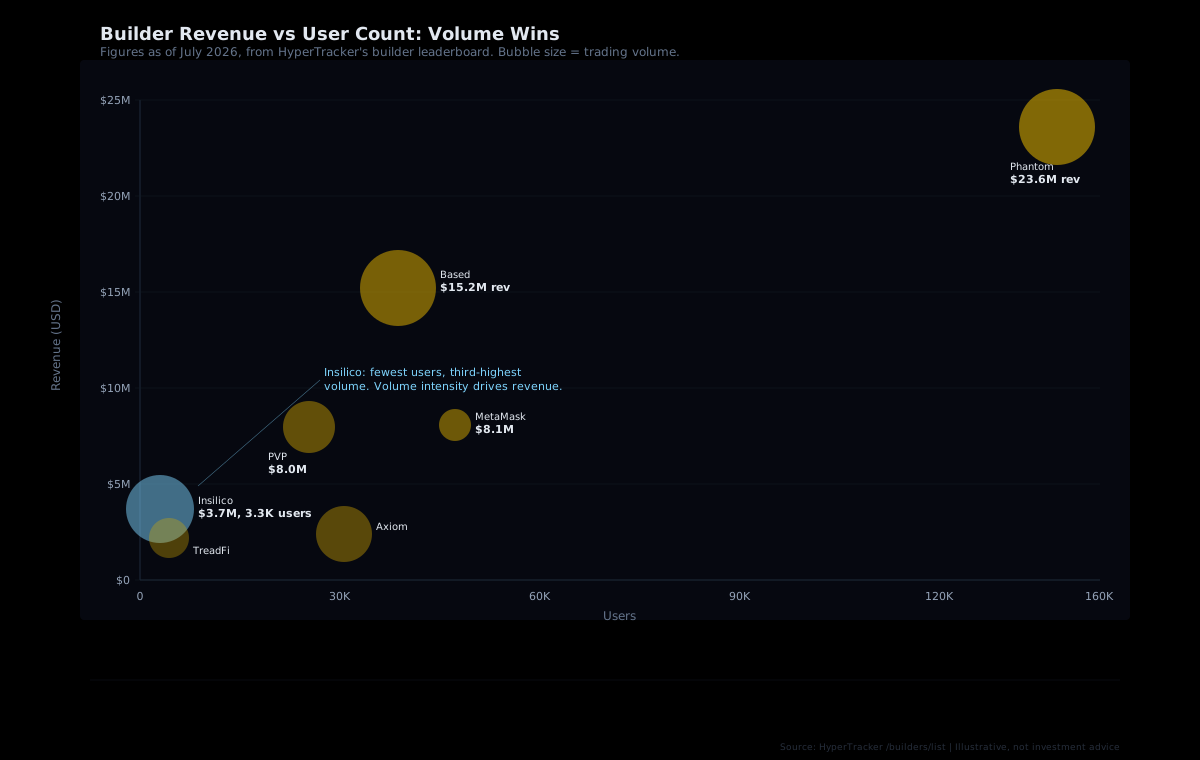
Volume intensity matters more than user count
Insilico ranks fifth in revenue ($3.7 million) with only 3,339 users, which makes it the smallest user base in the top 10 by a wide margin. But it routes $36.3 billion in total volume, the third-highest figure overall. That translates to roughly $10.9 million in volume per user. Compare that to Axiom: 34,093 users but a much lower revenue-per-user ratio because its user base includes more casual traders. If you're building something that attracts high-volume users (quant strategies, algorithmic execution, copy trading), even a small user base can generate meaningful revenue.
Wallets are a distribution advantage
Phantom and MetaMask occupy the #1 and #3 revenue spots, which makes sense. Wallets are where users start every trading session. When you already control the entry point, adding a builder code to the order flow is a natural extension. Phantom's 153,128 users represent the largest user base in the ecosystem by more than 3x, and that distribution advantage converts directly to revenue. If you're building a wallet or a browser extension with trading capabilities, builder codes turn your existing user base into a revenue stream.
Revenue is concentrated but the tail is long
The top 10 builders account for roughly $69 million of the $90.7 million total, which means the remaining 1,400+ builders share roughly $21 million. That's a power-law distribution, consistent with most marketplace economics. But the tail is still meaningful: hundreds of builders have earned five and six figures each. The barrier to entry is low enough that experimentation costs almost nothing.
Builder Codes vs. Referral Codes: The Distinction That Matters
Hyperliquid runs two separate attribution systems that builders frequently confuse. Builder codes and referral codes serve different purposes and stack independently.
Referral codes are user-level. When someone joins Hyperliquid through your referral link, you earn 10% of their trading fees in perpetuity (until they reach $1 billion in cumulative volume). Creating a referral code requires $10,000 in trading volume. Referral codes are tied to the user, and they apply regardless of which interface the user trades through.
Builder codes are order-level. They apply to specific orders routed through your application, regardless of who referred the user. A user who signed up through someone else's referral link can still trade through your app with your builder code attached.
The two can stack. If a user was referred by person A but trades through builder B's interface, both A and B earn fees on that trade. This means your builder code revenue is independent of your referral network, and vice versa.
Staking referral program: Hyperliquid's proposed staking referral system would let builders who stake HYPE earn a higher percentage of their users' trading fees, up to 40% at the highest staking tier. Builders could also share up to 50% of that staking referral revenue back with the user as a fee discount. This program, if implemented, would make builder codes even more profitable for builders who stake significant HYPE.
Common Setup Mistakes (And How to Avoid Them)
The builder code system is simple in concept but there are a few gotchas that trip up new builders.
Signing with the wrong key
The ApproveBuilderFee action must be signed by the user's main wallet. Agent keys and API keys cannot sign approvals. If your app handles wallet connections through an agent-based system, you'll need to prompt the user to sign the approval with their primary wallet before delegating subsequent order signing to an agent.
Forgetting the max-fee gate
Users approve a maximum fee rate for your builder address. If you try to attach a fee higher than what the user approved, the order will fail. Design your approval flow to request a max rate that gives you flexibility (many builders request the full 10 bps for perps), and then set the actual fee per-order to whatever rate you want below that ceiling.
Not checking approval status on load
Approvals are persistent, so returning users shouldn't see the approval prompt again. Query the approval status using {"type": "maxBuilderFee", "user": "0x...", "builder": "0x..."} when your app loads and skip the approval step if the response shows an active approval.
Setting fees too high
The maximum is 10 bps for perps, but that doesn't mean you should charge the maximum. Users can see your fee rate before approving, and they can revoke at any time. Most top-earning builders charge substantially less than the cap, because a lower fee on higher volume produces more revenue than a high fee that drives users to a competitor. Watch what similar applications charge and price competitively.
Tracking Builder Performance with Our API
Once your builder code is live, you'll want visibility into how it's performing, both your own code and the broader ecosystem. Our builder analytics endpoints give you programmatic access to the same data behind the leaderboard table above.
The /builders/list endpoint returns every registered builder with their revenue, user count, and volume for any timeframe (all-time, monthly, weekly, daily). You can track your own builder code's growth over time, benchmark against competitors, and identify trends in the ecosystem. The /builders/users endpoint breaks down individual user activity under a given builder code, so you can see which users are driving your revenue and how their behavior changes over time.
This kind of visibility matters because builder code revenue isn't static. User behavior shifts with market conditions, new competitors launch, and fee rates across the ecosystem evolve. Our data shows that the top builders monitor these metrics daily. You should too.
Track Your Builder Code Revenue
Our builder analytics API gives you real-time visibility into revenue, user activity, and volume across the entire Hyperliquid builder ecosystem. Query the leaderboard, benchmark your performance, and spot trends before your competitors do.
What to Build Next
The builder code data reveals where value flows on Hyperliquid, and it suggests where the next opportunities sit. Wallets dominate the leaderboard because they own the user's starting point. But the fastest-growing segments are specialized tools: copy-trading platforms, AI trading agents, portfolio management dashboards, and analytics interfaces. These products attract users who trade more frequently and in larger size, which translates directly to higher per-user revenue.
If you're looking for a starting point, consider what's missing in the ecosystem today. Alert systems that notify users when specific cohorts shift their positioning. Risk management overlays that cap leverage based on liquidation cluster data. Multi-strategy execution engines that split orders across algorithms. Each of these adds enough value to justify a builder fee, and each routes volume through your code with every execution.
The bottom line is simple. Over $90 million has already been paid out to builders through this system. The setup takes less than an hour. The minimum investment is 100 USDC. And every order your app routes is revenue you're either collecting or leaving on the table.