
Hyperliquid Wants Kalshi's Prediction Market Crown (And It Has Zero Fees)
By CMM Team - 12-Sep-2026
Hyperliquid Wants Kalshi's Prediction Market Crown (And It Has Zero Fees)
Prediction markets went from a niche curiosity to a $24 billion-per-month category in under a year. Kalshi grabbed the lead, Polymarket kept pace, and regulated exchanges started circling. Then Hyperliquid showed up with a simple pitch: zero fees to open, full cross-margin with your perp book, and permissionless market deployment for anyone willing to stake the collateral.
HIP-4, the protocol upgrade that brought outcome contracts to Hyperliquid's mainnet on May 2, 2026, didn't just add a new product tab. It turned Hyperliquid into the only venue in crypto where a single margin account can hold perps, spot, tokenized equities, and prediction positions simultaneously. For builders shipping analytics tools, that means a fundamentally new data layer to track, and for traders, a way to hedge event risk without moving capital off-platform.
Four months after launch, here's where the battle stands and what it means for anyone building on top of the Hyperliquid stack.
The $24 Billion Market That Arrived Overnight
Before mid-2025, prediction markets were a footnote. Combined monthly volume on Kalshi and Polymarket sat below $5 billion. By April 2026, that number had multiplied nearly fivefold. The growth wasn't gradual; it was a step function driven by sports betting, macro event contracts, and election speculation.
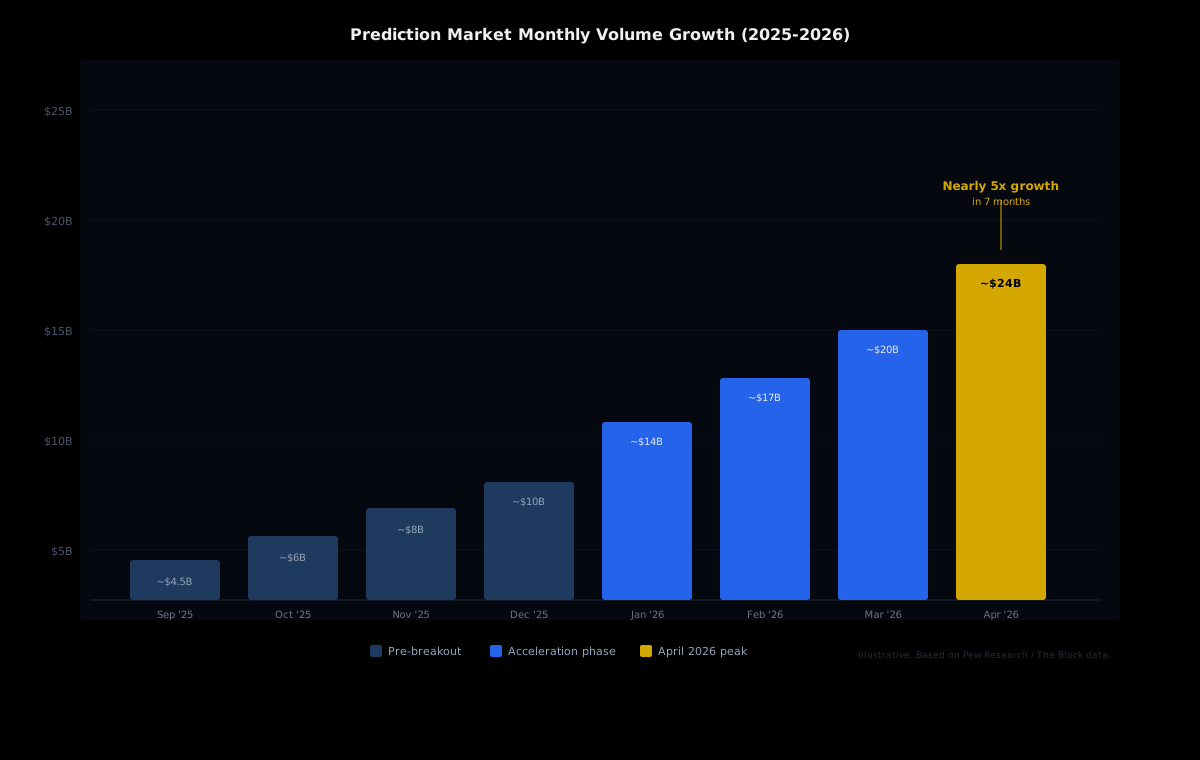
Kalshi now commands roughly 62% of the market, up from 55% in January 2026. Sports betting drives the bulk of it, accounting for approximately 72% of Kalshi's volume. Investment bank Bernstein estimates that 2026 prediction market volumes will reach $240 billion, a 370% increase over 2025.
Polymarket isn't far behind. Q2 2026 notional volume across the entire prediction market sector hit $113.8 billion, and Polymarket has been running leveraged contracts, its latest weapon in a bid to keep up. The 2026 FIFA World Cup alone generated $884 million in volume on Polymarket, making it the platform's second-largest market by all-time volume.
This is the market Hyperliquid walked into. And its weapon is architecture, not just lower fees.
How HIP-4 Changes the Rules
HIP-4 introduced outcome contracts directly into HyperCore, the same matching engine that processes Hyperliquid's $5 to $6 billion in daily perp volume. The contracts are binary: they settle to 0 or 1 in USDC based on whether a real-world event occurs. No leverage, no liquidation risk, no fees to open a position.
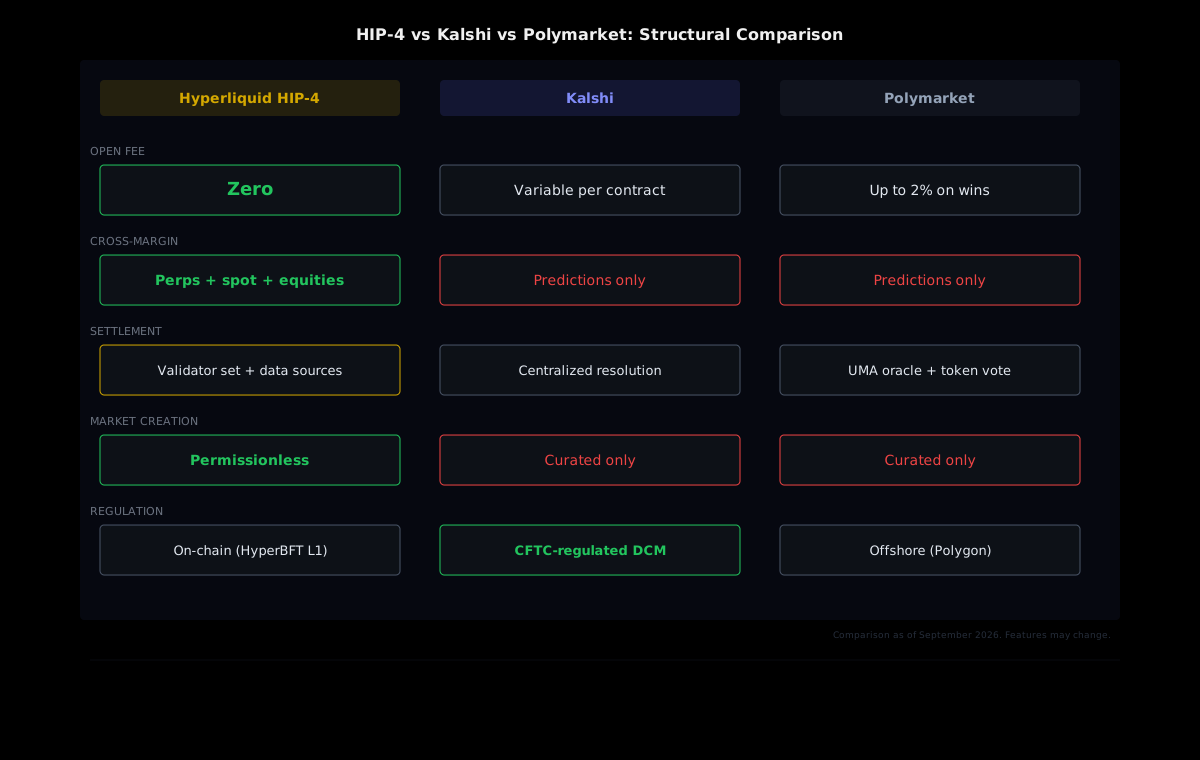
Settlement runs through Hyperliquid's validator set against pre-specified data sources. There's no token vote, no dispute window, and no path for a position holder to influence the resolution. This is a deliberate departure from Polymarket's UMA oracle model, where contested outcomes have sparked controversy over token-holder voting power.
Cross-Margin Is the Real Differentiator
The headline-grabbing detail is zero open fees. But the structural advantage is cross-margining. A trader can hold a long ETH perp, a tokenized NVDA position via HIP-3, and a prediction contract on whether the Fed cuts rates, all against the same collateral pool. Standalone prediction platforms like Kalshi and Polymarket can't replicate this because they don't operate a perpetual futures exchange.
"Sophisticated traders will be able to take advantage of portfolio margin and figure out ways to generate alpha from these two different market types," noted Sunny Shi of Syncracy Capital.
Permissionless Deployment Opened in August
Phase 1 of HIP-4 launched with curated markets (Bitcoin price outcomes through Outcomexyz). But permissionless deployment went live on mainnet on August 29, 2026. Now any builder can deploy outcome markets by staking 500,000 HYPE and selecting from approved settlement templates.
The economics mirror HIP-3: deployers keep up to 50% of trading fees their markets generate. The stake locks for at least 183 days and must remain until all outstanding markets settle. It's slashable if validators catch manipulation.
This matters because it converts HIP-4 from a product into infrastructure. Kalshi is a single venue with curated markets. Hyperliquid is now a protocol where anyone can build a prediction market exchange on top.
Three Platforms, Three Architectures
Understanding where Hyperliquid fits requires mapping the competitive landscape honestly. Each platform has structural strengths the others can't easily replicate.
| Feature | Kalshi | Polymarket | Hyperliquid (HIP-4) | | --- | --- | --- | --- | | Regulation | CFTC-regulated DCM | Offshore (Polygon) | On-chain (HyperBFT L1) | | Fee to open | Variable (per contract) | Up to 2% on wins | Zero | | Cross-margin with perps | No | No | Yes (unified account) | | Permissionless deployment | No (curated) | No (curated) | Yes (500K HYPE stake) | | Settlement | Centralized resolution | UMA oracle + token vote | Validator set + data sources | | Leverage on predictions | No | Up to 10x (new) | No (fully collateralized) | | Sports markets | Yes (72% of volume) | Limited | Growing (post-permissionless) |
Kalshi's moat is regulatory approval and brand recognition. In the U.S., it's the only CFTC-designated contract market for event contracts, which gives it exclusive access to institutional participants who need regulatory clarity. That advantage is real and durable.
Polymarket's edge is liquidity depth and a proven track record in political and crypto-native markets. It also moves fast: 10x leveraged contracts on Bitcoin, Nvidia, and gold rolled out in 2026, a direct response to Hyperliquid's cross-margin proposition.
Hyperliquid's edge is composability. Prediction markets, perpetuals, spot, and tokenized equities share a single order book infrastructure, collateral pool, and builder ecosystem. That architectural integration is harder to retrofit than it is to build from scratch.
What This Means for Cohort Analytics
Here's where HIP-4 gets interesting for anyone building intelligence tools on Hyperliquid. Outcome markets produce positioning data that behaves differently from perps in every dimension.
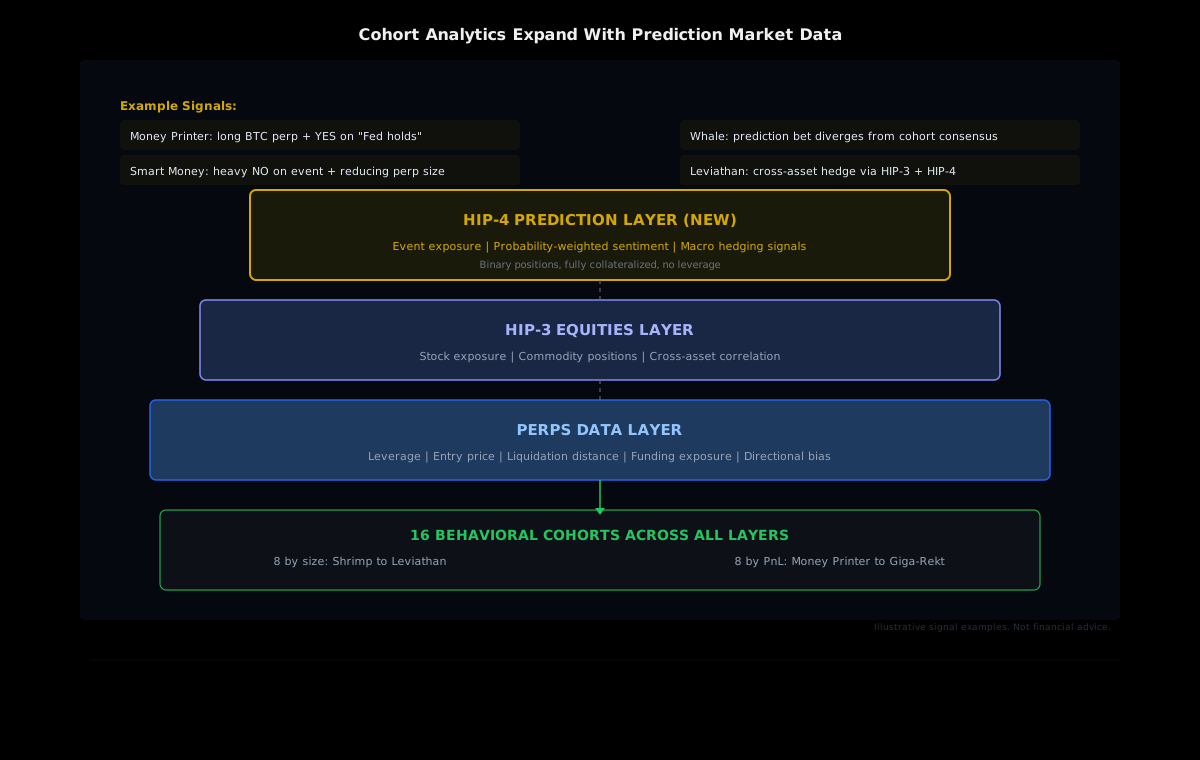
With perpetual futures, our data classifies every wallet into one of 16 behavioral cohorts: 8 by account size (from Shrimp at $0-$250 up to Leviathan at $5M+) and 8 by all-time PnL (from Money Printer at +$1M+ down to Giga-Rekt below -$1M). You can track leverage, directional bias, entry prices, and liquidation proximity. The signals are rich because perps have continuous risk parameters.
Outcome positions are binary and fully collateralized, so there's no leverage to analyze and no liquidation threshold to flag. But they create different types of signals:
- Event exposure mapping. Which cohorts are hedging macro events alongside their perp positions? A Money Printer holding a large BTC long plus a YES contract on "Fed holds rates" is expressing a specific macro thesis that pure perp data wouldn't reveal.
- Probability-weighted sentiment. When Smart Money cohorts concentrate on one side of a prediction market, especially when that side diverges from the broader implied probability, it's a signal worth watching.
- Cross-product correlation. Traders with both perp positions and outcome bets in a single margin account generate data about how sophisticated participants hedge event risk. This is a new analytics layer that didn't exist before HIP-4.
The Incumbents Are Responding
Kalshi and Polymarket aren't standing still. Both platforms have been evolving their products in Hyperliquid's direction, blurring the lines between prediction markets and derivatives exchanges.
Kalshi announced perpetual futures contracts under the brand name "Timeless", moving from event-based contracts toward continuous derivatives. If Timeless gains traction, Kalshi would offer something closer to cross-product trading within its own regulated environment.
Polymarket went the leverage route, adding 10x contracts on major assets. It's a direct answer to the capital efficiency argument: if Hyperliquid's cross-margin lets you do more with less collateral, Polymarket's leverage achieves something similar (with correspondingly higher risk).
The convergence is unmistakable. Prediction platforms want derivatives features. Derivatives exchanges want prediction markets. And the platform that integrates both most seamlessly will likely capture the deepest liquidity pool.
Building on Both Sides of the Trade
For builders already shipping on Hyperliquid, HIP-4 creates concrete opportunities across three tiers.
Frontend builders (wallets, bots, aggregators) already earn fees through builder codes. Those same codes now work on outcome markets. Every prediction trade routed through a third-party interface generates revenue with zero additional integration work. The incremental effort is UI: surfacing outcome markets alongside perps and spot.
Analytics platforms gain a new data dimension. Tracking which cohorts are active in prediction markets, correlating event positioning with perp exposure, and surfacing divergences between implied probability and cohort sentiment opens up product surface area. HyperTracker's 16-cohort classification system already covers every wallet on the platform, so outcome market activity maps directly onto existing behavioral segments.
Market deployers can now create prediction markets permissionlessly. The 500,000 HYPE stake requirement is steep (roughly $41 million at recent prices), but deployers keep up to half the trading fees and can run rolling series of events from a single slot. For well-capitalized builders, this is a new business model built directly into the protocol.
Hyperliquid already has 1.4 million users and clears billions daily in perp volume. Prediction markets don't need to build their own user base from scratch; they inherit it.
Track Cohort Behavior Across Perps and Prediction Markets
HyperTracker classifies every wallet on Hyperliquid into 16 behavioral cohorts. See what Smart Money, Whales, and Money Printers are positioning into, from perps to outcomes.
Where This Goes Next
The prediction market race is still early. Q2 2026 notional crossed $113.8 billion, and the sector shows no signs of slowing. Bernstein's $240 billion estimate for the full year looks increasingly conservative if sports betting continues to accelerate.
For Hyperliquid specifically, the path forward is about network effects. Each new product type (spot, perps, HIP-3 equities, HIP-4 outcomes) adds stickiness because switching costs compound across product categories. A trader using three product types from a single margin account is far harder to lose than one using just perps.
For builders, the signal is clear: the platforms that win the prediction market race will be the ones that treat outcome contracts as composable infrastructure, integrated with derivatives, spot, and analytics in a single stack. Hyperliquid bet its architecture on that thesis from the start. Whether it can execute against Kalshi's regulatory moat and Polymarket's liquidity network remains the open question.
The data will tell us. And now, there's more of it to track than ever.