
The Clarity Act Votes Tomorrow. Perp DEX Builders Aren't Ready.
By CMM Team - 14-Sep-2026
The Clarity Act Votes Tomorrow. Perp DEX Builders Aren't Ready.
The U.S. Senate votes on the Digital Asset Market Clarity Act tomorrow, September 15, at 2:15 p.m. ET. It is a cloture vote, a procedural motion that requires 60 senators to agree to advance the bill to full floor debate. If it clears, the most comprehensive crypto legislation ever written moves to amendments and a final vote. If it fails, the bill is effectively dead until at least 2027, because the Senate's remaining calendar is consumed by midterm campaigns, appropriations fights, and the debt ceiling.
Most builders on Hyperliquid and other perp DEXes are watching this from the sidelines, treating it as a policy story that does not affect shipping code. That is a mistake. The Clarity Act contains specific provisions about developer liability, DeFi protocol classification, and CFTC jurisdiction over spot and derivatives markets that will reshape what it means to build a trading product on a decentralized exchange. Whether the bill passes or stalls, the regulatory direction it represents is already influencing how institutions evaluate on-chain infrastructure.
If you ship anything that touches perpetual futures on a decentralized platform, the next 48 hours matter more than any protocol upgrade this year.
What the Clarity Act Actually Says About DeFi
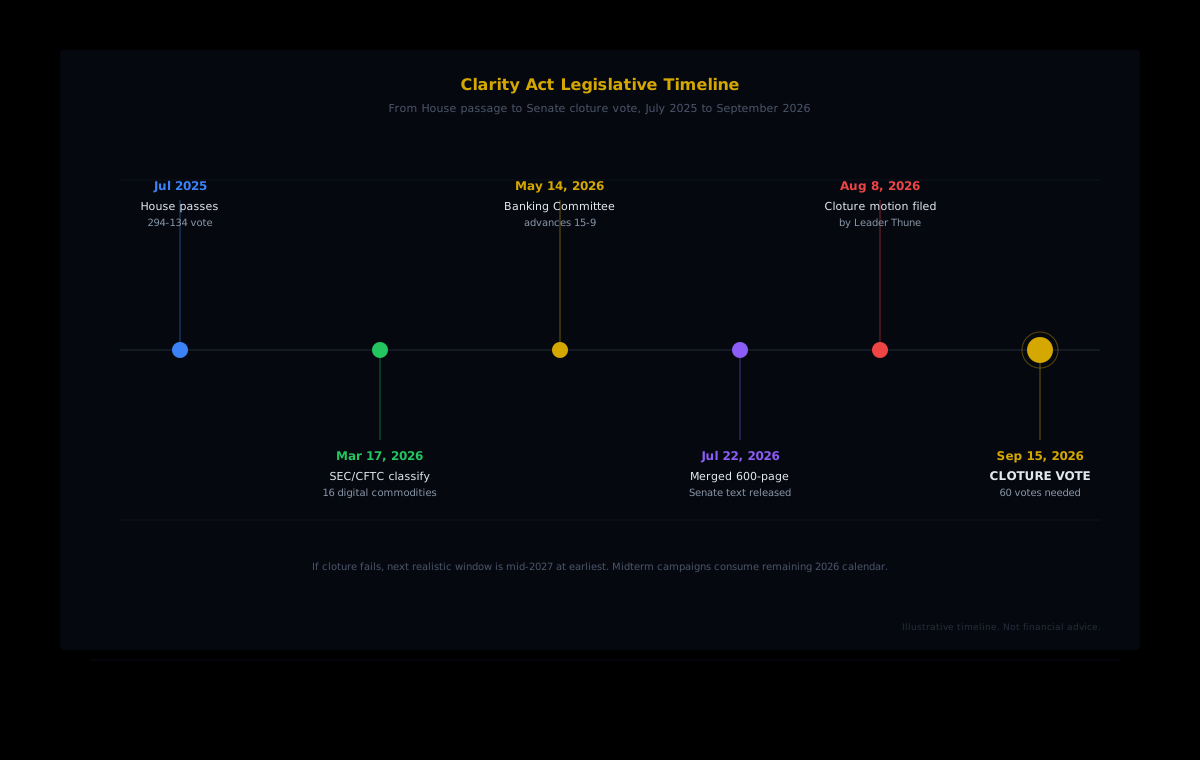
The Digital Asset Market Clarity Act, formally H.R. 3633, passed the House in July 2025 with a 294-134 bipartisan vote. The Senate Banking Committee advanced its portion 15-9 on May 14, 2026, and Senator Cynthia Lummis released a merged 600-page Senate text on July 22 combining work from the Banking and Agriculture committees.
Three provisions matter for perp DEX builders specifically.
The Decentralization Test
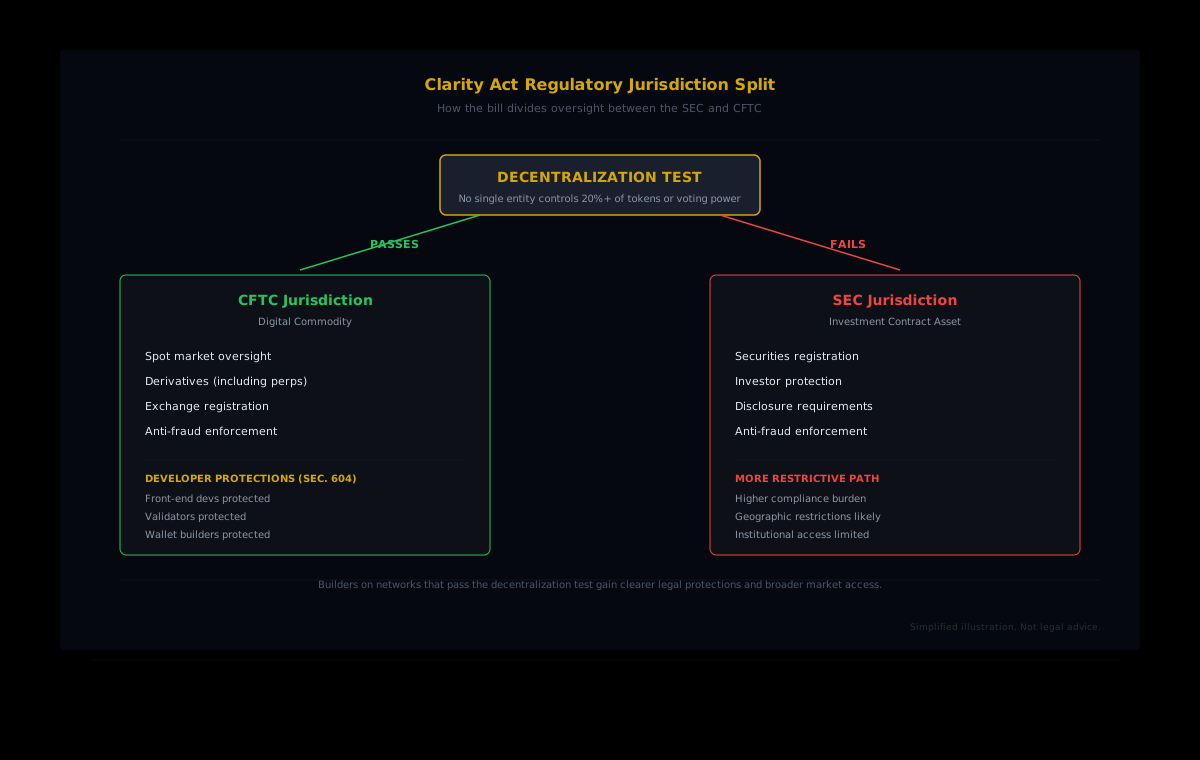
The bill establishes a "mature blockchain" test with four statutory conditions. If a network meets all four, the tokens on that network qualify as digital commodities regulated by the CFTC rather than securities under the SEC. The threshold that matters most: no person or commonly controlled group may hold 20% or more of the tokens or voting power. The other three requirements are that the system must be functional for transactions, the underlying code must be public (open source), and operation must follow pre-established, transparent rules.
For Hyperliquid, this is relevant because the HYPE token's distribution and the chain's governance structure determine whether its native assets fall under CFTC commodity jurisdiction or SEC securities oversight. That classification cascades down to every builder on the platform.
Developer Protections Under Section 604
Section 604 incorporates the Blockchain Regulatory Certainty Act, shielding developers from money-transmitter registration and Bank Secrecy Act obligations purely for providing infrastructure.
The Act creates specific exemptions for non-custodial software. Persons are excluded from regulation if they are: compiling or validating network transactions, providing computational work, providing user interfaces for a blockchain system, or developing a trading protocol or software system, including wallets. This exemption does not limit the CFTC's or the SEC's anti-fraud, anti-manipulation, or false-reporting authorities.
Translation for builders: if you write a front-end for a perp DEX, run a validator, or develop a trading bot that interacts with on-chain protocols, the Clarity Act would explicitly protect you from being treated as a money transmitter. But if your product manipulates markets or commits fraud, you are still liable. The shield covers infrastructure, not bad behavior.
CFTC Jurisdiction Over Digital Commodity Spot Markets
The bill gives the CFTC exclusive jurisdiction over digital commodity spot trading on registered venues. On March 17, 2026, the SEC and CFTC jointly classified 16 tokens as digital commodities, including Ethereum, Solana, and Bitcoin. That classification gives the CFTC clear authority to regulate derivatives, including perpetual futures, on those assets.
This is the legal foundation that makes onshore perps viable. CFTC Chairman Michael Selig announced in March 2026 that his agency would clear a path for perpetual futures trading on U.S.-regulated exchanges. The Clarity Act would harden that framework into statute rather than leaving it as agency guidance that could be reversed by a future administration.
The Vote Math (And Why It Might Fail)
Republicans hold 53 Senate seats. Cloture requires 60 votes. That means at least seven Democrats must cross the aisle.
Three disputes remain unresolved. First, ethics rules targeting conflicts of interest for senior government officials with crypto holdings. Second, the scope of DeFi developer protections under Section 604, which Senator Catherine Cortez Masto has pushed to narrow by strengthening anti-money-laundering obligations for certain DeFi activity. Third, stablecoin yield provisions that determine whether crypto firms can offer rewards on stablecoin balances.
Prediction market odds reflect the difficulty. And multiple analysts have characterized passage this year as uncertain at best. If cloture fails tomorrow, the next realistic window for this legislation is mid-2027 at the earliest, after midterm elections and a potential change in House leadership.
Why Perp DEX Builders Should Care Either Way
The bill's outcome creates two distinct futures for builders. Both require preparation.
If Cloture Passes
The Clarity Act moves to floor debate and amendments. The developer exemptions in Section 604 become the new baseline for how regulators treat on-chain infrastructure. Builders gain explicit legal clarity that writing front-ends, running validators, and developing trading protocols does not make them money transmitters. Institutional capital, which has been waiting for a federal framework before committing to DeFi infrastructure, gets the signal it needs.
For Hyperliquid builders specifically, the combination of CFTC jurisdiction over digital commodity derivatives and the developer protection carve-outs creates the clearest legal path yet for building perpetual futures products that U.S. users can access without geographic restrictions.
If Cloture Fails
The regulatory vacuum persists. DeFi developers continue operating under a patchwork of enforcement actions and informal agency guidance. The CFTC's framework for onshoring perpetual futures, which Chairman Selig has been advancing through agency action, continues without statutory backing. That means it could be reversed by a future CFTC chair without congressional approval.
Builders who depend on the current permissive environment face the risk that a single enforcement action could redefine their legal exposure overnight. Without legislation, the rules are whatever the current agency leadership says they are.
The Perp Market the Clarity Act Would Unlock
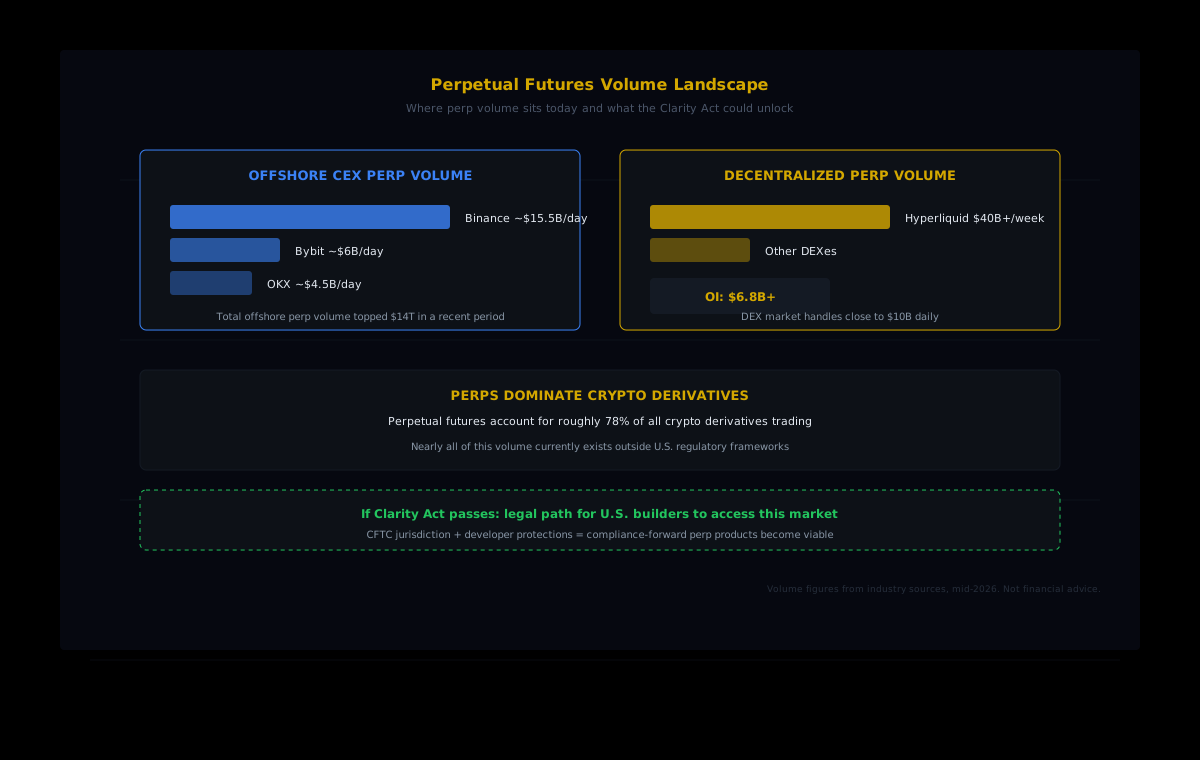
The scale of what is at stake becomes clear when you look at where perpetual futures volume sits today. Offshore volume topped $14 trillion in a recent period, a figure that roughly doubled in six months. Perps account for roughly 78% of all crypto derivatives trading.
Decentralized exchanges have been capturing a growing share. Hyperliquid alone processes over $40 billion in weekly volume, with open interest exceeding $6.8 billion. The broader perp DEX market handles close to $10 billion daily.
All of that volume currently exists outside U.S. regulatory frameworks. The Clarity Act would create a legal path to bring some of it onshore, or at least give U.S. builders the clarity to participate without fear of enforcement. For builders on Hyperliquid, that means a potential wave of U.S.-based users, institutional integrations, and compliance-forward products that are not viable in the current ambiguous environment.
What Builders Should Do This Week
Regardless of tomorrow's vote outcome, the direction of travel is clear. U.S. regulators are moving toward a framework that distinguishes between infrastructure providers and financial intermediaries. Builders who position themselves on the right side of that line will have advantages whether the legislation passes now or in 2027.
Audit Your Product's Regulatory Surface
The Clarity Act's developer exemptions protect four categories: transaction validation, computational work, user interfaces, and protocol/wallet development. If your product fits cleanly within one of those categories, document it. If your product takes custody of funds, routes orders through a centralized matching engine you control, or pools user deposits, it likely falls outside the exemption. Knowing where you stand now is cheaper than finding out through an enforcement action later.
Track Cohort Behavior Around Regulatory Events
Major regulatory votes move markets, but they move different segments of the market differently. Institutional wallets and experienced traders (what our data classifies as Money Printer and Smart Money cohorts) tend to position ahead of policy catalysts. Retail segments often react after the fact. The divergence between those cohorts around events like tomorrow's vote creates both risk and opportunity.
Our cohort analytics API classifies every wallet on Hyperliquid into 16 behavioral cohorts, eight by portfolio size and eight by all-time PnL performance. When regulatory clarity changes who can participate in DeFi markets, the positioning shifts show up in cohort data before they show up in price.
Build for Compliance from Day One
The cheapest time to add compliance infrastructure is before you need it. Whether the Clarity Act passes now or later, products that can demonstrate they are non-custodial, that they provide user interfaces rather than intermediary services, and that they have audit trails for their on-chain interactions will be better positioned when the regulatory framework solidifies.
Monitor Smart Money Around the Clarity Act Vote
HyperTracker's cohort analytics API classifies every Hyperliquid wallet into 16 behavioral segments. Track how Money Printers, Smart Money, Whales, and retail cohorts reposition around tomorrow's regulatory catalyst. One API call gives you the positioning data institutions use to time entries.
The Bigger Picture for On-Chain Builders
The Clarity Act is not just about perpetual futures. It is the first serious attempt to define what "decentralized" means in U.S. law, to draw a line between protocols and financial intermediaries, and to give the CFTC clear jurisdiction over digital commodity markets. Those definitions will shape every product built on every chain for the next decade.
For Hyperliquid builders, the implications are particularly direct. The platform's USDC-settled perpetual futures already sit at the intersection of the two regulatory categories the bill creates. If the chain and its tokens pass the decentralization test, builders get CFTC commodity jurisdiction and explicit developer protections. If they do not, the SEC path is more restrictive and less certain.
Tomorrow's vote is the beginning of that sorting, not the end. Even if cloture fails, the framework the Clarity Act establishes, the decentralization test, the developer exemptions, the CFTC jurisdiction boundaries, will define the terms of every regulatory conversation that follows. Builders who understand those terms now will ship faster when the rules arrive.
The Senate votes at 2:15 p.m. ET. By dinner, every perp DEX builder in the world will know whether their regulatory runway just got longer or shorter. Either way, the builders who prepared are the ones who keep shipping.