Five Metrics That Actually Matter on Hyperliquid (and Dozens That Don't)
By CMM Team - 17-Jun-2026
Five Metrics That Actually Matter on Hyperliquid (and Dozens That Don't)
Open a Hyperliquid analytics dashboard and you will find dozens of charts updating in real time: price, volume, mark price, index price, 24-hour change, 7-day change, 30-day change, trades per minute, maker volume, taker volume. Scroll further and there are funding snapshots, basis spreads, liquidation tickers, and at least three different ways to visualize the same open interest data.
It feels like information. It is mostly noise.
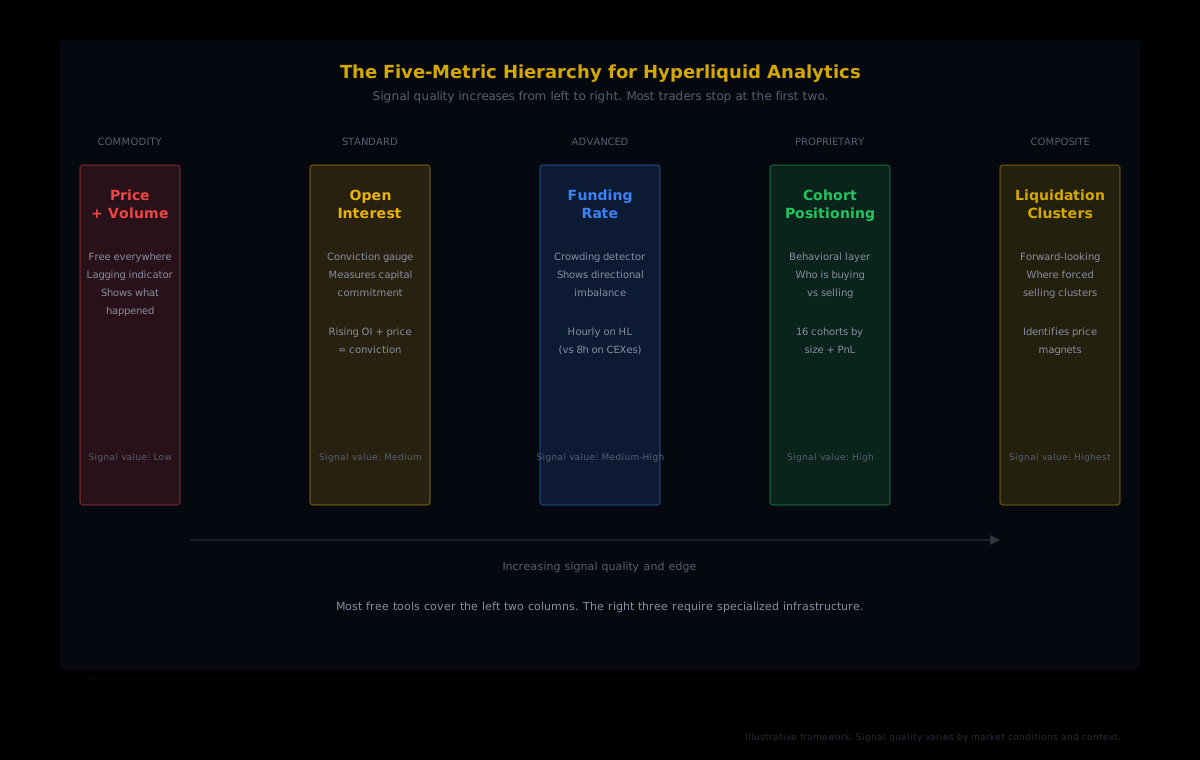
The problem is not a lack of data. Hyperliquid is fully on-chain, which means every trade, every position open and close, every liquidation is verifiable and public. The problem is that most of the metrics traders stare at are commodity signals, available everywhere and already priced into every move before you can act on them. The five metrics that consistently separate informed traders from reactive ones are not obscure. They are just layered differently, and most dashboards either do not surface them or bury them under the commodity stuff.
Here is the stack, from least to most useful.
Metric 1: Price and Volume (Necessary, Insufficient)
Start with the obvious. Price tells you what happened. Volume tells you how many people cared. Together they form the floor of any analytics stack, and every charting platform from TradingView to CoinGecko serves them for free.
The issue is not that price and volume are useless. They are necessary. But they are lagging indicators by definition. By the time a candle prints and volume spikes, the move has already happened. You are looking at a receipt, not a forecast.
On Hyperliquid specifically, volume data carries an extra wrinkle. Because every trade is on-chain, you can verify it independently. That is a genuine advantage over centralized exchanges where wash trading can inflate volume figures. But verification and usefulness are different things. Verified volume still tells you what happened, and what happened is the same information available to every other participant watching the same chart.
Price and volume are table stakes. If your analytics stack stops here, you are trading with the same edge as everyone else, which is to say, none at all.
Metric 2: Open Interest (The Conviction Layer)
Open interest measures the total value of outstanding perpetual contracts. Unlike volume, which resets every period, OI is a running tally of how much capital is committed to open positions at any given moment.
This distinction matters because OI tells you something volume cannot: whether a price move is backed by new conviction or just old positions changing hands. Rising OI alongside rising price suggests new money entering long positions. Rising price with flat or declining OI suggests shorts covering, a mechanically different (and usually less durable) kind of rally.
Hyperliquid's OI has grown substantially in 2026. The platform now holds over $10 billion in perpetual futures open interest, making it the third-largest perpetual futures venue by this measure. About $4 billion of that is tied to HIP-3 builder-deployed markets, which cover everything from crypto assets to equities, commodities, and synthetic pre-IPO contracts.
OI is a meaningful upgrade over price and volume because it surfaces commitment. But it still has a blind spot. It tells you how much capital is in the market. It does not tell you whose capital it is.
Metric 3: Funding Rate (The Crowding Detector)
Perpetual futures have no expiry date, so they need a mechanism to stay anchored to spot price. That mechanism is the funding rate: a periodic payment between longs and shorts that penalizes whichever side is more crowded.
When funding is positive, longs pay shorts. When negative, shorts pay longs. The rate itself is a direct readout of directional imbalance in the market. A persistently high positive funding rate means the market is overwhelmingly long, and those longs are paying for the privilege of holding their positions. That cost compounds, because leverage amplifies funding 1:1. A position with 10x leverage pays 10x the effective funding rate on its margin.
On Hyperliquid, funding settles hourly, compared to the 8-hour cycle used by most centralized exchanges like Binance and Bybit. That faster cadence means funding signals on Hyperliquid update more frequently, making regime shifts in crowding visible sooner.
The Four Regimes
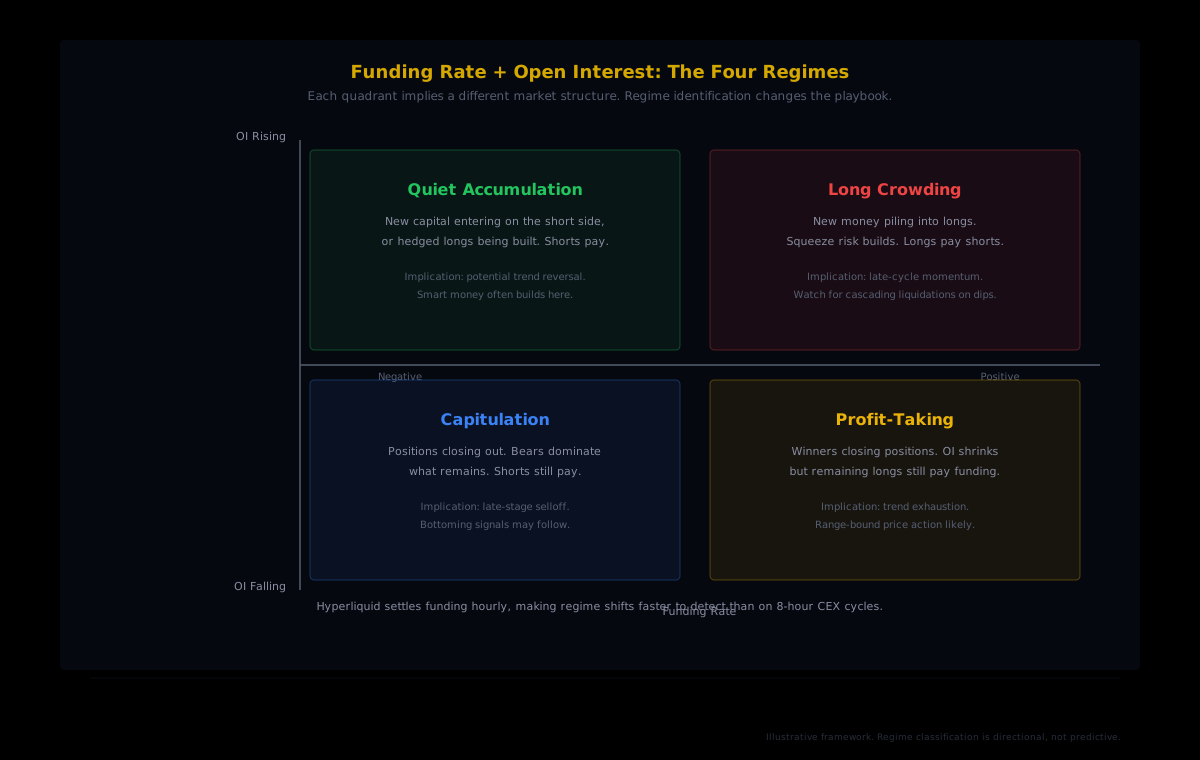
Funding and OI together create a simple but powerful regime framework:
- Rising OI + positive funding: Long crowding. New capital piling into longs, with squeeze risk building on any dip. Late-cycle momentum.
- Rising OI + negative funding: Quiet accumulation. New capital entering on the short side, or hedged positions being built. Often where smart money starts positioning.
- Falling OI + negative funding: Capitulation. Positions closing out, bears dominate what remains. Late-stage selloff territory where bottoming signals may follow.
- Falling OI + positive funding: Profit-taking. Winners closing positions while remaining longs still pay funding. Range-bound price action often follows.
Funding rate data is available on CoinGlass, Coinalyze, and through Hyperliquid's own interface. It is a standard metric. But combined with OI, it becomes a regime identifier, and most traders do not think in regimes. They think in candles.
Metric 4: Cohort Positioning (The Behavioral Layer)
This is where commodity analytics end and proprietary intelligence begins.
Consider a scenario: ETH open interest rises sharply over 24 hours. Funding is slightly positive. A standard dashboard tells you that more capital entered the market and it is slightly long-biased. That is correct, but it is incomplete. Who added the positions? Was it retail traders chasing momentum with small accounts, or was it experienced wallets with strong all-time track records?
The distinction matters enormously. If the new OI came from wallets classified as Money Printers (all-time PnL above +$1M) adding longs while Shrimp accounts (equity below $250) are also piling in, that is a different signal than if Money Printers are flat and the OI spike is entirely driven by small, historically losing accounts.
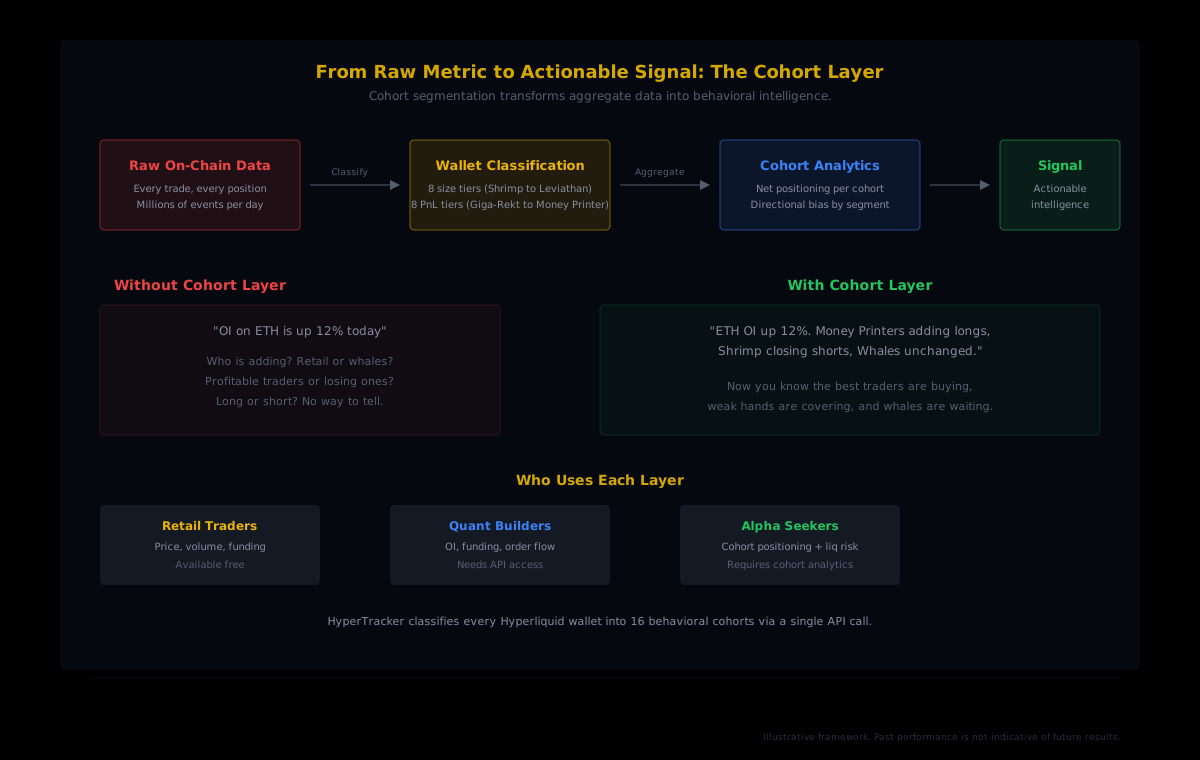
Cohort analytics split the market into behavioral segments. Our data classifies every Hyperliquid wallet into 16 cohorts: 8 by account size (from Shrimp at $0-$250 through Fish, Dolphin, Apex Predator, Small Whale, Whale, Tidal Whale, up to Leviathan at $5M+) and 8 by all-time profitability (from Giga-Rekt at below -$1M through Full Rekt, Semi-Rekt, Exit Liquidity, Humble Earner, Consistent Grinder, Smart Money, up to Money Printer at +$1M+).
This transforms every aggregate metric. OI is no longer just a number. It is a matrix of who added what. Funding rate is no longer just a percentage. It is a map of which segments are paying and which are collecting. The same data that every dashboard shows, filtered through a behavioral lens, becomes a fundamentally different (and more actionable) signal.
The key question cohort analytics answers: Is the smart money doing the same thing as everyone else, or are the experienced wallets and the retail crowd on opposite sides of the trade?
When cohorts diverge, something is happening that aggregate metrics cannot see. And because Hyperliquid is fully on-chain, every wallet's history is verifiable, which means the cohort classifications are based on auditable behavior, not self-reported labels.
Metric 5: Liquidation Risk Clusters (The Forward-Looking Layer)
The four metrics above describe the market as it exists right now. Liquidation cluster analysis does something different: it maps where forced selling will happen if price reaches certain levels.
Every leveraged position on Hyperliquid has a liquidation price. When price reaches that level, the position is forcibly closed by the protocol. The closing action itself creates additional selling (or buying) pressure, which can push price further into other liquidation zones, triggering a cascade.
Liquidation cluster analysis aggregates the liquidation prices of all open positions and visualizes where the density is highest. These dense zones act as price magnets: markets tend to move toward pockets of concentrated liquidation because there is profit to be made by triggering them.
This is the most forward-looking metric in the stack because it answers a question the others cannot: "If price moves to X, what happens mechanically?" It is also the hardest to compute. You need position-level data across the entire exchange, you need to calculate liquidation prices based on each position's leverage and entry, and you need to aggregate that in real time.
Pairing Liquidation Clusters with Cohort Data
Liquidation clusters on their own tell you where forced selling is concentrated. Combined with cohort data, they tell you whose positions are at risk. A cluster of liquidations from Leviathan wallets at a specific price level implies a different market impact than the same notional value from thousands of Shrimp accounts.
Large wallets being liquidated can move markets. Small wallets being liquidated is noise that the market absorbs without much reaction. Knowing the composition of a liquidation zone, not just its size, is what separates actionable intelligence from another heatmap.
What to Ignore (The Noise List)
If five metrics matter, the corollary is that dozens do not. Not because the underlying data is wrong, but because they duplicate signals or measure things that do not improve your decision-making.
Metrics that feel useful but rarely change behavior:
- 24-hour price change: Already reflected in the candle. You do not need a separate number to tell you that price went up.
- Maker/taker volume split: Interesting for market microstructure research. Irrelevant for most trading decisions.
- Trades per minute: Activity ≠ information. High trade count during a wick means retail panic, not a signal to act on.
- Basis spread to spot: Matters for arbitrageurs running funding carry strategies. For directional traders, funding rate subsumes this.
- Mark vs index price divergence: A risk management metric for the exchange itself. Unless you are worried about ADL events, it is noise.
- Multiple timeframe volume charts: Three views of the same data do not triple your edge. One clean volume visualization is enough.
This is not a critique of the platforms that display these metrics. CoinGlass, Coinalyze, and Artemis all serve legitimate use cases. The point is that traders have limited attention, and spending it on metrics that do not sharpen your thesis costs you the focus to act on the ones that do.
Building the Stack in Practice
The metrics above form a natural hierarchy, and the good news is that you do not need to build the entire stack from scratch.
The bottom two layers, price/volume and basic OI, are free. TradingView, CoinGecko, and CoinGlass all cover them well. Funding rate data is also widely available, though Hyperliquid's hourly cadence means you want a source that updates at that frequency rather than showing 8-hour snapshots from centralized exchanges.
The top two layers, cohort positioning and liquidation cluster analysis, require specialized infrastructure. Classifying every wallet on Hyperliquid into behavioral segments, computing per-cohort net positioning, and aggregating liquidation exposure across the entire exchange in near-real-time is not something you can replicate with a free dashboard. Building the infrastructure yourself from raw RPC data requires significant engineering, ingestion pipelines, and ongoing maintenance.
Skip the Infrastructure, Start with Cohort Intelligence
HyperTracker's API gives you pre-computed cohort analytics, liquidation risk scoring, and order flow data for every asset on Hyperliquid. Sixteen behavioral cohorts, one API call. Plans start at $179/mo.
The practical question for most traders and builders is where to draw the line between free commodity data and paid intelligence. If your strategy is purely technical (chart patterns, support/resistance, breakout trading), the bottom three metrics might be sufficient. If your edge depends on understanding who is positioned where and what happens mechanically at specific price levels, you need the full stack.
The Metric That Matters Most Is the One Everyone Ignores
Every metric in this stack is available in some form. Price is universal. Volume is universal. OI is widely reported. Funding rates are published by every exchange. Even liquidation data is surfaced by several platforms.
The layer that almost nobody uses, because it is the hardest to compute, is cohort positioning. It requires classifying every wallet on the exchange by behavior, computing aggregate positions for each segment, and updating that classification as wallets' track records evolve over time. The reason it matters more than the others is simple: it answers the question that all the other metrics leave open.
OI tells you how much. Funding tells you which direction. Cohort data tells you who. And in a market where the experienced wallets and the retail crowd often take opposite sides of the same trade, knowing who is the entire game.