Funding Rate Carry on Hyperliquid: What the Math Actually Looks Like
By CMM Team - 18-Jun-2026
Funding Rate Carry on Hyperliquid: What the Math Actually Looks Like
A 0.01% hourly funding rate looks like nothing. It is one basis point per hour, a rounding error on most position screens. But multiply it by 8,760 hours in a year and the number becomes roughly 88% APR. That gap between "looks like nothing" and "annualizes to a hedge fund return" is where the funding rate carry trade lives, and where most of the misunderstanding around it starts.
The carry trade is one of the oldest strategies in finance: borrow cheap, lend dear, pocket the spread. On Hyperliquid, the perp funding rate is the spread, and the structure is simple enough to describe in one sentence. But the math between headline APR and what you actually keep is where people get burned.
This article walks through the carry trade on Hyperliquid from first principles: how the funding mechanism works, how to structure the trade, what the annualized math really says (and what it hides), the cost drags that eat into gross yield, when the trade breaks, and how to use cohort positioning data to spot regime changes before the funding rate flips on you.
How funding works on Hyperliquid (the short version)
The funding rate is a periodic payment between longs and shorts that keeps the perpetual contract price tethered to the underlying oracle price. When the perp trades above the index, longs pay shorts. When it trades below, shorts pay longs. The payment scales with how far the perp price has drifted from the index over the funding window.
Hyperliquid settles funding every hour, 24 times per day. The rate is computed on an 8-hour cycle, with each hourly payment equal to one-eighth of the computed rate. That means the per-hour cost is comparable in magnitude to a CEX 8-hour rate divided by eight, but it hits your account three times more frequently than Binance or Bybit's three-daily schedule.
The formula is F = Average Premium Index (P) + clamp(interest rate - P, -0.0005, 0.0005). The premium is sampled every 5 seconds and averaged over the hour. The interest rate component is fixed at 0.01% per 8 hours, or 0.00125% per hour, which annualizes to about 11.6% APR paid to shorts. And funding is capped at 4% per hour, which is the circuit breaker for extreme dislocations.
Your payment per interval is position_size * oracle_price * funding_rate. Oracle price, not mark price. So the bill is consistent regardless of where the perp is trading relative to the index at that specific second.
Structuring the carry trade
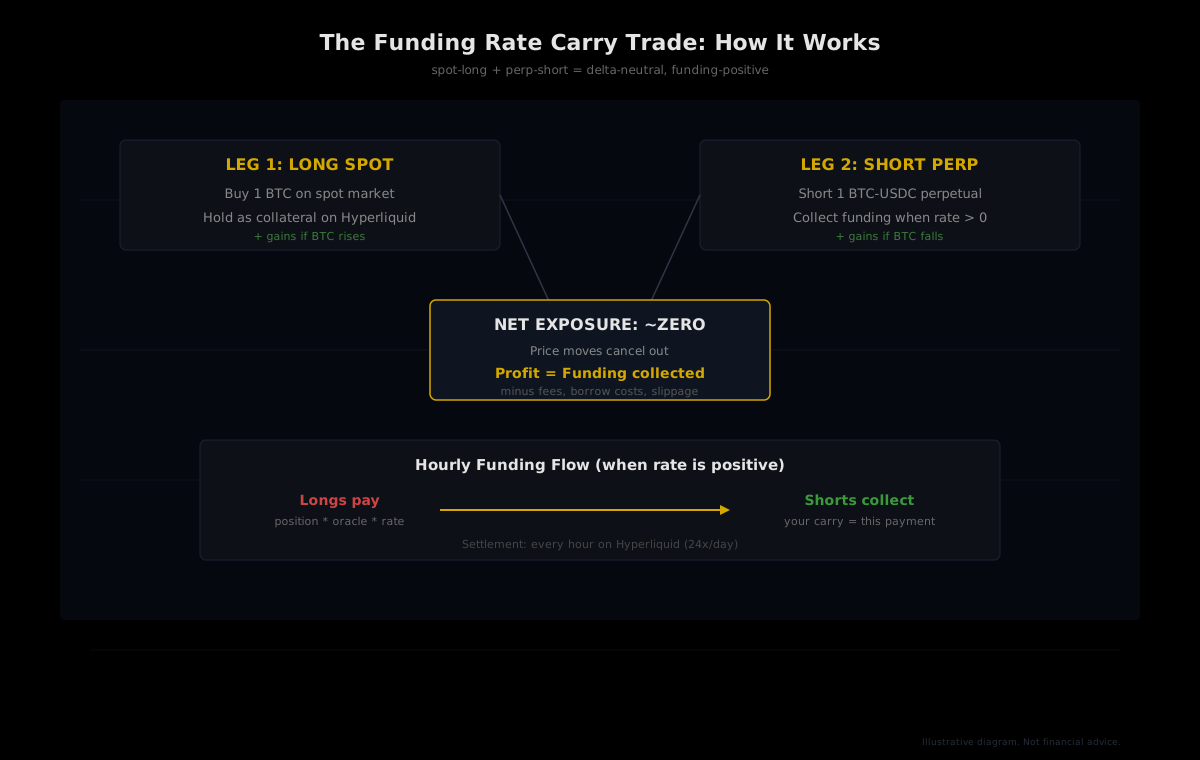
The carry trade is a delta-neutral position that earns the funding rate without taking directional risk on the underlying asset. In its simplest form:
- Buy spot. Hold BTC (or whatever asset) in spot on Hyperliquid or an external venue.
- Short the perp. Open a short perpetual position of the same notional size on Hyperliquid.
- Collect funding. When funding is positive (longs paying shorts), your short perp collects hourly payments. The spot leg hedges the directional exposure, so if BTC goes up, the spot gain offsets the perp loss, and vice versa.
The profit is the net funding collected, minus all costs. In theory, the position is market-neutral. In practice, the neutrality is approximate, because the spot and perp legs don't always move in perfect lockstep, and there are real costs at every step of the way.
Hyperliquid's portfolio margin advantage
Hyperliquid's portfolio margin system makes the carry trade significantly more capital-efficient because spot and perp positions offset each other for margin purposes. You can hold BTC spot and short BTC perp from a single unified balance without maintaining separate collateral pools. There is no trading cost to rebalance over significant price ranges, which means you can let the position run through large price moves without manually adjusting margin.
That is a meaningful edge over running the same trade with the spot leg on a CEX and the perp leg on Hyperliquid, where you would need to manage two separate margin pools and worry about cross-venue settlement timing during volatile moves.
The annualization trap
Here is where the funding rate carry trade goes from "interesting" to "needs a spreadsheet." The headline math is seductive but misleading if you don't decompose it properly.
Hyperliquid computes funding on an 8-hour cycle, paid in hourly installments. To annualize:
- Take the 8-hour rate and multiply by 1,095 (3 periods per day × 365 days)
- Or take the hourly rate and multiply by 8,760 (24 hours × 365 days)
Both yield the same number. An 8-hour rate of 0.01% (the interest rate baseline) annualizes to about 11% APR. An hourly rate of 0.01%, which would mean an 8-hour rate of 0.08%, annualizes to roughly 88% APR. A 0.02% hourly rate annualizes to about 175% APR. These are real numbers that appear on real screens, and they are technically correct. They are also misleading for one critical reason: the rate does not persist.
Funding rates are driven by the premium index, which moves with trader positioning. When longs are crowded, funding is high. When positioning flattens, funding drops. When the market flips, funding can go negative, meaning you start paying instead of collecting. The annualization assumes a constant rate for 8,760 hours straight, which has never happened in the history of any perp exchange.
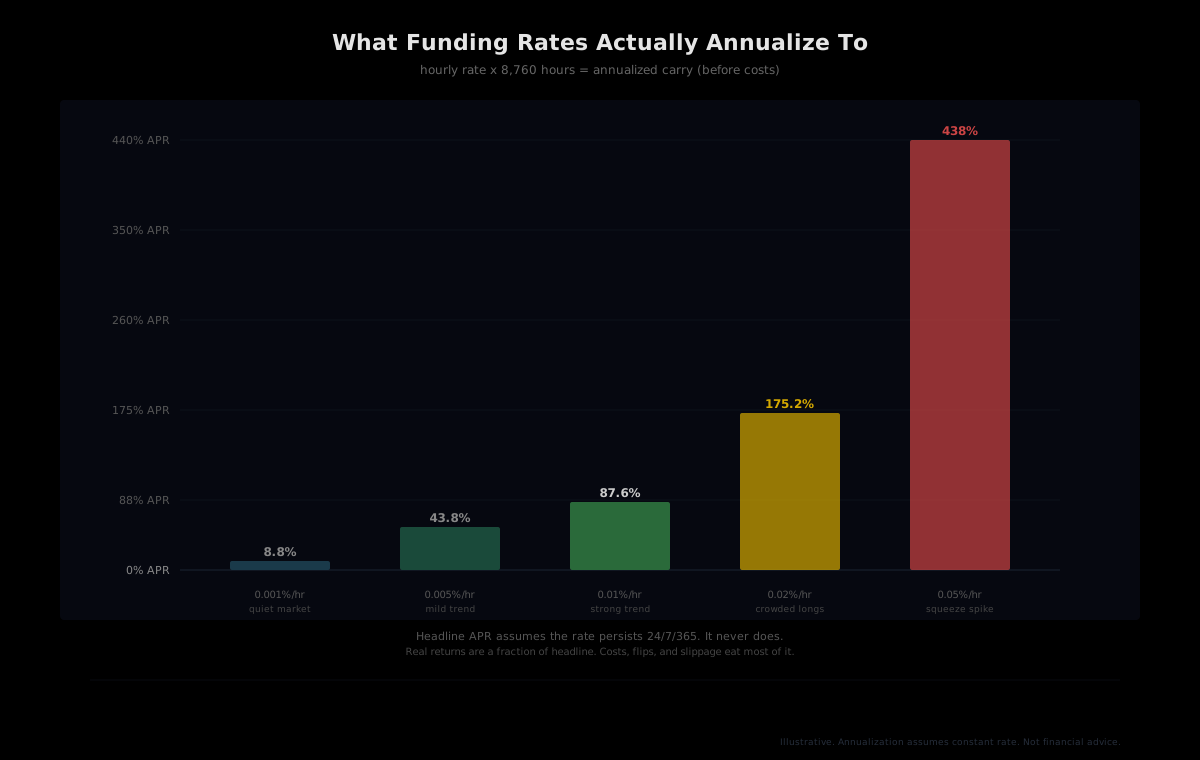
The annualized rate is a snapshot, not a forecast. Treat it as a measure of how hard the market is leaning right now, not as a prediction of how much you will earn over 12 months. The carry trader's actual return is the time-weighted average of every hourly funding payment across the life of the trade, minus all costs.
The cost drags most people ignore
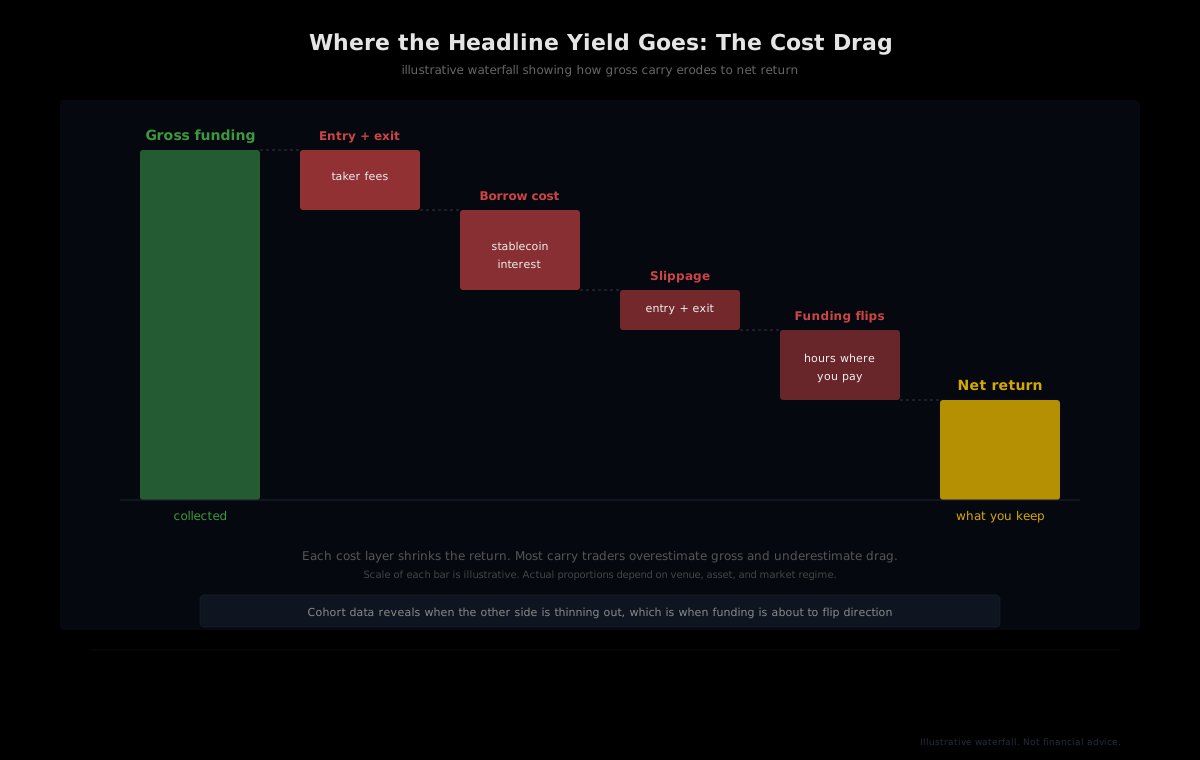
The gap between gross funding collected and net profit kept is where the carry trade either works or doesn't. Here are the cost layers, in order of impact:
Entry and exit fees. You need to open and close both legs of the trade. Taker fees on Hyperliquid perps range from 0.024% to 0.045% depending on your rolling 14-day volume tier. On a round trip (open + close, both legs), you could pay roughly 0.10% to 0.18% in trading fees. If you are collecting 0.01% per hour in funding, it takes 10 to 18 hours just to break even on the entry cost. That means the trade needs to persist long enough for the funding to cover the fixed cost of getting in.
Borrow costs. If you are borrowing stablecoins to fund the spot leg (or borrowing spot to run the trade on portfolio margin), there is a borrowing interest rate. Hyperliquid's stablecoin borrow rate follows a utilization curve that can spike when demand for borrowing is high. That cost directly reduces your net carry.
Slippage. Market orders create slippage. On liquid pairs like BTC and ETH, this is small. On thinner perps, the slippage on a reasonably sized entry can eat a full day's funding.
Funding flips. This is the biggest variable cost and the one that separates profitable carry traders from everyone else. If funding flips negative while you are short the perp, you start paying instead of collecting. The longer your trade is on, the more exposed you are to a regime change, and you will not know in advance when it happens. What you can do is watch for the conditions that typically precede a flip.
When the carry trade breaks
The carry trade is not a passive strategy. It has specific failure modes that are worth naming clearly:
Sudden leverage spikes. If a sharp move forces one side to delever quickly, the mark price can gap away from the oracle price, creating temporary unrealized loss on the perp leg that exceeds the hedge on the spot leg. Under portfolio margin, this can compress your margin ratio toward the 0.95 liquidation threshold faster than you expect.
Extended negative funding. Sometimes the regime changes and stays changed. Funding can remain negative for days or weeks during a prolonged bearish period, which means your short perp is now costing you money every hour instead of earning it. The carry trade is only profitable when funding is net positive over the holding period, and you need to decide in advance how many hours of negative funding you are willing to absorb before closing.
Spot-perp basis divergence. If you are running the spot leg on a different venue, prices can diverge temporarily during high-volatility events. The delta between the two legs is supposed to be zero, but it can widen during congestion, exchange downtime, or bridge delays. This is less of a problem if both legs are on Hyperliquid under portfolio margin, which is one of the structural advantages of doing the entire trade on-chain.
Oracle dislocations. Funding payments use the oracle price, and if the oracle temporarily deviates from the actual market price, funding can behave unpredictably for that interval. This is rare, but it is a mechanical risk that exists in any oracle-dependent system.
Using cohort data to spot regime changes
The hardest part of the carry trade is not setting it up. It is knowing when to get out. Funding flips from positive to negative when positioning shifts, specifically when the crowded long side begins to unwind or the short side starts building. The signal is in the positioning data, and it shows up before the funding rate moves.
Our data classifies every wallet on Hyperliquid into one of 16 behavioral cohorts: 8 by account size (from Shrimp at under $250 to Leviathan at $5M+) and 8 by all-time PnL (from Giga-Rekt to Money Printer). Because the cohorts are computed from perp equity and all-time performance, they reveal who is on each side of the trade. When carry traders watch for a funding regime change, the question is really "who is driving the current imbalance, and are they leaving?"
A few patterns to watch:
- Smart Money (cohort: +$100K to $1M all-time PnL) reducing long exposure while retail cohorts stay long is often a leading indicator that the long side is about to thin out. When the experienced side exits first, funding compression follows, because the premium that sustains high positive funding depends on the balance of capital, not just the count of positions.
- Whale and Tidal Whale (cohorts: $500K-$5M account size) flipping net short is a structural signal. Large accounts moving to the short side increase the demand for funding payments from longs, which tends to keep funding elevated in the short term. But if it is a sustained move rather than a hedge, it can precede a broader positioning shift.
- Retail cohorts (Shrimp, Fish) piling in on one side tends to be a contrarian signal for experienced carry traders. Heavy retail positioning on one side often marks the peak of a funding regime, because retail flow is typically late and the most sensitive to a reversal.
None of these signals are deterministic. But they add context that a raw funding rate number alone does not provide. The funding rate tells you the cost of the current imbalance. Cohort positioning tells you whether the imbalance is stable or fragile.
Monitor cohort positioning shifts in real time
HyperTracker's API delivers 16 behavioral cohorts, segment-level positioning, and order flow data with a 5-minute refresh cycle. Build the positioning monitors that let you see regime changes before they show up in the funding rate.
Practical checklist for running the trade
If you are considering the carry trade on Hyperliquid, here is what the setup looks like in practice:
- Choose your asset. BTC and ETH have the deepest liquidity and tightest spreads, which minimizes slippage. Smaller perps can offer higher funding rates, but the execution costs scale up quickly.
- Check the funding regime. Look at the trailing 24-48 hours of funding history, not just the current rate. You want to see sustained positive funding, which suggests a durable long-side imbalance. A single-hour spike is not a trade signal.
- Size relative to liquidity. Your entry should not move the market. If your position is large enough to impact the perp's premium on entry, you are paying yourself a worse funding rate. For most traders, staying well within the top-of-book liquidity is the right approach.
- Use portfolio margin if eligible. The unified collateral model eliminates cross-venue settlement risk and reduces capital requirements. Eligibility requires either over $5M in weighted volume or over $10K in account value.
- Define your exit conditions. Before entering, decide: how many consecutive hours of negative funding will you tolerate? What is your minimum acceptable net APR after costs? What cohort positioning shift would trigger a close? Write these down. The carry trade is mechanical, and the exit should be too.
- Monitor costs in real time. Track your net carry (gross funding minus borrow costs, minus accumulated fees) per day, not just the headline rate. If net carry turns negative for more than your threshold, close the position.
The carry trade is a business, not a trade
The funding rate carry trade on Hyperliquid is structurally simple and mathematically appealing. One basis point per hour, 88% APR, delta-neutral. The pitch writes itself. But the pitch hides the operational reality: carry trading is an infrastructure business. It requires continuous monitoring, real-time cost tracking, regime detection, and disciplined exits.
The traders who run this profitably treat it like a business with thin margins and high volume. They know their all-in cost per hour. They know exactly what positioning shift will cause the rate to flip. They have automation watching the trade around the clock, because a carry position that is not monitored is a carry position that can quietly bleed money during the hours you are not looking.
Hyperliquid's hourly settlement, portfolio margin integration, and on-chain transparency make it one of the more structurally sound venues for this kind of trade. The mechanics are clean. The question is always whether the trader running the strategy is equally clean about the costs, the risks, and the exit.
The funding column on a Hyperliquid screen is just a number. What you build around that number determines whether it is revenue or tuition.