Funding Rate Arbitrage on Hyperliquid: Where the Real Edge Hides
By CMM Team - 24-Jun-2026
Funding Rate Arbitrage on Hyperliquid: Where the Real Edge Hides
Funding rate arbitrage is one of the oldest delta-neutral strategies in crypto derivatives. The concept is simple: exploit the spread between funding rates on different venues, collect the difference, and walk away market-neutral. But the gap between "simple concept" and "profitable execution" is where most traders lose money, because the costs hiding inside the trade are rarely obvious until the P&L hits.
Hyperliquid has changed the calculus for this strategy in a specific, structural way. Its hourly funding settlement creates rate dynamics that diverge from the 8-hour cadence used by Binance, Bybit, and most other CEXes. That divergence is the spread. But whether you can actually capture it depends on understanding the fee math, the settlement mechanics, and the positioning signals that warn you when a regime shift is about to flatten your carry.
This piece breaks down the cross-venue funding arb between Hyperliquid and centralized exchanges: how the mechanics work, what the real cost structure looks like, and how cohort data from our API can flag the moments when the trade stops working.
How Cross-Venue Funding Arbitrage Works
The standard funding rate arbitrage uses two legs. On a single exchange, the classic version is long spot, short perp: you hold the asset and short the perpetual contract against it, collecting funding when longs pay shorts. Price moves cancel out because your spot position offsets the perp.
Cross-venue funding arbitrage is a variation. Instead of hedging with spot, you take opposite perp positions on two different exchanges. Go long on the venue with the lower funding rate, go short on the venue with the higher rate, and collect the spread between them. The directional risk cancels because your longs and shorts are equal in size. The profit comes purely from the rate differential.
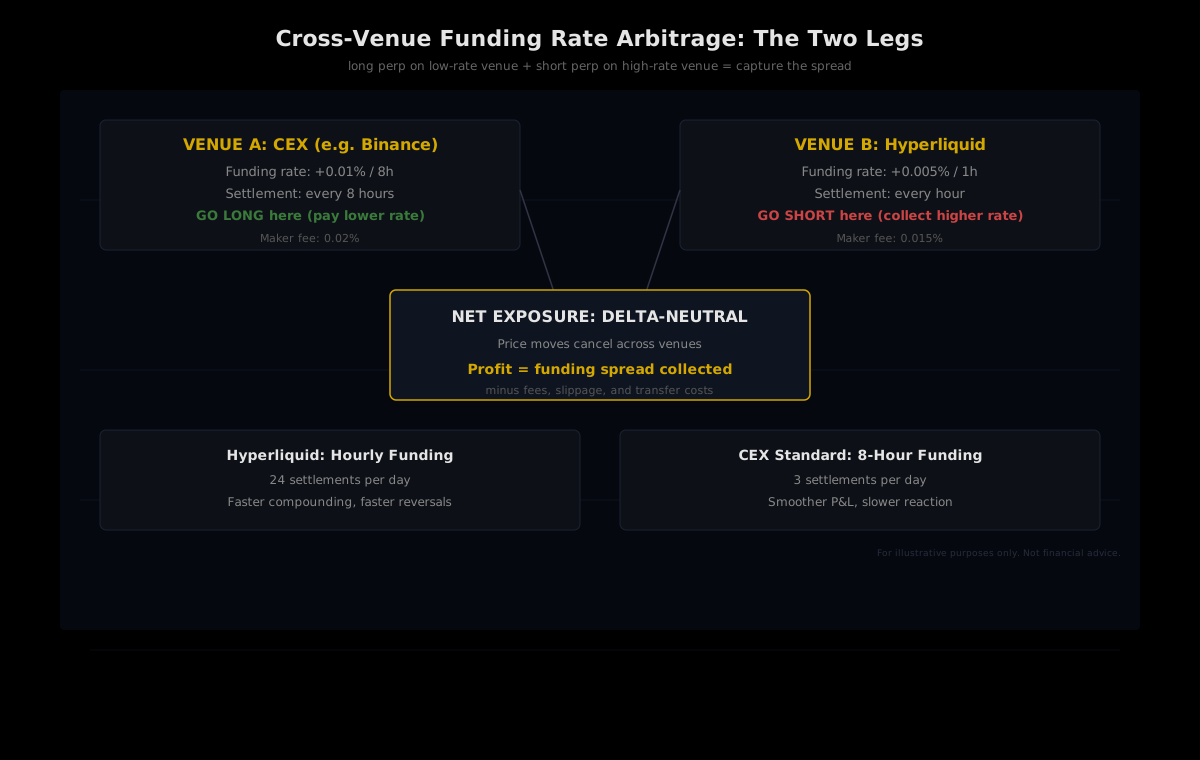
Why does the spread exist at all? Different exchanges have different user bases, different liquidity depth, and different market maker inventory conditions. Binance's massive retail flow tends to be long-biased in bull markets, pushing its funding rate higher. Hyperliquid's on-chain trader base, which skews more toward sophisticated participants, can price funding differently because the crowd composition is different.
The Settlement Cadence Gap
The most important structural difference between Hyperliquid and CEXes is settlement frequency. According to Hyperliquid's documentation, "funding is paid every hour at one eighth of the computed rate for each hour." That means 24 settlements per day, compared to three on Binance or Bybit (every 8 hours).
This distinction matters more than it looks. A 0.01% hourly rate on Hyperliquid is roughly equivalent to a 0.08% rate on Binance's 8-hour window, because you are paid (or charged) eight times per Binance interval. In calm markets, the net daily effect is similar. But during trending conditions where funding stays persistently directional, hourly compounding makes the economics different.
There is also a tactical wrinkle: positions opened and closed within the same hour on Hyperliquid pay no funding at all. That creates opportunities for short-duration trades that avoid the cost entirely.
The Fee Math That Eats Your Edge
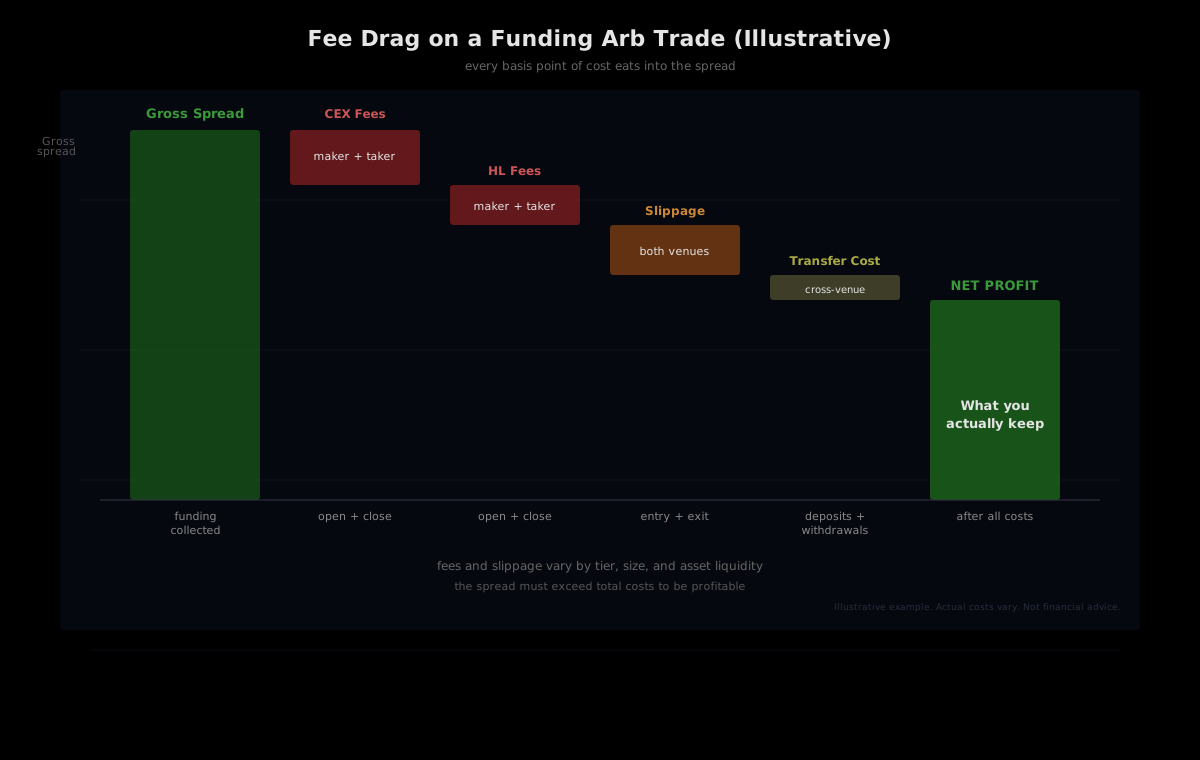
The single biggest mistake in funding arb is ignoring the all-in cost structure. The gross funding spread can look attractive on a screener, but fees, slippage, and transfer costs often consume most of it. Here is the real cost stack.
Trading Fees Across Venues
Opening and closing positions on two exchanges means paying fees four times: once to open each leg and once to close each leg. The maker and taker rates differ by venue.
| Venue | Maker Fee | Taker Fee | Funding Interval | | --- | --- | --- | --- | | Hyperliquid (base tier) | 0.015% | 0.045% | Hourly | | Binance (USDT-M base) | 0.02% | 0.05% | 8-hour | | Bybit (base) | ~0.02% | ~0.055% | 8-hour |
Hyperliquid undercuts CEXes on both sides at base tier: 0.015% maker versus 0.02% on Binance, and 0.045% taker versus 0.05%. For a full round-trip on both venues using maker orders, the combined fee load is roughly 0.07% (Hyperliquid open + close at 0.015% each, plus Binance open + close at 0.02% each). That is the minimum cost just to enter and exit the trade, before slippage or anything else.
Slippage and Size Constraints
Maker orders reduce fees but introduce execution risk: your order may not fill if the market moves away. Taker orders guarantee fills but cost more. In practice, most arb trades use a mix, which means the effective fee sits somewhere between the maker and taker rates on each venue.
Slippage is the larger concern at scale. On major pairs (BTC, ETH), smaller positions face minimal slippage on both venues. But as size increases, the order book's depth on Hyperliquid becomes the binding constraint. The spread may look profitable at screen size, but the fills degrade as you scale up. Slippage compounds because you pay it on both legs.
The break-even check: Before entering any funding arb, add up your round-trip fees on both venues and estimate slippage. If the expected funding spread over your holding period does not clearly exceed that number, the trade is not worth taking.
Transfer and Opportunity Costs
Cross-venue arb requires capital on two platforms. Unlike single-venue spot-perp arb, you cannot deploy all your capital to one place. If the trade requires rebalancing (moving margin from the winning leg to the losing leg as the price moves), transfer times and costs add friction.
Hyperliquid charges a flat fee per withdrawal (roughly $1 USDC). CEX withdrawal fees vary by network and asset. These costs are small per transfer but add up if you rebalance frequently.
The more subtle cost is opportunity. Capital locked in a delta-neutral funding arb earns the spread, but it cannot be deployed elsewhere. When the spread compresses to a few basis points annually, the opportunity cost of tying up capital becomes the dominant factor.
Hyperliquid's Funding Rate Formula
Understanding how Hyperliquid computes its rate helps you predict when spreads will widen or compress. According to the protocol's documentation, the formula is:
Funding Rate (F) = Average Premium Index (P) + clamp(interest rate - P, -0.0005, 0.0005)
The premium index measures the gap between Hyperliquid's mark price and an external spot oracle blended from several reference exchanges. When the perp trades above the oracle (bullish positioning), the premium is positive, funding is positive, and longs pay shorts. The interest rate component is fixed at 0.01% per 8 hours (equivalent to 0.00125% per hour).
The clamp function limits the interest rate adjustment to plus or minus 0.0005 per hour, which prevents extreme spikes. But the overall rate itself is capped at 4% per hour, a ceiling that is rarely hit but exists as a circuit breaker.
One critical detail: the oracle price, not the mark price, is used to convert position size to notional value for funding calculations. This means funding payments reflect the true market price rather than any exchange-specific premium, which keeps the calculation cleaner for cross-venue comparisons.
When the Trade Works (And When It Stops)
Funding rate arbitrage is not a set-and-forget strategy. The spread between venues fluctuates constantly, and the conditions that make it profitable can vanish in hours. The question is not just "is there a spread right now?" but "will this spread persist long enough to exceed my costs?"
Conditions That Support the Spread
Sustained funding differentials between Hyperliquid and CEXes tend to appear during periods of strong directional conviction. When retail traders on CEXes crowd into leveraged longs, the CEX funding rate gets pushed higher. If Hyperliquid's more sophisticated user base is less aggressively long (or even short-biased), the gap widens.
New token listings create temporary but large spreads. A token listed on Hyperliquid but not yet on a major CEX (or vice versa) can have funding rates untethered from the cross-venue equilibrium. These windows are short, but the rates can be extremely elevated because there are fewer arbitrageurs competing to close the gap.
Conditions That Kill the Spread
Funding reversals are the primary risk. A rate that was paying you can flip to charging you, and on Hyperliquid's hourly cadence, you will feel it fast: 24 times per day rather than three. If you are short on Hyperliquid and the rate flips negative (shorts pay longs), every hour erodes your position instead of building it.
Liquidation cascades on one venue can also blow up the trade. A sharp price move may liquidate your long leg on the CEX while leaving the Hyperliquid short leg untouched. Your "delta-neutral" book is now a naked short, and the losses compound quickly. Cross-venue arb inherently carries this risk because margin is isolated to each platform.
Using Cohort Data as an Early Warning System
Here is where the strategy gets more interesting for builders and systematic traders. The structural imbalance that drives funding rates, lots of longs paying shorts or vice versa, does not appear out of nowhere. It builds up as different segments of the market take positions. And those segments are visible in cohort analytics.
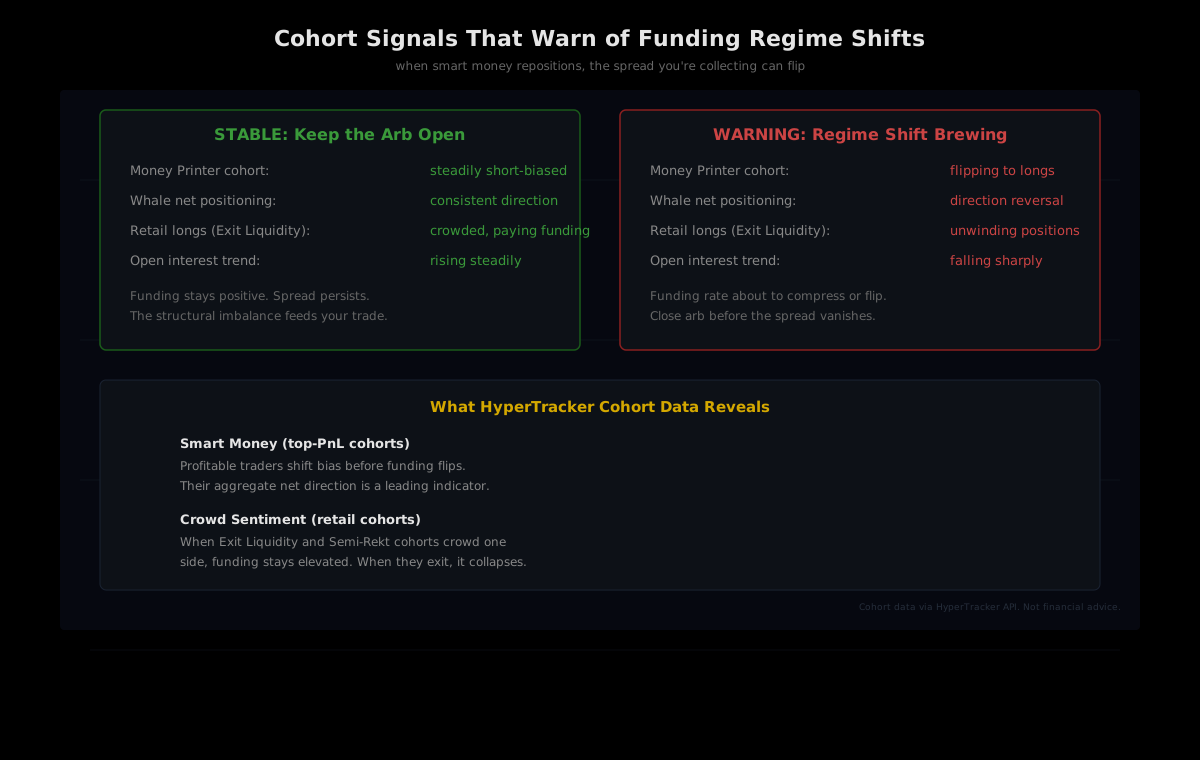
Our API classifies every Hyperliquid wallet into one of 16 behavioral cohorts: 8 by size (from Shrimp at $0-$250 all the way up to Leviathan at $5M+) and 8 by all-time PnL (from Money Printer at +$1M+ down to Giga-Rekt below -$1M). This classification is updated every 5 minutes and available through a single API call.
Smart Money as a Leading Indicator
The top-PnL cohorts (Money Printer and Smart Money) tend to adjust their positioning before funding rates shift. When these wallets collectively move from net short to net long, the funding rate on Hyperliquid often compresses or reverses shortly afterward, because the flow dynamics that were sustaining the rate are changing.
For a funding arb trader, this is a timing signal. If you are collecting funding on the short side and the Money Printer cohort starts flipping long, it may be time to close the trade before the spread disappears. You do not need to predict the rate; you need to see who is moving and in which direction.
Retail Crowd as a Persistence Signal
Conversely, our retail-loss cohorts (Exit Liquidity, Semi-Rekt) act as a persistence indicator. When these segments are heavily crowded on one side of the market, the funding rate tends to stay elevated because the directional pressure from these wallets sustains the imbalance. As long as the crowd keeps piling in, the spread keeps paying.
The warning sign is when retail starts unwinding. A sharp drop in the number of wallets in these cohorts holding longs, combined with falling open interest, signals that the structural imbalance feeding your arb trade is dissolving. Exit before the crowd does.
Build Funding Arb Signals with Cohort Data
HyperTracker's API gives you 16 behavioral cohorts, smart money positioning, and order flow snapshots refreshed every 5 minutes. Use cohort bias shifts as leading indicators for funding regime changes. Start with a free tier (100 requests/day) or go to Pulse ($179/mo) for systematic polling.
Practical Considerations for Execution
If you are building a systematic funding arb strategy rather than doing it manually, there are several engineering decisions that affect performance.
Monitoring Rate Divergences
You need a feed that normalizes rates across venues. Comparing a 0.005% hourly rate on Hyperliquid against a 0.03% 8-hour rate on Binance requires converting both to the same time window before assessing the spread. Tools like CoinGlass and Hyperliquid's own funding comparison page show cross-venue rates side by side. For automated systems, pulling rates from both APIs and normalizing them in code is more reliable.
Margin Management Across Venues
Because your margin is split between two platforms, a price move in either direction will draw down margin on the losing leg while building surplus on the winning leg. You need a rebalancing threshold: at what point do you move capital between venues to prevent a margin call? Automated rebalancing is ideal but adds operational complexity, especially when transfers take time.
Hyperliquid's on-chain settlement means withdrawals are fast (typically minutes), but CEX withdrawals can take longer depending on the network and any manual review requirements. During volatile periods, exchanges may pause withdrawals entirely.
Exit Triggers
Define your exit conditions before entering. Common triggers include: the funding spread compresses below your cost threshold, open interest drops significantly (suggesting the crowd is leaving), or cohort data shows smart money repositioning against your trade. Automated exits based on these triggers are more reliable than manual monitoring, especially given Hyperliquid's hourly cadence.
The Honest Edge Assessment
Cross-venue funding arbitrage between Hyperliquid and CEXes is a real strategy with a real, if narrow, edge. The structural difference in settlement frequency (hourly versus 8-hour) creates persistent micro-spreads that can be captured systematically. The lower fee structure on Hyperliquid (0.015% maker versus 0.02% on Binance) helps, because every basis point of cost reduction directly improves net returns.
But the edge is narrow, and the risks are real. Funding reversals can erase days of accumulated carry in a single session. Liquidation risk from split margin is a structural hazard that no amount of monitoring eliminates entirely. And as more participants run this strategy, the spreads compress toward zero, because that is what arbitrage does.
The traders who sustain profitability in this space tend to be the ones with the best information about positioning. They know when the crowd is overleveraged and the spread will persist. They know when smart money is shifting and the window is closing. That positioning intelligence is the real edge, more than any rate differential on a screener.
Funding rate arbitrage does not reward the fastest bot or the highest leverage. It rewards the trader who knows when to be in the trade and, more importantly, when to get out.