
When Every Cohort Agrees, the Market Is About to Move
By CMM Team - 21-Jun-2026
When Every Cohort Agrees, the Market Is About to Move
The most dangerous moment in a perp market is when nobody disagrees. Money Printers are long. Exit Liquidity is long. The Grinders, the Rekt wallets, the Smart Money cohort: all leaning the same direction, all positioned for the same outcome. The heatmap goes monochrome. And then the market does exactly what a monochrome heatmap predicts: it reverses.
Cohort consensus is a regime signal. When every behavioral segment on Hyperliquid converges on the same directional bias, you are not looking at strength. You are looking at a crowded trade. The question is whether you can spot the convergence before it snaps back.
This article breaks down how to read aggregate cohort sentiment as a market regime filter: what cohort agreement looks like on a heatmap, why consensus is a contrarian signal in perp markets, how to measure the degree of agreement across segments, and what to do when you see it forming.
Why most sentiment indicators miss the mark
Traditional crypto sentiment tools reduce the entire market to a single number. The Fear and Greed Index takes volatility, momentum, social buzz, and dominance, runs them through a blender, and outputs a score from 0 to 100. It is useful in a broad, "vibes check" kind of way. It is also blind to the structural question that actually matters for perp traders: who is positioned, and do they agree?
A Fear and Greed reading of 75 (greed) tells you the crowd is optimistic. But it does not tell you whether that optimism is driven by high-conviction whales with strong track records, or by overleveraged retail wallets that will be the first to liquidate when price ticks against them. Those two scenarios require completely different responses. One is a trend-following setup. The other is a reversal waiting to happen.
Cohort-level sentiment fills that gap. Instead of one number, you get 16 independent readings, each reflecting the aggregate directional bias of a behaviorally distinct group of traders. When those 16 readings disagree, the market is expressing genuine uncertainty, which is healthy. When they converge, you have consensus, and in leveraged markets, consensus is fuel for the next violent move.
The 16-cohort framework on Hyperliquid
Our cohort system classifies every active wallet on Hyperliquid into one of 16 behavioral segments. Eight are based on account size (perp equity), and eight are based on all-time realized PnL. Each cohort captures a distinct trading personality with its own risk appetite, holding patterns, and historical accuracy.
Size cohorts
These run from Shrimp ($0 to $250 in perp equity) through Fish, Dolphin, Apex Predator, Small Whale, Whale, and Tidal Whale, all the way up to Leviathan ($5M+). The size dimension tells you how much capital is behind a directional lean. When Leviathans go long, the notional weight behind that bias is orders of magnitude larger than when Shrimp go long, even if both cohorts show the same directional label on the heatmap.
PnL cohorts
These range from Money Printer (+$1M all-time PnL) and Smart Money (+$100K to $1M) down through Consistent Grinder, Humble Earner, Exit Liquidity, Semi-Rekt, Full Rekt, and Giga-Rekt (below -$1M). The PnL dimension tells you how good these traders are, historically. A long bias from the Money Printer cohort carries different information than a long bias from Exit Liquidity, because the former has a demonstrated edge and the latter has a demonstrated tendency to be on the wrong side.
This two-axis classification creates a positioning matrix. You can see that high-equity, high-PnL wallets are going one way while low-equity, negative-PnL wallets are going the other. That divergence is signal. And when the divergence collapses into agreement, that is signal too, just a very different kind.
What cohort consensus actually looks like
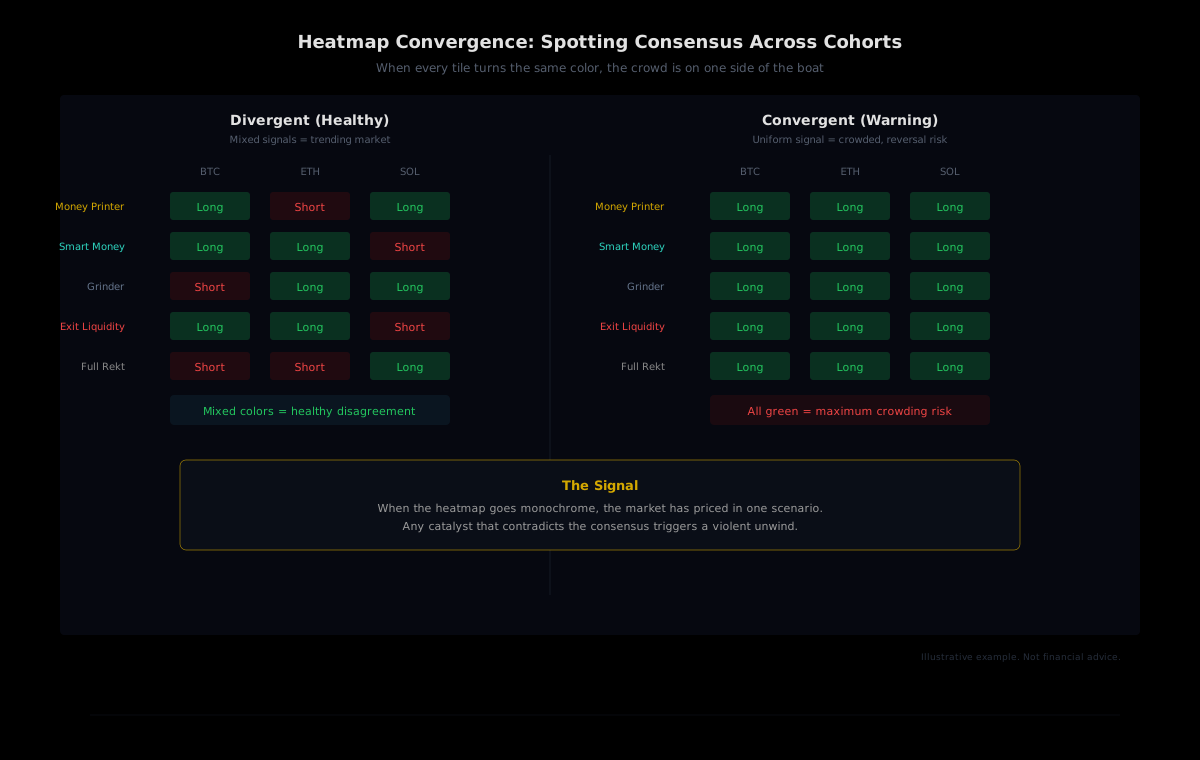
On a standard day, the heatmap is a mix of greens and reds across rows and columns. Money Printers might be long BTC while Full Rekt wallets are short it. Smart Money could lean short on ETH while Grinders are leaning long. The color patchwork is the market doing its job: price discovery through disagreement.
Consensus looks different. The heatmap tilts toward a single color. Across BTC, ETH, SOL, and the major perps, you see green from top to bottom, or red from top to bottom. The PnL cohorts agree with each other. The size cohorts agree with the PnL cohorts. The entire Hyperliquid open interest, segmented into 16 behavioral buckets, points in one direction.
The key insight: Agreement across cohorts with different historical accuracy is the strongest version of this signal. When Money Printers (who are usually right) and Exit Liquidity (who are usually wrong) are both positioned the same way, at least one group is about to get punished. And when the trade unwinds, the less-skilled cohort typically exits first, creating a cascading move.
This is why consensus in a perp market is fundamentally different from consensus in a spot market. In spot, widespread bullishness can sustain itself because there is no forced seller. In perps, every levered position has a liquidation price. When too many positions cluster on the same side, the fuel for a squeeze builds on the opposite side, and it takes progressively less force to trigger the cascade.
Measuring agreement: from heatmap glance to structured filter
Eyeballing the heatmap works for quick reads, but a systematic regime filter requires a more structured approach. Here is a conceptual framework for quantifying cohort agreement:
Step 1: Extract cohort-level bias
For each of the 16 cohorts and each major asset, our data provides the aggregate directional lean: net long or net short. You can pull this via the HyperTracker API's cohort metrics endpoint, which returns positioning data per segment.
Step 2: Calculate agreement ratio
Count how many of the 16 cohorts lean the same direction on a given asset. If 12 out of 16 are long BTC, the agreement ratio is 75%. If all 16 lean long, it is 100%. The higher the ratio, the more uniform the positioning.
Step 3: Weight by PnL tier
A flat count treats Money Printer and Giga-Rekt as equal signals, which misses the point. Weight the agreement by historical accuracy: give higher-PnL cohorts more influence. If only the top four PnL cohorts (Money Printer, Smart Money, Consistent Grinder, Humble Earner) agree with each other but disagree with the bottom four, the weighted agreement is moderate, and the signal is to follow the smart money side. If all eight PnL cohorts agree, weighted agreement is maximal, and crowding risk is elevated regardless of direction.
Step 4: Map to regime
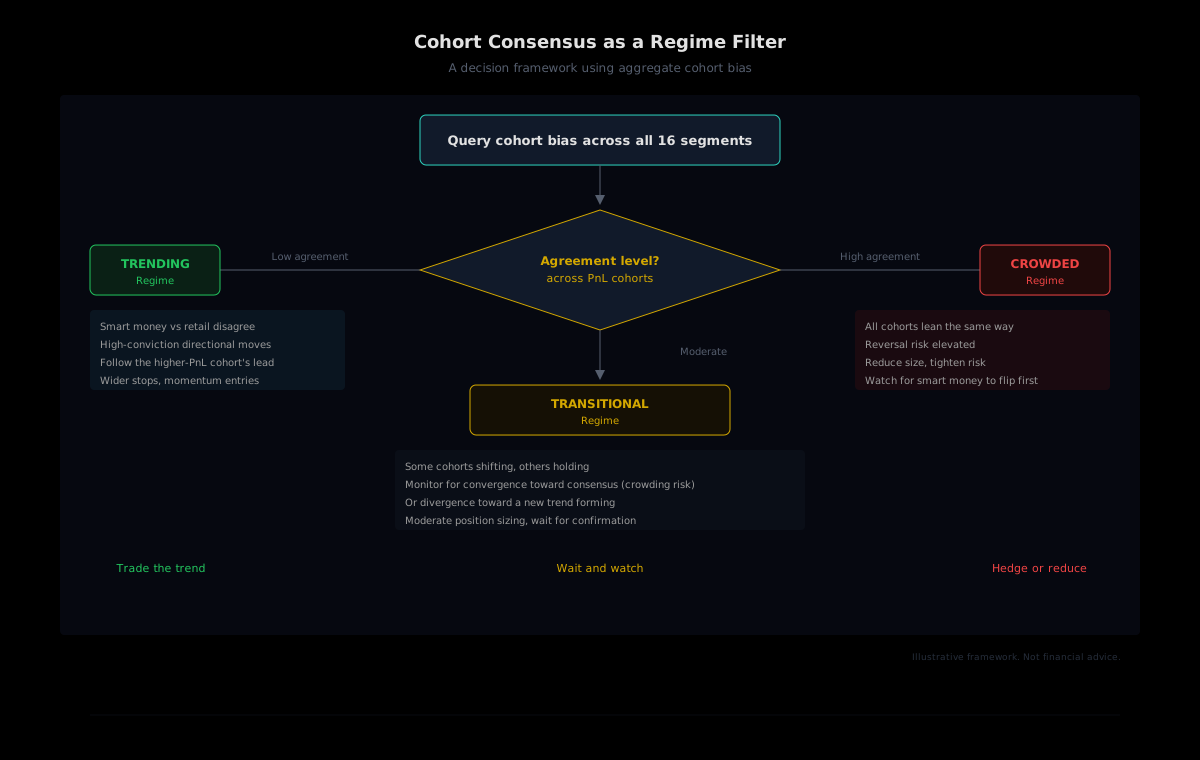
| Agreement Level | Regime Label | Implication | | --- | --- | --- | | Below 50% | Divergent | Active disagreement. Trending market. Trade with the higher-PnL cohort's lean. | | 50% to 75% | Transitional | Some cohorts shifting. Watch for convergence (crowding) or divergence (new trend). | | Above 75% | Consensus | Crowded positioning. Reversal risk elevated. Reduce size, tighten stops. |
These thresholds are illustrative starting points. Adjust based on your risk tolerance, strategy timeframe, and how you define "agreement" for your use case.
The convergence-to-reversal pattern
Markets do not flip from divergent to consensus overnight. The progression has a rhythm, and recognizing where you are in that rhythm is the core value of this filter.
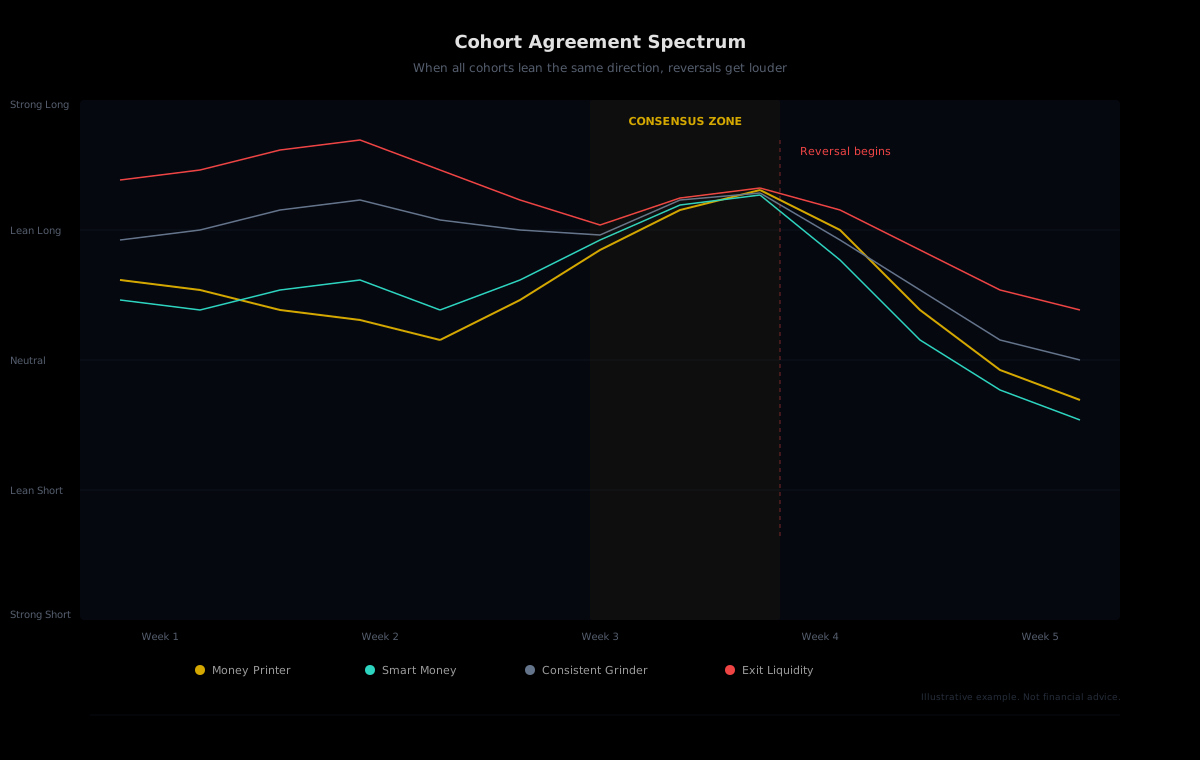
It typically starts with the lower-PnL cohorts chasing a move. Price pushes in one direction, and the less-experienced traders pile on. Exit Liquidity, Semi-Rekt, and Full Rekt wallets add to the winning side, often with higher leverage than the cohorts that initiated the move. As they join, the heatmap shifts. What was a two-tone picture becomes increasingly monochrome.
The middle stage is when mid-tier cohorts (Grinders, Humble Earners) align with the crowd. At this point, the agreement ratio crosses the 75% threshold. The move may still have momentum, but the marginal buyer (or seller) is now the weakest participant. Every new position added to the consensus side is capital that will exit fastest under stress.
The late stage is when even the top PnL cohorts stop adding to the direction and start flattening or flipping. This is the divergence that precedes the reversal: smart money quietly exits the consensus trade while the rest of the market is still piling in. On the heatmap, you will see the top two or three PnL rows shift color while the bottom rows stay locked in. That internal divergence, within an otherwise monochrome heatmap, is the sharpest version of the signal.
Practical considerations for using this filter
Cohort consensus is a regime filter. It tells you when crowded trades have formed, which matters because a market can stay crowded for longer than you can stay patient, especially during strong macro-driven trends where one-sided positioning is sustained by external catalysts rather than pure speculative excess.
Combine with funding rate data
Cohort consensus pairs well with funding rate analysis. High consensus plus extreme positive funding (longs paying shorts heavily) is a stronger reversal signal than either metric alone. The cohort data tells you the positioning is uniform; the funding rate tells you the cost of maintaining that positioning is elevated. When both indicators flash simultaneously, the unwind tends to be faster because crowded longs face both directional losses and ongoing funding costs.
Watch for cross-asset consensus
Single-asset consensus (everyone is long BTC) is significant but contained. Cross-asset consensus (everyone is long BTC, ETH, and SOL simultaneously) is the higher-risk version. Cross-asset consensus means the same pools of capital are directionally exposed across multiple positions, and a drawdown in one asset triggers margin calls that force liquidation of the others. Our heatmap shows positioning across all Hyperliquid assets in a single view, which makes spotting cross-asset convergence straightforward.
Monitor the unwind in real time
When consensus breaks, the value of cohort data shifts from prediction to real-time tracking. You can watch which cohorts are exiting first, how quickly the agreement ratio is dropping, and whether the top PnL cohorts are flipping to the opposite side or simply going flat. A clean reversal, where smart money actively takes the other side, tends to produce a deeper move than a slow unwind where everyone gradually reduces.
See cohort consensus on HyperTracker
The HyperTracker heatmap shows directional bias for all 16 cohorts across every Hyperliquid asset, updated throughout the day. Spot convergence patterns before they unwind. The free tier gives you access to the dashboard; API plans start at $179/mo for programmatic access to build your own regime filters.
Why this matters more on a fully on-chain exchange
This kind of analysis is only possible because Hyperliquid settles every trade on-chain. On a centralized exchange, you can see aggregate funding rates and open interest, but you cannot decompose that open interest by trader behavior. You cannot know whether the long bias in BTC is concentrated in historically profitable wallets or in wallets that have consistently been wrong. That level of decomposition is simply not available on centralized exchanges.
On Hyperliquid, every position, every fill, every wallet balance is on-chain and attributable. Our system ingests that data, classifies every wallet into one of 16 behavioral cohorts, and surfaces the aggregate positioning as a heatmap. The cohort consensus filter is only possible because the underlying exchange is transparent enough to support it.
That transparency is also what makes the signal harder to game. A whale can move funding rates on a CEX by opening a large position in a single account. On Hyperliquid, the cohort classification captures aggregate behavior across thousands of wallets in each segment. One whale going long does not flip the Leviathan cohort's aggregate bias. It takes a genuine shift in positioning across the segment.
Building consensus detection into your workflow
For builders looking to operationalize this as a regime filter, the approach is straightforward. Query our cohort metrics endpoint for each of the 16 segments. Extract the directional bias per asset. Compute the agreement ratio across PnL cohorts, weighted by tier. Map the result to the regime table above. Run this check on a regular cadence: once per hour or once per day, depending on your strategy's time horizon.
The output is a single regime label, Divergent, Transitional, or Consensus, that overlays your existing trading rules. During Divergent regimes, you trade normally. During Transitional, you reduce new exposure. During Consensus, you tighten stops and avoid initiating new positions in the direction of the crowd.
None of this is guaranteed to predict a reversal. Crowded trades can stay crowded. But the asymmetry is clear: the risk-adjusted cost of being cautious during consensus periods is low, while the cost of being over-exposed when a crowded trade unwinds can be account-defining. Cohort consensus gives you a structured way to measure that crowding in real time, decomposed by the skill level and capital weight of the participants.
When every cohort agrees, the market is telling you something. It is telling you that every scenario except one has been priced out. And markets have a way of finding the scenario nobody positioned for.