HIP-3 Explained: What Builder-Deployed Perps Mean for Traders
By CMM Team - 27-Apr-2026
HIP-3 Explained: What Builder-Deployed Perps Mean for Traders
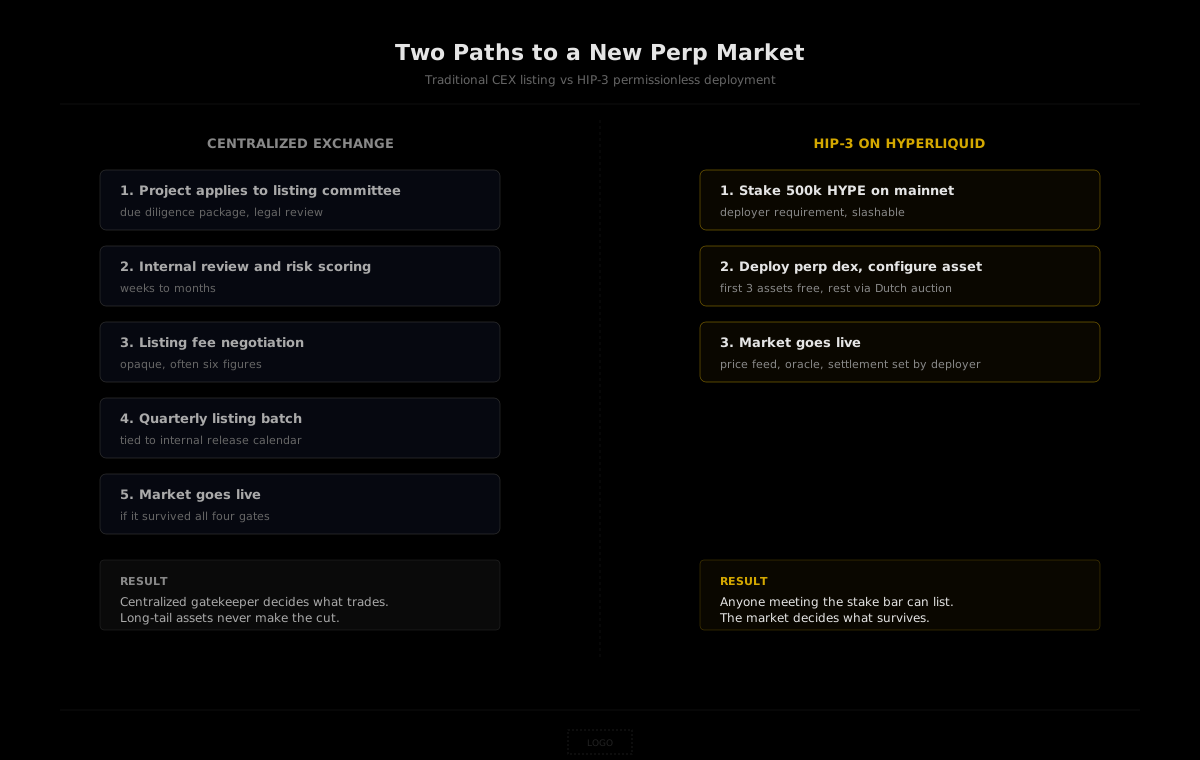
For most of crypto's history, a small group of people decided what you were allowed to trade. A listing committee at a centralized exchange would review a project, run internal risk, negotiate fees, and slot it into a quarterly release. If your asset was niche, regional, or weird, the door stayed shut. HIP-3 changes that on Hyperliquid. Anyone who meets the staking bar can deploy a perp market for any asset they want, configure its fees and oracle, and let the market decide whether it survives.
For traders, this is not a footnote. It rewrites who picks the markets, how fees get set on a given perp, and what new risks you carry when you size into something that did not exist a week ago. This article walks through what HIP-3 actually is, the fee math you need to understand before clicking buy, the new risk surfaces, and a five-point check to run before trading any builder-deployed perp.
The short version: HIP-3 turns perp listing into a permissionless deployment. More markets, faster long-tail coverage, new fee economics, and new ways to lose money if you do not read the deployer config.
The listing problem on every other exchange
If you have ever watched a small-cap or thematic asset get traction and waited months for a perp to appear on your favorite venue, you have felt the bottleneck. Centralized listing teams have to triage hundreds of asks against finite engineering bandwidth, legal review, and a quarterly calendar that rarely flexes. Fees for the slot are negotiated in private. The criteria are opaque. The cycle from "this asset is interesting" to "you can short it with leverage" runs in months, not days.
That model worked when listings were rare and the cost of a bad market was high to the venue. It does not match a market where new themes appear weekly: AI agents, restaking tokens, RWAs, regional commodities, prediction-style payouts. The pace of new narratives outruns any committee, so the long tail of tradable risk lives in spot markets and OTC desks rather than on-screen leverage.
The economics for the venue itself are also distortive. Listing fees become a meaningful revenue line, which means the gating decision is partly commercial and partly risk-based, and the trader cannot tell from the outside which mattered more on any given approval. The result is a perp catalog that reflects what venues chose to monetize, not necessarily what traders most wanted to trade.
Hyperliquid's answer is to let the bottleneck go. If you can stake the bond and run the deployment, you can list. The market then decides whether the perp gets liquidity and survives, or fades. That is a different filter, and it produces a different shape of asset coverage.
What HIP-3 actually is
HIP-3 is the proposal that introduced builder-deployed perpetuals on Hyperliquid. The mechanics, per the official docs, come down to a stake, a deployment slot, and an auction for additional assets.
The bar to entry is meaningful. A deployer must keep a substantial HYPE stake locked on mainnet, with the requirement persisting for thirty days even after every perp they deployed has been halted . The mainnet stake floor has launched at 500k HYPE, with the docs noting it is expected to ease over time as infrastructure matures .
Once staked, a deployer can spin up one perp dex with its own configuration . The first three assets in that dex deploy without going through an auction; further assets compete in a Dutch auction for slots .
Critically, the deployer chooses the underlying. The docs are clear that the asset should have a real reference: "perps make the most mathematical sense when there is a well-defined underlying asset or data feed which is difficult to manipulate and has underlying economic significance" . The protocol does not police asset choice up front. It backstops the system at the validator layer: validators can slash the deployer's stake by stake-weighted vote if the market is operated maliciously, and a daily price move greater than 50% triggers a manipulation review .
Fee economics: growth mode and deployer fee share
This is the section to read carefully. HIP-3 introduces two levers that change what a trade actually costs you on a builder-deployed perp, and both behave differently from the native HL perp you may be used to.
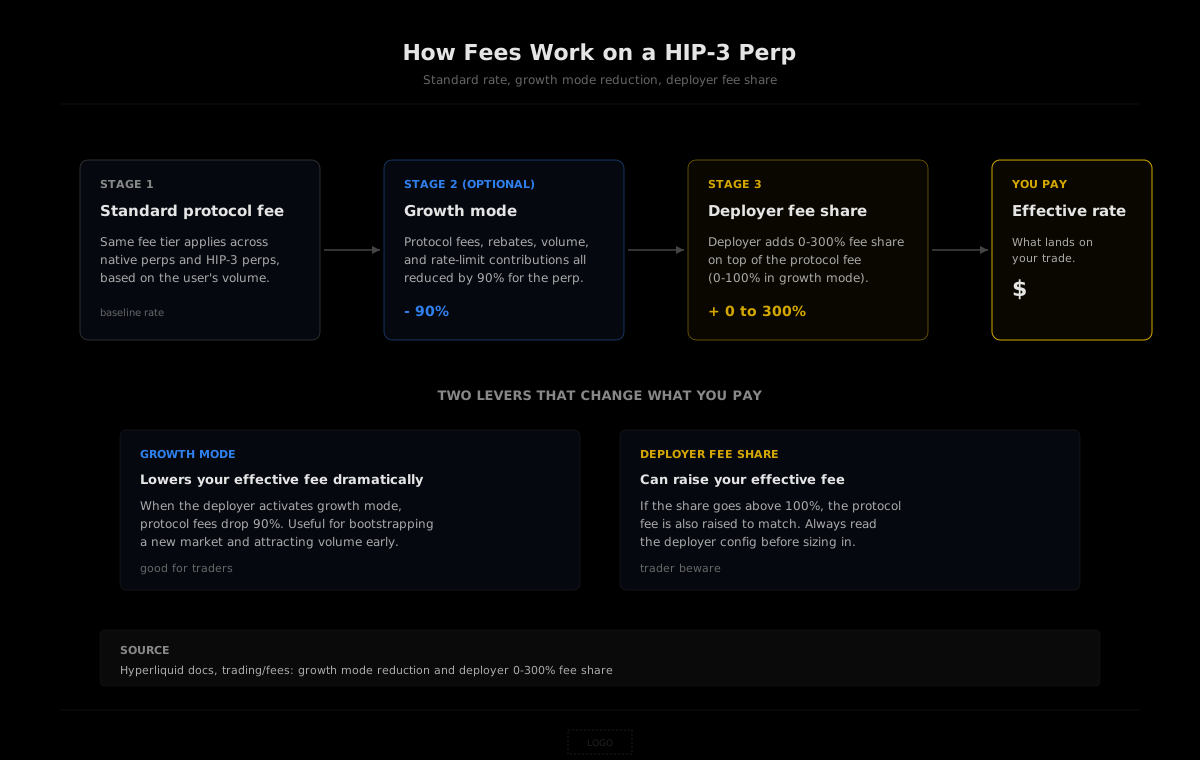
The first lever is growth mode. When a HIP-3 deployer activates it, "protocol fees, rebates, volume contributions, and L1 user rate limit contributions are reduced by 90%" . The intent is to bootstrap a new market by making early volume cheap. For a trader, that means the fee you pay on a fresh HIP-3 perp can be meaningfully below what you would pay on a native HL perp with the same notional, as long as growth mode stays on.
The second lever is the deployer fee share. Builders can configure an additional fee share on top of the protocol fee, ranging from "0-300% (0-100% for growth mode)" . This is where it gets interesting: if the deployer sets a share above 100%, the protocol fee scales up to match it . So the same trade size on two different HIP-3 perps can carry very different all-in costs depending on what the deployer chose.
Note also that fee tiers carry across: a trader's standard fee tier applies to native perps, HIP-3 perps, and spot alike . There is one volume table, not three. That is a small detail with large implications: trading HIP-3 markets actively contributes to your fee tier on the rest of Hyperliquid (subject to growth-mode reductions), and vice versa.
Why this matters for traders
The first-order effect is breadth. With permissionless deployment, the catalog of perps stops being a curated list and starts being a long tail. Regional commodities, thematic baskets, niche tokens that never cleared a CEX listing committee, post-merger arbitrage on names that move only a handful of weeks per year: anything with a reasonable oracle and a deployer willing to back it can become a perp. For traders, the practical change is that "I want leverage on X" stops returning "X is not listed" as often.
The second-order effect is fee competition. Because deployers configure their own share, two perps on the same underlying could exist at very different all-in cost structures. A deployer running growth mode with a low fee share is bidding for early volume. A deployer running with a high share is taxing it. Traders can route to whichever HIP-3 perp on a given underlying carries better economics, the same way they route between exchanges on majors.
The third-order effect is market structure. New markets bootstrap with thin order books and unstable funding before they find their level. That creates short-lived dislocations between HIP-3 perps and reference markets. Traders who watch for those dislocations get arb opportunities that simply did not exist when listings were quarterly. Traders who wander in without watching get filled at prices the market will correct against them within hours.
There is also a behavioral change worth naming. When the catalog is finite and curated, your job as a trader is mostly within-market: time the entry, manage size, exit cleanly. When the catalog is open-ended, your job extends one level up: pick which markets are worth showing up to in the first place. Cohort and order-flow data become the screen, because eyeballing a fresh ticker tells you nothing useful. Smart money starting to position on a HIP-3 perp is a stronger signal than its candles, because the candles have not had time to mean anything yet.
The new risk surfaces
Permissionless listing is a feature, but it shifts work from the exchange to you. Five risks are worth naming explicitly.
Deployer trust. The 500k HYPE stake is real skin in the game, and validators can slash it on malicious operation. That is a backstop, but a backstop is not the same as prevention. Anonymous deployers with no public footprint should clear a higher bar from you than known teams, because if something goes wrong the recovery is reactive, not preventive.
Oracle quality. A perp is only as good as its price feed. The docs flag that the underlying should be "difficult to manipulate." If the externalPerpPx for a HIP-3 market keys off a single thinly traded venue, a motivated actor can push the reference and trigger liquidations. Validators will conduct a manipulation review when daily moves exceed 50% relative to start-of-day price, but reviews happen after the fact .
Liquidity bootstrap. A brand-new HIP-3 perp can look like a market with one fill and a published mid, and behave like a desert when you actually click. Slippage on size, gappy candles, and unstable funding are the early-life norm.
Fee surprises. If a deployer ships with a share above 100%, the all-in fee is materially higher than what you pay on native HL perps. Always read the configured share before sizing a position, because growth-mode-style cheap fees and steep deployer-tax fees can sit on the same exchange surface and look identical at a glance.
Cross-margin exposure. "Enabling cross margin on an asset is irreversible," per the docs . Once a HIP-3 asset is approved for cross, your exposure to one bad market can pull losses across your whole HL account. Isolated-only HIP-3 perps are safer to experiment with.
How to evaluate a HIP-3 perp before trading it
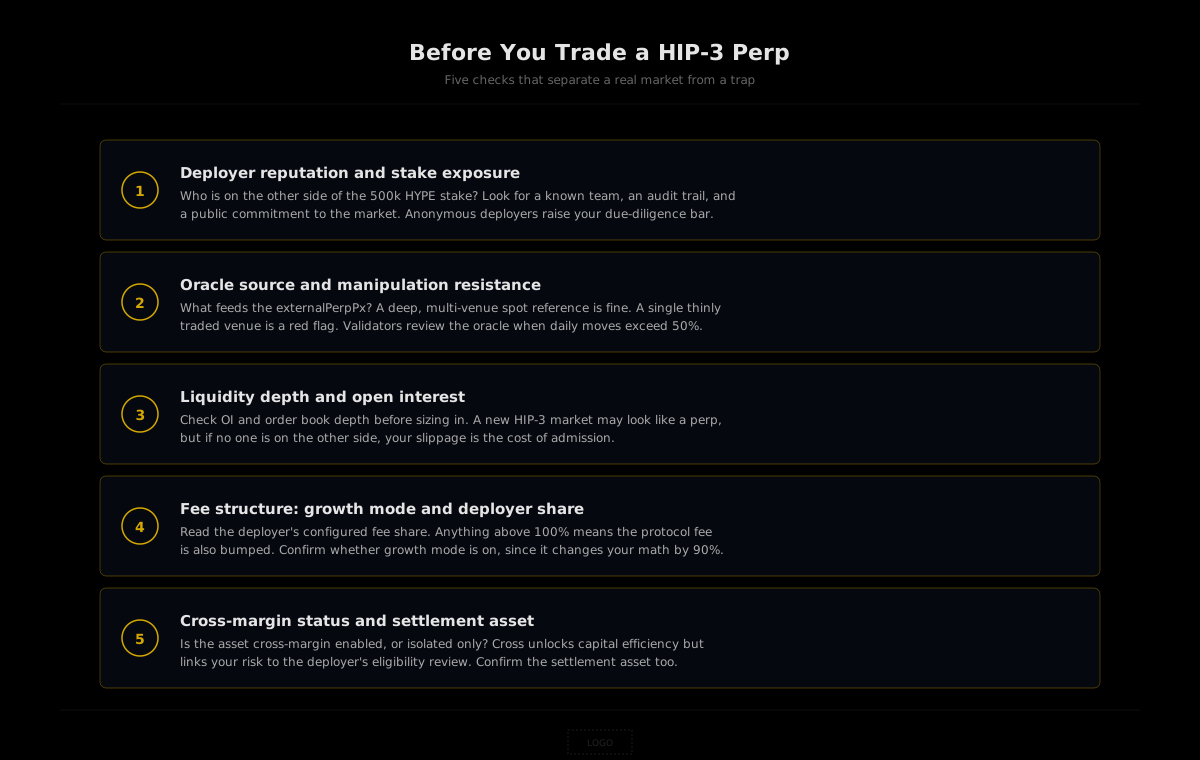
A repeatable five-point check covers the failure modes above. Run this before sizing into any builder-deployed perp.
- Deployer reputation and stake exposure. Who is on the other side of the stake? Look for a public team, a track record, and a reason for them to be running the market. Anonymous is not disqualifying, but it raises the bar on the other four checks.
- Oracle source and manipulation resistance. What feeds the externalPerpPx? Multi-venue, deep spot is fine. Single thin venue or a custom feed without depth is a red flag.
- Liquidity depth and open interest. Pull OI and book depth before sizing in. If the only volume on the chart is the deployer's seeding, your slippage tax will eat any edge you thought you had.
- Fee structure: growth mode and deployer share. Confirm whether growth mode is on (90% reduction in protocol fees) and what fee share the deployer set. Above 100% means the protocol fee scales up to match it. The all-in number is what hits your trade, regardless of how the headline rate is presented.
- Cross-margin status and settlement asset. Cross-margin is convenient but irreversible at the asset level. If you are testing a new HIP-3 perp, isolated keeps the blast radius contained.
What HyperTracker shows for HIP-3 markets
Our coverage of HIP-3 perps is at parity with native Hyperliquid perps. Every cohort metric, position aggregate, and order-flow snapshot we ship for HL majors is also available on builder-deployed assets. That means the same wallet-level intelligence you use to read native perps applies to HIP-3 markets the day they go live.
Concretely, our 16 trader cohorts (8 by size, 8 by all-time PnL) classify every wallet trading a HIP-3 perp the same way we classify wallets on BTC or ETH. Position metrics, leaderboards, liquidation risk scoring, and order-flow snapshots run on the same refresh cadence (5 minutes) across the asset set. If a HIP-3 perp on a thematic basket goes live and a Whale-tier cohort starts accumulating, our data shows it in the same query you would run on majors.
For builders, this means the long tail of HIP-3 markets is queryable through one API. You do not need to wait for special endpoint coverage. For traders, it means you can read smart-money positioning on a fresh HIP-3 perp with the same intelligence you use everywhere else on Hyperliquid.
Read smart money on every HIP-3 market
Pulse plan ($179/mo) covers the full HIP-3 surface alongside native HL perps: 16 cohorts, position metrics, leaderboards, order flow, and liquidation risk. Free tier available for testing (100 requests per day, no credit card).
Closing the loop
For a decade, the question "what gets a perp" had a small group of people for an answer. HIP-3 swaps that group for a stake, an oracle, and a market. That is more freedom and more responsibility in the same motion. The trader who reads the deployer config, checks the oracle, and sizes against real liquidity will find new edges the old listing model never permitted. The trader who clicks because the ticker is new will fund the rest of us. The market is open. The check is on you.