Maker vs Taker on Hyperliquid: Fees, Order Types, and Which One Saves You Money
By CMM Team - 23-Apr-2026
Maker vs Taker on Hyperliquid: Fees, Order Types, and Which One Saves You Money
The fee you do not notice until you tally it
Most retail traders never think about fees in real time. You see "0.045%" on the order ticket, you shrug, you click market buy. The cost feels invisible because it disappears into the next price tick. But pull a year of trade history off any active wallet and the picture changes fast. A trader doing three round trips a day on a $10,000 average notional is putting roughly two thousand orders through the book a year. At taker rates on every fill, that becomes a four-figure cost. At maker rates on the same flow, it can be a fraction of that. Same edge. Same setup. Different choice of order type.
That is what the maker/taker distinction is for. Exchanges do not charge one flat fee for trading. They charge two, depending on whether your order added liquidity to the book or removed it. The gap between the two rates is small per trade and meaningful per year. This guide walks through what the distinction actually is, how Hyperliquid implements it, when each side is the right call, and how to think about the order types that sit between the two extremes.
The short version: if your order rests in the book and waits, you are the maker and pay less. If your order crosses the spread and fills now, you are the taker and pay more. Hyperliquid's exact rates and tier discounts are published in the Hyperliquid fee docs. The trick is knowing when each cost is worth paying.
Maker vs taker: the actual mechanic
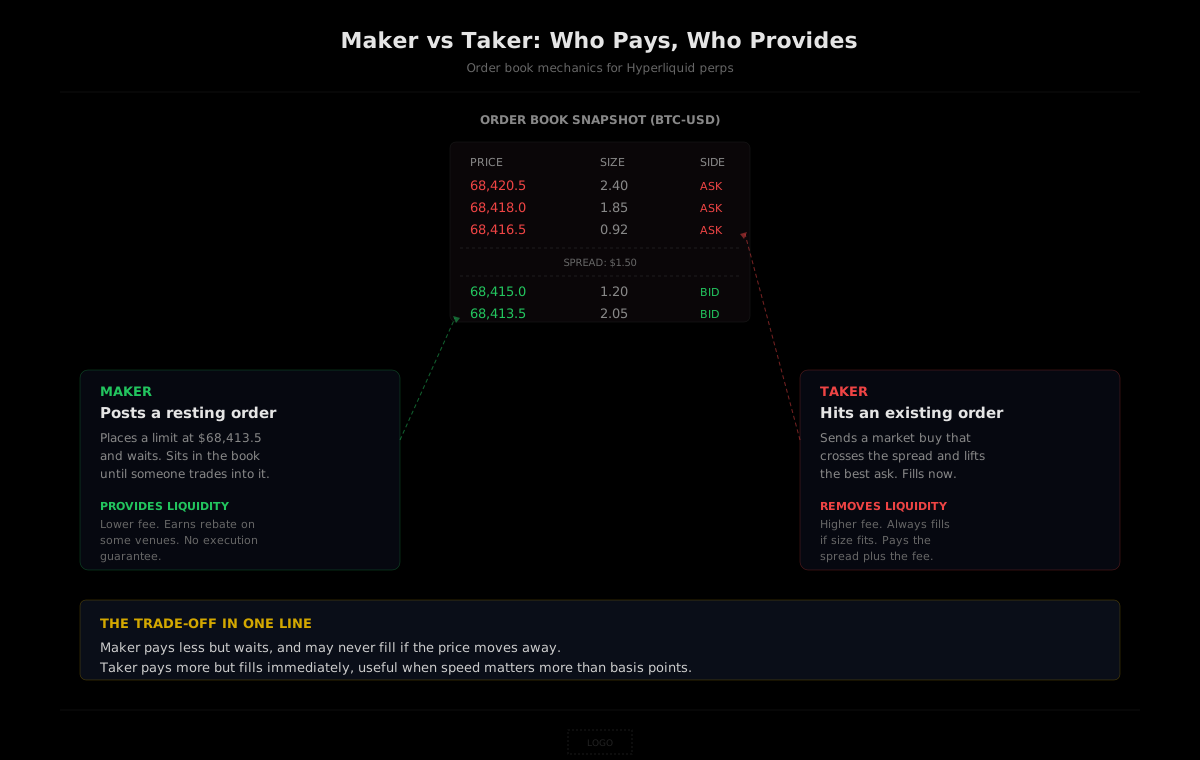
Every perp exchange runs an order book. Buyers post bids at prices they would accept. Sellers post asks at prices they would sell at. The best bid and best ask form a spread, and the trade only happens when one side reaches across that spread to meet the other.
A maker is whoever posts the resting order that someone else trades into. Imagine they put a limit buy in the book at an example price of $68,415, walk away, and wait. When a market sell hits, the trade happens at $68,415 and the maker's order fills. Their order added liquidity. Without it, the seller would have had to take a worse price further down the book.
A taker is the one who reaches across the spread. They send a market buy that lifts the best ask, or a limit buy aggressive enough to cross. The trade happens immediately because the maker's resting order was already there to absorb it. The taker removed liquidity and is charged for the privilege.
This is why the two rates exist. Exchanges want resting liquidity in the book because it makes the venue tradable. They subsidize the makers (lower fee, sometimes a rebate) and tax the takers (higher fee). The spread between the two rates is the price the venue puts on convenience.
How Hyperliquid implements it
Hyperliquid runs a fully on-chain order book, which means every fill, every cancel, every rebate event is verifiable. The fee model is the standard maker-taker split that most perp venues use, with three specifics worth knowing.
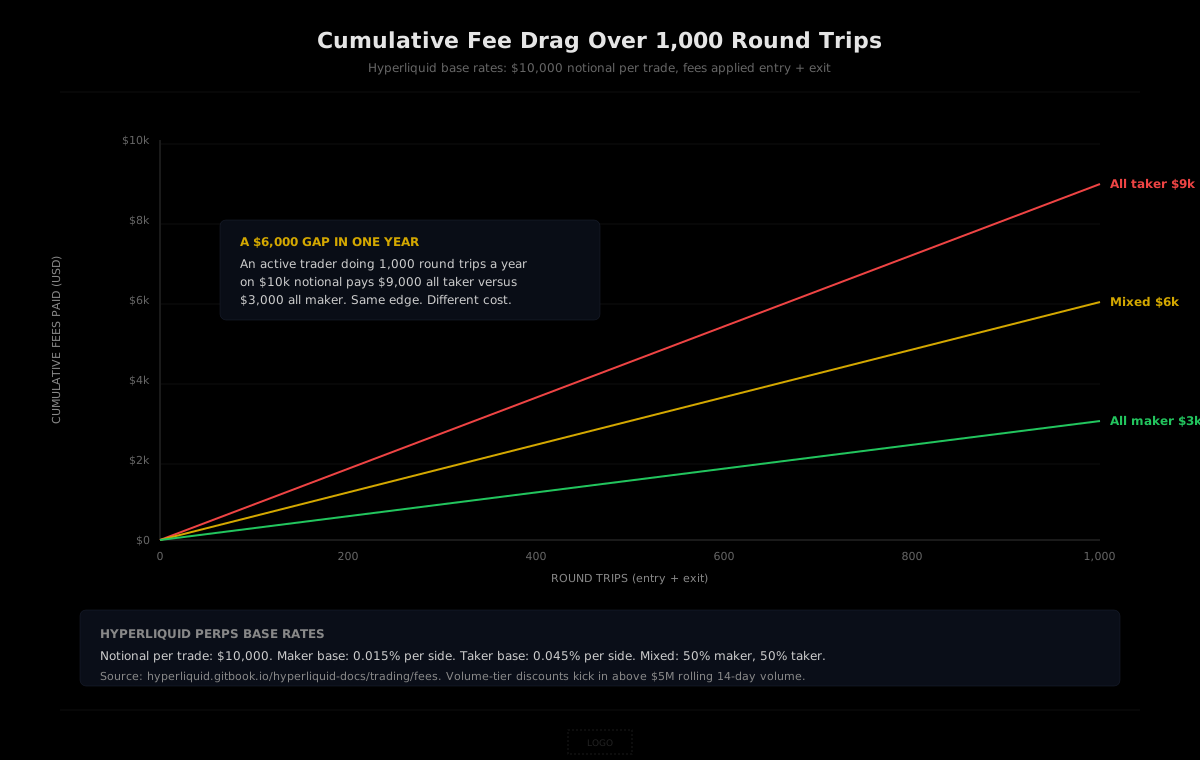
Base rates for perps. The standard tier maker fee is 0.015% per side. The standard tier taker fee is 0.045% per side. That is your starting point if your 14-day rolling volume is below the first volume tier. Spot uses a separate, higher fee schedule.
Volume-tier discounts. Hyperliquid scales fees down as your rolling 14-day volume goes up. Higher volume traders pay less on both sides of the trade. The schedule starts at the >$5M tier and runs through >$7B. Check the live schedule before optimizing your strategy around a specific number, because the tiers change as the protocol matures. For most retail wallets, the base rate is the rate that matters.
Builder code rebates. Hyperliquid lets third-party frontends and apps attach a "builder code" to the orders they route. The builder collects a fee on top of the standard schedule, set by them, in exchange for the interface and routing. If you trade through a third-party builder, your effective taker cost is the venue fee plus whatever the builder charges. If you trade direct from the Hyperliquid native frontend, you are paying the venue side only.
Two things to take away. First, the headline fee on the order ticket is not always the full picture. Builder fees stack on top. Second, your effective rate moves around as your volume crosses tier breakpoints, which means a backtest run at the lowest tier rate will overestimate edge for any wallet that does not hit that tier.
The math at base rates
The fee gap on a single trade looks trivial. The fee gap over a year looks different. Run the math once at the published base rates and the case for thinking about order placement gets sharp.
Maker is 0.015% per side, taker is 0.045% per side. A $10,000 round trip then costs you:
- All-taker (market in, market out): 0.045% + 0.045% = 0.090% = $9.00 per round trip
- All-maker (limit in, limit out, both filled passively): 0.015% + 0.015% = 0.030% = $3.00 per round trip
- Mixed (limit entry filled passively, market exit when the trade hits target): 0.015% + 0.045% = 0.060% = $6.00 per round trip
The $6 gap between all-taker and all-maker on one round trip looks negligible. Now scale it. A trader doing three round trips a day, every weekday, hits roughly 780 round trips a year. At base rates that is $7,020 a year all taker, $2,340 a year all maker, and $4,680 a year on the mixed pattern. Same number of trades. Same notional. The choice of order type changes the annual fee bill by thousands.
The scaling continues for higher activity. A bot doing 10,000 round trips a year on $10k notional pays $90,000 in taker fees versus $30,000 in maker fees at base rates. That $60,000 gap is the difference between a strategy with edge and a strategy that is feeding the venue.
When limit orders pay off
Maker fills are not free. The cost is the chance the order never executes. Imagine you post a buy at an example price of $68,400 because you want a slightly better entry, the price ticks up to $68,500, and your limit sits in the book unfilled while the move you wanted to catch leaves without you. The fee saved is irrelevant because no fill means no trade.
Limit orders earn their fee discount in three specific situations.
Range-bound markets. When price is oscillating in a defined band, posting limits at the edges of the range is mechanical. You buy at the bottom of the range and sell at the top. Most fills happen because price came to you, not because you chased it. Maker fees apply to almost every entry and exit. This is the classic case for limits.
Planned, patient entries. If your thesis is "I want to add to BTC if it pulls back to the 4-hour 50-EMA," you have time. Posting a limit at the level you want gives you the better fill rate when price gets there, and you do not pay the taker premium for a setup you were going to wait for anyway. The risk is the level never gets touched and you miss the move. That is the cost of being patient.
Scale-in and scale-out programs. Splitting an entry across five limits at progressively better prices means most of those fills will be passive. You may not get every clip filled, but the ones that do hit cost the maker rate. For larger size traders, this is also better for execution quality, because you avoid running through the book all at once.
The common thread is time. Limit orders work when you have it. They fail when you do not.
When taker is the right call
There are setups where paying the taker fee is the correct decision and the cheaper-looking maker route is the actual mistake.
Volatility events. When price is moving fast in your direction or against you, the spread widens, the book thins, and the fills you want are not waiting for you. A market order locks in execution at the cost of a few extra basis points. A limit order gives you a discount on a fill you might never get. Earnings releases, macro prints, exchange-specific liquidations, large oracle moves: these are all moments where taker is the right call.
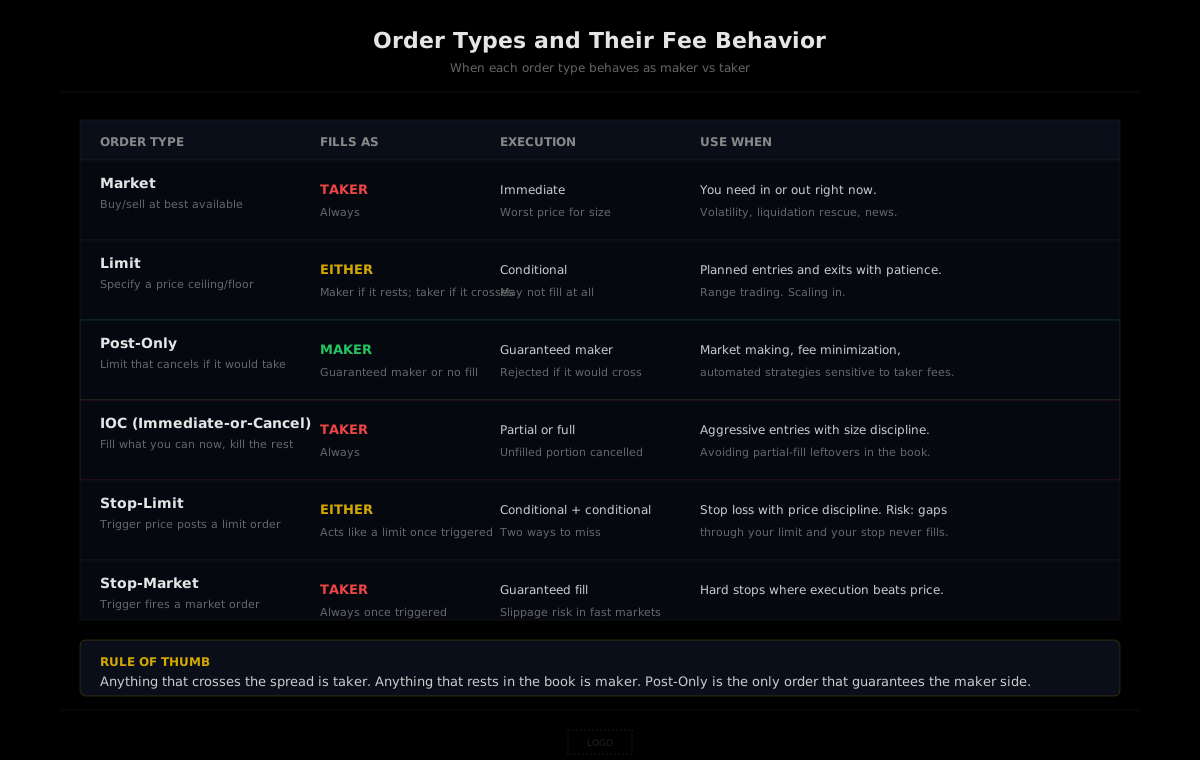
Stop loss execution. If you have a stop at a level and price hits it, you want out. A stop-limit can save you a few bps on the exit, but it can also leave you in a position that is gapping through your level because no one is there to take the limit at your price. Stop-market is taker by definition and that is usually the right design. The fee is the insurance premium against a missed exit.
Asymmetric risk windows. If you are managing a leveraged position and your liquidation price is close, a market order to reduce risk is always cheaper than a liquidation. The few bps you save by trying to maker out of a position you should already be exiting are not worth the tail risk.
Small size. On smaller notional, the absolute dollar gap between maker and taker is too small to matter relative to your time. As an illustrative example, if $0.50 in fees is the difference, the optimization is not the order type, it is whether you should be trading that setup at all.
Order types beyond limit and market
Limit and market are the two ends of a spectrum. Hyperliquid supports several order types in between, each one tuned for a specific trade-off between execution certainty and fee side.
Post-Only. A post-only order is a limit order with one extra rule: if the order would cross the spread and fill immediately as a taker, it is rejected instead. This guarantees you the maker side of the trade. If your strategy depends on never paying the taker fee, post-only is the order type you want, because a regular limit posted too aggressively can still fill as a taker if it crosses.
IOC (Immediate-or-Cancel). An IOC fills as much as it can right now and cancels the rest. It is always taker, because it executes against resting orders. The advantage over a market order is size discipline: if you send an IOC for 5 BTC and only 2 BTC is available at acceptable prices, you fill 2 BTC and the rest cancels rather than slipping you down the book.
Stop-Limit and Stop-Market. A stop is a trigger that sits on top of an underlying order type. Stop-Limit fires a limit order when price crosses your trigger. Stop-Market fires a market order. The choice is the same trade-off as before. Limit gets you a better fee but can leave you holding a position that gapped through your stop. Market guarantees the exit at the cost of slippage and the taker fee.
TWAP (Time-Weighted Average Price). TWAP slices a large order into smaller pieces over a window. Each slice can be configured to behave as maker or taker depending on the implementation. For institutional size, TWAP is how you avoid moving the market against yourself by being too aggressive too fast.
Tracking fees on your own trades
The point of all of this is to make decisions, and decisions need feedback. If you cannot see what you are paying in fees per trade and per strategy, you cannot tune your order placement. The HyperTracker closed-trades endpoint exposes both fee and feeUsd on every closed position, so any wallet's actual fee bill is queryable directly.
curl -H "Authorization: Bearer $HT_TOKEN" \
  "https://ht-api.coinmarketman.com/api/external/closed-trades?address=0xabc...&limit=200"
Sum the feeUsd field across the response and divide by trade count to get an average fee per trade for the wallet. Compare that to what an all-maker placement would have cost at the same notional and you have a real number for how much fee drag is leaking from your strategy. For builders, this is also how you back out whether a copy-traded wallet's edge survives its own fee structure.
One caveat that comes up often. The fee field can be negative on individual fills when the trade earned a maker rebate rather than paying a fee. Aggregate at the trade level rather than the fill level, and use feeUsd for the dollar-denominated truth.
What to actually do with this
If you are an active trader on Hyperliquid, three habits do most of the work.
Default to limit orders for planned entries. If you have a thesis and a level, post the order and let it come to you. The fee discount and the better entry price compound over months.
Use post-only for any automated strategy where fee minimization matters. Regular limits can still fill as taker if they cross. Post-only is the only order that guarantees the cheaper side.
Reserve market orders for the moments that actually warrant the cost. Volatility, stops, liquidation defense, news. Paying the taker fee for speed is correct when speed is the actual constraint.
Then check your actual fee bill. The closed-trades endpoint tells you what you really paid instead of what you assumed. Treat the number on the order ticket as the start of the calculation rather than the end.
See your real fee bill, per trade
HyperTracker's closed-trades endpoint returns fee and feeUsd on every closed position for any Hyperliquid wallet. Pulse plan ($179/mo) gets you 50,000 requests against the full closed-trades surface, plus 16 cohort endpoints, leaderboards, and order flow. Free tier available for testing (100 requests per day, no credit card).
The takeaway
Fees are the most predictable cost in trading and the easiest one to ignore. They show up as a small number on every order ticket and a large number on every annual statement. The maker/taker split is not a quirk of exchange design. It is a tax on impatience and a subsidy on patience. Hyperliquid implements both. The traders who do well over a long horizon are the ones who treat order placement as a real decision instead of a default click. Get the order type right, let the math work, and the fee line stops eating your edge.