
How to Follow a Leaderboard Wallet Without Getting Rekt
By CMM Team - 27-Jun-2026
How to Follow a Leaderboard Wallet Without Getting Rekt
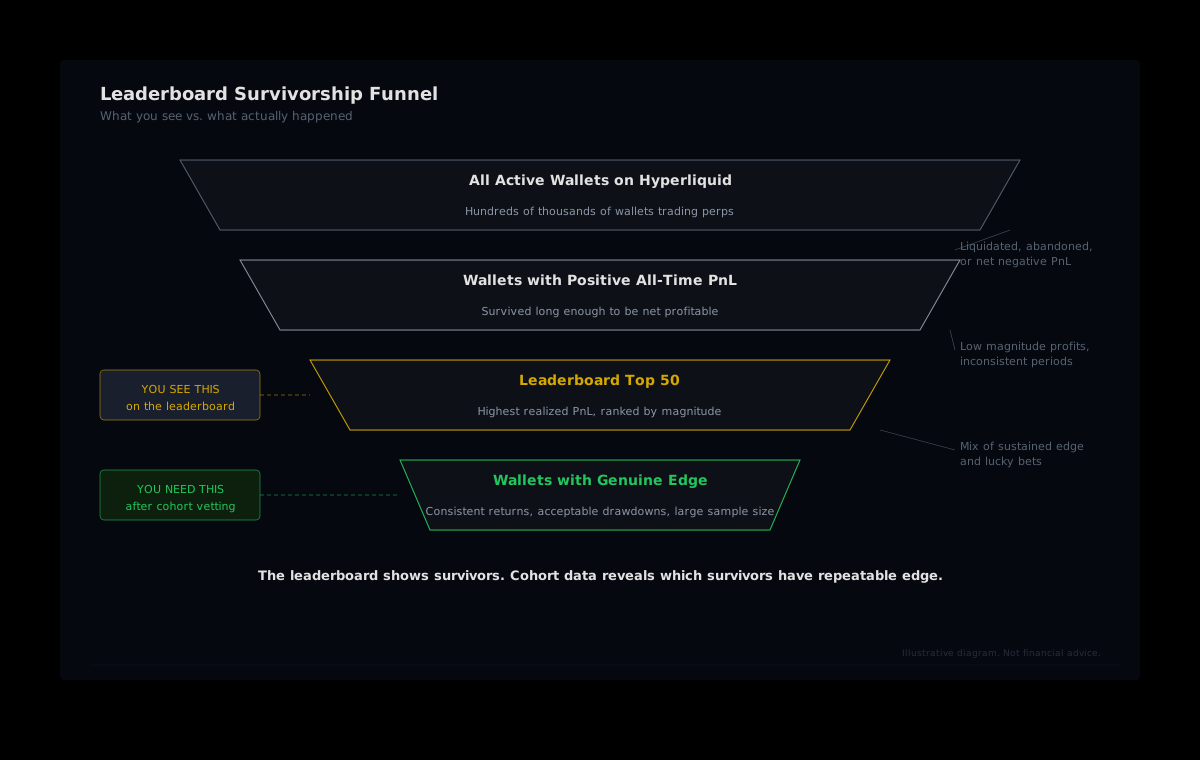
The Hyperliquid leaderboard is a highlight reel. It shows the wallets that survived, ranked by how much they made. What it does not show is the hundreds of wallets that traded with the same style, took similar risk, and got liquidated before they could make the list.
That gap between what the leaderboard displays and what actually happened is where most copy traders lose money. A wallet sitting at number 14 with $800K in all-time profit looks like a signal worth following. But without context, you cannot tell whether that performance came from consistent edge across months of trading or from a single leveraged bet that happened to land on the right side of a liquidation cascade. The leaderboard rewards both outcomes equally, so the job falls to you to tell them apart.
This article is the vetting process. It covers the five things that go wrong when traders blindly follow a leaderboard wallet, the cohort-based framework that separates sustained edge from survivorship noise, and the API workflow that lets you automate the entire filter before committing capital.
What the leaderboard is actually showing you
Hyperliquid's leaderboard ranks wallets by realized PnL across four windows: all-time, monthly, weekly, and daily. Every metric is on-chain and verifiable, which means the numbers are real. That is better than most CEX leaderboards where track records can be curated or gamed. But "real numbers" and "useful signal" are different things.
The leaderboard is a snapshot of outcomes, sorted by magnitude. It filters for survivors. A wallet that made $2M in January and lost $1.8M in February might still rank above a wallet that earned $150K steadily across both months, because the leaderboard sorts by the bigger number. It does not weight for consistency, drawdown, or risk-adjusted return.
This creates a structural problem for anyone using the leaderboard as a copy-trading signal source. The wallets at the top are disproportionately likely to be high-variance traders whose style worked during a specific market regime. Following them assumes that the regime will persist, which is the one thing markets do not do reliably.
Five ways following leaderboard wallets goes wrong
1. Survivorship bias
For every wallet on the leaderboard, there are wallets that took comparable risk and did not survive. You never see those wallets because the leaderboard only shows positive outcomes. When you pick a top-ranked wallet to follow, you are selecting from a biased sample that systematically excludes the failures.
2. Bankroll mismatch
A leaderboard wallet with $3M in equity opening a 10x long allocates a fraction of their account to the position. If you mirror that trade proportionally on a $20K account, the math looks similar in percentage terms. But the $3M account can absorb significant drawdowns while retaining substantial working capital. Your $20K account has zero margin for error at the same leverage. The same trade, the same direction, the same asset, and completely different risk of ruin.
3. Timing gaps
On-chain perps trade continuously, and you will never enter at the same price as the lead wallet. By the time you detect the position, parse the signal, and execute your copy, the market has moved. In trending markets, you consistently enter worse. In choppy markets, the slippage eats whatever edge the lead wallet had.
4. Hidden context
A position you see on-chain might be leg three of a five-leg strategy. The lead wallet could be hedged on another venue, carrying a spot position that offsets the perp exposure, or executing a basis trade where the perp side is only half the picture. You copy the directional leg without the hedge, which means you are taking directional risk the lead wallet is not taking.
5. Strategy decay
A wallet that was profitable for six months running a specific approach can stop working when market conditions shift. Funding rate arbitrage stops paying when rates compress. Momentum strategies fail in range-bound markets. The leaderboard shows what happened. It does not predict what will happen next.
Vetting with cohort context
The leaderboard tells you a wallet made money. Cohort data tells you how it made money and whether the pattern is likely to persist. HyperTracker classifies every wallet on Hyperliquid into one of 16 behavioral cohorts: eight based on account size (from Shrimp at $0 to $250 up to Leviathan at $5M+) and eight based on all-time PnL performance (from Money Printer at $1M+ profit down to Giga-Rekt at below -$1M).
When you pull a leaderboard wallet's cohort classification, you get two pieces of information the leaderboard alone cannot give you:
- Scale context. A wallet in the Leviathan size cohort ($5M+ equity) trades differently than one in the Fish cohort ($250 to $10K). The Leviathan has structural advantages: tighter spreads on larger orders, more margin to absorb adverse moves, and the ability to scale into positions gradually. Copying a Leviathan's trades without a Leviathan's bankroll changes the risk profile of every position.
- Track record depth. The PnL cohort tells you whether profitability is deep or shallow. A Money Printer ($1M+ cumulative profit) has demonstrated sustained edge across multiple market regimes. A Consistent Grinder ($10K to $100K) might have edge, but the smaller profit magnitude makes it harder to distinguish skill from favorable conditions. The PnL cohort is a better quality filter than raw leaderboard rank because it reflects cumulative performance, not peak performance.
The vetting workflow
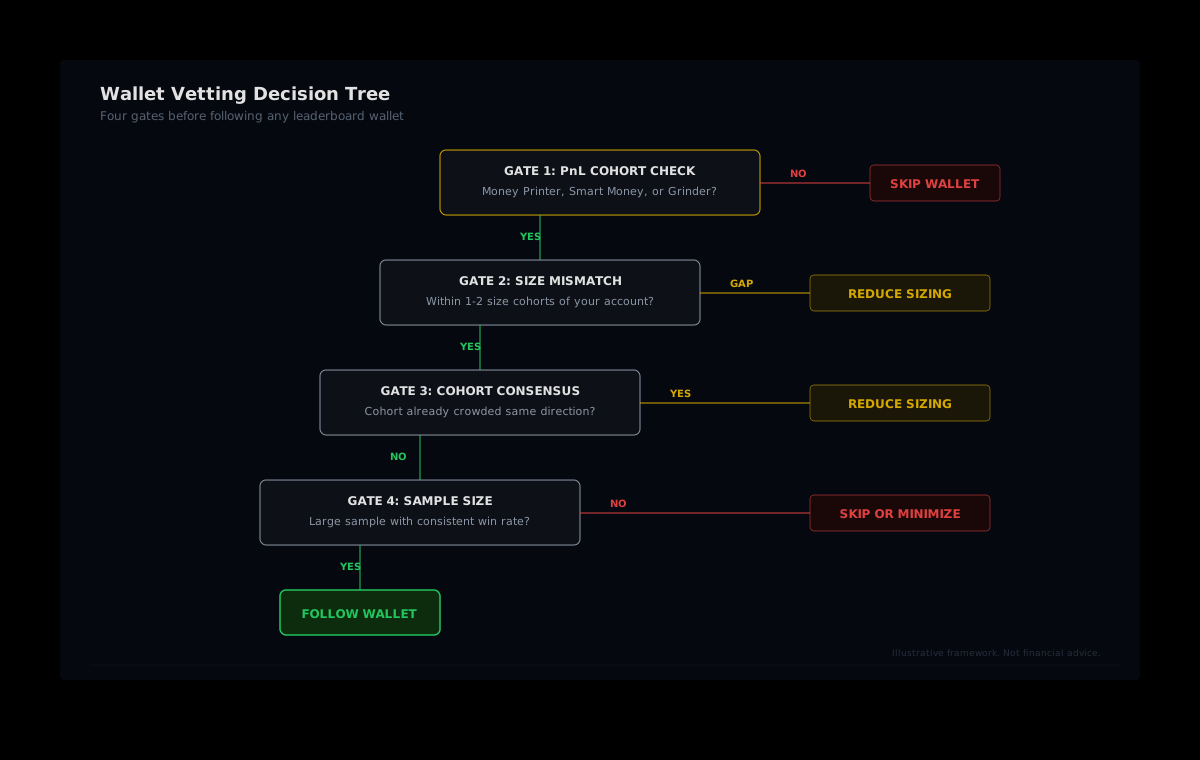
Before following any leaderboard wallet, run it through this filter:
- Pull the cohort classification. Use HyperTracker's wallet lookup to find the wallet's size cohort and PnL cohort. If the wallet falls in any negative PnL cohort (Exit Liquidity, Semi-Rekt, Full Rekt, Giga-Rekt), stop. A wallet with negative all-time PnL is on the leaderboard because of a recent hot streak that has not yet overcome its cumulative losses. Following that wallet is a bet on mean reversion working in your favor, which is the opposite of what mean reversion usually does to leveraged traders.
- Check the size mismatch. Compare the lead wallet's size cohort to your own account. If they are a Whale ($500K to $1M) and you are a Fish ($250 to $10K), the leverage and sizing that works for them will not work for you. Scale down accordingly. The larger the gap between size cohorts, the more conservative your position sizing should be.
- Look at cohort aggregate positioning. If you are about to follow a wallet long on ETH, check what the Money Printer and Smart Money cohorts are doing with ETH as a whole. If the cohort consensus is already heavily long and the wallet you are following is just joining the crowd, the signal is weaker than if the wallet is an early mover against the crowd.
- Check win rate and trade frequency. A wallet with hundreds of trades and a modest win rate is more informative than a wallet with a dozen trades and a higher win rate. Sample size matters. The leaderboard does not filter by it. You should.
Aggregate signals over individual wallets
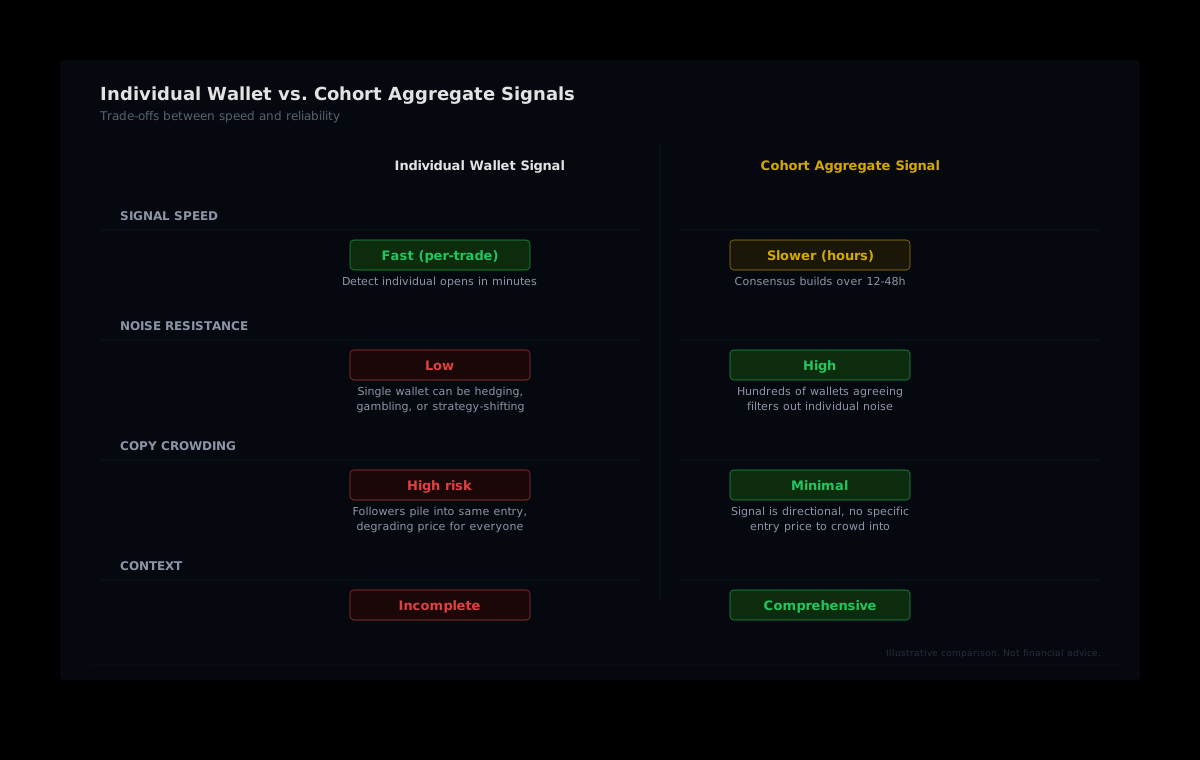
There is a structurally safer way to use leaderboard data that avoids most of the risks above: instead of copying a single wallet, use the aggregate behavior of a cohort as a directional signal.
When the Money Printer cohort collectively increases net long exposure on BTC substantially over a short period, that directional shift represents a consensus across hundreds of independently profitable wallets. The signal is not dependent on any single wallet's decision. It cannot be distorted by one address hedging on another venue. And it does not suffer from the copy-crowding problem where dozens of followers pile into the same wallet's trades and degrade the entry price for everyone.
Our data from the /coins/metrics endpoint shows cohort-level positioning by asset, which means you can see what each behavioral segment is doing without needing to identify or follow any individual wallet. The aggregate view turns the leaderboard from a list of wallets to copy into a sentiment indicator weighted by demonstrated skill.
The trade-off is that aggregate signals move slower. You will not catch the entry that a single fast-moving wallet gets. But you also will not get caught by a single wallet's mistake, hedge leg, or strategy decay. For most traders, the reduction in noise is worth the slightly delayed signal.
Building the filter with the API
The vetting workflow described above should run programmatically. Nobody is going to manually check a wallet's cohort, compare size brackets, pull aggregate positioning, and evaluate trade history before every follow decision. Here is how to wire it together with HyperTracker's API.
Step 1: Pull the leaderboard and filter by PnL cohort.
import requests

API_BASE = "https://ht-api.coinmarketman.com/api/external"
headers = {"Authorization": "Bearer YOUR_JWT_TOKEN"}

# Get top traders from the leaderboard
leaderboard = requests.get(
    f"{API_BASE}/leaderboard",
    headers=headers,
    params={"type": "allTime", "limit": 50}
).json()

# For each wallet, get cohort classification
for trader in leaderboard:
    wallet = requests.get(
        f"{API_BASE}/wallets",
        headers=headers,
        params={"address[]": trader["address"], "limit": 1}
    ).json()

    segment_ids = wallet[0].get("segmentIds", [])
    # PnL cohorts: Money Printer=8, Smart Money=9, Grinder=10
    # Humble Earner=11, Exit Liquidity=12, Semi-Rekt=13,
    # Full Rekt=14, Giga-Rekt=15
    pnl_cohort = next((s for s in segment_ids if 8 <= s <= 15), None)

    if pnl_cohort and pnl_cohort <= 10:
        print(f"PASS: {trader['address'][:10]}... cohort={pnl_cohort}")
    else:
        print(f"SKIP: {trader['address'][:10]}... negative PnL cohort")
Step 2: Check aggregate positioning before following.
# Check what the Money Printer cohort thinks about the asset
coin_metrics = requests.get(
    f"{API_BASE}/coins/metrics",
    headers=headers,
    params={"coin": "BTC", "segmentId": 8}  # Money Printer segment
).json()

# If the cohort is already heavily positioned, the signal is weaker
net_long_pct = coin_metrics.get("longPct", 50)
print(f"Money Printer BTC net long: {net_long_pct}%")

# Example thresholds - adjust based on your strategy
if net_long_pct > 70:
    print("Cohort already crowded long. Reduce position size.")
elif net_long_pct < 40:
    print("Cohort is net short. Following a long is contrarian.")
else:
    print("Neutral positioning. Standard sizing applies.")
Step 3: Build a composite score.
Combine the cohort check, size mismatch, and aggregate positioning into a single follow/skip decision. The logic is straightforward: wallets pass if they are in a profitable PnL cohort (Money Printer, Smart Money, or Consistent Grinder), the size mismatch between their account and yours is within a tolerable range, and the cohort aggregate is not already crowded in the same direction.
The code examples above show the individual checks. In production, you would wrap them in a single function that fires whenever a watched wallet opens a new position, and only mirrors the trade if all three gates pass.
What to watch after you follow
Vetting a wallet is not a one-time event. Markets shift, strategies decay, and a wallet that passed every filter three months ago might be trading a completely different style today. Set up ongoing monitoring for every wallet you follow:
- Cohort migration. If a wallet drops from Smart Money to Consistent Grinder, or worse, its cumulative PnL is declining. That is a signal to reduce your exposure to their trades or stop following entirely.
- Consecutive losses. Multiple consecutive losing trades from a followed wallet should trigger a pause, regardless of cohort tier. Even Money Printers have cold streaks, and blindly following through a drawdown is how small accounts get wiped.
- Leverage creep. If a wallet that typically trades at moderate leverage suddenly shows up with an extremely high leverage position, something changed. Either their risk tolerance shifted (which invalidates your sizing assumptions) or they are gambling. Neither scenario is good for a follower.
- Correlation buildup. If you follow multiple wallets and they all start taking the same directional bet on the same asset, your effective exposure is far larger than any single position suggests. Monitor your total exposure by asset across all followed wallets. If concentration gets too high, skip new signals in the same direction until the crowding clears.
HyperTracker's wallet alerts fire notifications whenever a tracked wallet opens, adds to, reduces, or closes a position. Set alerts on every wallet you follow so you see their moves in close to real time. The dashboard is free to use, so you can monitor as many wallets as you want without paying for API access until you are ready to build automated tooling.
Vet Leaderboard Wallets with Cohort Data
HyperTracker gives you the cohort classification, aggregate positioning, and wallet-level metrics you need to tell the difference between a leaderboard survivor and a wallet with genuine edge. Browse the leaderboard, check any wallet's cohort, and set alerts for free.
The bottom line
Leaderboards are discovery tools. They are good for finding wallets worth investigating. They are terrible for deciding which wallets to follow blindly. The difference between using a leaderboard well and using it recklessly is the vetting step in the middle: check the cohort, compare the bankroll, read the aggregate signal, and verify the sample size before committing any capital.
A wallet on the leaderboard survived. That is all the leaderboard tells you. Whether it survived through skill or through luck is the question that cohort data answers, and it is the only question that matters for your next trade.