
Japan's Crypto Tax Cut Changes the Math for Perp Traders
By CMM Team - 15-Jul-2026
Japan's Crypto Tax Cut Changes the Math for Perp Traders
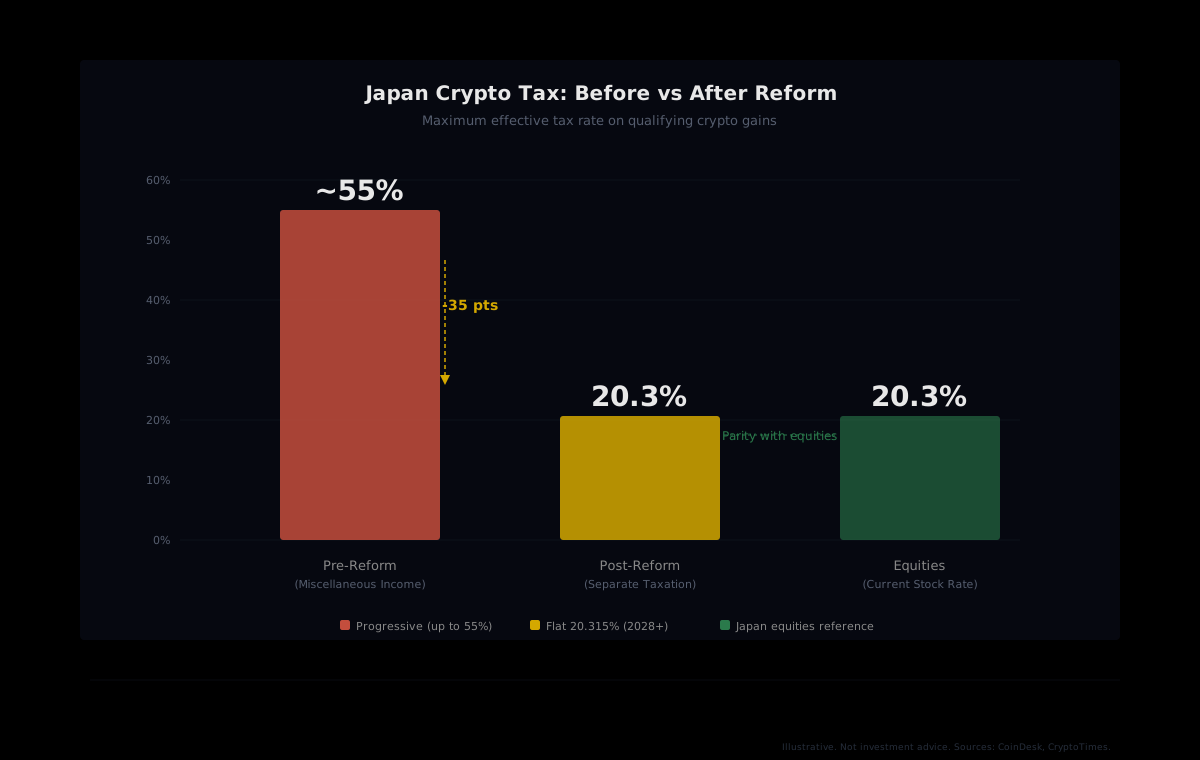
Japan's parliament just passed the most significant piece of crypto legislation any developed economy has produced this cycle. The bill reclassifies cryptocurrencies as financial instruments under the Financial Instruments and Exchange Act (FIEA), and a closely linked tax proposal cuts the maximum rate on qualifying crypto gains from roughly 55% to a flat 20%. The changes cover spot trading, derivatives, and crypto ETFs. If you trade perps on Hyperliquid or any other venue, the downstream effects are worth modeling now, because the math on position sizing, tax drag, and even which cohorts you follow just changed.
Here's what actually passed, what it means for derivatives traders, and how to adjust your playbook before the new rules take effect.
What Japan Actually Passed (and When It Kicks In)
The legislation amends both the FIEA and the Payment Services Act (PSA), shifting crypto from a payments framework to an investment regime. The reclassification takes effect in fiscal 2027. The flat tax rate follows separately in 2028.
That distinction matters. The legal architecture arrives first, meaning Japan can start approving crypto ETFs and enforcing securities-style rules before the tax cut actually hits individual returns. Traders who plan around the 2028 tax year, rather than rushing in during 2027, will model this correctly.
The effective rate lands at 20.315% once you include the national income component (15%), local inhabitant tax (5%), and the reconstruction surtax (2.1% of the 15%). For practical purposes, call it 20%. That's the same rate Japanese investors pay on equity gains, which is exactly the point: the bill treats crypto like stocks.
Which Crypto Activities Qualify (And Which Don't)
The tax cut applies to "specified crypto assets" handled by FIEA-registered businesses. Around 105 tokens listed on domestic licensed exchanges qualify, with Bitcoin and Ether among them. The bill explicitly covers three categories:
- Spot trading on registered Japanese exchanges
- Derivatives transactions, including perpetual futures and options
- Crypto ETFs and trusts, once approved
That derivatives inclusion is the headline for perp traders. If you're trading BTC or ETH perpetuals through a platform that falls under Japan's FIEA regime, your gains will be taxed at 20% instead of up to 55%. The savings compound quickly at scale.
The Exclusion List
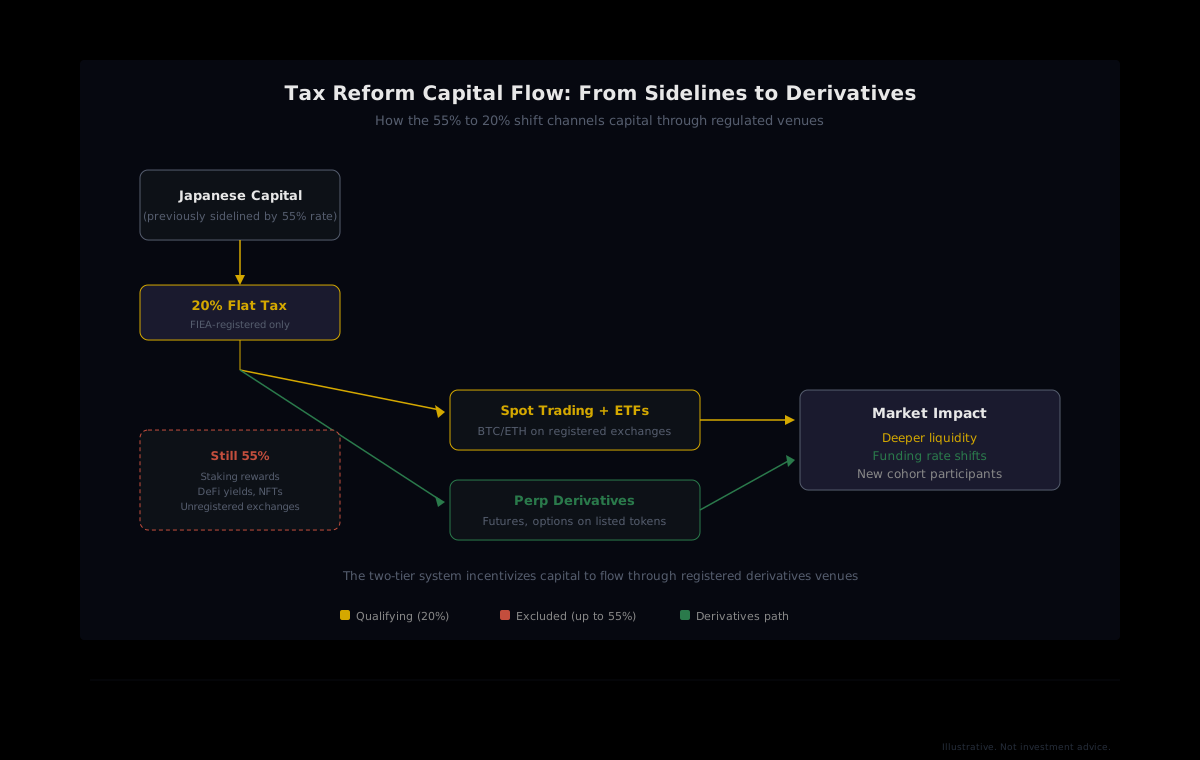
Not everything qualifies. Staking rewards, lending yields, DeFi protocol income, and NFT transactions remain classified as miscellaneous income, still taxable at progressive rates up to 55%. Stablecoins stay under the Payment Services Act. And trades on foreign or unregistered exchanges don't qualify either.
This creates a two-tier system. Perp trading on a registered exchange? 20%. Farming yield on a DeFi protocol? Up to 55%. The gap incentivizes institutional capital to flow toward regulated derivatives venues rather than on-chain yield, because the after-tax return on a well-timed perp trade now dramatically outperforms a staking yield that gets cut in half by the tax code.
Loss Carryforward: The Overlooked Edge
The bill introduces a three-year loss carryforward for qualifying crypto assets. If you take a loss in 2028, you can offset it against gains in 2029, 2030, or 2031. This is standard for equities in Japan, but it's new for crypto, and it fundamentally changes how you should think about risk management.
Before this reform, a bad month in crypto was a dead loss. You couldn't carry it forward or use it to reduce future tax bills. Aggressive position sizing was punished twice: once by the market, and again by the tax code. Now, losses become a future asset. A drawdown in January can reduce your tax bill the following year, which means your expected return on a given trade is higher because the downside has a partial rebate.
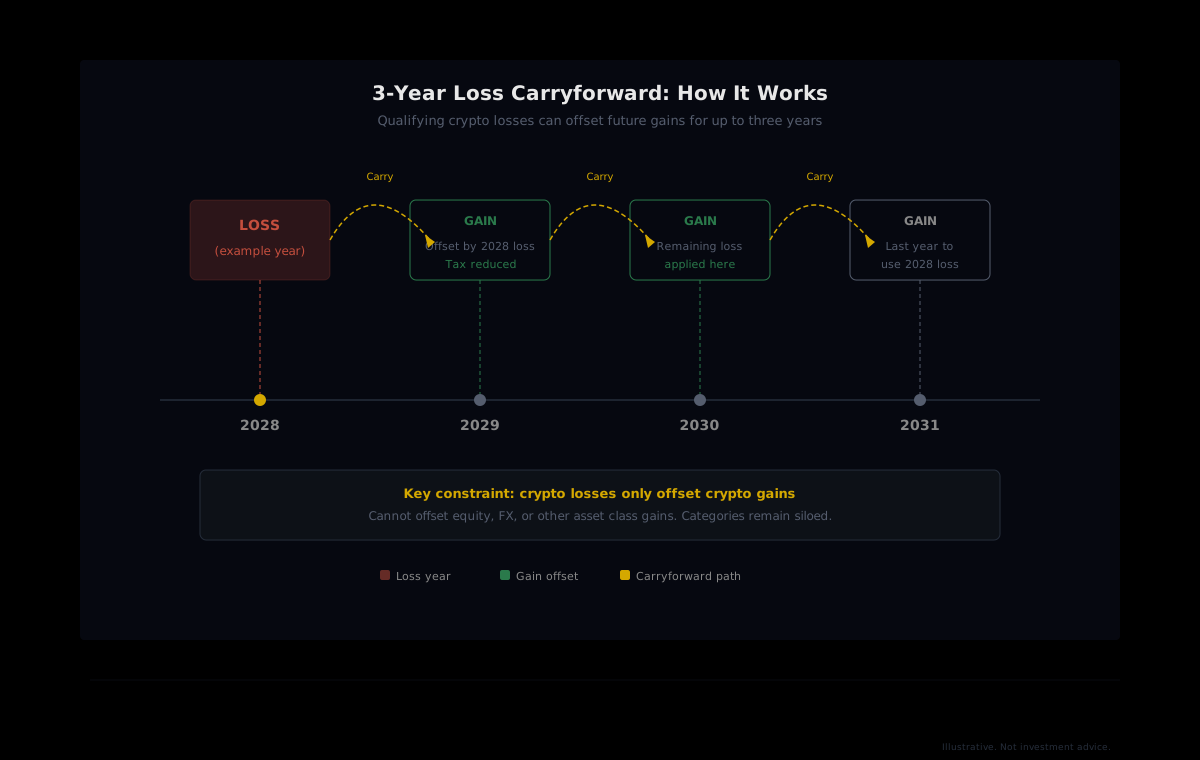
One important limitation: crypto losses can only offset crypto gains. You can't use a bad BTC trade to reduce your stock portfolio's tax bill. The categories stay siloed, which means you'll need to think about your crypto P&L as a standalone ledger.
How This Changes Perp Trading Math
The tax cut shifts several variables that perp traders should recalculate. None of this is prescriptive advice, but the directional effects are clear.
After-Tax Returns Jump Meaningfully
Consider a simple scenario. A trader in Japan's top bracket earns the equivalent of ¥10M in crypto gains over a year. Under the old system, roughly 55% goes to taxes. Under the new system, roughly 20% does. The difference in take-home is large enough to change whether certain strategies are viable at all. Carry trades, basis trades, and funding rate arbitrage all have tighter margins. A 35-percentage-point reduction in tax drag can turn a marginally profitable strategy into a clearly profitable one.
Position Sizing Gets More Flexible
With loss carryforward in place, the penalty for being wrong on a single trade decreases. This doesn't mean traders should lever up recklessly. But it does mean that the optimal position size for a given edge is larger than it was before, because the tax code now partially absorbs downside variance. The Kelly criterion inputs change when losses carry forward.
Cohort Signals Become More Actionable
For traders using cohort intelligence to track smart money positioning, the tax reform adds a layer of context. Japanese institutional capital has been underweight crypto for years, partly because the tax burden made returns uncompetitive with equities. As the rates equalize, expect capital flows into crypto derivatives to increase, which means cohort-level positioning data becomes more important for reading directional bias.
When our data shows the Money Printer or Smart Money cohorts building positions on Hyperliquid, part of what you're seeing may be capital that previously sat on the sidelines because the tax math didn't work. The reform changes who shows up in the cohort data and the way they trade.
The ETF Wildcard
The FIEA reclassification is the legal prerequisite for spot crypto ETFs in Japan. No products have been approved yet, but the infrastructure is now in place. Nomura and SBI are reportedly preparing crypto-integrated investment trusts.
For perp traders, the ETF pipeline matters because it creates a new spot demand channel. When a Japanese ETF provider needs to acquire BTC to back shares, that buying pressure shows up in spot markets and ripples into perp funding rates. More spot demand with the same perp supply tends to push funding positive, which benefits short-side carry traders and creates opportunities for anyone monitoring the basis.
The timeline is uncertain, but the reclassification removes the legal blocker. When ETF flows eventually materialize, they'll arrive as a new variable in the funding rate equation that Hyperliquid traders already monitor closely.
Enforcement Gets Teeth
The bill doesn't just cut taxes. It also raises the maximum prison term for operating an unregistered crypto business from 3 years to 10 years, and increases the maximum fine to ¥10 million. Insider trading rules now extend to crypto.
This matters for the trading ecosystem because stricter enforcement tends to push volume toward regulated venues. Traders who want the 20% rate must use registered platforms, which concentrates liquidity on fewer, better-monitored exchanges. That concentration can improve execution quality but also means the data you're analyzing (order flow, cohort positioning, liquidation clusters) becomes more representative of actual market activity rather than wash trades on unregulated venues.
What to Actually Recalculate
If you're a perp trader with exposure to the Japanese tax regime, here's a practical checklist of variables that shift under the new rules:
- Tax drag on strategies: Rework expected returns for any strategy where you previously modeled a 55% tax hit. The new effective rate is roughly 20.315%.
- Loss recovery value: Losses now have a three-year offset window. Factor this into risk models as a partial downside rebate.
- Platform selection: Only FIEA-registered exchanges qualify for the lower rate. Verify your exchange's status before assuming the 20% applies.
- Staking vs. trading allocation: With trading taxed at 20% and staking still at up to 55%, the relative attractiveness of active trading over passive yield increases.
- Cohort monitoring: Watch for new capital entering derivative markets. Our cohort data on Hyperliquid can show shifts in Smart Money and Whale positioning that may reflect institutional Japanese capital entering the market.
- Funding rate sensitivity: ETF-driven spot demand will eventually push funding rates. Build alerts around funding rate spikes that coincide with ETF flow dates.
Track the Smart Money Flows
HyperTracker's 16 behavioral cohorts classify every wallet on Hyperliquid by size and all-time P&L. See where institutional capital is positioning before the tax reform brings new players to the table.
The Bigger Picture for Derivatives Markets
Japan is the third-largest economy in the world, and it just gave crypto derivatives the same tax treatment as equities. The signal is unmistakable: regulated crypto derivatives are a legitimate asset class, and the regulatory arbitrage between jurisdictions is narrowing.
Singapore and Hong Kong still offer zero capital gains tax on crypto for individuals, so Japan isn't the cheapest jurisdiction. But the combination of a clear legal framework, loss carryforward, ETF infrastructure, and securities-grade enforcement creates a package that institutional capital cares about more than a zero rate in a less regulated environment.
For perp traders on Hyperliquid and other venues, the takeaway is structural. More capital in the derivatives ecosystem means deeper liquidity, tighter spreads, and more sophisticated counterparties. It also means the cohort data you use to read the market will include a broader set of participants with longer time horizons and different risk preferences. The game is evolving. The edge goes to traders who recalibrate before the crowd arrives.