
Stock Perps Just Went Legal: What Builders Should Ship First
By CMM Team - 10-Nov-2026
Stock Perps Just Went Legal: What Builders Should Ship First
On November 3, 2026, the CFTC approved equity perpetual futures for trading on US-regulated exchanges. Coinbase filed to list single-stock perps on Apple, Tesla, Microsoft, and Nvidia back in September. ICE, the parent company of the New York Stock Exchange, partnered with TradeXYZ to bring Hyperliquid-based perpetual markets to US exchanges. The legal framework exists. The infrastructure is lining up. And the product layer is wide open.
For builders in the Hyperliquid ecosystem, this changes the game. Stock perps were already available offshore through HIP-3, which has been live since October 2025. But a CFTC-approved legal framework means regulated exchanges can now list the same type of instrument onshore. That creates an entirely new class of builder opportunities, from analytics layers to distribution frontends to structured products, all designed around equity perps.
This article breaks down what just happened, why it matters for builders, and the five opportunity layers where the first movers will ship.
What the CFTC Actually Approved
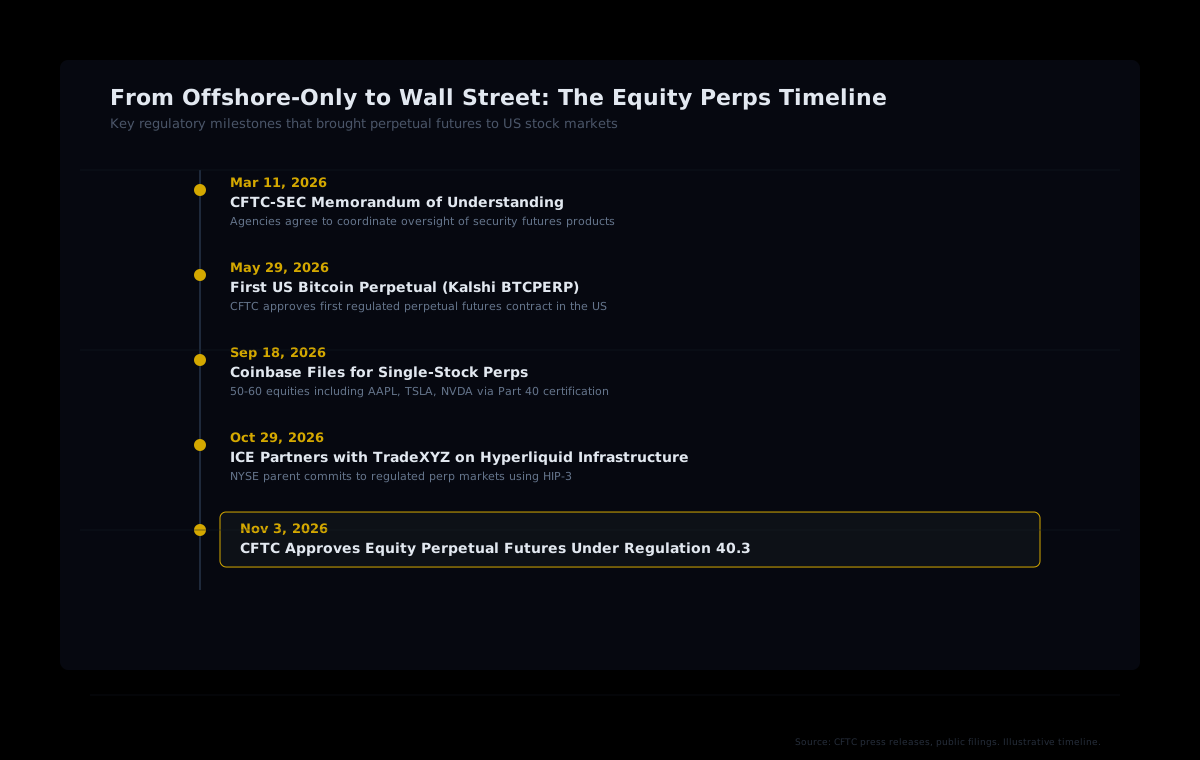
The approval came under Regulation 40.3, classifying equity perpetual futures as security futures products under the Commodity Futures Modernization Act of 2000. Because these contracts reference individual stocks, they fall under joint oversight from both the CFTC and the SEC. The two agencies signed a memorandum of understanding on March 11, 2026 to coordinate their supervisory responsibilities.
CFTC Chairman Michael Selig framed the move as ending the era of offshore-only perpetual trading. He stated that American traders should be able to "access perpetual futures under US regulatory safeguards rather than being forced to turn to offshore, and often unregulated, venues."
Key distinction: Perpetual futures have no expiration date, unlike traditional futures. Traders maintain leveraged positions indefinitely using funding rate mechanisms that anchor the contract price to the underlying asset. This design originated in crypto markets (BitMEX popularized it in 2016) and is now coming to US equities.
The regulatory path here started earlier in 2026. On May 29, Kalshi received approval for the first US-listed Bitcoin perpetual futures contract. Then Coinbase filed for single-stock perps in September, covering roughly 50 to 60 equities including Apple, Tesla, Microsoft, and Nvidia. The November 3 announcement extended the legal framework from crypto perps to equity perps, making stock perpetual futures tradeable on dual-registered exchanges.
The Leverage Constraint Builders Need to Understand
Offshore crypto perps offer leverage up to 50x on platforms like Hyperliquid. US-regulated equity perps will be different. The joint CFTC-SEC minimum margin requirement is 15%, which translates to roughly 6.7x maximum leverage. Coinbase's filing reportedly set margin at 15.5%, slightly more conservative at about 6.5x.
Compare that to traditional stock options under Reg T, which require 50% margin (2x leverage). Equity perps sit in a middle ground: more leverage than options, far less than offshore crypto. This constraint shapes every product a builder designs around equity perps. Risk engines, margin monitoring, and liquidation alerts all need to account for a leverage ceiling that is meaningful but bounded.
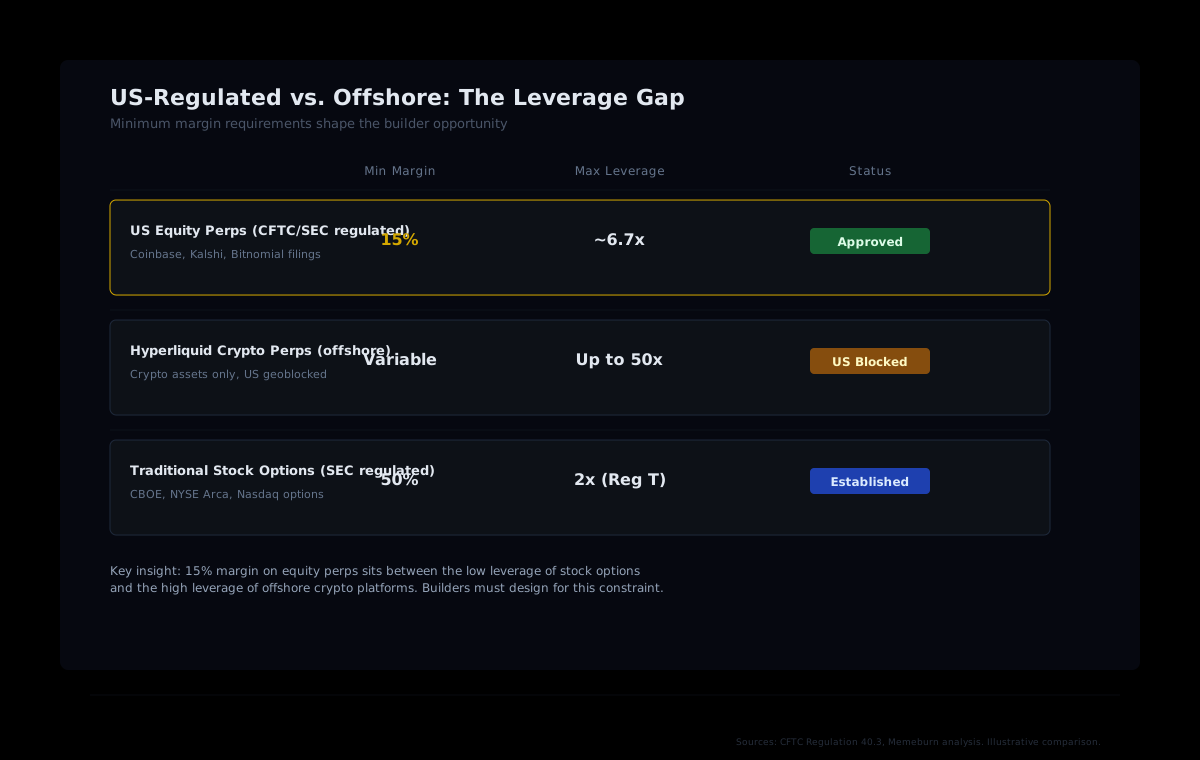
For builders accustomed to crypto's high-leverage environment, the takeaway is clear: equity perps reward precision over aggression. Products that help traders optimize within the 6.7x ceiling will find a natural audience among regulated equity traders.
Who Is Filing (and Building) Right Now
The race to list equity perps on regulated US venues involves some of the biggest names in both crypto and traditional finance:
- Coinbase: Filed with the CFTC on September 18 under Part 40 certification. The proposal covers 50 to 60 stocks, with Apple as the representative contract specification. Cash-settled, hourly funding payments, and a 24/5 trading schedule. COIN stock rose roughly 12% on the filing.
- Kalshi: Already operates US-listed Bitcoin perpetual futures (approved May 2026). Filed equity perp rules in late September. Has a regulatory head start as the first mover in US perps.
- ICE / TradeXYZ: The NYSE parent partnered with TradeXYZ to bring Hyperliquid-based perp markets to the US, using HIP-3 as the underlying technology layer.
- Bitnomial (Payward / Kraken): Hyperliquid formally designated Payward as its intended first CFTC-regulated HIP-3* deployer. HIP-3* adds onchain allowlists for compliance.
The legal challenges are real. CME Group sued in June 2026 arguing these contracts should be classified as swaps, and the Capital Markets Alliance filed suit on the same day as the CFTC approval. But the direction of travel is unmistakable: equity perps are coming to US exchanges, and builders who ship products around them will have a first-mover window.
Five Layers Where Builders Should Ship
The equity perps opportunity is not one product. It is a stack. Builders can enter at any layer, but the highest-margin opportunities are at the top: closer to the end user, further from raw infrastructure.
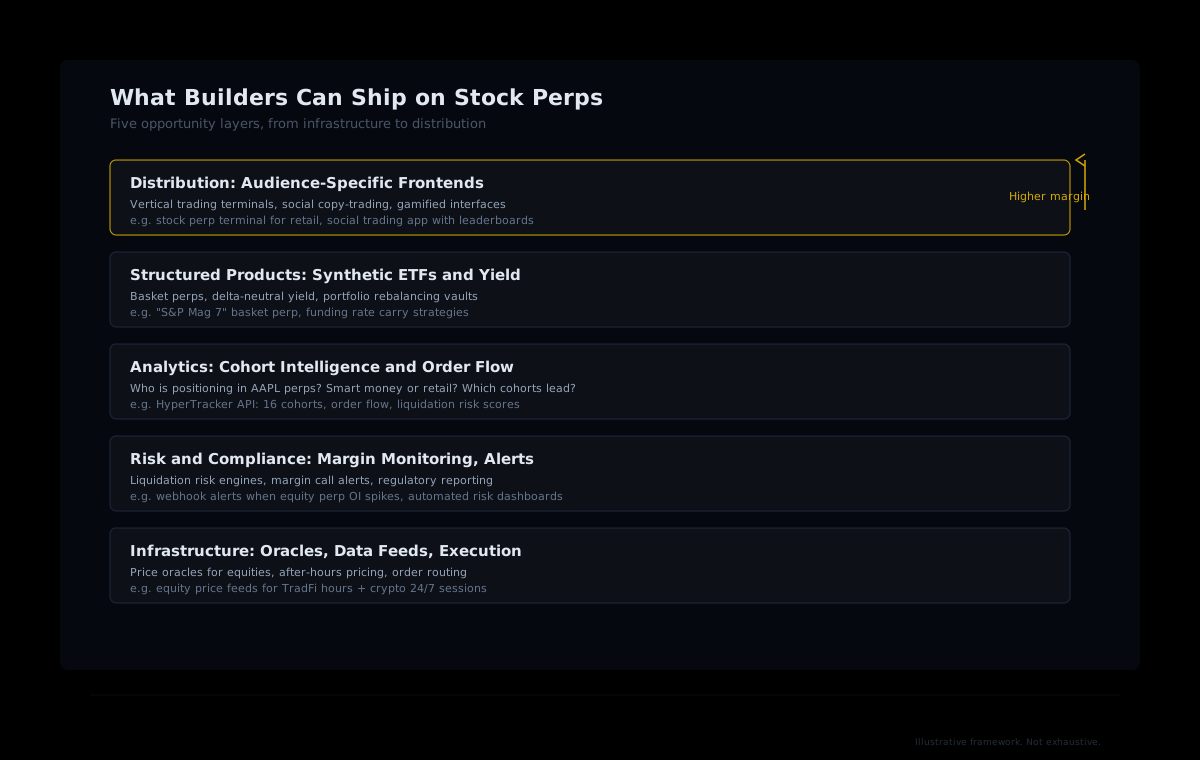
Layer 1: Infrastructure (Oracles, Data Feeds, Execution)
Equity perps need reliable price oracles that work during both market hours and after-hours sessions. Unlike crypto, which trades 24/7, stock prices have gaps overnight and on weekends. Builders who solve the after-hours pricing problem, whether through futures proxies, last-trade anchoring, or synthetic benchmarks, fill a critical infrastructure need.
Layer 2: Risk and Compliance
With 15% minimum margin and joint CFTC-SEC oversight, compliance tooling matters more for equity perps than it does for offshore crypto. Builders can ship margin monitoring dashboards, automated liquidation risk alerts, and regulatory reporting pipelines. If you are building a trading application that routes equity perp orders, you need to handle the regulatory layer correctly from day one.
Layer 3: Analytics (Cohort Intelligence and Order Flow)
This is where things get interesting for the Hyperliquid ecosystem. When Apple, Tesla, and Nvidia perps go live on regulated exchanges, the same questions that crypto traders ask will apply: Who is positioning? Are smart money cohorts leading or following? What does the order flow look like before a big move?
HyperTracker already classifies every wallet on Hyperliquid into 16 behavioral cohorts, 8 by account size and 8 by all-time PnL performance. Our API delivers cohort-level positioning, order flow snapshots, liquidation risk scores, and leaderboard data. As equity perps scale across both offshore (HIP-3) and onshore (regulated exchanges), the analytics layer becomes the connective tissue that helps traders and builders make sense of who is doing what.
Builder angle: Imagine a dashboard that shows Money Printer cohort positioning across both BTC perps and AAPL perps simultaneously. Or an alert system that fires when Leviathan-class wallets shift their equity perp exposure. These are products that did not exist a month ago because the regulatory framework was not there.
Layer 4: Structured Products (Synthetic ETFs and Yield)
Equity perps unlock structured products that combine multiple stocks into basket positions. Think "Magnificent 7" synthetic perps, or delta-neutral yield strategies that harvest the funding rate spread between equity perps and the underlying stocks. Vaults that automatically rebalance across equity and crypto perps could capture a new class of yield-seeking capital.
Layer 5: Distribution (Audience-Specific Frontends)
The highest-margin opportunity. Instead of building another generic trading terminal, builders can create vertical frontends for specific audiences: a social copy-trading interface for retail equity perp traders, a gamified leaderboard for active traders, or a professional-grade analytics terminal for fund managers who want equity perp exposure alongside their crypto positions.
Hyperliquid's builder code program already monetizes this layer directly. Builders who route trades through their frontend earn a fee (up to 10 basis points on perps) on every fill. The same model that has already generated significant revenue for builders in the crypto perps ecosystem extends naturally to equity perps.
Why Hyperliquid's HIP-3 Gives Builders a Head Start
HIP-3 (Builder-Deployed Perpetuals) has been live since October 13, 2025. It lets anyone with enough staked HYPE launch a perpetual market for any asset, stocks, commodities, indices, anything with a reliable price feed. HIP-3 markets already cover S&P 500, gold, crude oil, and individual equities.
The key detail for builders: HIP-3 provides a permissionless sandbox where you can prototype equity perp products today, on live infrastructure with real liquidity, before regulated US exchanges launch their own offerings. Builders who ship analytics, copy-trading, or structured products on HIP-3's equity perps now will have working products (and users) by the time Coinbase or Kalshi go live with regulated equity perps.
The US regulatory pathway through HIP-3* (the permissioned variant) adds onchain allowlists for compliance. This means the same HIP-3 infrastructure can serve both the offshore permissionless market and the US regulated market, and builders who build on HIP-3 can target both audiences with minimal changes.
Tracking What Smart Money Does With Equity Perps
When a new instrument class goes live, the first question every serious trader asks is: what are the large accounts doing? With equity perps, that question gets even more interesting because you are bridging two worlds. Are crypto whales taking equity perp positions? Are traditional equity traders discovering perps for the first time? Which cohorts move first when AAPL perps open?
Our data captures these patterns across Hyperliquid's HIP-3 markets with 5-minute order flow snapshots. The 16 behavioral cohorts, from Shrimp ($0-$250 equity) to Leviathan ($5M+), and from Giga-Rekt (below -$1M all-time PnL) to Money Printer (+$1M+), provide a behavioral map of how different trader segments interact with equity perps.
Builders can query our API to answer questions like:
- Are Money Printer wallets accumulating TSLA perp positions before earnings?
- What is the long/short ratio among Whale-class accounts on equity perps vs. crypto perps?
- Which cohorts are most active on HIP-3 equity markets vs. native crypto markets?
- Are Leviathan accounts using equity perps to hedge crypto exposure?
These questions were not answerable before HIP-3 brought equity perps on-chain. Now they are. And the builders who surface these insights first will own the analytics layer for the next generation of perp trading.
Build on Equity Perp Intelligence
HyperTracker's API gives you cohort analytics, order flow, and liquidation risk data across all Hyperliquid markets, including HIP-3 equity perps. Start with 100 free API calls per day.
The Legal Challenges Are Real (But the Direction Is Clear)
This is not a clean sweep. The Capital Markets Alliance filed a lawsuit on November 3, arguing that perpetual contracts without a maturity date cannot meet the statutory definition of a "security future" and should instead be classified as securities-based swaps under SEC authority. CME Group has its own ongoing challenge.
These legal battles matter. If equity perps get reclassified as swaps, the regulatory burden and margin requirements change significantly. Builders should design their products with this uncertainty in mind: modular architectures that can adapt to different regulatory outcomes will outlast rigid, single-venue designs.
But the broader trajectory is clear. The CFTC and SEC are coordinating. Coinbase, Kalshi, ICE, and Bitnomial are all filing. The White House has publicly supported bringing Hyperliquid into the US "in a fully compliant and legal fashion." The question is not whether equity perps will trade in the US. It is who builds the best products around them.
Ship Now, Iterate Later
The equity perps opportunity rewards speed. Here is the practical builder playbook:
- Prototype on HIP-3 today. Equity perp markets are live on Hyperliquid. Build your analytics dashboard, copy-trading bot, or structured product on real infrastructure with real liquidity.
- Use cohort data to differentiate. Any builder can route orders. Builders who surface intelligence on who is trading, from which cohorts and with what conviction, build products that retain users.
- Design for the 6.7x leverage constraint. Products optimized for US-regulated margin requirements (15% minimum) will serve a different, potentially larger, audience than high-leverage offshore tools.
- Build modular. The regulatory landscape is still settling. Products that can serve both HIP-3 (offshore, permissionless) and HIP-3* (US, permissioned) without a full rewrite will have the widest market.
- Monetize through builder codes. Hyperliquid's builder code program pays you directly for order flow you route. Every equity perp trade through your frontend earns revenue.
The CFTC just gave equity perps a legal foundation. Hyperliquid's HIP-3 gives builders the permissionless infrastructure to ship right now. And the analytics layer, the cohort intelligence that tells you what smart money is actually doing with stock perps, is already available through our API. The builders who ship first will define this market.