
Your Cohort Pipeline Will Cost More Than You Think
By CMM Team - 29-Jun-2026
Your Cohort Pipeline Will Cost More Than You Think
You have a trading bot, a dashboard idea, or a fund that wants to track smart money positioning on Hyperliquid. The first instinct is obvious: build the analytics pipeline yourself. Pull raw data from the L1, classify wallets, compute cohort metrics, serve them through your own API. How hard can it be?
Harder than you think, and more expensive by an order of magnitude. Teams that start building their own cohort pipeline consistently underestimate five things: the number of infrastructure layers involved, the engineering hours each layer consumes, the ongoing costs once the pipeline is live, the data quality problems that surface three months in, and the opportunity cost of senior engineers doing plumbing instead of building the product they were hired to build.
This article walks through every layer of a Hyperliquid cohort analytics pipeline, from raw fill ingestion to production API, with realistic cost estimates at each stage. The goal is simple: give builders enough information to make the build-versus-buy decision with real numbers.
The five layers of a cohort pipeline
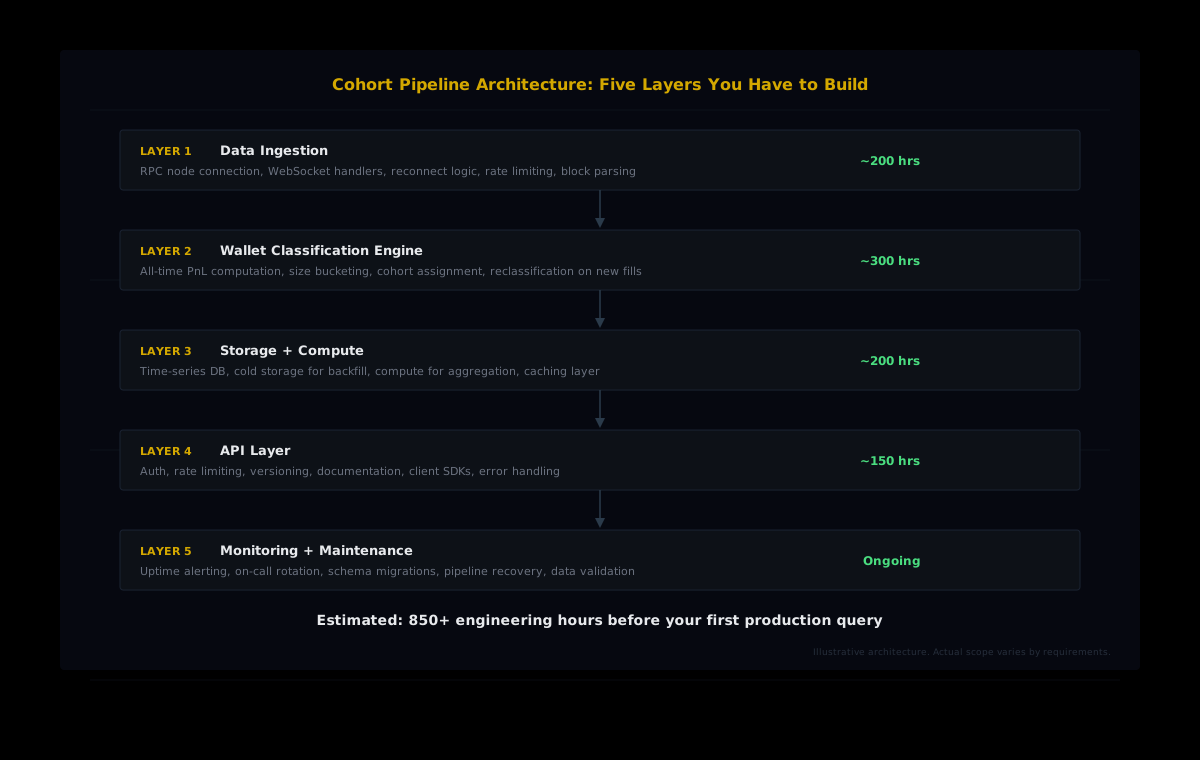
A cohort analytics pipeline is more than a database and a few API endpoints. It is five distinct infrastructure layers, each with its own failure modes and engineering requirements. Skip any one of them and the whole thing breaks, quietly, in ways that corrupt your data long before you notice.
Layer 1: Data ingestion
Everything starts with getting raw data off the Hyperliquid L1. You need an RPC node connection (Hyperliquid's public endpoint caps at 100 requests per minute, so you will need a dedicated provider), WebSocket handlers for streaming position updates, reconnect logic for dropped connections, rate limiting to avoid getting throttled, and block parsing to extract fills, positions, and order events.
The RPC provider alone is a meaningful recurring cost. Dwellir charges $299/month for gRPC streaming, with dedicated clusters starting at $4,000/month for unlimited throughput. Cheaper options exist (Chainstack starts at $49/month for 20 million requests), but high-volume analytics pipelines that process every fill on the exchange burn through rate limits quickly.
Engineering time for this layer alone is typically around 200 hours, because the edge cases are where the complexity hides. What happens when the node drops mid-block? How do you detect and fill data gaps from outages? How do you handle Hyperliquid's rolling rate limits without losing events? These are solved problems, but solving them from scratch takes time.
Layer 2: Wallet classification
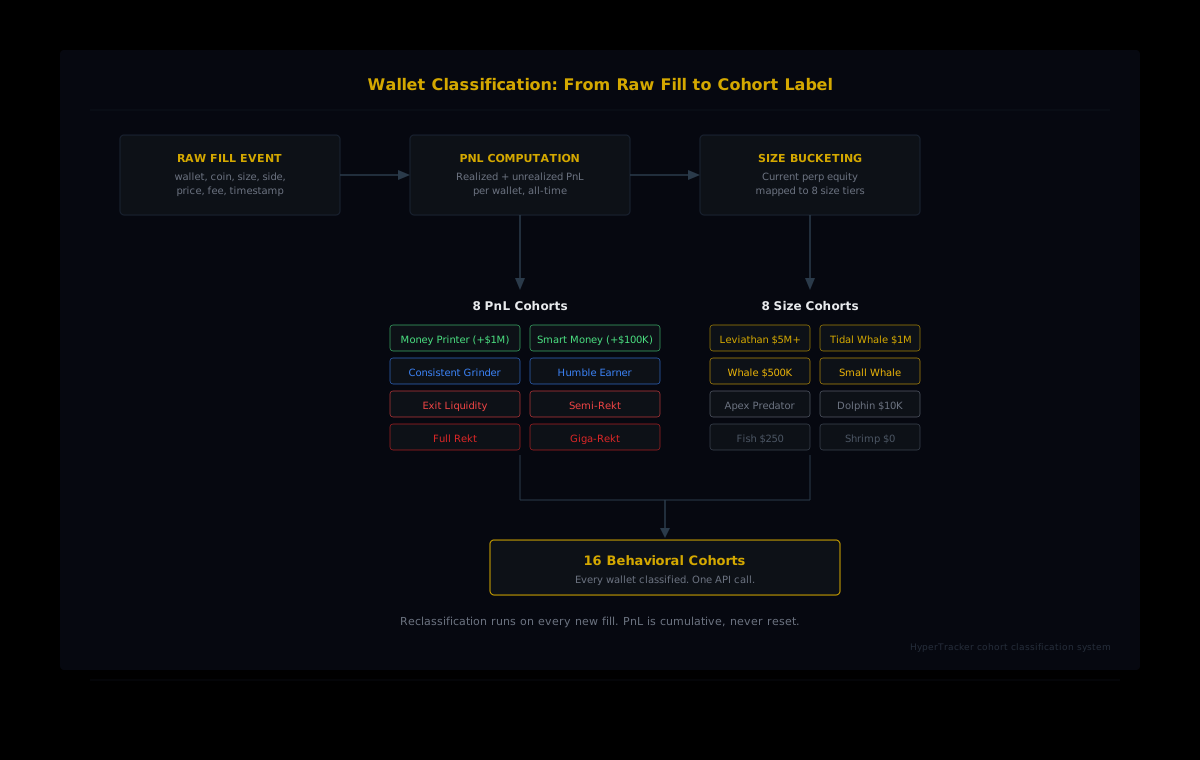
This is the hardest layer to get right, and the one most teams underestimate. Cohort classification means computing all-time PnL for every wallet on Hyperliquid, bucketing each wallet by current perp equity size, and assigning behavioral labels based on where each wallet falls in the distribution.
Our data uses 16 behavioral cohorts: eight by size (Shrimp through Leviathan) and eight by all-time PnL (Giga-Rekt through Money Printer). Each cohort has specific dollar thresholds. For example, a Smart Money wallet has between +$100K and +$1M in cumulative all-time PnL, while a Leviathan holds $5M or more in perp equity.
The difficulty is not in the initial classification. It is in keeping classifications accurate as new fills arrive. Every trade changes a wallet's PnL and potentially its equity, which means cohort membership is dynamic. A wallet that was a Consistent Grinder last week might cross the $100K threshold and become Smart Money today. Your pipeline needs to recompute and reclassify on every fill, without falling behind the incoming data rate.
Expect roughly 300 engineering hours for this layer, and budget for at least two months of tuning before the classifications match production accuracy. You will find edge cases around wallets that straddle thresholds, accounts that close and reopen positions rapidly, and the challenge of maintaining PnL continuity across account migrations.
Layer 3: Storage and compute
Cohort metrics are time-series data. You need a time-series database for hot storage (recent data, frequently queried), cold storage for historical backfill (months of position and fill data for backtesting), a compute layer for aggregation (cohort-level positioning, bias signals, order flow summaries), and a caching layer to serve repeated queries without hammering the database.
Cloud costs here depend heavily on data volume. Hyperliquid processes thousands of fills per minute during active trading hours, and storing six months of position history with fill-level granularity adds up. Expect $1,000 to $2,000 per month for managed database services, plus compute costs for the aggregation jobs that crunch raw fills into cohort-level metrics.
Engineering time: around 200 hours, with the complication that storage architecture decisions made early tend to be expensive to change later. Pick the wrong time-series backend and you are looking at a migration three months down the road.
Layer 4: API layer
Once you have classified wallets and computed cohort metrics, you need to serve them. That means JWT authentication, per-user rate limiting, API versioning (so you can evolve endpoints without breaking clients), documentation, error handling, and ideally client SDKs for the languages your users care about.
If you want webhook delivery (push updates when a cohort crosses a threshold) or WebSocket streaming, that is another layer of complexity on top of the basic REST API. Each delivery mechanism has its own infrastructure: message queues, connection managers, retry logic, and dead letter handling.
Budget around 150 engineering hours for a production-quality REST API, more if you need push delivery.
Layer 5: Monitoring and maintenance
The layer nobody budgets for until something breaks. Your pipeline needs uptime alerting (did the data ingestion stop?), data quality checks (are the cohort counts drifting?), on-call rotation for when the RPC node goes down at 3am, schema migrations as you add new endpoints, and pipeline recovery procedures for when a bad deployment corrupts the classification state.
This is not a build-once cost. It is permanent overhead. A part-time on-call engineer costs $5,000/month or more, and you need that coverage 24/7 because Hyperliquid trades around the clock.
The real monthly bill
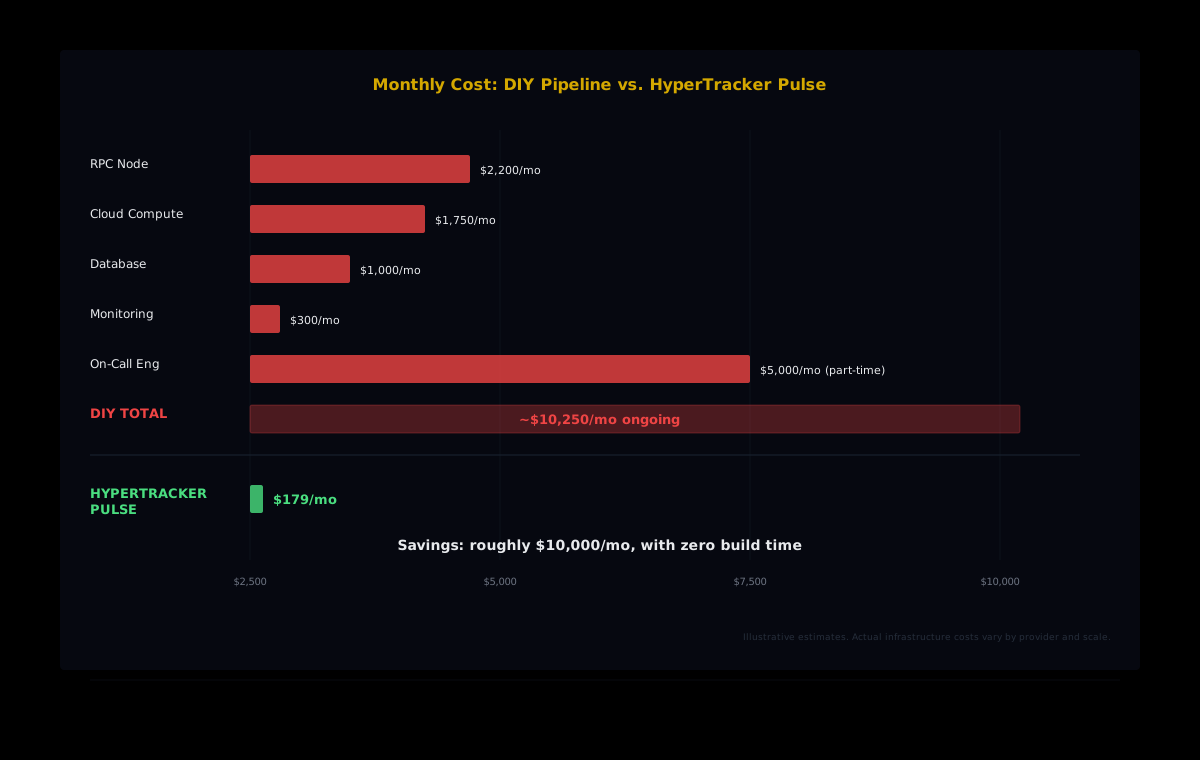
Add it all up and the ongoing monthly cost of running your own cohort pipeline looks something like this:
| Cost Category | Estimated Monthly | Notes | | --- | --- | --- | | RPC node provider | $300 to $4,000 | Depends on throughput needs | | Cloud compute | $1,500 to $2,500 | Aggregation jobs, API servers | | Database (managed) | $1,000 to $2,000 | Time-series hot + cold storage | | Monitoring and tooling | $200 to $500 | Alerting, logging, dashboards | | On-call engineering | $5,000+ | Part-time, 24/7 coverage | | Total | $8,000 to $14,000+ | Before a single line of product code |
That does not include the upfront engineering investment. At 850+ hours across the five layers, and assuming a blended rate of $150/hour for crypto-experienced engineers, the initial build runs somewhere around $125,000 in engineering time alone. Even at lower rates, the build absorbs three to six months of a senior engineer's full attention.
The costs teams always underestimate
The infrastructure bill is the obvious cost. The hidden costs are worse.
Opportunity cost
Your best engineers spend six months building data plumbing. That is six months of not building the product that generates revenue: the trading bot, the portfolio dashboard, the risk management system. The cohort pipeline is infrastructure. It is necessary for what you are building, but it is not the thing your users pay for.
Data quality debt
Cohort classifications are only as good as the data feeding them. Missed fills produce incorrect PnL calculations. Incorrect PnL pushes wallets into the wrong cohorts. Wrong cohorts produce wrong signals. And the dangerous part: these errors are silent. Your pipeline will not crash or throw an error when a wallet is misclassified. It will just serve wrong data, confidently, until someone notices the downstream signals do not match reality.
Data quality is not a one-time problem you solve at launch. It is an ongoing discipline that requires validation pipelines, reconciliation checks, and periodic audits. Budget for it or accept that your cohort data will drift from ground truth over time.
Maintenance drag
Hyperliquid is evolving rapidly. New asset classes (HIP-3 spot listings, prediction markets), protocol upgrades, and API changes all require pipeline updates. If the L1 introduces a new order type, your ingestion layer needs to handle it. If gas mechanics change, your fill parsing might break. Every protocol change creates maintenance work, and because Hyperliquid ships updates frequently, the maintenance never stops.
When building makes sense
The build path is not always wrong. Two scenarios genuinely favor it:
Custom cohort definitions. If you need classification logic that goes beyond the standard behavioral segments, like combining on-chain activity with off-chain signals, or defining cohorts around specific strategy patterns that a general-purpose API does not support, building gives you full control over the classification engine.
Extreme scale. If your application processes more than two million API requests per month and needs custom SLAs with guaranteed latency percentiles, an in-house build can eventually cost less per query at very high volumes. The crossover point is high, though, and most teams overestimate how quickly they will reach it.
For everyone else, the math points in one direction.
The managed alternative
HyperTracker's Pulse plan delivers all 16 behavioral cohorts, covering eight size tiers and eight PnL tiers, through 21 REST API endpoints at $179/month. That includes 50,000 API requests per month, 5-minute data refresh, 6+ months of historical data for positions and fills, liquidation risk scoring, leaderboards, and order flow with stop and take-profit visibility.
Higher tiers add volume and delivery options: Surge at $399/month for 150,000 requests, Flow at $799/month with webhooks and 400,000 requests, and Stream at $1,999/month for WebSocket delivery and two million requests.
The difference is not subtle. At $179/month, you get the output of an infrastructure stack that would cost $10,000+ per month to operate yourself, with zero build time, zero maintenance burden, and data quality backed by a team that has been processing Hyperliquid fills since the exchange launched.
What a production query looks like
Instead of building and maintaining five infrastructure layers, a single API call returns cohort-level positioning for any asset on Hyperliquid:
curl -X GET "https://ht-api.coinmarketman.com/api/external/cohort-metrics?coin=BTC&start=2026-07-01T00:00:00.000Z" \
  -H "Authorization: Bearer YOUR_JWT_TOKEN"
The response gives you cohort-level aggregates: how many wallets in each behavioral segment are long, short, and by how much. Cohort bias, positioning deltas, entry/exit flows. The intelligence that took hundreds of hours to build, served in one call.
For builders who want push delivery instead of polling, the Flow plan at $799/month includes webhooks that fire when cohort positioning crosses configurable thresholds. Set a webhook for "Money Printer cohort flips net short on ETH" and your bot gets the signal the moment it happens, without polling.
Skip the pipeline. Ship the product.
HyperTracker gives you 16 behavioral cohorts, 21 endpoints, and 6+ months of history. Start building with the data, without building the infrastructure.
The decision framework
If you are weighing build versus buy for cohort analytics, ask three questions:
- Is cohort analytics your core product, or infrastructure for it? If it is the product (you are selling analytics), building makes sense because differentiation matters. If it is infrastructure (you are building a bot, dashboard, or fund that consumes cohort data), buying lets you focus on the product layer that generates revenue.
- Do you need custom classifications? If standard behavioral segments (size and PnL based) cover your use case, there is no reason to reinvent them. If you need proprietary classification logic, building gives you full control.
- Can you absorb three to six months of build time? In crypto, markets move fast. Six months of pipeline building is six months your trading product is not live. The opportunity cost of delayed launch is often larger than the infrastructure savings from self-hosting.
Most teams that start building switch to a managed API within the first two months, once the true scope of the pipeline becomes clear. The ones that finish the build successfully tend to be well-funded teams with dedicated infrastructure engineers who are not needed on the product side. That is a narrow profile.
Whichever path you choose, go in with real numbers. The pipeline will cost more than you think.