1 Million HYPE to Launch a Market: HIP-4's Builder Bet
By CMM Team - 16-Jul-2026
1 Million HYPE to Launch a Market: HIP-4's Builder Bet
Deploying a prediction market on Hyperliquid costs 1 million HYPE. At current prices, that is roughly $60 million in locked capital before a single trade executes. The number sounds extreme until you understand the economics behind it: that stake is recyclable, the opening fees are zero, and the same slot can power a rolling series of markets for as long as the builder wants to run them.
HIP-4, Hyperliquid's outcome market primitive, went live on mainnet on May 2, 2026. It is the latest piece of infrastructure on a platform that already handles perpetual futures, spot trading, and permissionless perps under HIP-3. For builders, the question is whether the unit economics of deploying prediction markets justify the capital commitment, and what kind of products become viable when your event contracts share an order book and margin account with every other Hyperliquid instrument.
Here is how the economics actually work, what builders should model before staking, and where HyperTracker's cohort analytics fit into the picture.
The 1M HYPE Stake: Capital Lock, Quality Filter, or Both?
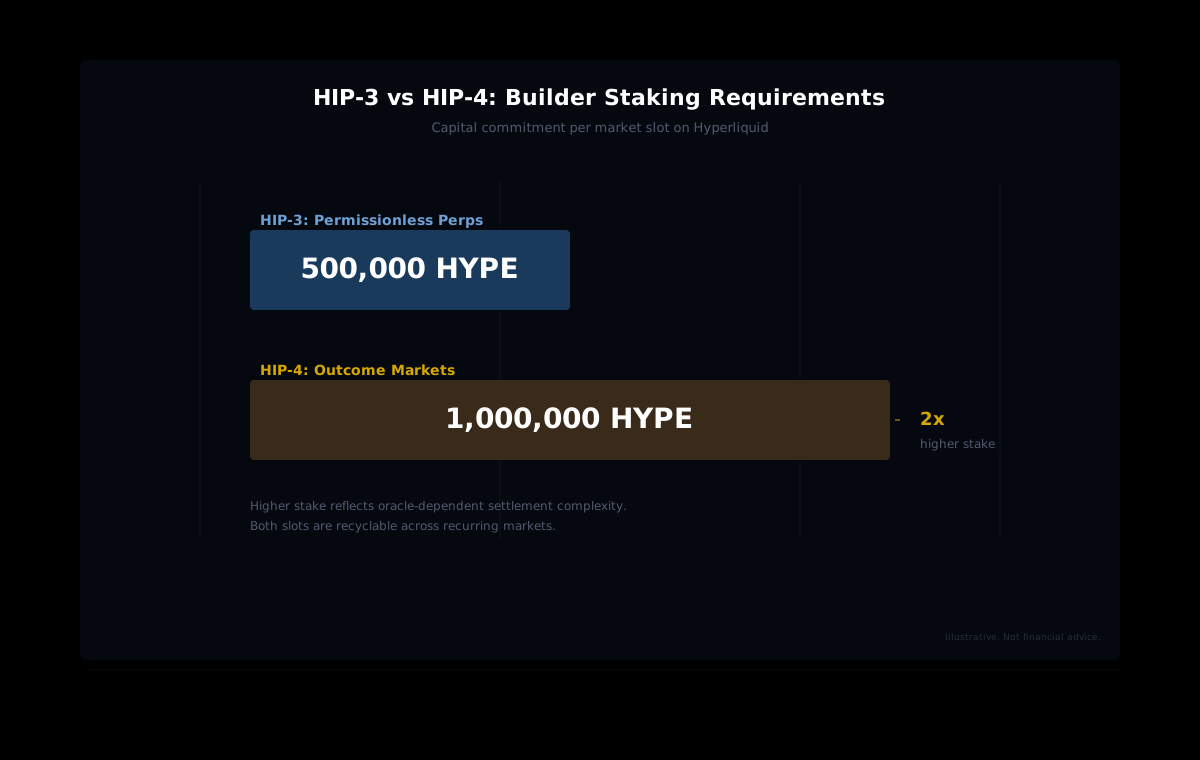
HIP-3 (permissionless perpetual futures) requires builders to stake 500,000 HYPE per market slot. HIP-4 doubles that to 1,000,000 HYPE. The rationale is straightforward: outcome markets depend on oracles for settlement, which introduces manipulation risk that perpetual futures priced against on-chain mark prices do not carry. Higher skin in the game means fewer bad actors willing to deploy junk markets or corrupt resolution feeds.
That stake is slashable. If validators determine a builder manipulated oracle data, introduced invalid state transitions, or caused prolonged downtime, the 1M HYPE gets burned. This is a meaningful economic penalty, and it functions as quality control for the entire prediction market ecosystem. Standalone platforms like Polymarket have struggled with low-quality, illiquid markets cluttering their interface. Hyperliquid's staking barrier filters for builders who are serious enough to commit real capital.
The counterargument: a $60M barrier prices out smaller teams and indie developers. Only well-capitalized entities or communities pooling resources can realistically deploy. Whether that concentration of market creation is a feature or a bug depends on your perspective, but the early evidence suggests Hyperliquid is betting on fewer, higher-quality markets rather than an infinite long tail of thinly-traded events.
Slot Recycling: Where the Unit Economics Get Interesting
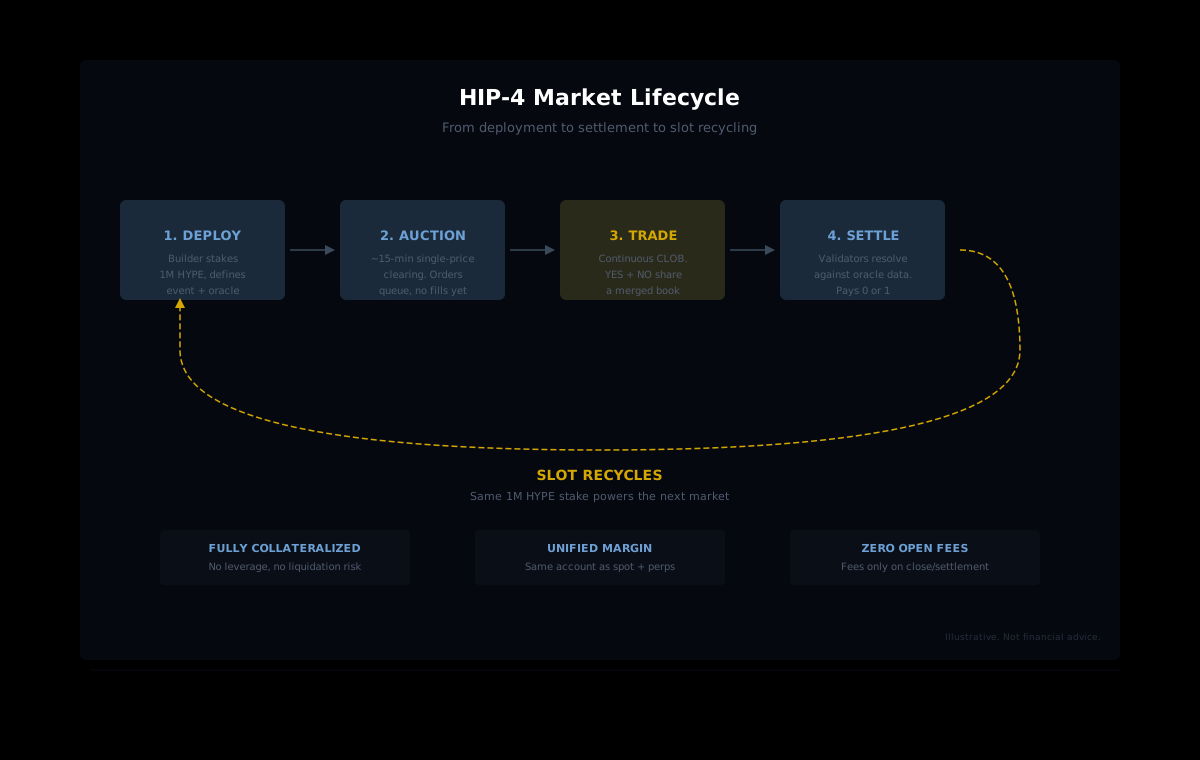
The critical detail most analyses miss: the 1M HYPE stake is not a per-market cost. It is a per-slot cost. Once a market resolves and settles, the builder can redeploy that same slot with a new event.
Consider a builder deploying a daily BTC price binary. That is 365 markets per year from a single staked slot. The effective cost per market drops from $60M to roughly $164K per deployment cycle (assuming one year of daily markets). For weekly macro events (CPI prints, FOMC decisions, jobs reports), the slot runs 52 markets per year, bringing per-market capital overhead to around $1.15M. Still substantial, but orders of magnitude more efficient than the raw staking figure implies.
This design naturally pushes builders toward recurring, standardized, high-liquidity markets. Monthly economic data releases, daily price outcomes, weekly protocol governance votes. The economics penalize one-off novelty markets ("Will Elon tweet about Dogecoin on Tuesday?") because the slot sits idle between events. Hyperliquid's staking model, whether intentionally or not, filters for the kinds of markets that institutional traders actually want to trade.
Zero Fees to Open, But Revenue on the Close
HIP-4 charges zero fees to open a position. This is a direct competitive play against Polymarket (which charges up to 2% on winning positions) and Kalshi's tiered fee structure. The positioning is deliberate: lower the barrier for traders to enter, capture volume, and monetize on settlement.
Fees follow HyperCore's spot fee schedule and apply only on closing or settlement. Builders can add an additional fee share of up to 50% on top of Hyperliquid's base fees. For canonical (validator-deployed) markets, fees are currently set to zero during the initial growth phase.
The fee structure creates an interesting builder revenue model. A builder who deploys a popular recurring market, adds a modest fee share on top, and runs the slot continuously could generate meaningful revenue from a single staked position. The math depends entirely on volume, which brings us to the early numbers.
Early Traction: 6M Contracts on Day One
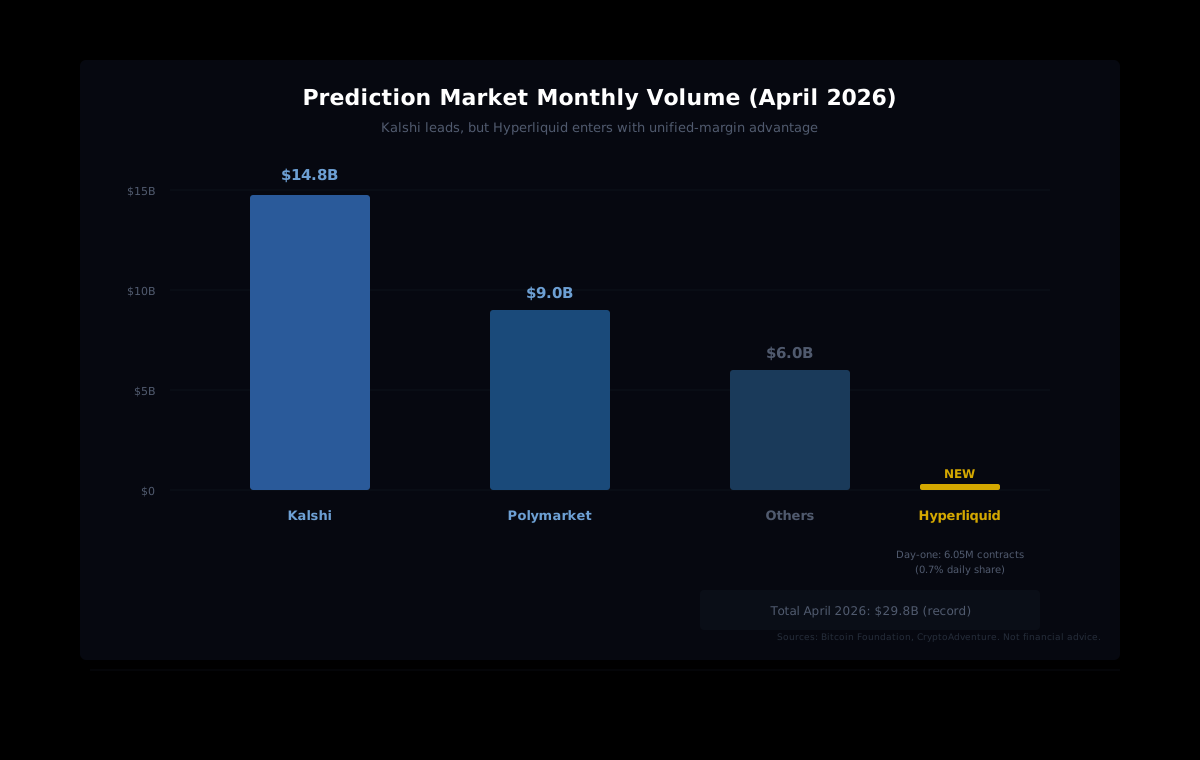
HIP-4's first mainnet market was a daily binary outcome on Bitcoin's mark price, settling at 06:00 UTC. On launch day, trading volume reached 6.05 million contracts. For context, on the same day Kalshi recorded 546 million contracts and Polymarket recorded 190 million. That gave Hyperliquid roughly 0.7% of the daily prediction market volume on its very first day.
Small in absolute terms. But consider the trajectory. Within 14 days of launch, a single HIP-4 market crossed $50 million in total volume. The broader prediction market sector hit a record $29.8 billion in total volume across all platforms in April 2026, up from $26.5 billion in March. Kalshi led at $14.8 billion, followed by Polymarket at $9 billion.
What makes Hyperliquid's entry different from yet another prediction market fork: its existing user base. The platform processed around $219 billion in trading volume in March 2026 alone and has roughly 1.4 million active traders. Those traders do not need to create new accounts, fund new wallets, or learn new interfaces. HIP-4 contracts sit inside the same margin account as their perps and spot positions.
Unified Margin: The Builder's Distribution Hack
This is the architectural advantage that makes HIP-4 fundamentally different from standalone prediction platforms. Outcome contracts operate inside the same account and execution engine as Hyperliquid's spot and perpetual futures markets. A trader holding a long ETH perpetual can simultaneously hold prediction market positions, all within one margin context.
For builders, this collapses the cold-start problem. Instead of building a user base from scratch (which is what Polymarket, Kalshi, and every other prediction platform had to do), a builder deploying an HIP-4 market instantly taps into Hyperliquid's existing liquidity and user base. The trading infrastructure, market makers, and execution engine are already there.
The composability angle opens up product categories that standalone prediction platforms cannot support. Cross-asset hedging (long ETH perp + short on "ETH above $5K by Friday"), structured products combining outcome contracts with perpetual positions, and event-driven trading bots that adjust perp exposure based on prediction market probabilities. These become possible because everything lives inside one margin system.
How Cohort Data Changes the Prediction Market Game
Prediction markets attract a different behavioral profile than perpetual futures. Positions are fully collateralized with no leverage and no liquidation risk. The maximum loss is always your entry cost. This means the wallet segmentation patterns shift: traders who might be Dolphins or Apex Predators in perps could behave like entirely different cohorts when trading binary outcomes.
Our data from HyperTracker's 16 behavioral cohorts gives builders a unique lens into this. By tracking how different wallet segments (classified by both size and all-time PnL) interact with HIP-4 markets, builders can answer questions that pure prediction market platforms cannot:
- Are Money Printers (wallets with +$1M all-time PnL) entering prediction markets, and how does their conviction compare to perps positioning?
- Do Smart Money wallets (+$100K to +$1M PnL) take directional prediction market bets that align with or diverge from their perpetual futures positions?
- Which cohorts are early adopters of new HIP-4 market types, and does that predict volume growth?
If a builder is considering whether to deploy a weekly CPI market or a daily BTC binary, cohort analytics provide a demand signal. If Whales ($500K-$1M equity) and Tidal Whales ($1M-$5M equity) are actively positioning in macro-correlated perps before economic releases, the demand for a corresponding prediction market is likely there. The cohort data does not guarantee success, but it reduces the guesswork around which markets deserve slot allocation.
Track Wallet Cohorts Across Hyperliquid
16 behavioral segments. Every wallet classified by size and all-time PnL. See how different cohorts position before you deploy your next HIP-4 market.
The Competitive Landscape: Why This Matters Now
Prediction markets are growing faster than almost any other category in crypto. The sector's combined volume surged more than 300% in 2025, and the trajectory has continued into 2026 with record months. Three platforms now control the vast majority of volume: Kalshi (regulated, US-focused), Polymarket (crypto-native, UMA oracle), and now Hyperliquid (unified DEX, validator settlement).
Each has a different moat. Kalshi has CFTC approval and institutional distribution. Polymarket has brand recognition and the largest prediction market community. Hyperliquid has something neither can replicate: an existing high-volume derivatives exchange with unified margin across instruments.
The HIP-3 precedent is instructive here. Permissionless perpetuals launched in October 2025 and now represent more than 35% of all Hyperliquid trading volume. If HIP-4 follows a similar adoption curve, builder-deployed prediction markets could become a significant portion of platform activity within a few quarters. That is the bet builders are making when they lock up 1M HYPE.
What Builders Should Model Before Staking
The decision to deploy an HIP-4 market is fundamentally a capital allocation question. Here is what the spreadsheet should include:
- Slot utilization rate: How many markets per year will this slot support? Daily events yield 365 deployments. Weekly events yield 52. The higher the utilization, the lower the effective per-market cost.
- Volume projection: What is the realistic daily volume for this market type? Early HIP-4 data shows a single BTC binary hitting $50M in 14 days. Niche events will trade thinner.
- Fee share revenue: If you add a fee share on top of base fees, what is the projected take rate at different volume levels?
- HYPE opportunity cost: That 1M HYPE could be staked for validator rewards, deployed in DeFi, or sold. The opportunity cost of locking it in an HIP-4 slot is real and should be modeled against expected revenue.
- Slashing risk: Oracle manipulation, downtime, or invalid state transitions result in the stake being burned. The risk is low for competent builders, but not zero.
The builders who will thrive in this model are those who treat slot deployment like a business, with recurring markets, disciplined fee structures, and data-driven decisions about which events to list. The ones who stake 1M HYPE on a whim and deploy a single novelty market are the ones who will find the economics punishing.
The Bottom Line
HIP-4 is not just another prediction market protocol. It is a new instrument type on the largest on-chain derivatives exchange, with unified margin, zero opening fees, and a recyclable staking model that rewards sustained deployment. The 1M HYPE barrier is high by design, filtering for builders who can commit real capital and run real businesses on top of the protocol.
For the rest of us watching from the outside, the signal to track is how wallet cohorts respond. When Money Printers start placing event bets alongside their perp positions, that is not a prediction market experiment anymore. That is a new market structure emerging in real time, and our cohort data is one of the clearest lenses to watch it unfold.