$101M Lost to Wrench Attacks: Why Smart Money Is Going Dark
By CMM Team - 09-May-2026
$101M Lost to Wrench Attacks: Why Smart Money Is Going Dark
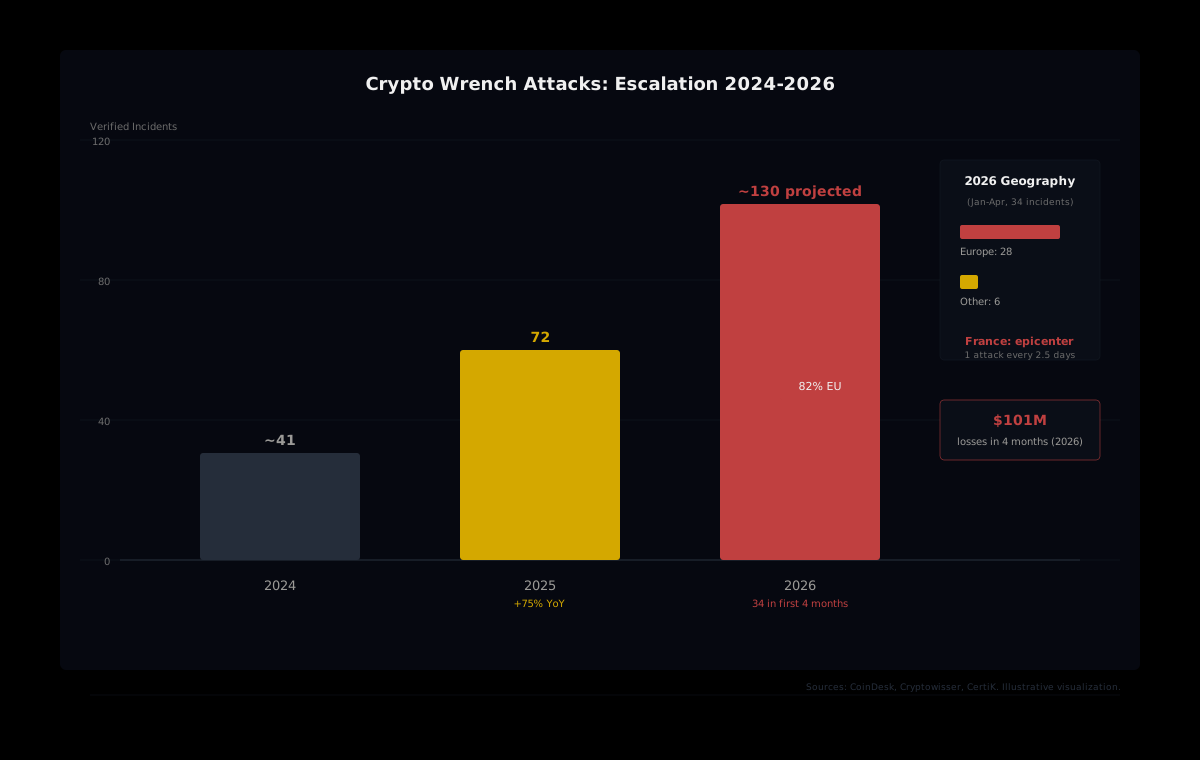
Someone knows where you live. In the first four months of 2026, researchers documented 34 verified wrench attacks globally, a 41% increase compared to the 24 incidents recorded during the same period in 2025. Total losses tied to these attacks reached approximately $101 million within those four months alone. The victims were not hacked. They were kidnapped, beaten, and forced to sign transactions at gunpoint.
The threat has shifted. Digital security keeps improving, so criminals are targeting the human link instead. And on-chain transparency, the very feature that makes decentralized trading trustworthy, is now a targeting map for organized crime.
For traders on Hyperliquid and other on-chain venues, this creates a genuine tension. The same wallet visibility that prevents exchange manipulation also tells attackers exactly how much you hold. Understanding how smart money cohorts are adapting their privacy strategies is no longer just an operational concern. It is a personal safety question.
The violence is escalating
In 2025, there were 72 verified physical coercion incidents globally, a 75% increase from the previous year. Cases involving physical assault rose 250% year-over-year, with confirmed losses exceeding $40 million. Europe now accounts for over 40% of global incidents, up from 22% in 2024.
France has emerged as the global epicenter. The country has experienced 41 physical attacks tied to cryptocurrency holders since the beginning of 2026, roughly one assault every two and a half days. Of the 34 globally documented cases, 28 occurred in Europe, representing 82% of all incidents.
The high-profile cases are the ones that make headlines. In January 2025, Ledger co-founder David Balland was kidnapped in France along with his partner, with attackers severing one of his fingers as part of a ransom demand. But the structural trend is more concerning than any single incident. Attackers are no longer acting opportunistically. They are operating as organized, transnational groups combining OSINT-driven targeting with extreme physical violence.
On-chain transparency: the double-edged sword
Hyperliquid does not require KYC. No email address, no ID document, no selfie. Your wallet address is your account, and every order, cancel, trade, and liquidation happens transparently on-chain with one-block finality. That transparency is the point. It is why traders trust the platform, because no opaque matching engine can front-run your orders or manipulate liquidation thresholds behind closed doors.
But that same transparency means every large position is visible to the entire market. If someone can link a wallet address to a real-world identity (through OSINT, social media posts, conference appearances, or data broker records), they can see exactly how much that person holds and where it sits.
The paradox: on-chain verifiability protects traders from exchange manipulation. It also tells criminals exactly who holds what.
This is the fundamental tension that smart money is navigating right now. The solution is not to abandon transparency. It is to separate on-chain activity from real-world identity with much more rigor than most traders currently practice.
How the targeting works
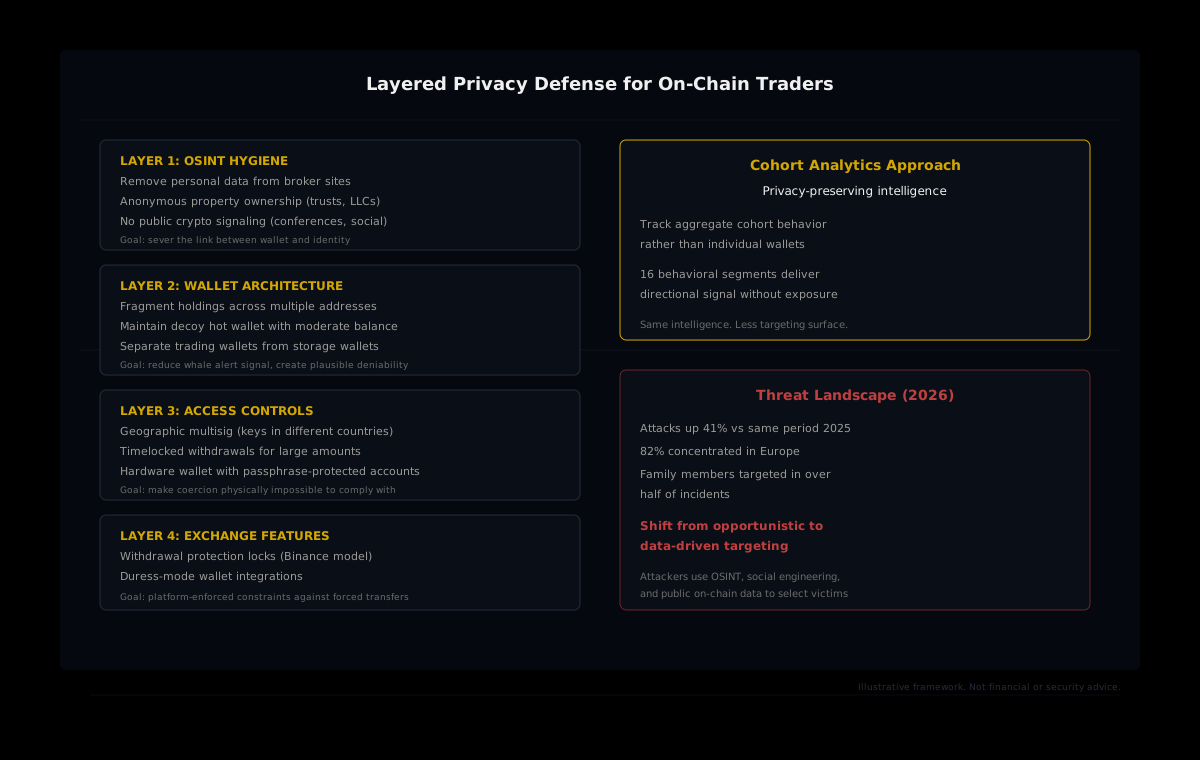
CertiK's research identifies a clear shift toward what it calls a "data-driven targeting model." Attackers no longer need physical surveillance when they can access a victim's full name, home address, and financial profile through public data. More than half of 2026 incidents have involved family members, either as direct victims or as pressure levers to force cooperation.
The attack chain typically follows a pattern:
- On-chain identification: Whale alert services, block explorers, and public leaderboards flag high-value wallets. Large positions on platforms like Hyperliquid are visible to anyone with a browser.
- Real-world linking: Social media posts, conference attendance, ENS names, and data broker records connect wallet addresses to physical identities. The average crypto holder appears on dozens of data broker sites with home address and phone number exposed.
- Physical execution: Small teams of three to five individuals, often recruited through Telegram and Snapchat, carry out kidnappings, home invasions, or coercion operations. The forced transactions are typically irreversible.
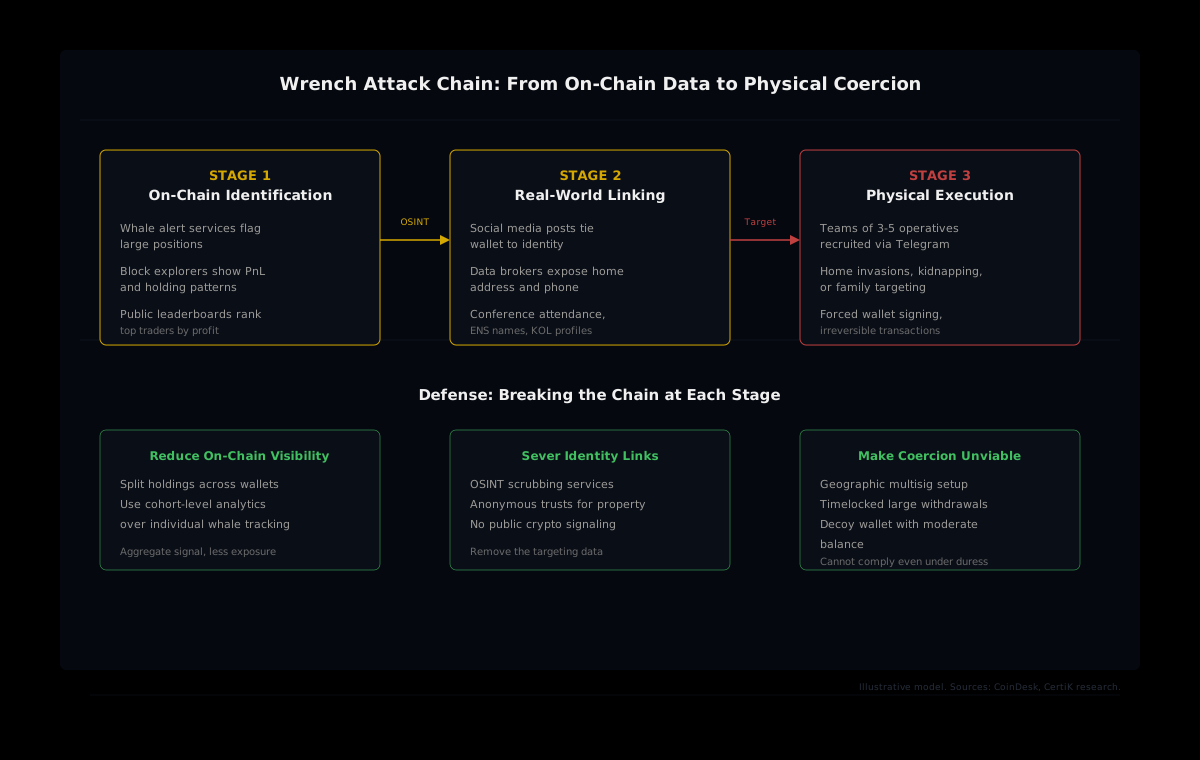
The structural takeaway is clear. As protocol and wallet security improves, the threat migrates toward the human link. As long as crypto holdings remain associated with identifiable personal data, physical coercion will remain the economically rational attack path for criminals.
Privacy strategies the smart money cohort is adopting
The most profitable traders on Hyperliquid are adapting. Our data shows behavioral shifts across the higher-value cohorts that suggest an increasing focus on operational security. While we cannot see individual privacy setups through cohort analytics, the patterns in wallet behavior tell a story.
Wallet fragmentation
Rather than concentrating holdings in a single wallet, experienced traders are distributing assets across multiple addresses. This reduces the signal that whale alert services detect. A Leviathan-sized position split across several wallets appears as multiple Whale or Small Whale positions in our cohort data, making the true holder less visible to casual on-chain surveillance.
Geographic multisig and timelocks
The most robust physical security setup involves multi-signature wallets with keys distributed across different geographic locations, combined with timelocks on large withdrawals. Under duress, a trader can demonstrate that moving their full stack is physically impossible without keys in multiple countries and a waiting period measured in days. This makes the wrench attack economically unviable because attackers cannot wait around for a timelock to expire.
Decoy wallets
Some traders maintain a visible "main" hot wallet with a moderate balance, enough to satisfy most attack crews, while keeping their real holdings in cold storage or multisig setups that cannot be accessed quickly. The decoy wallet strategy works because it aligns incentives: attackers get something, which reduces the violence, while the bulk of assets remain inaccessible.
OSINT hygiene
The most overlooked defense is removing personal information from public data sources. Professional deletion services can scrub home addresses, phone numbers, and property records from data broker sites. Purchasing property through anonymous trust structures, requesting Google Street View blurs, and avoiding public displays of crypto wealth all reduce the surface area for OSINT-driven targeting.
What cohort data reveals about the shift
Our API classifies every wallet on Hyperliquid into one of 16 behavioral cohorts: eight by wallet size (from Shrimp at $0-$250 up to Leviathan at $5M+) and eight by all-time PnL (from Giga-Rekt to Money Printer). This classification system captures aggregate behavior patterns that reflect broader market trends, including how traders respond to evolving physical threats.
The Money Printer cohort (all-time PnL above $1M) and Smart Money cohort ($100K-$1M) represent the wallets most likely to be targeted by wrench attackers, because their on-chain track records publicly demonstrate significant wealth. Our data shows these cohorts are structurally sophisticated in how they manage positions, and tracking their aggregate positioning provides useful signal for builders and analysts.
For builders creating portfolio tools, alert systems, or risk dashboards, understanding cohort-level positioning changes matters because it captures the aggregate behavior of the most sophisticated wallets. When the Money Printer cohort shifts positioning, it often signals information that retail has not yet priced in. Monitoring these movements through our API gives you an analytical edge, regardless of whether individual whales are fragmenting their wallets for privacy.
Building privacy-aware tools
If you are building on Hyperliquid, the wrench attack trend has practical implications for product design. Tools that display wallet-level PnL leaderboards or whale alert notifications serve a legitimate analytical purpose, but they also contribute to the targeting surface area that attackers exploit.
Responsible design choices include:
- Cohort-level aggregation over wallet-level exposure: Our API provides segment-level intelligence (what are the Money Printers doing as a group?) rather than requiring individual wallet tracking. Cohort analytics deliver the same directional signal with less individual exposure.
- Anonymized leaderboards: Displaying performance metrics without linking to specific wallet addresses reduces the OSINT surface area while preserving the analytical value.
- Push-based alerting on segments: Using HyperTracker's webhook delivery to monitor cohort positioning changes means your users get actionable intelligence about smart money behavior without needing to track individual whales.
- Timelock integrations: Building withdrawal delay features into wallet management tools gives users a credible defense against coercion scenarios.
The tension between transparency and privacy will define the next generation of on-chain analytics tooling. The products that solve it well, delivering institutional-grade intelligence without turning individual wallets into targeting maps, will win.
Cohort Intelligence Without Wallet-Level Exposure
HyperTracker's API gives you smart money positioning across 16 behavioral cohorts on Hyperliquid. Track aggregate behavior at the segment level, from Money Printers to Leviathans, without relying on individual wallet tracking. Start building with the free tier (100 requests/day) or go deeper with Pulse at $179/mo.
The industry is responding (slowly)
Exchanges are beginning to acknowledge the physical threat vector. Binance launched "Withdraw Protection," a user-activated lock that halts all on-chain withdrawals for a configurable period. The idea is simple: if you cannot move funds under duress because the withdrawal is locked, attackers have less incentive to coerce you in the first place.
Lloyd's of London has started backing coverage that includes wrench attacks (via brokers like AnchorWatch), treating crypto holders more like traditional high-net-worth individuals who need personal security insurance. Some security firms are offering specialized "crypto OpSec" audits that assess both digital and physical vulnerability.
But the fundamental problem remains unsolved. On-chain transparency is a feature, and most of the crypto community does not want to sacrifice it. The challenge is building the tooling and practices that let traders benefit from transparent markets without becoming visible targets.
Every wallet on Hyperliquid is a public record. Every profitable trade is a signal. The question is no longer whether you need operational security. The question is whether your privacy practices have kept pace with the people who are watching.