HIP-4's First Week: What 5,400 Prediction Wallets Reveal
By CMM Team - 10-May-2026
HIP-4's First Week: What 5,400 Prediction Wallets Reveal
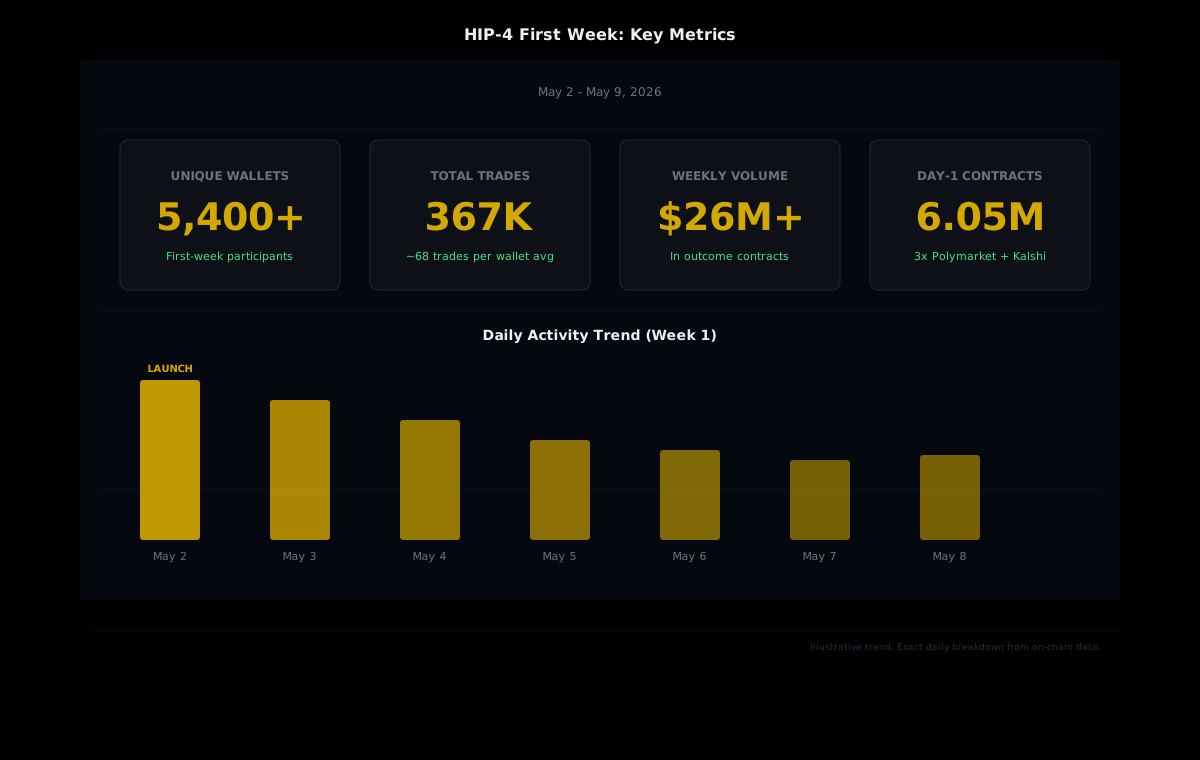
Hyperliquid launched prediction markets on May 2. Within seven days, over 5,400 unique wallets placed more than 367,000 trades across HIP-4 outcome contracts, generating over $26 million in volume. The first Bitcoin outcome market alone did roughly three times the volume of equivalent markets on Polymarket and Kalshi combined.
Those are interesting headline numbers. But they don't answer the question that actually matters: who showed up?
A prediction market's first week is a self-selecting filter. The traders who find it immediately, fund a position within hours, and trade a brand-new product type are a specific population. They are not a random sample of the broader market. They reveal something about where conviction lives, where capital is already sitting, and who views prediction markets as a natural extension of what they already do on Hyperliquid.
This article digs into what the first-week data tells us, how HIP-4's unified margin structure changes the prediction market game, what the Polymarket wallet overlap reveals about capital flow, and why cohort context turns a generic bet into a conviction signal.
The numbers behind the first week
HIP-4 launched on May 2, 2026, with a single binary outcome market: whether BTC would exceed a specific price threshold by a set time. The format is simple. Buy a YES or NO token priced between 0.001 and 0.999 USDH. If your side wins, the token settles to 1. If it loses, it settles to 0. Fully collateralized, no liquidation risk.
On day one alone, trading volume reached 6.05 million contracts. For context, Hyperliquid already processes around $6 billion in daily derivatives volume on its perps side. The prediction market is a new primitive layered on top of that existing infrastructure, which means the traders who arrived first were, in many cases, already there.
Hyperliquid also posted a spike in new wallet signups the day after HIP-4 launched, suggesting the prediction market drew in participants who had not previously used the platform. Whether those wallets stick around depends on how quickly the product expands beyond simple BTC price bets.
Why HIP-4's structure is the real story
The headline stat is volume. The structural advantage is unified margin.
On Polymarket, a trader opens a prediction market position in one account with USDC on Polygon. If they also trade perpetual futures, that happens on a completely separate platform with separate collateral. Capital is fragmented across products and chains, which means opportunity cost is real and constant.
HIP-4 changes that. A trader on Hyperliquid can hold a BTC perpetual long, a spot ETH position, and a binary "BTC above $X" outcome contract in the same margin account with the same USDH collateral. One platform, one wallet, one view of total exposure. This is the feature that no existing prediction market can replicate, because it requires the prediction market to live natively on a full-featured derivatives exchange.
For builders and analysts, unified margin has a second-order effect: every prediction market bet sits alongside the bettor's perps positions, spot holdings, leverage profile, and historical PnL. All of it is on-chain. All of it is readable through the same analytics infrastructure that already covers Hyperliquid's perps market.
Zero opening fees are a nice incentive. Fees only apply when closing, burning, or settling a position. But the unified margin is what keeps capital from leaking to other platforms.
The Polymarket overlap: same capital, different venue
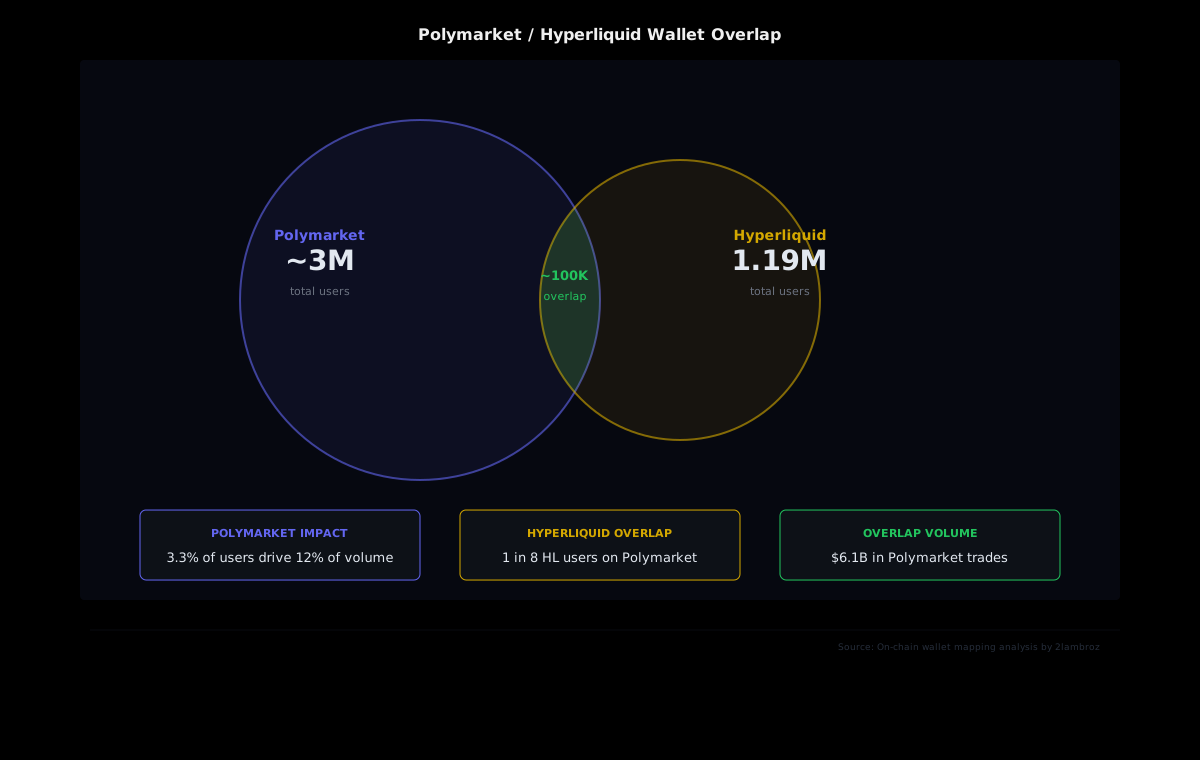
A researcher mapped every Polymarket wallet against Hyperliquid activity and found that roughly 100,000 wallets are active on both platforms. That is only about 3.3% of Polymarket's total user base, but those wallets punch above their weight: they drive roughly 12% of all Polymarket volume, representing around $6.1 billion in trades.
From the Hyperliquid side, about 1 in 8 users has a Polymarket account.
This overlap matters because it means the most active capital in prediction markets and on-chain derivatives trading is essentially the same pool of money. HIP-4 does not need to convince these traders that prediction markets are worth their time. They already trade them. The pitch is simpler: stop fragmenting your collateral across two platforms.
The prediction market competitive landscape
HIP-4 launched into a prediction market sector posting record volumes. In April 2026, total trading volume across all prediction platforms hit a record $29.8 billion, up from $26.5 billion in March. Kalshi leads at $14.8 billion, followed by Polymarket at $9 billion.
Hyperliquid's first-week prediction volume of over $26 million is a fraction of those figures. That is expected for a product that launched eight days ago with a single market type. The trajectory matters more than the absolute number at this stage.
Arthur Hayes, co-founder of BitMEX and CIO of Maelstrom, framed the competitive dynamic bluntly: "HIP-4 will quickly become a dominate prediction market because of Hyperliquid's large user base, much cheaper trading fees, and very robust tech infrastructure".
Whether that prediction holds depends on what happens when permissionless market creation goes live. Full permissionless deployment for third-party teams is expected around mid-June, timed to coincide with the FIFA World Cup. The 2026 World Cup is already Polymarket's second-largest market by all-time volume at $884 million. If HIP-4 can capture even a small slice of that event-driven volume, the competitive picture shifts.
Why cohort context changes prediction market signals
On Polymarket, a large bet from an anonymous wallet tells you one thing: someone placed a big position. You can see the size. You can see the direction. But you have no idea whether that wallet has a track record of being right, or whether the same address just lost $500K on perps last month.
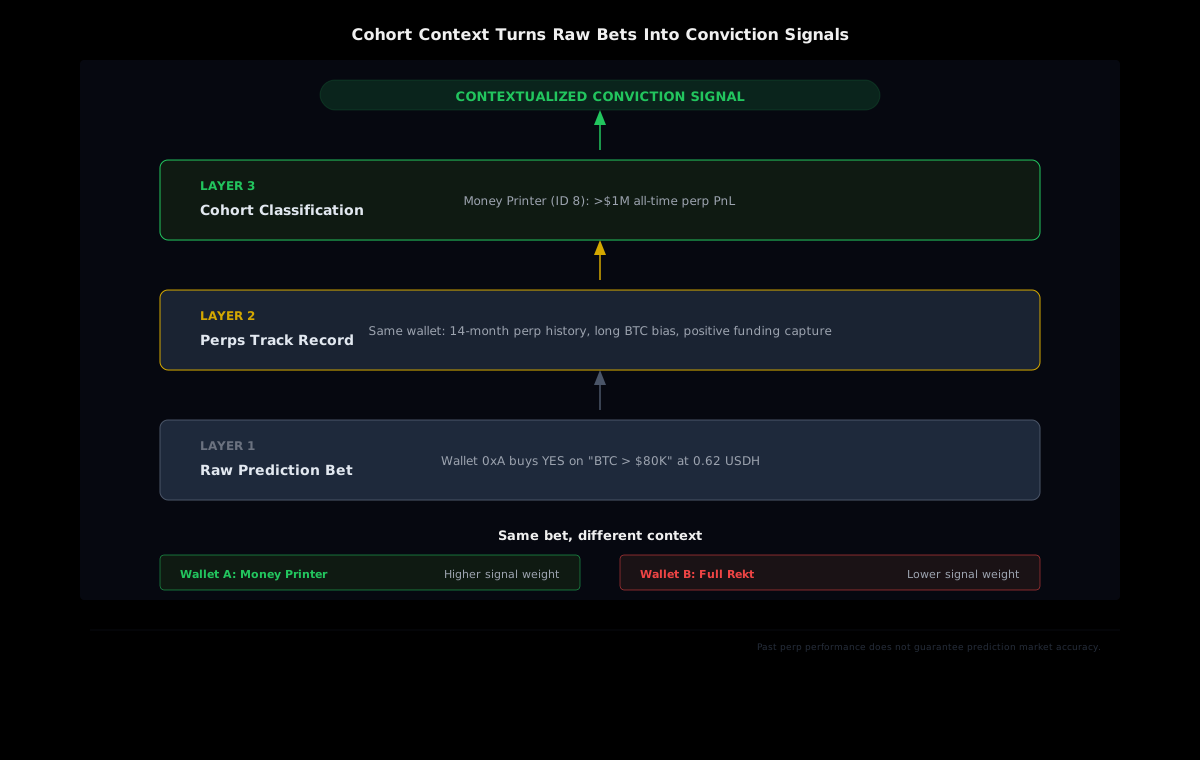
Hyperliquid is structurally different. Because prediction markets, perps, and spot all live in the same account, the same wallet that places a prediction bet also has a visible perps history. Our data classifies every Hyperliquid wallet into 16 behavioral cohorts: 8 by capital size (Shrimp through Leviathan) and 8 by all-time PnL (Money Printer through Giga-Rekt).
That classification turns a raw prediction market bet into a contextualized signal. Consider two wallets both buying YES on a BTC price outcome:
- Wallet A is classified as a Money Printer (over $1M in all-time perp PnL, segment ID 8). This wallet has been right enough, long enough, to accumulate seven figures of pure profit from derivatives trading.
- Wallet B is classified as Full Rekt (-$1M to -$100K lifetime, segment ID 14). This wallet's track record in derivatives is deeply negative.
Both bets are identical on the surface. The conviction behind them is not. Past perp performance does not guarantee prediction market accuracy, but it tells you something about calibration, risk management, and decision-making under uncertainty. Those skills transfer.
What to watch as HIP-4 matures
The first week establishes a baseline, not a ceiling. Several dynamics are worth tracking as prediction markets evolve on Hyperliquid.
Liquidity depth beyond BTC
HIP-4 launched with Bitcoin price outcomes. Expansion to HYPE, ETH, and eventually non-crypto events will determine whether the product attracts a broader user base or stays niche. Liquidity in the current markets is still building, and early price movements can be amplified by thin order books.
Permissionless markets and the World Cup catalyst
When permissionless market creation goes live around mid-June, anyone willing to stake 1 million HYPE can deploy their own outcome market. The FIFA World Cup will be the first major real-world event to test this infrastructure at scale. Sports betting is already the largest category on prediction platforms, with Kalshi deriving roughly 72% of its volume from sports.
Cross-product hedging patterns
The most interesting signal from HIP-4 will come when traders begin using prediction bets as hedges against their perps positions. A trader long BTC perps could buy a NO token on a "BTC above $X" outcome to create a defined-risk hedge within the same margin account. That kind of cross-product positioning will be visible on-chain and trackable through cohort analytics.
Cohort migration patterns
As prediction markets become another data layer within Hyperliquid, watch for patterns in which cohorts participate most actively. If the early adopters skew heavily toward Money Printer and Smart Money wallets, prediction markets may become another venue where informed capital leads and retail follows. If participation is evenly distributed across cohorts, the signal value of any single bet diminishes.
Tracking early movers with the API
The same HyperTracker API that covers perps positions, order flow, and cohort analytics extends to the wallets active in prediction markets. Because every prediction bet is placed by a wallet already classified into one of 16 cohorts, you can cross-reference prediction market activity against perps positioning.
import requests

API_BASE = "https://ht-api.coinmarketman.com/api/external"
headers = {"Authorization": "Bearer YOUR_JWT_TOKEN"}

# Check Money Printer (ID 8) and Smart Money (ID 9) positioning on BTC
for cohort_name, seg_id in [("Money Printer", 8), ("Smart Money", 9)]:
    resp = requests.get(
        f"{API_BASE}/position-metrics/coin/BTC/segment/{seg_id}",
        headers=headers,
    ).json()

    if resp:
        latest = resp[-1]
        print(
            f"{cohort_name}: "
            f"OI ${latest['openInterest']:,.0f}  |  "
            f"Net {latest['netDirection']}  |  "
            f"Long% {latest['longRatio']:.1%}"
        )
When Money Printer wallets are building perps exposure in one direction and simultaneously taking prediction bets in the same direction, that convergence across product types is a stronger signal than either position alone. When those two signals diverge, the ambiguity itself is worth noting before sizing into anything.
See which cohorts are active on Hyperliquid right now
The free tier includes 100 API requests per day. No credit card required. Start with Money Printer and Smart Money positioning on BTC, then cross-reference with prediction market activity as it scales.
HIP-4 is eight days old. The first markets are simple binary bets, and liquidity is still thin. This is not the moment for large positions or aggressive copy trading. But it is the moment to start watching, because the wallets that show up first to a new market are disproportionately the ones worth tracking later.
The traders who figured out Hyperliquid's perps before everyone else are the same ones placing the first prediction bets. The on-chain trail they leave is already readable. The question is whether you start watching now, or wait until the signal is priced in.