
Hyperliquid Prediction Markets Are Live: How to Spot the Whales First
By CMM Team - 06-May-2026
Hyperliquid Prediction Markets Are Live: How to Spot the Whales First
Prediction markets just crossed $24 billion in monthly volume. Hyperliquid wants a piece. On May 2, the exchange launched HIP-4 Outcome Markets, bringing binary prediction contracts to the same platform where traders already run perpetual futures and spot positions. Zero fees to open. Full collateralization in USDH. And every trade settled on-chain, which means every whale position is visible to anyone paying attention.
That last part is the angle most coverage misses. Prediction market whale tracking is already a proven edge on Polymarket, where tools like Stand and PolyTrack help traders follow high-conviction wallets. But Hyperliquid brings something Polymarket does not have: cross-margined accounts where a trader's prediction market bets sit alongside their perps positions, spot holdings, and historical PnL. One platform, one wallet, one complete picture of conviction.
The question is how to use that transparency before the market gets efficient.
How HIP-4 reshapes prediction markets
Hyperliquid's prediction markets are not a bolt-on product. HIP-4 adds binary outcome contracts as a native primitive, built into the same account and margin system that handles perps and spot. Traders buy YES or NO tokens priced between 0.001 and 0.999, representing the implied probability of an event. If you buy YES at 0.60 and the event occurs, you earn 0.40 per contract. If it does not, you lose the 0.60.
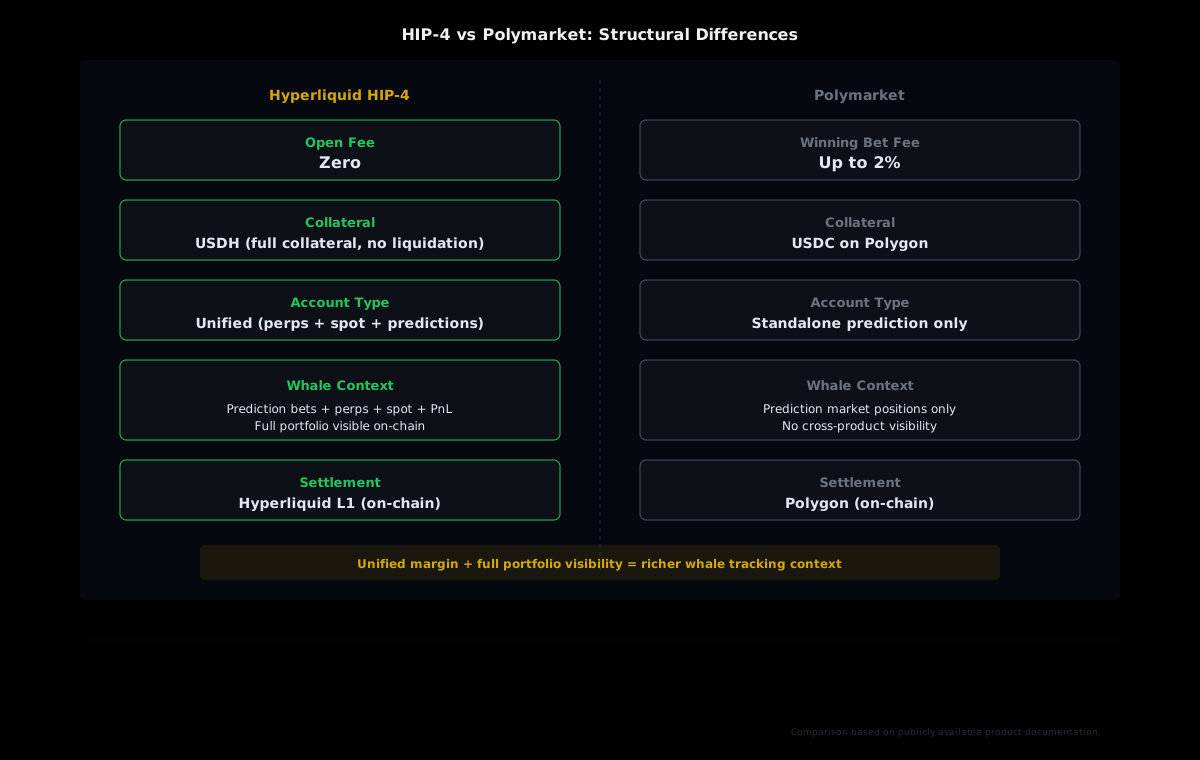
The key structural differences from Polymarket and Kalshi:
- Zero open fees. Costs apply only when closing or settling a trade. Polymarket charges up to 2% on winning bets.
- USDH collateral. Positions are fully collateralized in Hyperliquid's native stablecoin with no liquidation risk. You cannot lose more than your entry cost.
- Unified margin. Prediction market positions live in the same account as perps and spot. Cross-margining means a trader's capital efficiency is higher than splitting funds across platforms.
- On-chain settlement. Every position is publicly verifiable, just like perps on Hyperliquid. Whale tracking is structurally possible from day one.
The first market was a bet on whether Bitcoin's price would exceed a specific threshold by May 5. Within 24 hours, the platform recorded over 6 million contracts traded. Modest next to Kalshi's hundreds of millions, but notable for a product that launched days ago with a single market.
The $24 billion context
Hyperliquid is not entering a small market. Combined monthly trading volume across Kalshi, Polymarket, and smaller platforms topped $24 billion in March 2026. Bernstein projects the prediction market sector will hit $240 billion in annual volume for 2026, a 370% increase over last year.
In April, Kalshi led with approximately $13.4 billion in volume (52% market share), while Polymarket held roughly $8.5 billion (33% share). Polymarket still dominates user counts with over 678,000 unique users in April, more than eight times Kalshi's implied base.
The sector's growth is driven by three categories: sports betting (roughly 86% of Kalshi's March volume), geopolitical events, and crypto-native markets. Hyperliquid's entry targets crypto-native and geopolitical event traders, the segments where on-chain transparency and cross-margining with perps provide the strongest advantages.
Why whale tracking matters more here
On Polymarket, whale tracking works because trades settle on Polygon and every wallet is visible. An entire ecosystem of tools has sprung up to exploit that transparency. Stand, PolyTrack, PolyInsider, and HashDive all help traders identify and follow high-conviction wallets.
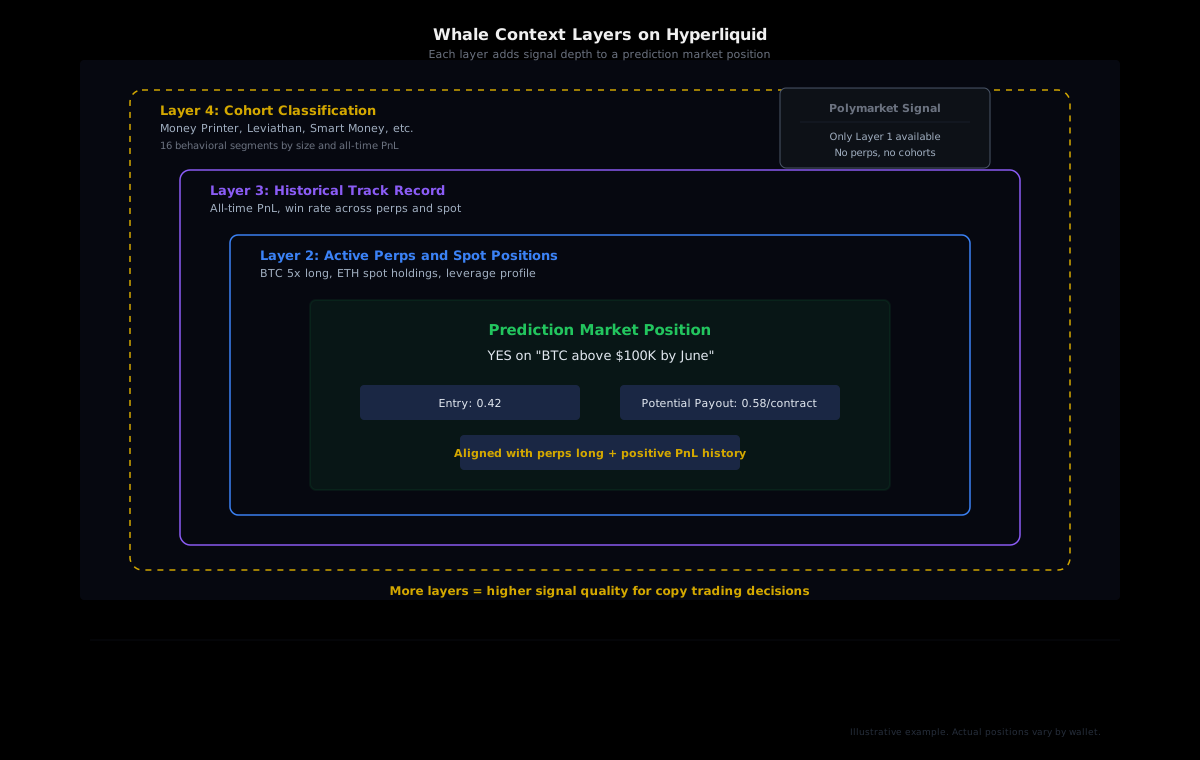
Hyperliquid offers the same on-chain transparency, but with a crucial difference: context. A Polymarket whale address tells you one thing, that someone placed a large bet on an event outcome. On Hyperliquid, the same address shows you their perpetual futures positions, their spot holdings, their leverage profile, and their historical PnL across all products. A prediction market bet gains meaning when you can see the rest of the portfolio.
Consider a practical example. A wallet buys $200,000 in YES tokens on a "BTC above $100K by June" prediction market. On Polymarket, that is the full signal. On Hyperliquid, you can also see that the same wallet holds a 5x leveraged BTC perp long, has accumulated positions over the past three weeks, and belongs to the Money Printer cohort (wallets with over $1M in all-time profit). The prediction market bet is not isolated; it is consistent with a broader thesis backed by a demonstrably profitable track record.
Using cohort data to filter prediction market signals
Raw whale tracking gets noisy fast. A large position might belong to a market maker providing liquidity, an OTC desk executing for a client, or a gambler with deep pockets and a 50% win rate. The challenge is separating informed conviction from noise.
This is where behavioral cohort data changes the equation. HyperTracker classifies every wallet on Hyperliquid into 16 behavioral cohorts, eight by capital size and eight by all-time PnL performance. When you overlay prediction market positions with cohort membership, you get a filter that Polymarket simply does not offer.
Size cohorts: who is betting big
The size cohorts (Shrimp through Leviathan) tell you how much capital backs a prediction market position. A Leviathan wallet (over $5M in perp equity) placing a large prediction market bet signals a fundamentally different level of conviction than a Fish wallet ($250 to $10K) making the same bet. Both might be right, but the Leviathan has more at stake across the platform.
PnL cohorts: who has earned the right to be followed
The PnL cohorts (Money Printer through Giga-Rekt) tell you whether a wallet has historically made money. A Money Printer (over $1M in all-time profit) taking a directional prediction market position is a stronger signal than the same bet from a Full Rekt wallet (between -$100K and -$1M lifetime). Past performance in perps does not guarantee prediction market accuracy, but it does tell you something about the trader's calibration and risk management.
Cross-referencing for consensus
The most valuable signals emerge when multiple cohort groups align. If Leviathan wallets and Money Printers are both building positions in the same direction on a prediction market, that convergence is worth paying attention to. When they diverge, like the whale vs. smart money split we have seen in perps during the recent negative funding streak, the signal is weaker and position sizing should reflect that ambiguity.
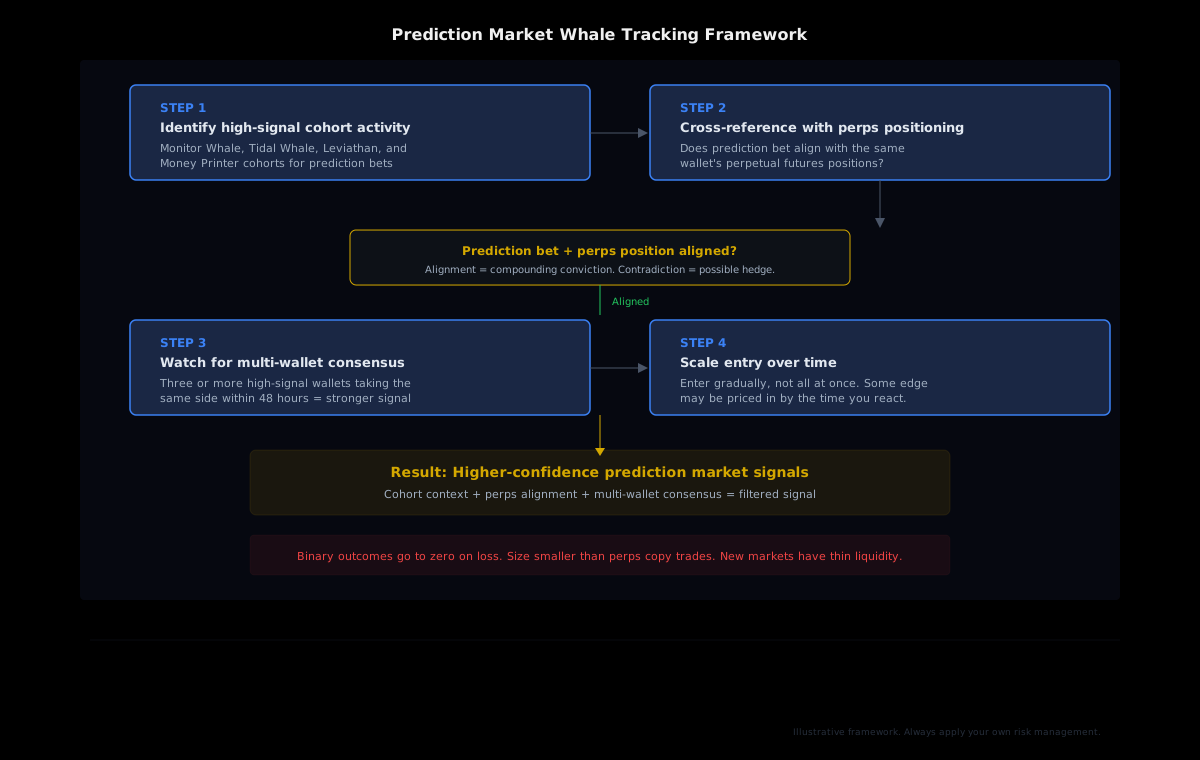
A practical framework for prediction market whale tracking
Tracking whales on Hyperliquid's new prediction markets follows a similar logic to tracking them on perps, but with a few adjustments for the product's unique mechanics.
Step 1: Identify prediction market activity from high-signal cohorts
Start by monitoring which cohorts are active in prediction markets. Early in HIP-4's life, most of the volume will come from existing Hyperliquid power users, the same wallets already tracked by perps-focused analytics. Use cohort-level positioning data to see whether the Whale, Tidal Whale, or Leviathan segments are taking directional prediction bets.
Step 2: Cross-reference with perps positioning
A prediction market position gains credibility when it aligns with the same wallet's perps activity. If a Money Printer wallet is buying YES on "ETH above $4,000 by July" while simultaneously holding a leveraged ETH long in perps, the conviction is compounding. If the prediction bet contradicts their perps position, it might be a hedge or a speculative side bet with different conviction weight.
Step 3: Watch for consensus triggers
Single-wallet signals are interesting but noisy. Consensus across multiple high-signal wallets is where the edge sharpens. If, for example, three or more Money Printer wallets take the same side of a prediction market within a 48-hour window, the probability that they share an information edge increases meaningfully.
Step 4: Scale entry, do not mirror instantly
Prediction markets move on information. By the time you see a whale position and react, some of the edge may already be priced in. Scale into positions over time rather than copying the full size immediately. This also protects you if the initial signal turns out to be a market maker's liquidity provision rather than a directional bet.
Risks that prediction market copy traders should understand
Whale tracking in prediction markets carries specific risks that differ from perps copy trading.
- Binary outcomes amplify mistakes. In perps, a wrong directional bet loses according to the size of the move. In prediction markets, a losing position goes to zero. There is no stop-loss. You either win or you lose the full entry cost.
- Time decay is real. Prediction contracts have expiry dates. A whale who enters early gets better pricing. A copy trader who enters late pays a higher probability premium, which reduces the expected payoff even if the bet is correct.
- Early markets are thin. HIP-4 is days old. Liquidity is still developing. Large positions in thin markets can move prices significantly, which means the entry price you see from a whale may not be the price you get.
- Wallet attribution uncertainty. On-chain addresses do not come with name tags. A large wallet might belong to a fund executing for multiple clients, or a market maker hedging. Without additional context, a large position is not automatically an informed bet.
Cohort data mitigates some of these risks by adding historical context to otherwise anonymous wallets. But it does not eliminate them. Position sizing discipline, smaller than you would use in perps copy trading, is the appropriate response to a new market with developing liquidity.
The composability advantage Hyperliquid is betting on
Arthur Hayes put it directly: "HIP-4 will quickly become a dominate prediction market because of Hyperliquid's large user base, much cheaper trading fees, and very robust tech infrastructure." Whether that timeline proves right or not, the structural argument is sound. Hyperliquid already dominates decentralized perpetual futures. HIP-3 perpetuals have accounted for 35% of platform trading volume since October 2025. Adding prediction markets gives the same user base another product within the same margin system.
For traders who already track whale behavior on Hyperliquid's perps, prediction markets are a new signal layer on a familiar stage. The wallets are the same. The cohort classifications still apply. The analytics infrastructure that works for perps carries directly over to prediction markets, because both products settle in the same account and contribute to the same on-chain record.
Permissionless market creation is coming in a later phase, with builders able to deploy custom prediction markets by staking HYPE tokens. When that happens, the number of trackable events and the whale activity around them will expand significantly.
Track prediction market whales with cohort intelligence
HyperTracker classifies every wallet on Hyperliquid into 16 behavioral cohorts by capital size and all-time PnL. As prediction market activity ramps up, the same cohort data that traders use for perps will surface the highest-conviction prediction market wallets. Start with the free tier and see which cohorts are moving.
Early, transparent, and trackable
HIP-4 is days old. The first markets are simple binary bets on price thresholds, and liquidity is still building. This is not the time for large positions or aggressive copy trading strategies.
But it is the time to start watching. Every prediction market bet on Hyperliquid settles on-chain. Every wallet that places one is already classified by HyperTracker into one of 16 behavioral cohorts. The same transparency that makes Hyperliquid's perps market a whale-tracking goldmine will apply to prediction markets from day one.
Polymarket built a $24 billion monthly market on the idea that people want to bet on real-world outcomes. Hyperliquid is betting that the same demand exists on a platform where prediction bets, perps, and spot all share one margin account. For copy traders, that composability means richer context for every signal. The whales are not hiding. They are trading on-chain, with their full portfolio history attached. The question is whether you are watching.