
Hyperliquid Portfolio Tracker: Multi-Wallet Position Aggregation
By CMM Team - 29-Apr-2026
Hyperliquid Portfolio Tracker: Multi-Wallet Position Aggregation
Most traders running serious size on Hyperliquid are not running it from one wallet. They are running it from three or four. Different sub-accounts for different strategies. A separate wallet for high-leverage directional bets, another for funding-rate carry, a third for hedges that need to be isolated from the main book. By the time the strategy works, the position data is fragmented across addresses, and answering simple questions like "what is my net BTC exposure right now?" requires opening four browser tabs and doing arithmetic in your head.
The fix is portfolio aggregation. Treat the wallets as one logical book, query their combined positions through an API, and stop refreshing tabs.
This guide covers how to build a multi-wallet portfolio tracker on Hyperliquid using HyperTracker's API. You will see how to aggregate positions across multiple addresses, what metrics matter at the portfolio level, and how to use cohort context to evaluate your portfolio against the rest of the market.
Why one wallet is not enough
The case for splitting trading capital across multiple Hyperliquid wallets shows up quickly once you start running real size. A few practical reasons:
Strategy isolation. A directional momentum strategy and a funding-rate carry strategy have very different risk profiles. Running them in the same wallet means your account stats, your max drawdown, and your liquidation price all reflect the average of the two. Splitting them gives you clean per-strategy metrics and lets you size each independently.
Counterparty / exchange risk. Even on a venue you trust, concentrating all your capital in one address concentrates your exposure to a single private key, a single exchange interface, a single set of permissions. Multiple wallets distribute that risk.
Cohort positioning. A wallet's HyperTracker cohort assignment is based on the equity in that single wallet. A trader with $1M total split across three wallets with $400K, $400K, and $200K each will be classified as three Apex Predators or Small Whales rather than as one Whale. This affects how others read your activity, and it affects which behavioral patterns your wallets are grouped with in cohort analytics.
Performance attribution. Splitting wallets lets you track which strategy actually drove your PnL. Running everything together makes it impossible to know whether you are profitable because of the directional book, or in spite of it.
The downside is operational complexity. You have more wallets to monitor, more positions to reconcile, more places where something can go wrong. That is what the API is for.
Pulling positions across multiple wallets
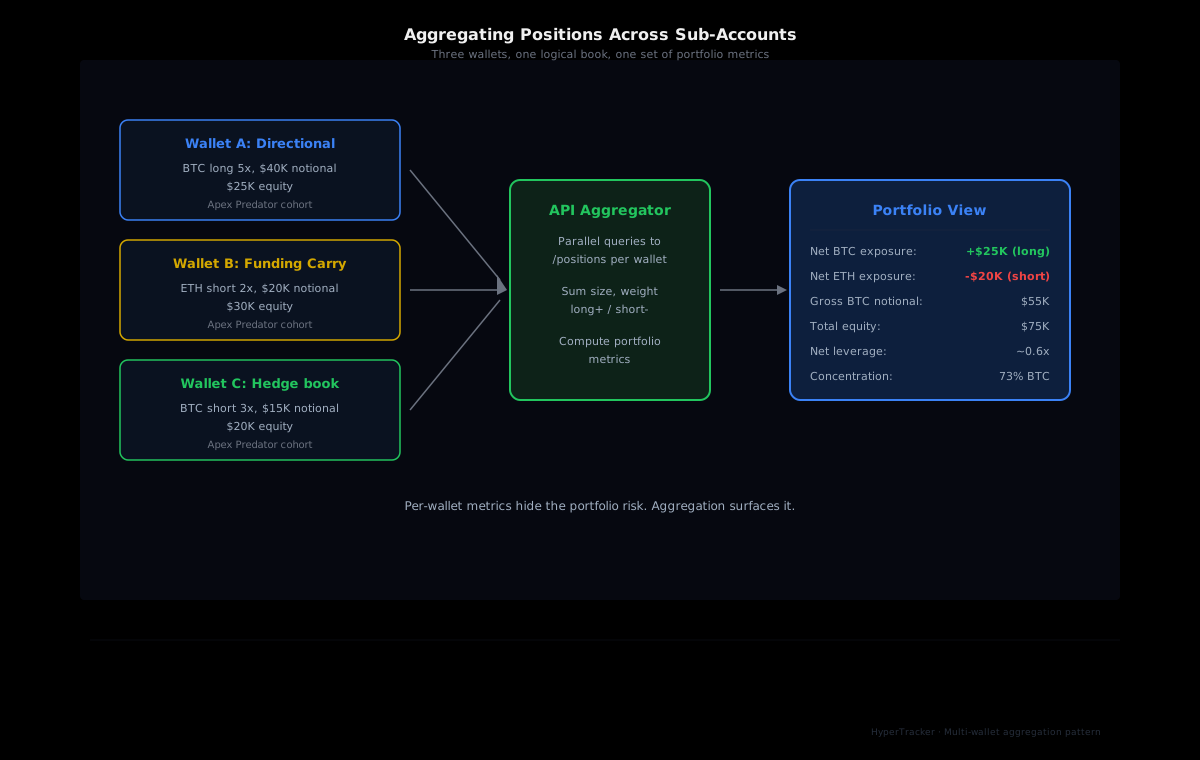
HyperTracker's positions endpoint accepts an address parameter, so the simplest aggregation is to query each of your wallets in parallel and combine the results client-side.
GET /api/external/positions?address=0xWALLET1&coin=BTC
GET /api/external/positions?address=0xWALLET2&coin=BTC
GET /api/external/positions?address=0xWALLET3&coin=BTC
Each call returns the open positions for that wallet, with size, entry price, current mark price, unrealized PnL, leverage, and liquidation price. To compute the portfolio's total BTC exposure, sum the size across all three wallets, weighting longs as positive and shorts as negative. Net exposure equals long size minus short size.
The same pattern works for fills (recent trades), closed trades (the ledger of closed positions), and position metrics (aggregated stats). Query each wallet, combine the results.
For real portfolio monitoring you probably want a small client wrapper that does this aggregation for you. A few hundred lines of Python is enough to maintain a list of wallet addresses, poll the positions endpoint for each on whatever cadence you need, and present the combined view as if it were one account.
Portfolio-level metrics worth tracking
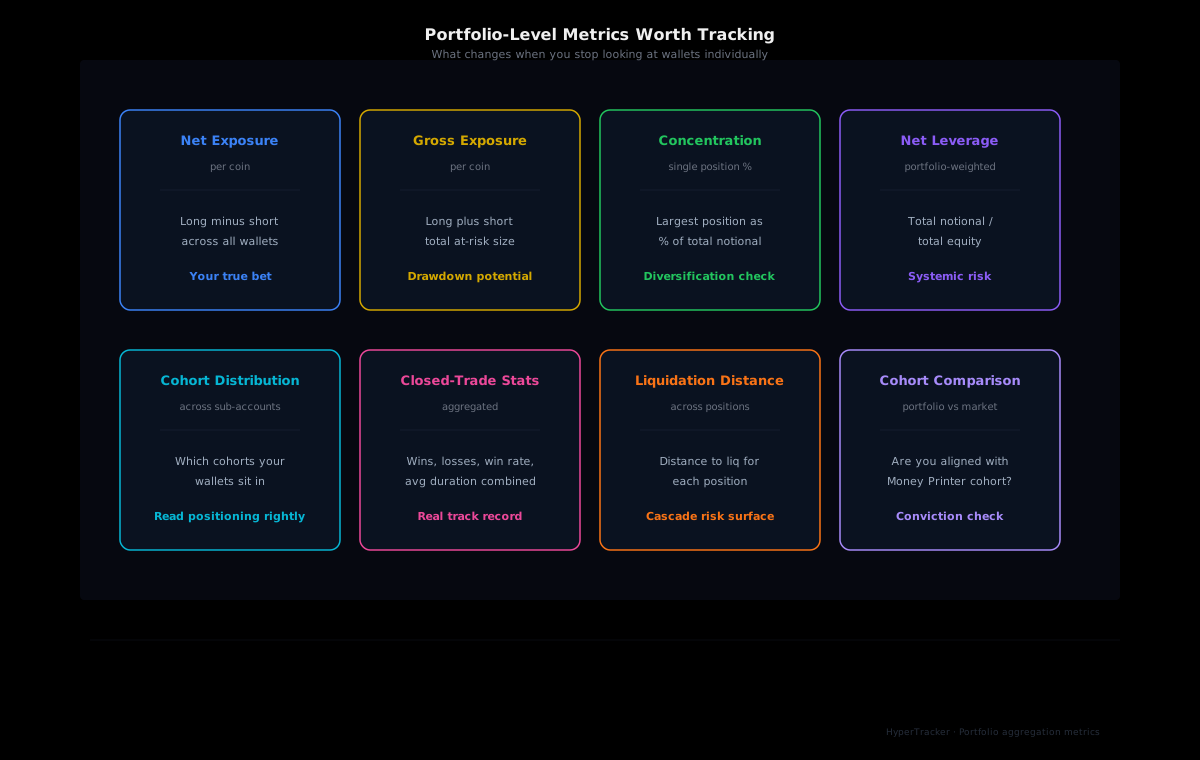
Once positions are aggregated, the metrics that matter at the portfolio level are different from the per-wallet metrics:
Net exposure by coin. The most important number. For each coin you have positions on, compute the long minus short across all wallets. This tells you your true directional bet, ignoring intra-portfolio offsets.
Gross exposure by coin. Long plus short, regardless of direction. This tells you how much capital is at risk on the asset, which matters for understanding total drawdown potential during a fast move.
Concentration ratio. What percentage of your total notional is in your single largest position. A portfolio with 80% of notional in one coin is barely diversified, even if it is technically multi-wallet.
Net leverage. Total notional exposure divided by total equity across all wallets. The per-wallet leverage numbers can be misleading if one wallet is at 10x and another is at 1x; the portfolio-weighted leverage tells you the actual systemic risk.
Cohort distribution. Which cohorts your wallets are classified into. If all your wallets are Apex Predators, your portfolio is a single capital tier even though it spans multiple addresses. Spreading wallets across cohorts (deliberately or not) affects how cohort positioning data applies to you.
Closed trades aggregate stats. Wins, losses, win rate, average duration, computed across all wallets. The closed-trades summary endpoint gives you the per-wallet stats; combining them tells you your portfolio-level track record.
Comparing your portfolio against cohort positioning
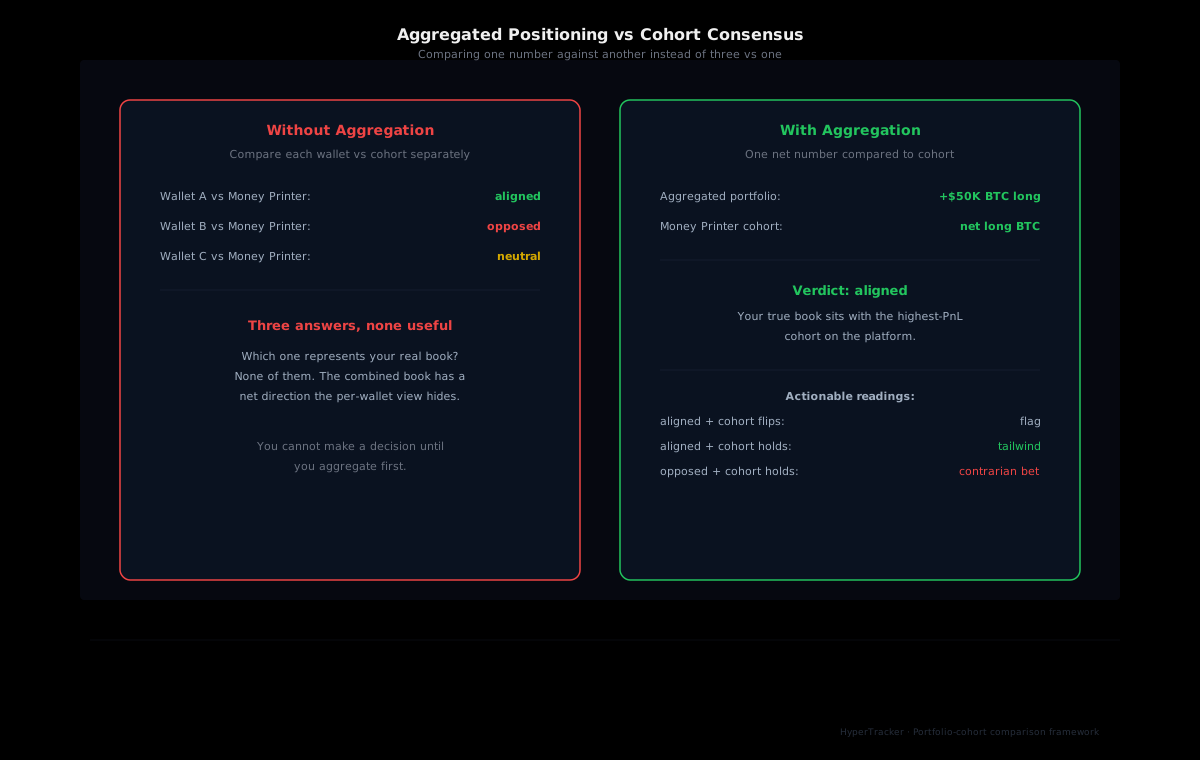
The most useful application of multi-wallet aggregation is comparing your net positioning against the cohorts you are watching.
Suppose your aggregated portfolio is net long $50K of BTC across three wallets. You can pull the Money Printer cohort's aggregate BTC positioning and ask: am I aligned with the highest-PnL wallets, or am I against them? If the Money Printer cohort is net short and you are net long, your trade is contrarian to the most successful traders on the platform. That is not necessarily wrong, but it is a flag worth understanding.
The same comparison works for size cohorts. If the Tidal Whale cohort is reducing BTC longs while you are adding, that is another flag. Either you have a thesis the largest accounts are missing, or you are late to a move they are starting to take profits on.
This is hard to do without aggregation. With your positions split across three wallets, comparing each wallet individually to the cohort positioning gives you three answers, none of which represent your actual book. With aggregation, you have one net number to compare to the cohort, and the comparison is immediately actionable.
Building a real-time monitoring layer
The polling-based approach above is fine for hourly or daily monitoring. For real-time alerting, you want to combine the positions endpoint with a few others:
Liquidation risk. The liquidation-risk endpoint scores how crowded the positioning is for each asset. If your portfolio is concentrated in BTC and the BTC liquidation risk score is climbing, the conditions for a wick that touches your stops are building.
Position metrics. The position-metrics endpoint shows aggregate open interest by asset across all of Hyperliquid. Cross-reference with your portfolio: if you are long BTC and OI is climbing while price is flat, new longs are entering, which usually precedes a move in your direction.
Order snapshots. The order-snapshots endpoint provides rolling 5-minute snapshots of order flow. If you are running a position and the order flow is starting to show sustained taker selling in your direction, you have early warning before the price reflects it.
A practical setup polls positions every minute (cheap), liquidation risk and position metrics every 5 minutes (sufficient resolution), and order snapshots every minute when you have open positions (the cost is justified by the alerting value).
Multi-wallet management as a strategy itself
There is a more advanced application of multi-wallet portfolio tracking: actively allocating across wallets as a strategy.
Some traders run a "best-performing wallet wins" approach where capital is rebalanced periodically toward whichever sub-strategy has performed best in recent windows. Others run the opposite: contrarian rebalancing toward whichever sub-strategy has underperformed, on the theory that mean reversion will benefit it. Both require accurate per-wallet stats over time, which the closed-trades and position-metrics endpoints provide.
The point is that splitting your trading across multiple Hyperliquid wallets is not just an organizational convenience. It opens up portfolio-management strategies that single-wallet traders cannot run. The infrastructure to actually use it is the multi-wallet aggregation layer.
See your portfolio + the market in one view
HyperTracker's API exposes positions, fills, closed trades, and stats per wallet, with cohort classification and aggregate cohort positioning available through the same authentication. Build the multi-wallet portfolio view once, and use the same endpoints to compare your book against what every cohort on Hyperliquid is doing in real time. Start with the free tier.
One wallet is a position. Three wallets is a portfolio. The API is what makes the difference between two browser tabs and a real trading operation.