
Don't Mirror Whales 1:1: A Copy Trading Position Sizing Guide
By CMM Team - 30-Apr-2026
Don't Mirror Whales 1:1: A Copy Trading Position Sizing Guide
A whale opens a 20x position sized at 40% of their $5M account. Your copy bot mirrors it at the same 20x, same 40% of your $20K. The market moves 3% against the trade. The whale shrugs off a drawdown. You get liquidated.
That is the failure mode of 1:1 copy trading, and it has nothing to do with bad signal selection. The wallet you copied was good. The polling logic worked. The execution engine fired in time. The mistake was treating their trade and your trade as the same trade, when one of them had fifty times the margin to absorb a bad move.
Profitable copy trading is not "find a good wallet and mirror them." It is "find a good wallet, then size the trade for your account, not theirs." A wallet's all-time PnL cohort tells you how much trust to extend, which decides how much capital to risk. Money Printers with $1M+ in cumulative profit earn different rules than Consistent Grinders at $10K to $100K. And wallets sitting in the negative PnL cohorts should not be copied at all, no matter how good their last three trades looked.
This guide is the position sizing framework that makes copy trading survivable. You will see the specific allocation per cohort tier, how to cap leverage based on your account size, the drawdown limits that stop a bad week from becoming a blown account, and the API workflow to wire all of it together on Hyperliquid.
A note on the numbers in this guide. The percentages, leverage caps, and drawdown thresholds below are illustrative — they show how a tier-weighted system can be structured, not what HyperTracker tells you to use. HyperTracker's product surface is the cohort classification itself: every Hyperliquid wallet is sorted into one of 16 cohorts by all-time PnL or perp equity. The sizing rules are yours to set, calibrated to your account size, risk tolerance, and total exposure across positions.
Why fixed-size copy trading breaks down
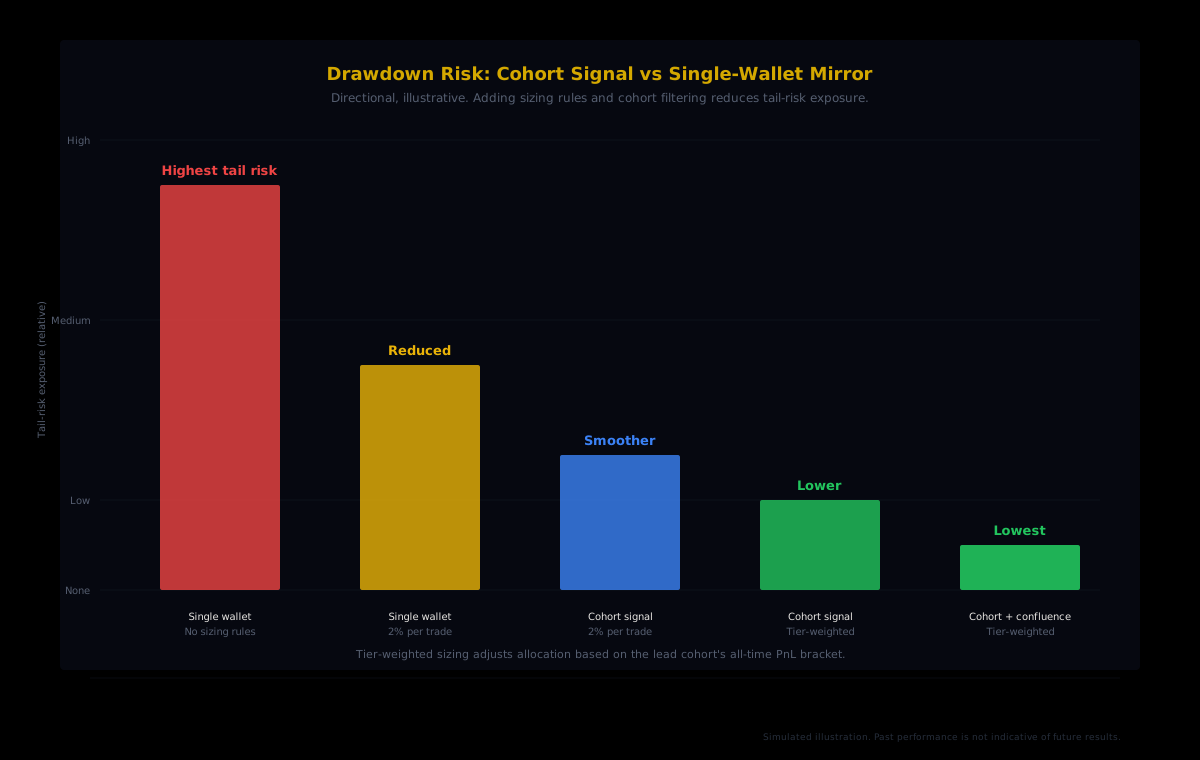
The simplest copy trading approach allocates the same percentage of your portfolio to every mirrored position. Two percent per trade, regardless of who the lead wallet is or what their track record looks like. This feels disciplined, and it works until it doesn't.
The problem is that all signals are treated as equally trustworthy. A wallet with $3M in all-time perp profits and a smooth equity curve gets the same 2% allocation as a wallet with $15K in profits from a single lucky trade last week. The first wallet has demonstrated sustained edge across market regimes. The second wallet has demonstrated nothing, statistically. Treating both the same is like betting the same amount on a coin flip and a loaded die.
Fixed sizing also ignores leverage mismatch. When a lead wallet with $2M in equity opens a 10x leveraged position, the notional exposure relative to their total portfolio might be 5%. When you mirror that same 10x leverage on a $20K account, a 10% adverse move creates a $20K loss, which is your entire account. The lead wallet loses 5% and moves on. You get liquidated.
There's a third failure: correlation. If you copy five wallets and all five are long ETH at 5x, your effective exposure is not 2% per wallet. It is 10% on a single directional bet. Fixed sizing per wallet ignores the portfolio-level concentration that builds up when multiple lead wallets take correlated positions.
The cohort-based sizing framework
HyperTracker classifies every wallet on Hyperliquid into one of 16 behavioral cohorts. Eight are based on account size (from Shrimp at $0 to $250 up to Leviathan at $5M+), and eight are based on all-time PnL performance (from Money Printer at $1M+ profit down to Giga-Rekt at below -$1M). For copy trading risk management, the PnL-based cohorts are what matters because they tell you whether the wallet you are following has a demonstrated history of profitability.
The principle is straightforward: wallets with longer and larger track records of profitability earn larger allocations. Wallets with shorter or negative track records earn smaller allocations or get filtered out entirely.
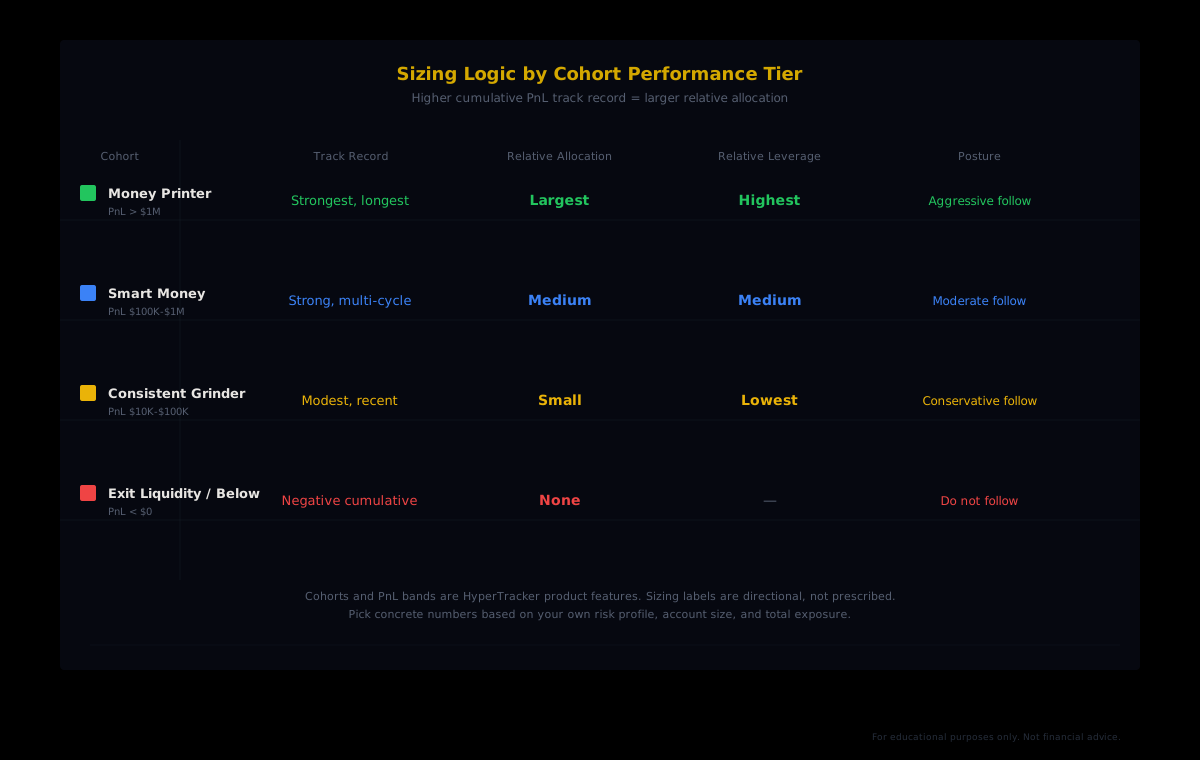
Tier 1: Money Printer (all-time PnL above $1M)
These wallets have generated over $1M in cumulative perp profits. That kind of performance across the volatility swings that Hyperliquid sees requires genuine skill, consistent execution, and sound risk management from the lead wallet itself. When a Money Printer opens a new position, the signal carries the most weight.
- Allocation per trade: 3-5% of your copy trading portfolio
- Maximum leverage: 5-10x (scale down if your account is under $50K)
- Maximum concurrent copied positions: 3-5 from this tier
- Stop loss: 1R risk (if you risk 4% of equity, your stop should limit the loss to 4%)
Tier 2: Smart Money (all-time PnL $100K to $1M)
Smart Money wallets have meaningful track records, but the sample size of their profitability is smaller than Money Printers. A wallet at $150K cumulative profit might have genuine edge or might have caught a single strong trend. The allocation reflects this uncertainty.
- Allocation per trade: 2-3% of your copy trading portfolio
- Maximum leverage: 3-5x
- Maximum concurrent copied positions: 2-4 from this tier
- Stop loss: 1R risk
Tier 3: Consistent Grinder (all-time PnL $10K to $100K)
Grinders are profitable, but the dollar magnitude of their edge is modest enough that it could be explained by favorable market conditions rather than skill. Copy trading from this tier should use the smallest position sizes and the lowest leverage to limit damage if the signal turns out to be noise.
- Allocation per trade: 1-2% of your copy trading portfolio
- Maximum leverage: 2-3x
- Maximum concurrent copied positions: 1-3 from this tier
- Stop loss: 1R risk, with a maximum holding period of 48 hours
Below Consistent Grinder: Do not copy
Wallets in the Humble Earner cohort ($0 to $10K PnL) and below, including Exit Liquidity, Semi-Rekt, Full Rekt, and Giga-Rekt, should be excluded from copy trading entirely. A wallet with negative all-time PnL has demonstrated a negative edge. Copying their trades is mathematically equivalent to taking the opposite side of a losing strategy, except you also pay the copy trader's execution delay as additional slippage.
Leverage caps: matching risk to account size
Leverage is where most copy traders blow up. A lead wallet running 10x on a $5M account is risking 2% of their equity per 1% adverse move. If you mirror that same 10x leverage on a $15K account, the math is identical in percentage terms, but the margin for error is completely different. The $5M account can absorb a 30% drawdown and still have $3.5M to recover with. Your $15K account hits zero at 10%.
The rule: never use the same leverage as the lead wallet unless your account equity is within the same order of magnitude. If the lead wallet has $1M+ and you have $20K, divide their leverage by 3-5x before mirroring.
| Your Account Size | Lead Wallet Leverage | Your Adjusted Leverage | | --- | --- | --- | | Under $10K | 10x | 2-3x | | $10K - $50K | 10x | 3-5x | | $50K - $200K | 10x | 5-7x | | $200K+ | 10x | 7-10x (match) |
This table applies to Money Printer signals. For Smart Money signals, reduce the adjusted leverage by one step. For Consistent Grinder signals, reduce by two steps. If a Grinder wallet opens a 10x position and your account is under $10K, your adjusted leverage is 1-2x. That might feel too conservative. It is exactly right, because you are following a wallet whose edge you cannot statistically confirm, and you are operating with an account that cannot survive a single bad trade at high leverage.
Drawdown limits and kill switches
Position sizing and leverage caps handle individual trade risk. Drawdown limits handle the scenario where multiple copied trades go wrong simultaneously, which happens more often than people expect because lead wallets tend to be correlated in their directional bias during high-volatility events.
Portfolio-level drawdown circuit breaker
Set a maximum drawdown for your entire copy trading portfolio. When cumulative losses from all mirrored positions hit this threshold, close everything and stop copying for a defined cooling-off period.
- Conservative: 10% max drawdown, 7-day pause
- Moderate: 15% max drawdown, 3-day pause
- Aggressive: 20% max drawdown, 24-hour pause
The pause is not optional. After a drawdown, the temptation is to immediately start copying again to "recover" the loss. That impulse leads to chasing, which leads to copying lower-quality signals from lower-tier wallets at higher leverage. The pause forces you to review what went wrong before re-entering.
Per-wallet drawdown tracking
Track cumulative PnL from each lead wallet you copy separately. If a specific wallet generates three consecutive losing trades or a cumulative loss exceeding 5% of your portfolio, stop copying that wallet regardless of their cohort tier. A Money Printer wallet that has gone cold is still cold. Past performance from any wallet is informative, but it does not guarantee the next trade will be profitable.
Correlation management across copied wallets
Copying five Money Printer wallets sounds safer than copying one, and in theory the diversification reduces single-wallet risk. In practice, top-performing wallets on Hyperliquid tend to trade the same high-liquidity assets (BTC, ETH, SOL) and often take similar directional views during trending markets. If all five wallets are long ETH and ETH drops 15%, your "diversified" copy portfolio takes a concentrated hit.
Two rules manage correlation risk:
- Asset concentration cap: No more than 30% of your copy trading equity should be exposed to a single asset across all copied positions. If two wallets are both long BTC and the combined notional exceeds 30% of your portfolio, reduce the position size on the second wallet's signal.
- Direction concentration cap: No more than 60% of your portfolio should be net long or net short across all copied positions. This prevents the scenario where you are following five wallets that are all directionally aligned, turning your copy portfolio into a single leveraged bet.
These caps require real-time portfolio monitoring. You need to know your total exposure by asset and direction before executing each new copied trade. Without this check, the copy trader builds up hidden concentration that only becomes visible when the correlated positions all move against you at the same time.
Building the risk engine with the API
The sizing framework above is only useful if it runs programmatically. Nobody is going to manually check a wallet's cohort tier, look up the allocation table, calculate the adjusted leverage, verify correlation caps, and then execute the trade. That workflow needs to be automated. Here is how to build it with HyperTracker's API.
Step 1: Identify the lead wallet's cohort at signal time.
import requests

API_BASE = "https://ht-api.coinmarketman.com/api/external"
headers = {"Authorization": "Bearer YOUR_JWT_TOKEN"}

# Get wallet details including cohort classification
wallet = requests.get(
    f"{API_BASE}/wallets",
    headers=headers,
    params={"address[]": "0xabc...target_wallet", "limit": 1}
).json()

# Extract PnL cohort
segment_ids = wallet[0].get("segmentIds", [])
# Money Printer = 8, Smart Money = 9, Consistent Grinder = 10
# Humble Earner = 11, Exit Liquidity = 12, Semi-Rekt = 13,
# Full Rekt = 14, Giga-Rekt = 15
Step 2: Look up the allocation rule.
TIER_RULES = {
    8:  {"name": "Money Printer",      "alloc": 0.04, "max_lev": 10, "max_positions": 5},
    9:  {"name": "Smart Money",        "alloc": 0.025, "max_lev": 5,  "max_positions": 4},
    10: {"name": "Consistent Grinder", "alloc": 0.015, "max_lev": 3,  "max_positions": 3},
}

# Find the PnL cohort (IDs 8-15)
pnl_cohort = next((s for s in segment_ids if 8 <= s <= 15), None)

if pnl_cohort is None or pnl_cohort > 10:
    print("SKIP: wallet not in a copyable cohort")
else:
    rule = TIER_RULES[pnl_cohort]
    position_size = portfolio_equity * rule["alloc"]
    leverage = min(lead_wallet_leverage, rule["max_lev"])
    print(f"Sizing: {rule['name']} -> ${position_size:.0f} at {leverage}x")
Step 3: Check correlation before executing.
# Get all current open positions across your copy portfolio
open_positions = requests.get(
    f"{API_BASE}/positions",
    headers=headers,
    params={"address[]": my_wallet, "open": True}
).json()

# Calculate exposure by asset
exposure = {}
for pos in open_positions:
    coin = pos["coin"]
    notional = abs(float(pos["size"]) * float(pos["entryPrice"]))
    exposure[coin] = exposure.get(coin, 0) + notional

# Check if adding the new position would exceed 30% asset cap
new_coin = signal["coin"]
new_notional = position_size * leverage
total_coin_exposure = exposure.get(new_coin, 0) + new_notional

if total_coin_exposure > portfolio_equity * 0.30:
    # Reduce size to fit under cap
    position_size = max(0, (portfolio_equity * 0.30 - exposure.get(new_coin, 0)) / leverage)
    print(f"Reduced to ${position_size:.0f} due to asset concentration cap")
The full risk engine wraps these three checks (cohort lookup, tier-based sizing, correlation check) into a single pre-execution function that runs before every copied trade. No trade gets executed without passing all three gates.
Cohort signals as a safer alternative
Everything above assumes you are copying individual wallets. There is a structurally safer approach: instead of mirroring a single wallet's positions, use the aggregate positioning of an entire cohort as a directional signal.
When the Money Printer cohort collectively shifts net long on BTC, that is a consensus signal from hundreds of wallets that have each independently generated over $1M in cumulative profit. The signal is not dependent on any single wallet's decision. It cannot be distorted by one whale hedging a position on another venue. And it does not suffer from the copy crowding problem where dozens of followers pile into the same wallet's trades and degrade the entry.
Our data from the /coins/metrics endpoint shows cohort-level positioning by asset: the percentage of each cohort that is long vs short, with changes tracked over time. When you see Money Printer net long exposure on ETH increase from 55% to 72% over 24 hours, that directional shift is a much more robust signal than watching a single address open an ETH long.
The position sizing rules still apply to cohort signals, but the allocation can be more aggressive because the signal quality is higher. A cohort consensus signal from Money Printers warrants the full 3-5% allocation. A single wallet signal from the same cohort warrants the lower end of that range.
Build Your Risk Engine with Cohort Data
HyperTracker's API gives you the cohort classification, wallet metrics, and position data you need to build a tier-weighted copy trading system. Query wallet cohorts, filter by PnL tier, and check aggregate positioning before every trade.
Start Building with the Free Tier
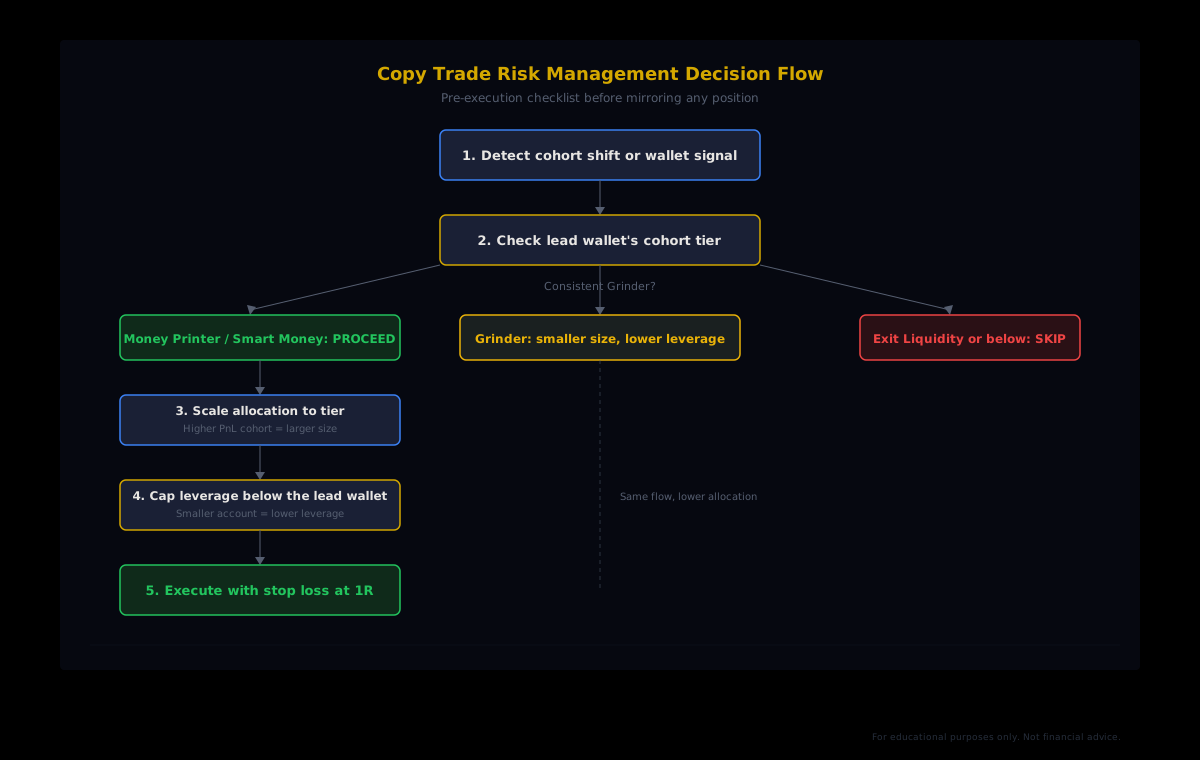
The position sizing checklist
Before mirroring any position, run through this sequence:
- Cohort check. Is the lead wallet in Money Printer, Smart Money, or Consistent Grinder? If they are below Consistent Grinder, skip the trade.
- Tier allocation. Look up the allocation percentage for their cohort. Money Printer: 3-5%. Smart Money: 2-3%. Grinder: 1-2%. Multiply by your portfolio equity to get the dollar amount.
- Leverage adjustment. Compare your account size to the lead wallet's account size. If yours is smaller by an order of magnitude or more, divide their leverage by 3-5x. Cap at the tier maximum.
- Correlation check. Will this trade push any single asset above 30% of your total copy portfolio? Will it push your net directional exposure above 60%? If yes, reduce size until it fits.
- Drawdown check. Are you already in drawdown? Have you hit your portfolio drawdown limit? Has this specific lead wallet generated three consecutive losses? If any answer is yes, skip.
- Execute with a stop loss. Set a stop that limits the loss to your intended risk amount (1R). Do not adjust the stop after entry.
Six checks. Every trade. No exceptions. The system only works if the rules are applied consistently, because the one time you skip the correlation check is the time three of your lead wallets are all long the same asset at maximum leverage, and a liquidation cascade takes them all out together. That is not a hypothetical. It is the most common way copy trading portfolios blow up.