
Geopolitical Shocks Move Crypto Smart Money Before Headlines Do
By CMM Team - 03-May-2026
Geopolitical Shocks Move Crypto Smart Money Before Headlines Do
On the last weekend of February 2026, the United States launched strikes on Iranian infrastructure. CME futures markets were closed. But on Hyperliquid, oil perpetual volume had already started climbing hours before the first headline dropped. By the time traditional traders could react on Monday morning, the on-chain market had already priced the shock.
This was not a one-off. It was a pattern that has repeated across every major geopolitical event of 2026: the Venezuela strike in January, the Greenland diplomatic escalation, and the sustained Iran tensions through March and April. Each time, the largest and most profitable wallets on Hyperliquid repositioned before the news cycle caught up. The moves showed up in cohort-level data, which means they were visible to anyone watching on-chain analytics at the time, even if the specific catalyst was still unknown.
The lesson is straightforward: geopolitical events create exploitable information asymmetry, and on-chain perps markets are where that asymmetry shows up first. This article breaks down the mechanics of how it works, what the February oil crisis revealed about smart money behavior, and how you can build a system to detect these signals using cohort analytics on Hyperliquid.
Why on-chain markets price geopolitical shocks first
Traditional commodity markets operate on fixed schedules. CME crude oil futures trade Sunday through Friday with daily settlement breaks. When a geopolitical event breaks on a Saturday afternoon, the price discovery mechanism for the most affected asset class simply does not exist in the traditional system. Traders with conviction have nowhere to express it until Sunday evening at the earliest.
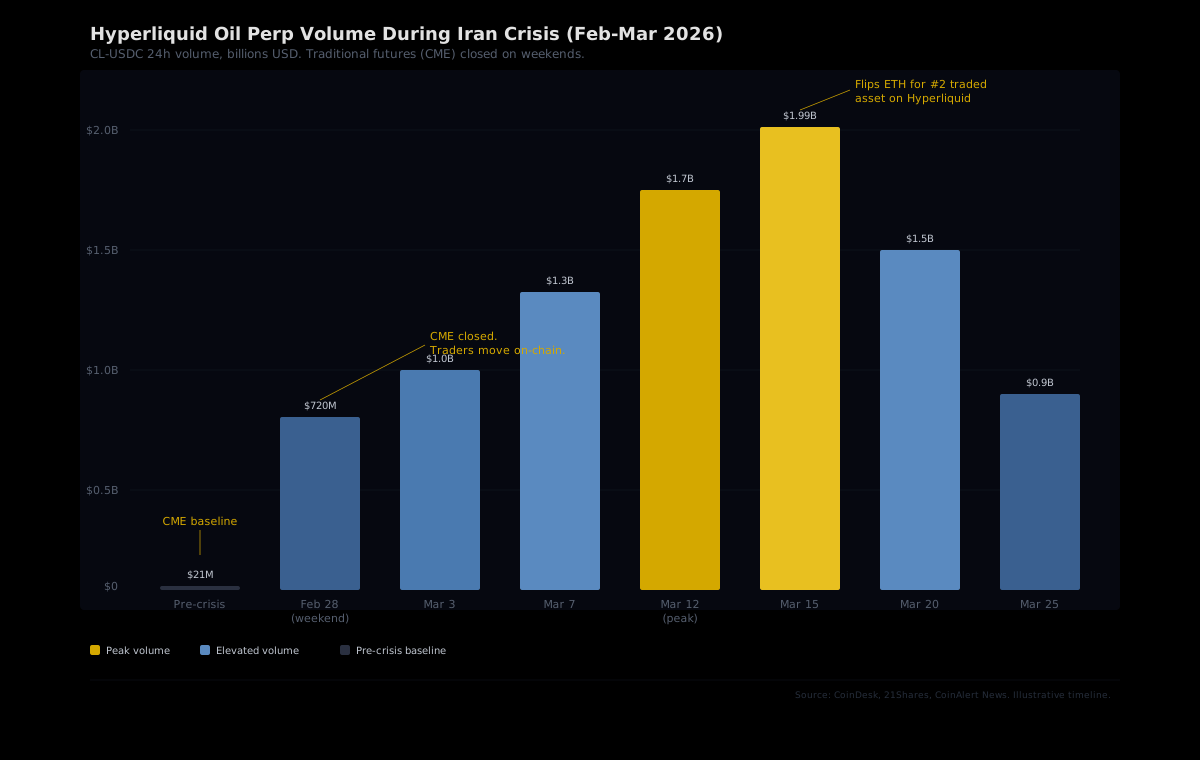
Hyperliquid's CL-USDC perpetual contract has no such constraint. It trades 24/7, settles in USDC, and offers up to 20x leverage. When the Iran strikes broke over the weekend of February 28, this contract became the de facto venue for global oil price discovery. Volume exploded from roughly $21 million per day to $1.99 billion in 24-hour volume, flipping ETH to become Hyperliquid's second-most traded asset behind Bitcoin.
JPMorgan flagged the phenomenon explicitly: "Oil trading exploded on the Hyperliquid exchange early this month when the Iran war erupted as CME traders were unable to react when Iranian infrastructure strikes broke over the weekend."
By the time CME opened on Monday and WTI pushed above $110, the gap between Hyperliquid's price and the traditional market had already closed. Hyperliquid had priced the shock nearly 48 hours ahead of the traditional system.
What the cohort data showed before the headlines
Raw volume is one thing. Cohort-level positioning tells a deeper story, because it reveals who was trading, not just how much.
HyperTracker classifies every wallet on Hyperliquid into one of 16 behavioral cohorts: eight by account size (from Shrimp at $0 to $250 up through Leviathan at $5M+) and eight by all-time PnL (from Money Printer at $1M+ profit down to Giga-Rekt at below -$1M). During every geopolitical event in 2026, the same pattern appeared in our data: the highest-PnL cohorts repositioned first, and the lower cohorts followed hours or days later.
Here is how it played out during the Iran crisis:
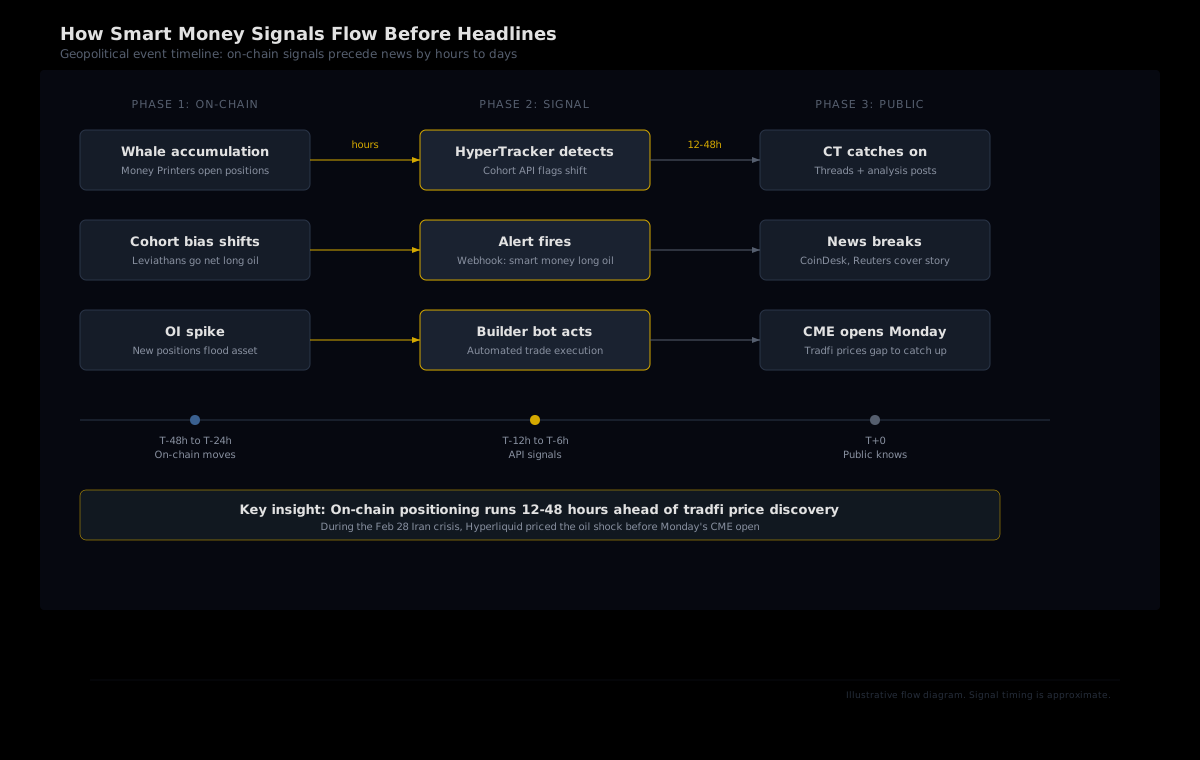
- T-48 to T-24 hours: Money Printer (all-time PnL above $1M) and Smart Money ($100K to $1M) wallets began accumulating long exposure to the CL-USDC perpetual. Open interest in the oil contract started climbing while the asset was still trading at pre-crisis levels.
- T-12 to T-6 hours: Whale ($500K to $1M equity) and Tidal Whale ($1M to $5M) wallets joined the long side. The cohort bias shifted measurably toward net long on oil, visible through the cohort metrics endpoint.
- T+0: The strikes made headlines. Retail accounts (Shrimp, Fish, Dolphin) piled in on the long side, but at much higher prices. The largest wallets were already positioned.
The critical takeaway: the cohort data showed the positioning shift before the event was public knowledge. You did not need to predict geopolitical events. You needed to notice that the wallets with the best track records were suddenly accumulating directional exposure in a specific asset.
The HIP-3 acceleration: traditional assets go on-chain
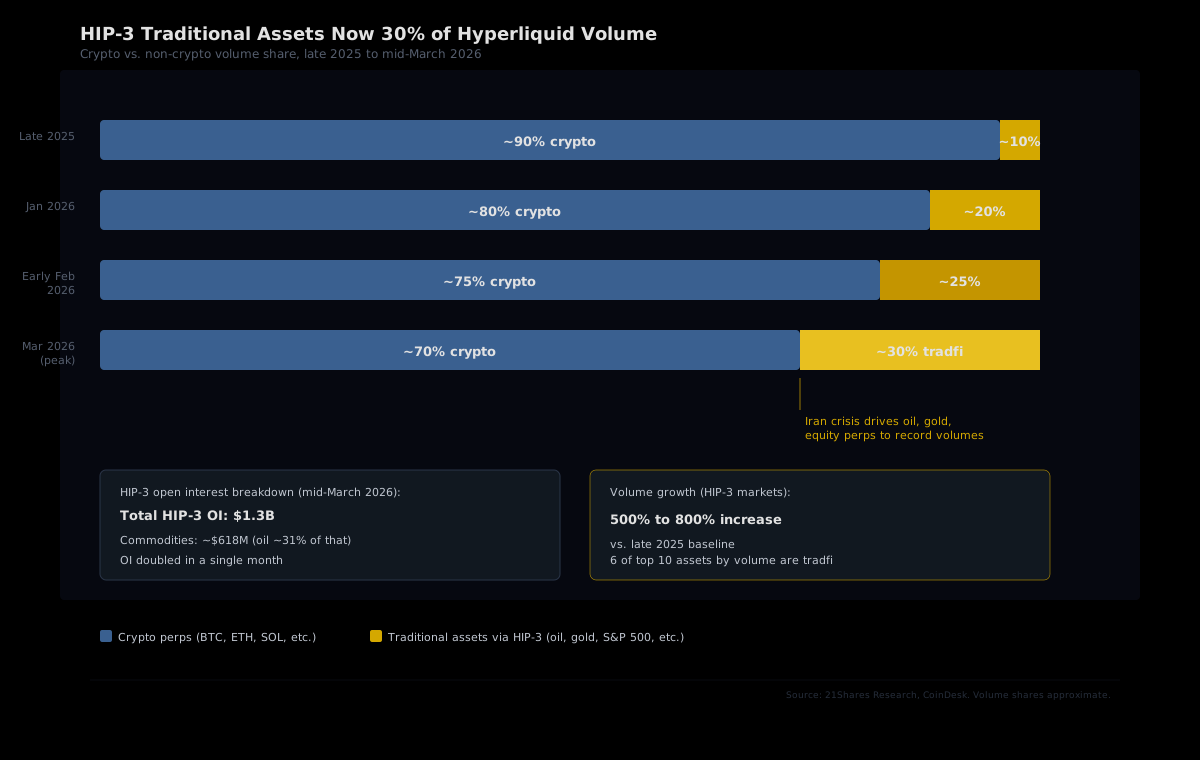
The Iran crisis did more than generate a short-term volume spike. It permanently shifted the composition of trading on Hyperliquid. HIP-3, the standard that governs non-crypto perpetual contracts on the platform, went from roughly 10% of total volume in late 2025 to approximately 27% to 30% of total volume by mid-March 2026, an increase of 500% to 800% from the prior baseline.
Open interest across HIP-3 markets reached $1.3 billion in mid-March, more than doubling in a single month. Commodities represented roughly $618 million of that total, with oil alone accounting for about 31%. Six of the top 10 assets by volume on Hyperliquid during peak crisis periods were traditional markets like commodities, equities, and metals.
This matters for smart money tracking because the trader base for HIP-3 assets is different from the typical crypto perps audience. Commodities traders, macro funds, and institutional hedgers are entering the Hyperliquid ecosystem specifically because it never closes. Our data shows these wallets clustering in the higher size cohorts (Whale, Tidal Whale, Leviathan), and they bring positioning patterns that correlate more closely with macro news cycles than crypto-native catalysts.
Building a geopolitical signal detector with cohort analytics
You do not need to predict wars or sanctions to trade geopolitical events profitably. You need a system that detects when the highest-conviction wallets are building unusual directional exposure in assets that correlate with macro risk. Here is how to build one.
Step 1: Monitor cohort bias shifts in real time
Poll the cohort metrics endpoint every 5 minutes for the assets you care about. For geopolitical signals, the highest-value assets are oil (CL), gold (XAU), and equity indices (SPX). Track the net long/short bias of the top three PnL cohorts: Money Printer (segment ID 8), Smart Money (segment ID 9), and Consistent Grinder (segment ID 10).
import requests

API_BASE = "https://ht-api.coinmarketman.com/api/external"
headers = {"Authorization": "Bearer YOUR_JWT_TOKEN"}

# Get cohort metrics for oil perp
oil_metrics = requests.get(
    f"{API_BASE}/cohort-metrics",
    headers=headers,
    params={"coin": "CL", "segmentId[]": [8, 9, 10]}
).json()

# Check for unusual directional alignment
for cohort in oil_metrics:
    segment_id = cohort["segmentId"]
    net_bias = cohort.get("longExposure", 0) - cohort.get("shortExposure", 0)
    print(f"Segment {segment_id}: net bias = {net_bias}")
Step 2: Define the signal threshold
A single cohort going net long on oil is not a signal. That happens regularly. The signal fires when multiple high-PnL cohorts shift in the same direction on the same asset within a short window. Specifically:
- If Money Printer AND Smart Money both shift to net long (or net short) on a HIP-3 asset within the same polling cycle, flag it as a potential geopolitical positioning event.
- If the size-based cohorts (Whale+) confirm the same directional shift within the next 1-2 polling cycles, the signal strengthens.
- If open interest in that asset is simultaneously climbing (more new positions being opened, not just existing ones being adjusted), you likely have a conviction-driven accumulation event.
Step 3: Set up webhook alerts
On the Flow tier ($799/mo) and above, HyperTracker supports webhook delivery. Configure a webhook that fires when cohort bias crosses your threshold. This way you get a push notification the moment smart money repositions, without needing to poll.
# Pseudocode for alert logic
if (money_printer_net_bias > threshold
    and smart_money_net_bias > threshold
    and oi_change_pct > 10):

    send_alert(
        asset="CL",
        direction="long",
        confidence="high",
        cohorts_aligned=["Money Printer", "Smart Money"],
        oi_delta=oi_change_pct
    )
Step 4: Size the trade for your account
Geopolitical trades carry tail risk. The event might escalate further (good for your position) or de-escalate overnight (bad). Size accordingly:
- Allocate 2-3% of your portfolio per geopolitical signal trade.
- Use 3-5x leverage maximum. These trades can gap significantly, and higher leverage on a gapping asset means liquidation risk even with a correct directional call.
- Set a time-based exit. If the trade has not moved meaningfully within 48-72 hours of the signal, the informational edge has likely been arbitraged away.
What smart money does differently during crises
One of the most consistent findings from our data during the 2026 crisis events is that the highest-PnL cohorts behave in ways that contradict retail instincts. When headlines scream "war" and "crisis," retail traders panic-sell crypto positions and chase the obvious trade (long oil, long gold). Smart money often does the opposite of what you would expect.
During the February Iran shock, Money Printer wallets were net buyers of BTC and ETH at the same time they were going long oil. The retail cohorts were selling crypto to free up margin for the oil trade or simply panic-selling everything. The result: the BTC dip to the low $60,000s was brief, because the largest wallets were absorbing the supply that smaller traders were dumping.
The pattern in three words: retail panics, smart money positions. The cohort data makes this visible within minutes rather than in hindsight.
This is the difference between watching aggregate volume (everyone is selling!) and watching cohort-segmented data (the losing cohorts are selling; the winning cohorts are buying). Aggregate data tells you what the market is doing. Cohort data tells you what the best traders in the market are doing. And during geopolitical shocks, those two stories diverge sharply.
The macro trade that never closes
The 2026 crisis cycle proved something that crypto-native traders have suspected and that traditional finance is now being forced to acknowledge: the 24/7 market is the better market for price discovery during geopolitical stress. Bitwise's Chief Investment Officer Matt Hougan said in early March that the transition to on-chain finance would happen "much faster" than his previous 5 to 10 year estimate, based specifically on the crisis weekend performance.
For builders and traders using HyperTracker, this creates an expanding opportunity set. Every new HIP-3 asset that lists on Hyperliquid is another venue where cohort-level positioning data can reveal smart money moves before the traditional market opens. As the crypto-to-tradfi volume ratio shifts (it moved from 90/10 to 70/30 in a single quarter), the value of behavioral analytics across all of these markets compounds.
Geopolitical events are inherently unpredictable. But the response of the wallets with the best track records is observable, measurable, and increasingly early. The wallets that made money through the 2026 crisis cycle were not the ones who predicted the next headline. They were the ones who noticed where the Money Printers were moving before anyone else was paying attention.
Track Smart Money Across Every Hyperliquid Market
HyperTracker's API gives you cohort-level positioning data for all 16 behavioral segments across crypto and HIP-3 assets. Monitor how Money Printers, Smart Money, and Whales are positioning in oil, gold, equities, and every crypto perp on the platform. Start with the free tier (100 requests/day) or go to Pulse ($179/mo) for full polling access.