
How to Track Hyperliquid Whales Without Just Following One Address
By CMM Team - 01-May-2026
How to Track Hyperliquid Whales Without Just Following One Address
Most "whale tracker" tools work the same way. They show you a leaderboard of large wallets, you pick one whose recent trades look smart, and you mirror their positions. The problem is that one wallet is one bias. The whale who looks brilliant this week might be the one who blew up two weeks ago and never showed up in your screenshots. And even when you pick a real edge, copying a single address means inheriting their drawdowns, their leverage decisions, and their timing.
The better question is not "which whale should I follow?" It is "what are whales as a group doing right now?" That shift, from individual to cohort, is the difference between watching one trader on Twitter and reading the order flow of every large wallet on the exchange at once.
This guide covers how to track whale activity on Hyperliquid using cohort-level positioning data instead of single-wallet mirroring. You will see how the 16 behavioral cohorts work, what the difference is between size cohorts and PnL cohorts, and how to combine the two for signals that survive the next time your favorite whale goes cold.
Why single-wallet whale tracking breaks
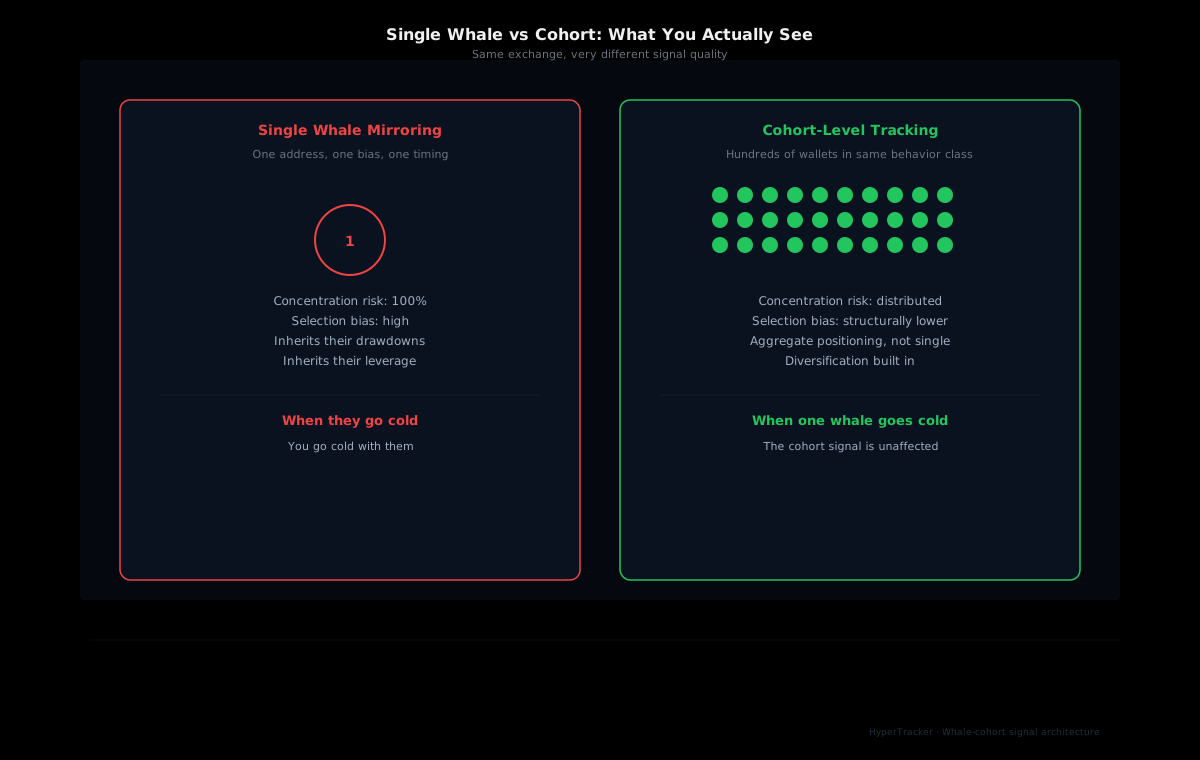
The wallets that show up on whale leaderboards are usually selected because they have been profitable recently. That selection bias is the first problem. Recency-weighted leaderboards rotate constantly: today's #1 was yesterday's nobody, and next month's #1 is currently making mistakes you have not seen yet.
The second problem is concentration risk. If you copy one whale at one leverage on one position, you have not diversified anything. You have just outsourced your trading decisions to someone whose risk tolerance is calibrated to their account, not yours. When that whale takes a 30% drawdown, so do you, except they have $5M of equity to absorb it and you have $20K.
The third problem is signal vs. noise. A single wallet's trades include their conviction picks, their hedges, their experiments, and their mistakes. There is no way to tell which is which from the outside. You see "whale longs ETH at 5x" and you do not know whether that is a high-conviction directional bet or a hedge against a different position they are running on another venue.
Cohort-level tracking solves all three. You are not picking individual wallets, so recency bias does not matter. You are not concentrating on one address, so the diversification is built in. And because you are watching aggregate positioning across hundreds of wallets in the same behavioral category, the signal-to-noise ratio is structurally higher.
The 16-cohort framework on Hyperliquid
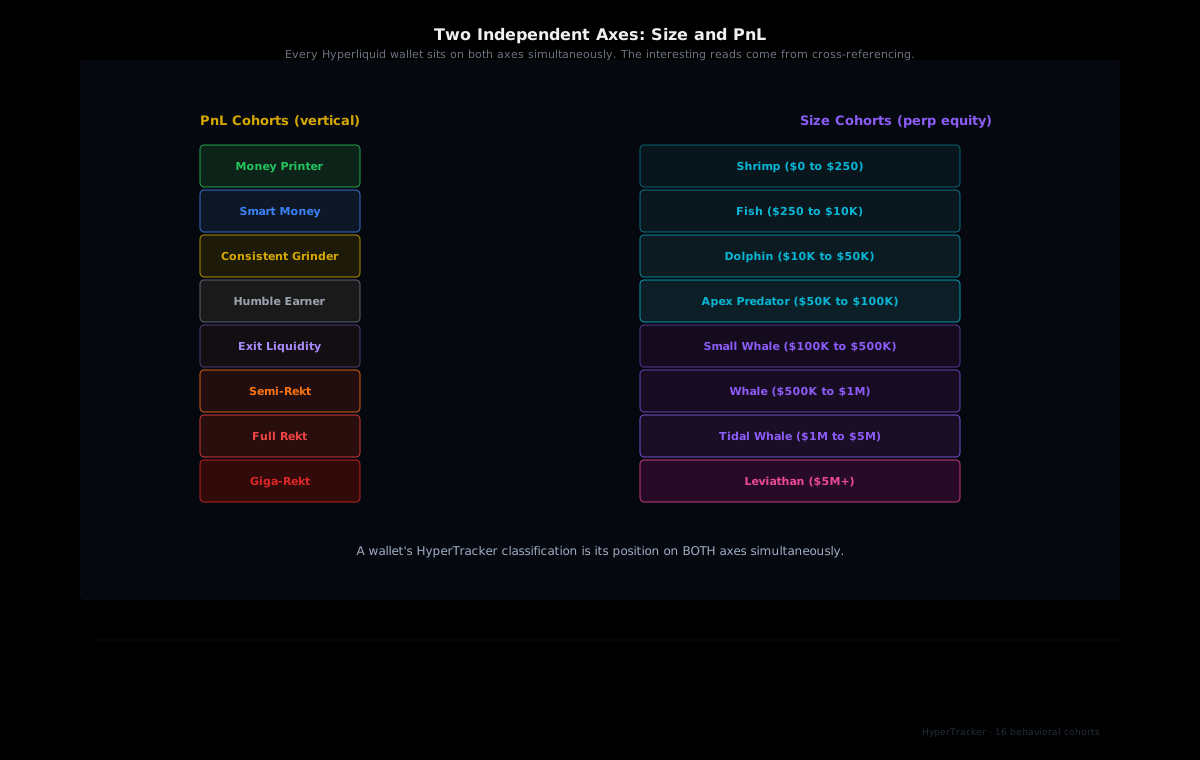
HyperTracker classifies every Hyperliquid wallet into one of 16 behavioral cohorts. Eight are based on account size (current perp equity), and eight are based on all-time PnL (cumulative realized profit since the wallet started trading on Hyperliquid).
Size cohorts (by current perp equity)
| Cohort | Equity Band | | --- | --- | | Shrimp | $0 to $250 | | Fish | $250 to $10K | | Dolphin | $10K to $50K | | Apex Predator | $50K to $100K | | Small Whale | $100K to $500K | | Whale | $500K to $1M | | Tidal Whale | $1M to $5M | | Leviathan | $5M+ |
The size axis tells you what each capital tier is doing. When the Tidal Whale and Leviathan cohorts shift to net long on a specific asset, that is the largest accounts taking directional exposure.
PnL cohorts (by all-time realized profit)
| Cohort | All-Time PnL | | --- | --- | | Money Printer | +$1M and up | | Smart Money | +$100K to +$1M | | Consistent Grinder | +$10K to +$100K | | Humble Earner | $0 to +$10K | | Exit Liquidity | -$10K to $0 | | Semi-Rekt | -$100K to -$10K | | Full Rekt | -$1M to -$100K | | Giga-Rekt | below -$1M |
The PnL axis tells you what each performance tier is doing. Money Printers have demonstrated sustained profitability across enough volume that the result is unlikely to be luck. When their aggregate positioning shifts, that is the wisdom of the most successful traders on the platform, not the conviction of any single individual.
Why size alone is not enough
A common mistake is treating "Whale" and "Smart Money" as synonyms. They are not. A wallet can be in the Tidal Whale cohort (large account) without being in the Money Printer cohort (profitable account). Plenty of large accounts have lost more than they made over their lifetime. Size tells you who has staying power. PnL tells you who has demonstrated edge.
The most useful signals come from cross-referencing the two. Three patterns to watch:
Convergence: when both the size cohorts and the PnL cohorts lean the same direction on an asset, that is the highest-conviction signal you can extract from cohort data. The biggest wallets and the most profitable wallets agree.
Divergence: when the size cohorts and the PnL cohorts disagree, the signal is ambiguous. Different strategies are at play. Capital-heavy wallets may be hedging or running market-neutral structures. Profit-heavy wallets may be harvesting funding or taking contrarian positions. Neither is necessarily right.
Cohort rotation: when a specific cohort shifts faster than the others, that often precedes broader cohort movement. Money Printers tend to move first. Tidal Whales follow. Smaller cohorts (Dolphin, Fish, Shrimp) are usually last.
Reading cohort positioning instead of leaderboards
Once you start thinking in cohorts, the standard whale leaderboard becomes much less interesting. Instead of asking "what is the #3 wallet doing?" you ask "what is the Money Printer cohort net positioning on BTC, and how has it moved in the last 24 hours?"
Practical things to track:
- Cohort bias by asset: the percentage of each cohort that is net long versus net short on a given coin. Useful for spotting consensus or divergence at a glance.
- Net cohort position: the aggregated long-minus-short notional for each cohort, by coin. Tells you the magnitude of conviction, not just the direction.
- Cohort positioning changes: how the bias and net position have moved over time windows (last hour, last day, last week). Direction of change often matters more than the snapshot.
- Cross-cohort divergences: flags for when size and PnL cohorts disagree. Useful as a "be careful" signal in addition to a directional read.
Each of these is a query against the cohort metrics endpoint. You can poll them on whatever cadence makes sense for your strategy: every few minutes for short-term trading, every few hours for swing trading, daily for macro positioning.
Signal hierarchy: which cohort matters most?
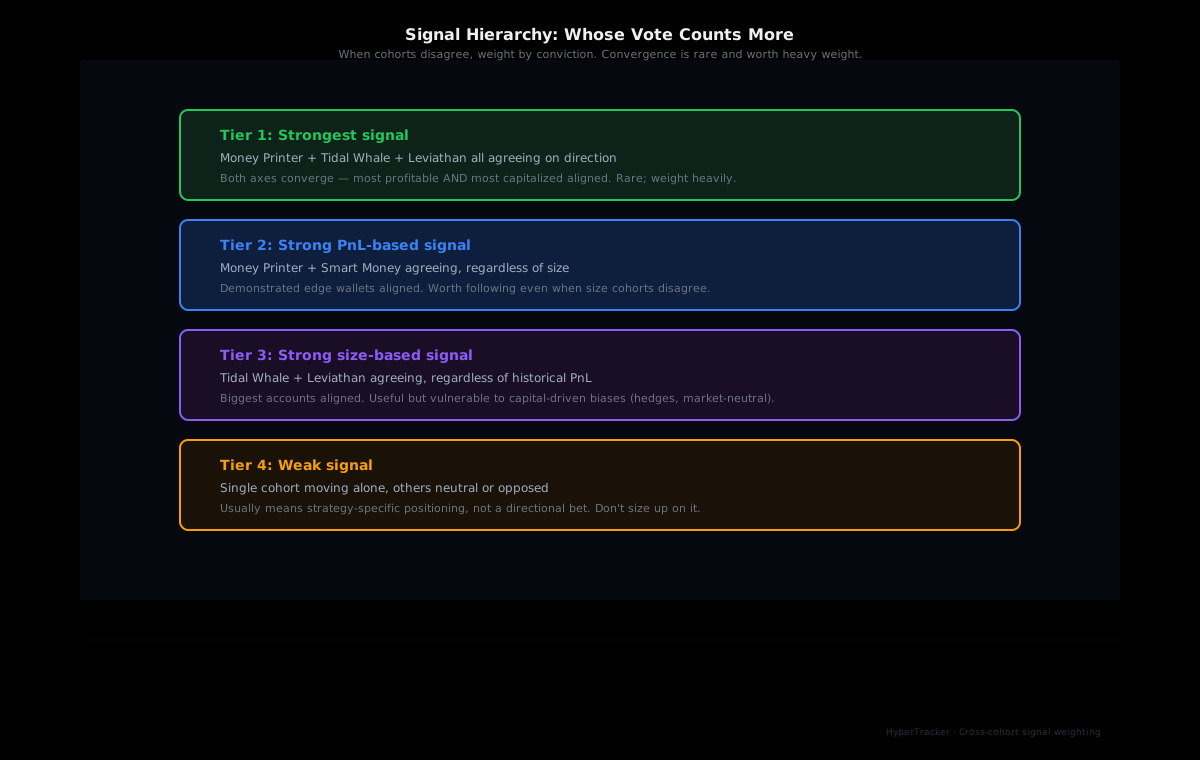
When all 16 cohorts agree, the signal is strong. When they disagree, the question is whose vote counts more. A practical hierarchy that has held up well:
- Money Printer + Tidal Whale + Leviathan agreeing — strongest signal. The most profitable AND the most capitalized wallets are aligned. This convergence is rare, and when it happens it is worth weighting heavily.
- Money Printer + Smart Money agreeing — strong PnL-based signal. The wallets with demonstrated edge are aligned, regardless of size. Worth following even when size cohorts disagree.
- Tidal Whale + Leviathan agreeing — strong size-based signal. The biggest accounts are aligned, regardless of historical profitability. Useful but inherently more vulnerable to capital-driven biases (hedges, market-neutral trades).
- Single cohort outliers — weak. One cohort moving in isolation usually means strategy-specific positioning, not a directional bet.
This hierarchy is a starting point. Your own strategy might prioritize differently. A copy trader who values track record above all else might weight the PnL cohorts higher. A trader following capital flow might weight size cohorts higher. The framework is the same; the weights are yours.
Building this into your workflow
Cohort tracking is most useful as a layer of context on top of whatever your existing strategy is. A few practical workflows:
Pre-trade check. Before opening a position, query the cohort positioning for the asset. If your trade aligns with both size and PnL cohort consensus, that is a tailwind. If it goes against both, that is not necessarily wrong, but it is a contrarian bet against the data.
Position management. Watch cohort movement in your open positions. If you are long an asset and the Money Printer cohort shifts to net short over a 4-hour window, that is a flag worth investigating, even if price has not yet moved against you.
Risk filtering. Use cohort divergence as a sizing input. When all 16 cohorts agree on direction, you can size more confidently. When they disagree, smaller positions, tighter stops, lower leverage.
Discovery. Browse the cohort breakdown on coins you do not normally trade. Sometimes the most interesting setups are in assets you would never have looked at if you were only following individual wallets.
See what every cohort is doing right now
HyperTracker classifies every wallet on Hyperliquid by both size and all-time PnL, with cohort-level positioning data exposed through the API. Query aggregate bias, net positioning, and cohort movement across all 16 segments through a single endpoint. Start with the free tier.
The whale leaderboard tells you who is rich. Cohort positioning tells you what the rich and the right are doing as a group. Those are different questions, and the second one usually has a more useful answer.