Negative Funding on Hyperliquid: What Copy Traders Should Watch
By CMM Team - 05-May-2026
Negative Funding on Hyperliquid: What Copy Traders Should Watch
Bitcoin's perpetual futures funding rate has been persistently negative for an extended stretch. On paper, that reads as overwhelming bearish positioning. But Bitcoin has continued grinding higher in recent weeks while shorts kept piling on. Something does not add up. And that disconnect is exactly the kind of environment where copy traders either find edge or get destroyed by it.
The wallets with the most capital on Hyperliquid and the wallets with the highest all-time profits are not always positioned the same way. When they diverge, copy traders face the hardest question: which signal do you follow, and how do you size the risk when even the best wallets disagree?
What sustained negative funding actually tells you
Funding rates on perpetual futures exist to keep the contract price tethered to spot. When funding is negative, shorts pay longs. This normally signals that the market is leaning bearish, because traders are willing to pay a premium to hold short positions.
On Hyperliquid specifically, funding is computed every hour at one-eighth of the 8-hour rate, which means the cost compounds faster than on centralized exchanges that settle every 8 hours. For shorts holding during a prolonged negative stretch, the funding cost adds up quietly. The longer the streak runs, the more drag accumulates on every short position still open.
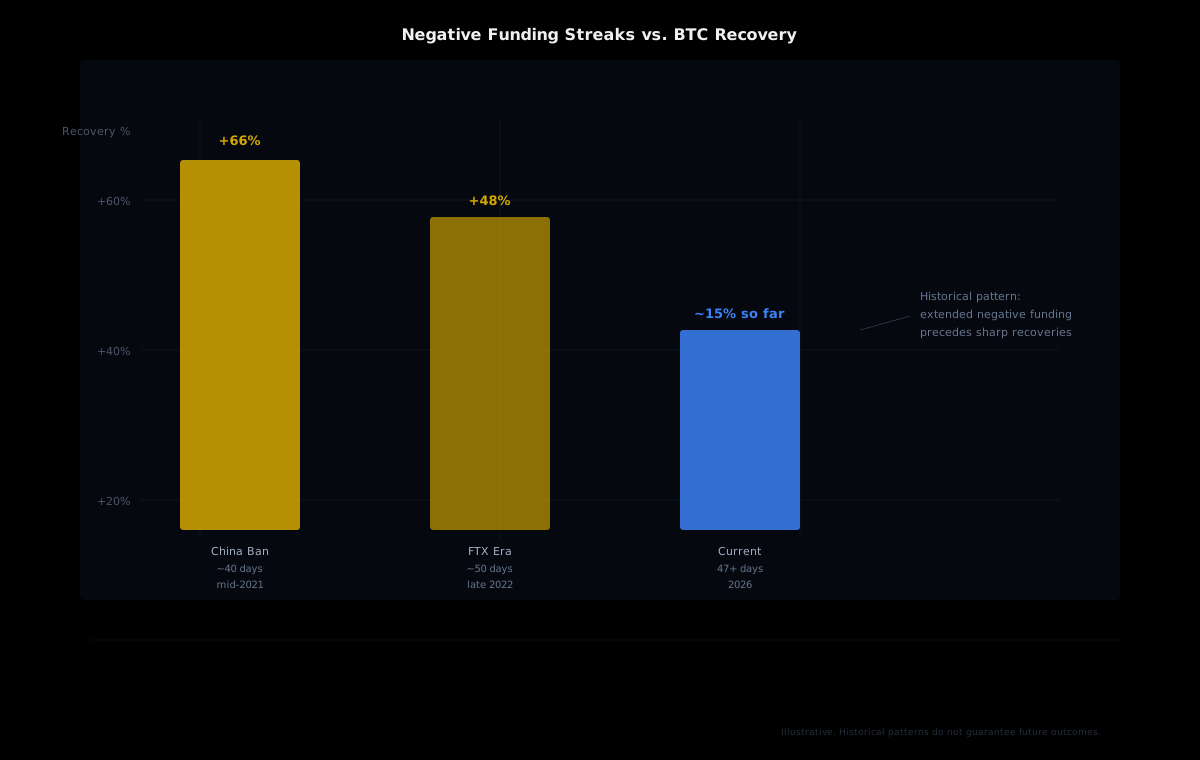
History provides context. Extended negative funding streaks have preceded some of the sharpest recoveries in Bitcoin's recent past. The pattern is not a guarantee. Sometimes a negative funding stretch reflects genuine fear and continues into a deeper drawdown. Other times it reflects structural hedging, with the resolution skewing upward. The job of the copy trader is to figure out which kind of negative funding regime they are operating in, then position accordingly.
Why the funding rate is negative this time
Not every negative funding streak means the same thing. In past episodes, negative funding reflected genuine fear. Traders were panic-shorting into a falling market. The current stretch has more structural drivers, none of which signal broad bearish conviction on their own.
Hedge fund hedging
During redemption notice periods, crypto hedge funds short futures to neutralize price exposure while they wait for capital to be returned to investors. This shows up as short positioning in the funding data, but the intent is risk management, not a directional bet.
Structured equity trades
Several institutional strategies require simultaneous Bitcoin futures shorts as hedges. Trades that bet on Bitcoin-adjacent equities outperforming spot Bitcoin, or that strip crypto volatility out of preferred share yields, all add steady short pressure to the futures market without representing bearish conviction.
Mining-to-AI pivots
Mining companies repurposing capacity for AI computing have created a class of equity trades that pair long mining stocks with short Bitcoin futures, isolating the AI thesis from crypto price risk. This is another structural source of shorts that does not reflect a directional view on Bitcoin itself.
For copy traders, this distinction matters. If negative funding reflected genuine fear, you would want to be cautious about following wallets going long. But if it reflects structural hedging, the negative rate is more noise than signal. The question then becomes: who on Hyperliquid is positioned for the move that follows?
The whale vs. profit-cohort divergence on Hyperliquid
This is where the picture gets interesting, and where cohort-level data becomes essential for copy traders.
On Hyperliquid, the largest wallets by capital are not always positioned the same way as the wallets with the best historical performance. There are stretches when the size cohorts (Whale, Tidal Whale, Leviathan) lean one direction while the PnL cohorts (Money Printer, Smart Money) lean the other.
This is not a contradiction. It is a divergence that reveals different strategies. The capital-heavy wallets may be positioned for a macro recovery, betting that structural short pressure eventually unwinds into a squeeze. The profit-heavy wallets may be harvesting funding payments or running hedged strategies that look short on the surface but are actually market-neutral.
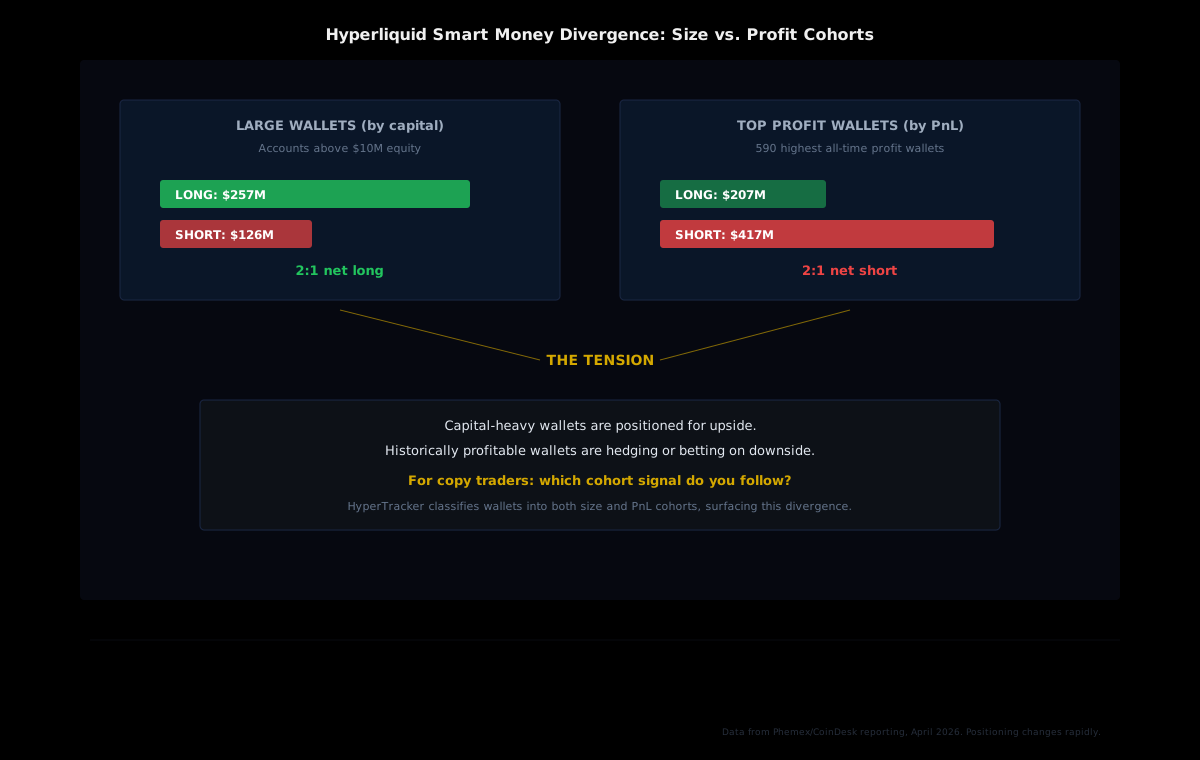
HyperTracker's 16 behavioral cohorts make this divergence visible at a glance. The size-based cohorts (Whale, Tidal Whale, Leviathan) tell you what the biggest accounts are doing. The PnL-based cohorts (Money Printer, Smart Money) tell you what the historically profitable accounts are doing. When these two signals agree, the copy trading case is straightforward. When they disagree, the copy trader's job is to decide which signal to weight more heavily.
How to use cohort data for copy trading during a funding divergence
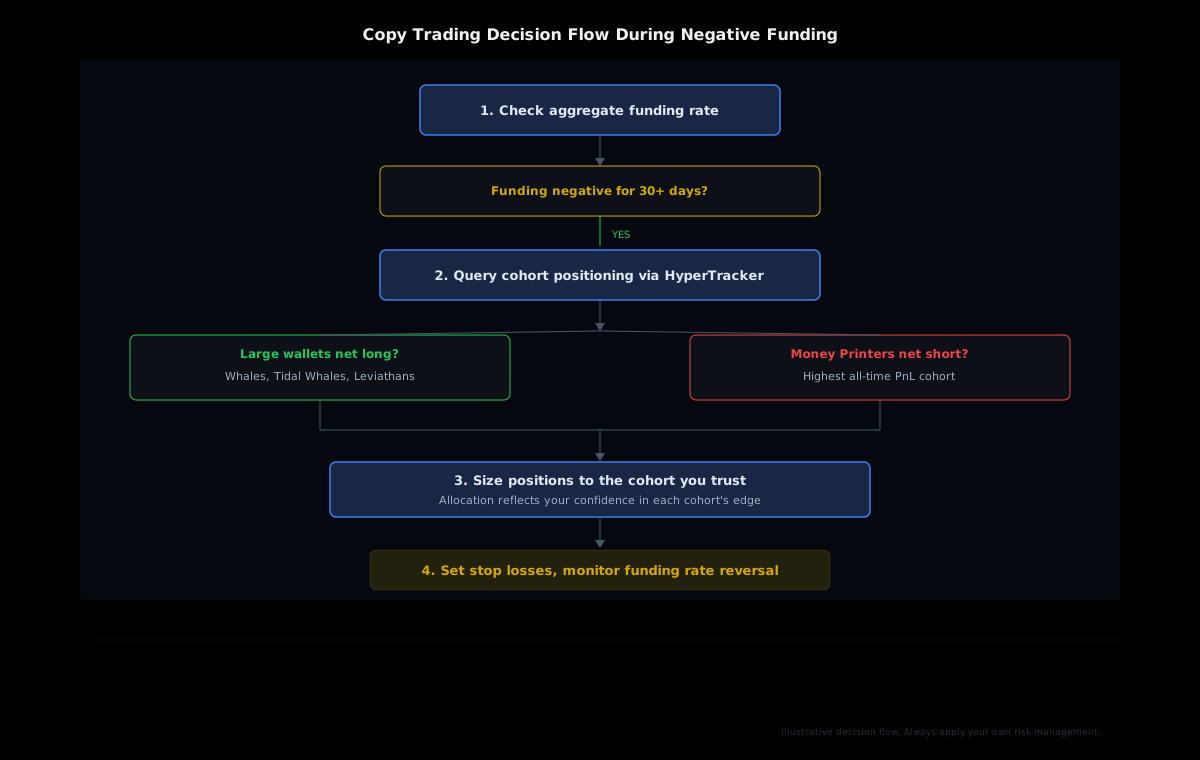
A negative funding environment with a whale divergence is not the time to blindly mirror a single wallet. It is the time to cross-reference signals across cohort groups and size your positions according to the confidence each signal provides.
Step 1: Identify which cohort group to follow
When the size cohorts and the PnL cohorts disagree, consider which type of edge you believe is more durable. Capital-heavy wallets survive longer in adverse conditions because they can absorb drawdowns. Profit-heavy wallets have demonstrated better timing historically. Both have validity, so the sizing should reflect your confidence level.
Step 2: Size positions to the signal
A trader who trusts the capital-heavy signal might allocate a larger relative share of their copy trading portfolio to those positions, reasoning that capital advantage provides more staying power during drawdowns. A trader who trusts the profit-heavy signal might size those trades more conservatively, given that they are betting against the capital base. The sizing decision depends on which type of edge you believe is more durable in the current environment. In environments of genuine uncertainty, reducing overall position size is the simplest risk control available.
Step 3: Monitor funding rate reversal as a trigger
Extended negative funding eventually resolves. When the 7-day average crosses back to positive, it signals that short positioning is unwinding. Historically, that crossover point has coincided with sharper legs of post-streak recoveries. Copy traders who are positioned long benefit from watching this metric as a confirmation signal. Those positioned short should treat it as a risk flag.
The funding rate as a filter for lead wallet selection
Beyond portfolio-level decisions, the funding rate environment changes how you should evaluate individual wallets for copy trading.
During negative funding, shorts pay longs every hour on Hyperliquid. A wallet that opened a leveraged long position weeks ago is collecting that hourly funding payment. If a historically profitable wallet has been net long through the entire negative streak, they have been accumulating funding income on top of any price appreciation. That combination of directional conviction and funding yield is a strong signal.
Conversely, a wallet that just flipped long yesterday has no such track record during this specific regime. The signal is weaker because the wallet has not endured the drawdowns or the volatility of the past weeks while maintaining conviction.
Our data lets you see this at the cohort level. You can check how the Money Printer cohort's aggregate positioning has shifted over time. If the highest-PnL wallets have been gradually reducing their shorts, that trend matters more than a snapshot of their current position. Cohort bias data, which HyperTracker refreshes on a rolling basis, shows the direction and momentum of positioning changes across all 16 segments.
Risk management when even smart money disagrees
The most dangerous copy trading mistake during a divergence is sizing as if you have conviction when you do not. When the whale cohorts and the profit cohorts disagree, the honest answer is that the signal is ambiguous. Ambiguity calls for smaller positions, wider stops, and lower leverage.
A few practical principles apply:
- Reduce overall exposure. When smart money disagrees with itself, the market is telling you it does not know either. Lower your total portfolio allocation to copy-traded positions until the signal converges.
- Diversify across cohort signals. If you are going to copy both a whale-cohort long and a Money Printer short, ensure the total notional exposure nets out to something your account can survive even if both trades go sideways.
- Use funding as a timing signal. The 7-day funding average crossing zero has historically marked the transition from accumulation to breakout. Using it as a trigger to scale into (or out of) positions adds a layer of discipline beyond pure wallet-following.
- Set hard drawdown limits. In any copy trading setup, define the maximum loss you will accept from a single lead wallet before pausing or removing them. During divergent environments, these limits should be tighter than usual.
See what every cohort is doing right now
HyperTracker classifies every wallet on Hyperliquid into 16 behavioral cohorts, eight by account size and eight by all-time PnL. Query aggregate positioning, cohort bias shifts, and individual wallet classifications through a single API call. Start with the free tier.
What happens when this streak ends
Every negative funding streak ends. The question is how it ends, because the unwind creates its own dynamics.
If spot price continues to grind higher while funding stays negative, shorts eventually face a cost-of-carry squeeze. Funding becomes a steady drag on every short position, raising the bar for short profitability. The longer the streak continues, the more violent the eventual unwind tends to be when shorts are forced to cover.
Hyperliquid has emerged as one of the highest-volume venues for decentralized perpetual futures, with deep liquidity and verifiable wallet-level positioning. That depth means when shorts start covering, the execution happens on-chain and in real time. Copy traders with positioning data can watch the unwind develop across cohorts before it fully reflects in price.
The funding rate is negative. The size cohorts and the PnL cohorts may not agree. Somewhere between those signals sits a trade. The copy traders who survive this environment will be the ones who sized for the uncertainty, and adjusted when the data told them to.