Saylor Bought the Dip. 67 Days of Negative Funding Say He's Not Alone.
By CMM Team - 11-May-2026
Saylor Bought the Dip. 67 Days of Negative Funding Say He's Not Alone.
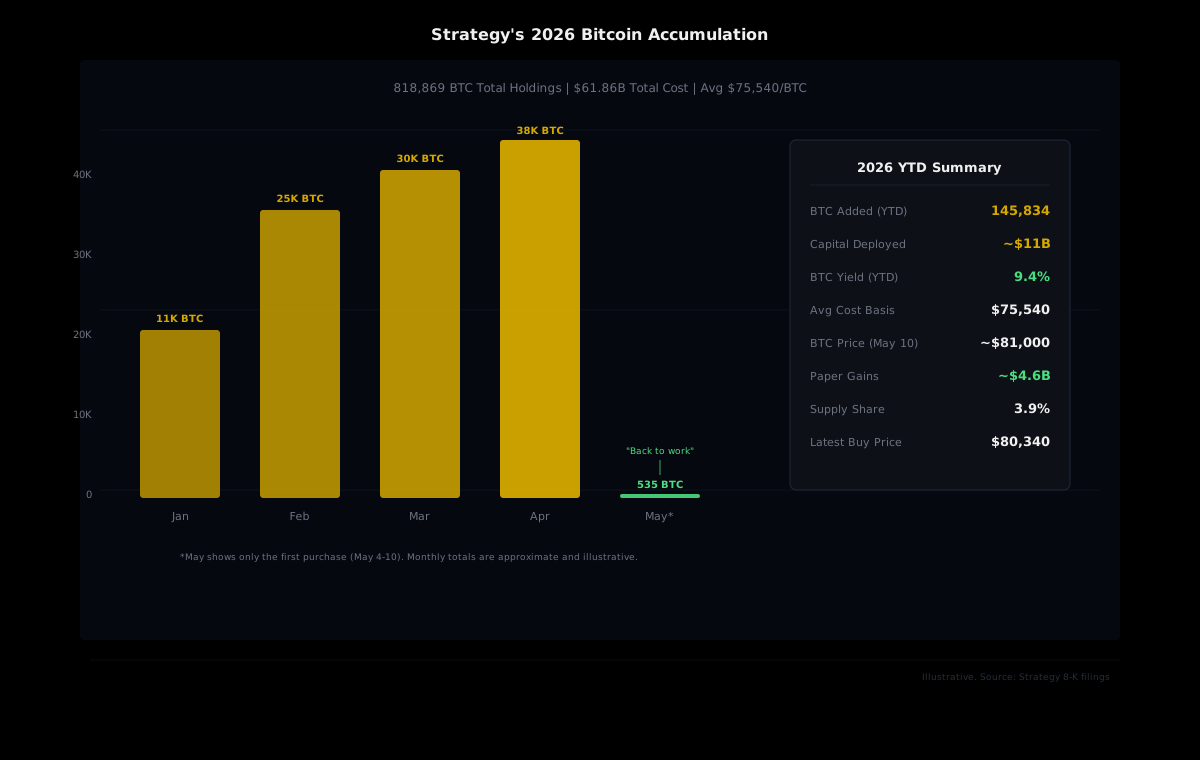
Strategy disclosed a 535 BTC purchase for approximately $43 million on Monday morning, resuming its weekly accumulation after a brief pause around Q1 earnings. The average price: $80,340 per coin. For a company that now holds 818,869 BTC worth roughly $61.86 billion, this is a rounding error on the balance sheet.
But zoom out. The buy happened during the longest streak of negative funding rates in a decade, and that tells a much more interesting story than one company's treasury allocation.
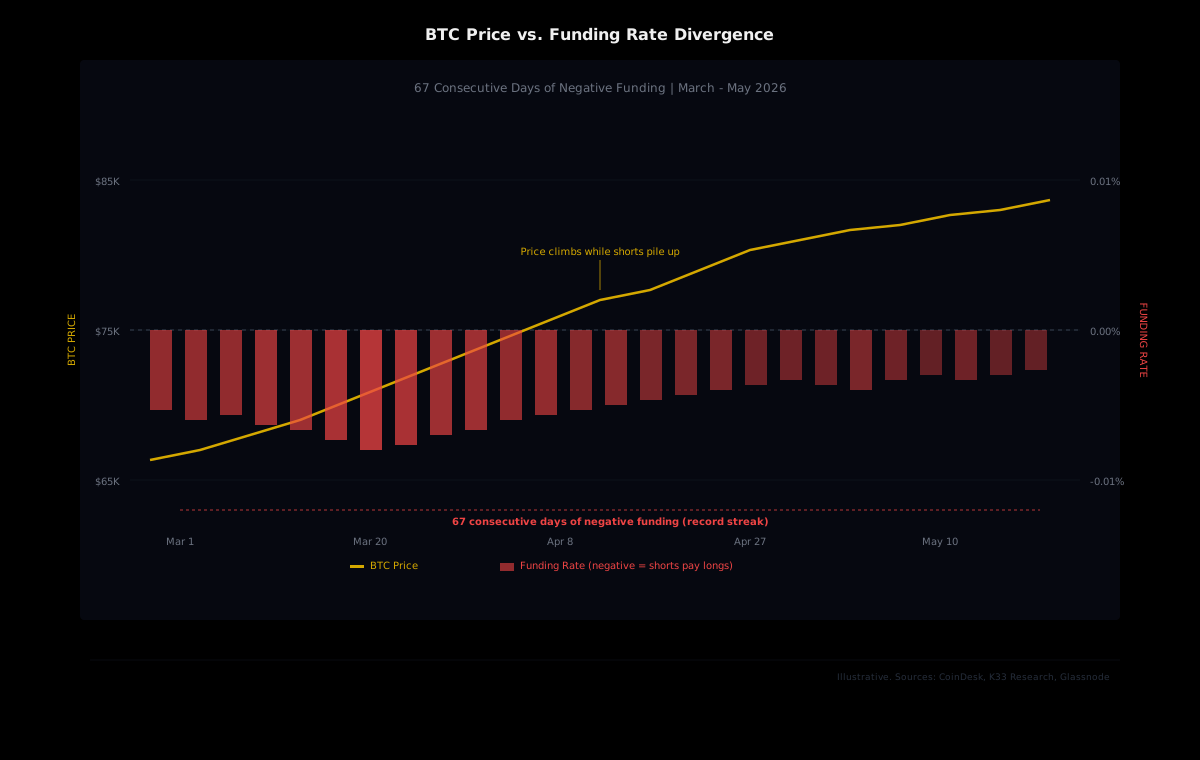
Bitcoin perpetual futures funding rates have been negative for 67 consecutive days, meaning short sellers have been paying long holders for over two months straight. Historically, stretches like this have coincided with local bottoms. Meanwhile, the spot price has climbed from the mid-$60,000s to around $81,000 (as of May 8). Spot buyers are quietly accumulating. Perps traders are betting against them. Someone is going to be wrong, and the funding rate structure is a powerful clue about who.
What Strategy actually did (and why it matters less than you think)
Saylor's Sunday "back to work" tweet has become a ritual. He posts the tracker image, the Monday 8-K follows, and crypto Twitter lights up. This week's filing showed 535 BTC purchased between May 4 and May 10 at an average of $80,340. Funded mostly through the MSTR ATM offering ($42.9 million), with a token $0.1 million from the STRC preferred stock program.
In isolation, this is not a major market event. Strategy holds 3.9% of all Bitcoin that will ever exist. Adding 535 more is maintenance buying, especially after April's 38,000+ BTC month. What makes it notable is the context: the purchase came six days after Saylor told investors Strategy was prepared to sell Bitcoin for the first time, a statement that sent a jolt through a market accustomed to Strategy's one-directional accumulation.
The sell signal was largely performative. Strategy sold 704 BTC in December 2022 to harvest tax losses, then rebought 810 two days later. The Q1 earnings framing is similar: a $12.54 billion unrealized loss under new FASB fair-value rules created a $2.2 billion deferred tax asset, and strategically selling a small slice to monetize that asset is textbook balance sheet management rather than a philosophical reversal.
67 days negative: what the funding rate is actually saying
Forget Saylor for a moment. The more consequential signal is happening in derivatives markets.
Bitcoin perpetual futures funding rates dropped to around -0.005% on a seven-day moving average, their most negative since 2023, according to Glassnode data. As of May 8, that streak had reached 67 consecutive days, the longest in a decade per K33 Research.
For traders who are new to this: funding rates are the mechanism that keeps perpetual futures prices anchored to spot. When funding is negative, short positions pay long positions a fee every hour on Hyperliquid (every eight hours on centralized exchanges). Persistent negative funding means the derivatives market is structurally leaning short. Traders are paying to maintain bearish bets.
The problem is that while shorts have been paying to stay positioned, the spot price has climbed from the low to mid $60,000s to around $75,000 and then continued higher, reaching $81,500 midweek before pulling back to $79,614. CoinDesk described this as the market "climbing a wall of worry, with short positioning potentially acting as fuel for further upside".
Historical precedent: what happened last time
Deeply negative funding rates have a track record. They have coincided with local bottoms in March 2020 (BTC around $3,000), mid-2021 (around $30,000), November 2022 during the FTX collapse (around $15,000), and during the 2023 Silicon Valley Bank crisis.
The pattern is not complicated. When the crowd leans too far in one direction, the reversal tends to be violent. Every short position is a future buy order: it has to be closed by purchasing. When price moves against shorts and funding costs stack up, the pressure to cover accelerates, which pushes the price further against remaining shorts. That self-reinforcing loop is why short squeezes are some of the fastest and most powerful moves in crypto markets.
XWIN Japan flagged $93,000 as a potential target, though cautioning that the move may not be linear. The 200-day moving average sat at $83,200 as of early May, a level BTC approached but did not break through.
Why "who" matters more than "what"
Here is the gap that aggregate data cannot fill. Funding rates tell you the market is leaning short. Strategy's 8-K tells you one company is accumulating. Neither tells you who else is buying on the other side, what their track record looks like, or whether the positioning shift is broad-based or concentrated in a handful of wallets.
This is where cohort analytics change the picture.
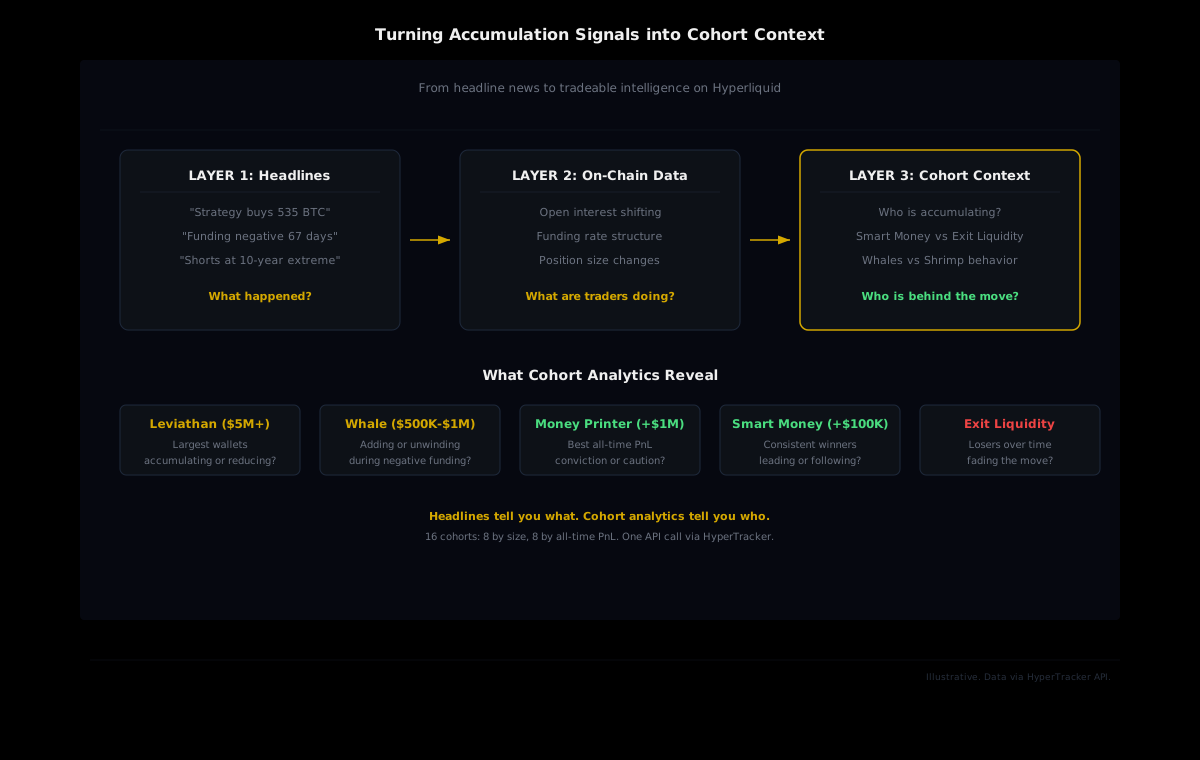
On Hyperliquid, every wallet is on-chain and classifiable. Our data segments the entire market into 16 behavioral cohorts: eight by account size (from Shrimp at $0-$250 up to Leviathan at $5M+) and eight by all-time PnL (from Money Printer at +$1M+ down to Giga-Rekt at below -$1M). When funding stays negative for two months and the price keeps climbing, the interesting question is not just "who is long?" but "are the wallets that are long the ones with a track record of being right?"
Consider the difference between these two scenarios:
- Scenario A: BTC longs are concentrated in Exit Liquidity and Giga-Rekt cohorts. The wallets with the worst track records are the ones fighting the short trend. This is a much weaker signal.
- Scenario B: Smart Money and Money Printer cohorts are increasing long exposure while Shrimp and Fish cohorts are crowding the short side. Historically profitable wallets are positioned against historically unprofitable ones. This is a materially different setup.
Aggregate metrics cannot distinguish between these. Cohort context can. A single API call to our cohort endpoint returns the positioning of every segment, so you can see whether the accumulation happening alongside negative funding is being led by wallets that have historically gotten these setups right.
The derivatives setup, in practical terms
If you trade perps or build tools for traders who do, the current structure presents a readable framework:
Negative funding as a carry trade. With shorts paying longs, holding a long position in BTC perps has a positive carry component. You are being paid to hold the position, which means even flat price action generates a return. For builders running strategies via the HyperTracker API, monitoring funding rate structure across cohorts adds a layer of signal: is carry being harvested by consistently profitable wallets, or are longs in negative-funding environments dominated by lower-conviction accounts?
Open interest as squeeze fuel. Persistent negative funding combined with rising open interest means the short side is not capitulating. Positions are being maintained even as the market moves against them. The longer this goes on, the larger the potential energy stored in the system. A decisive break above resistance could trigger rapid covering. Tracking which cohorts hold the largest short exposure helps estimate where that capitulation threshold might be.
Spot-derivatives divergence. When spot accumulation (visible through realized cap recovery and corporate treasury buys) runs counter to derivatives positioning (visible through funding rates and OI), it creates a tension that resolves in one direction. Cohort data tells you which side of that tension has historically better judgment.
Building on this signal
For builders and analysts on Hyperliquid, this kind of macro setup is exactly where cohort intelligence adds value. The raw ingredients (funding rates, open interest, spot price) are available everywhere. What turns them into something actionable is knowing whether the wallets on each side of the trade have historically profitable behavior patterns or not.
Turn headlines into cohort context
HyperTracker's API classifies every Hyperliquid wallet into 16 behavioral cohorts by size and all-time PnL. When the next macro catalyst hits, you will know who is accumulating and who is fading the move. One API call, 5-minute refresh, starting at $179/mo.
The current divergence between spot accumulation and derivatives positioning will resolve. Either the shorts are right and the rally fades, or the historical precedent holds and 67 days of pent-up short pressure fuel the next leg higher. Either way, the traders who can see beyond aggregate numbers into the behavioral composition of each side will have a structural edge.
Saylor's $43 million buy is a footnote. The 67 days of negative funding are the chapter. And the cohort data on who is positioned for what comes next is the part that most traders are still missing.