Coinbase Went Down for 6 Hours. Hyperliquid Didn't.
By CMM Team - 08-May-2026
Coinbase Went Down for 6 Hours. Hyperliquid Didn't.
On the evening of May 7, a data center in Northern Virginia overheated. Within minutes, Coinbase's trading interface went dark. Users with open leveraged positions could not close them, could not set stop losses, could not do anything except watch the market move without them. Trading did not fully resume until roughly 1 AM PDT on May 8, nearly seven hours after the first disruption. The root cause was a thermal event at an AWS facility that damaged hardware in multiple availability zones.
While Coinbase was offline, Hyperliquid kept processing trades. Its on-chain order book, secured by distributed validators running HyperBFT consensus, does not depend on a single cloud provider. No overheating server room in Virginia can take it down because no server room in Virginia runs it.
This was not a freak event. It was the second major AWS-driven Coinbase outage since October 2025. And it raises a question every serious trader should be asking: why is the world's largest publicly traded crypto exchange still single-threaded on one cloud provider?
What happened on May 7
At approximately 5:25 PM PDT, AWS detected what it later described as "increased temperatures" in its US-EAST-1 region, one of the most heavily used data center clusters in the world. The thermal event triggered a power loss that damaged EC2 instances and EBS volumes in availability zone use1-az4.
By 6:53 PM PDT, Coinbase had acknowledged degraded performance across its platform. Roughly 45 minutes later, the company publicly connected the issue to AWS infrastructure failure. Users reported failed transactions, delayed withdrawals, and inability to access trading services. Solana and ALEO transfers were also delayed.
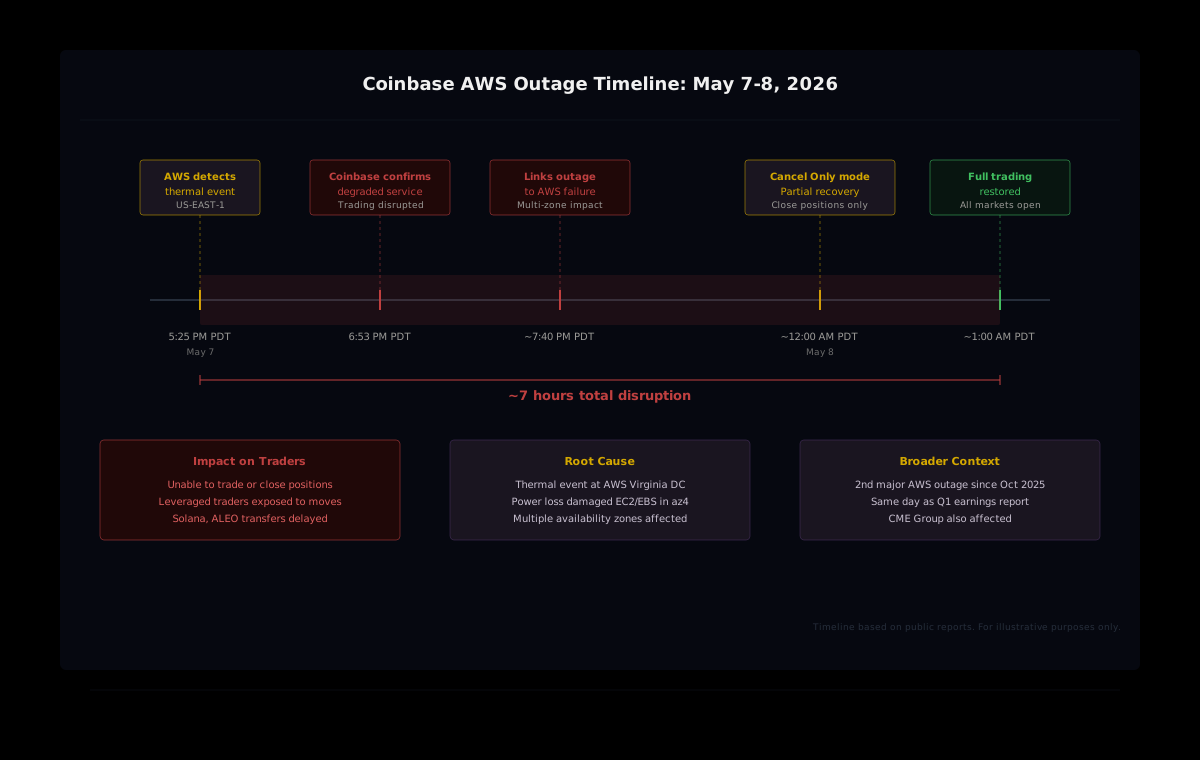
Coinbase said its "systems are designed to be resilient to a single zone outage," but acknowledged that "in this case, we observed failures impacting multiple AWS zones, which caused an extended outage of core trading services." To prevent disorderly trading during recovery, the exchange reopened in "Cancel Only" mode before gradually restoring full functionality.
The timing made the optics particularly painful. Just hours earlier, Coinbase had reported a $394 million GAAP net loss for Q1 2026, missing analyst estimates of a $0.04 normalized profit. Transaction revenue had fallen roughly 40% year-over-year to $756 million. Two days before the outage, CEO Brian Armstrong had announced a 14% workforce reduction affecting roughly 700 employees.
Software engineer Gergely Orosz, who has over 310,000 followers on X, called the timing "unfortunate optics." He was being diplomatic.
The single point of failure problem
The deeper issue is structural. Coinbase runs critical trading infrastructure on AWS. When AWS goes down, Coinbase goes down with it. This is a deliberate engineering choice. As Orosz noted, "When AWS (or a part of it) goes down, Coinbase appears to go down with it."
Coinbase is not the only exchange that depends on a single cloud provider, but it is the most visible example. Exchanges that distribute infrastructure across multiple cloud providers and on-premises deployments are better positioned to absorb regional failures. The architectural choice matters.
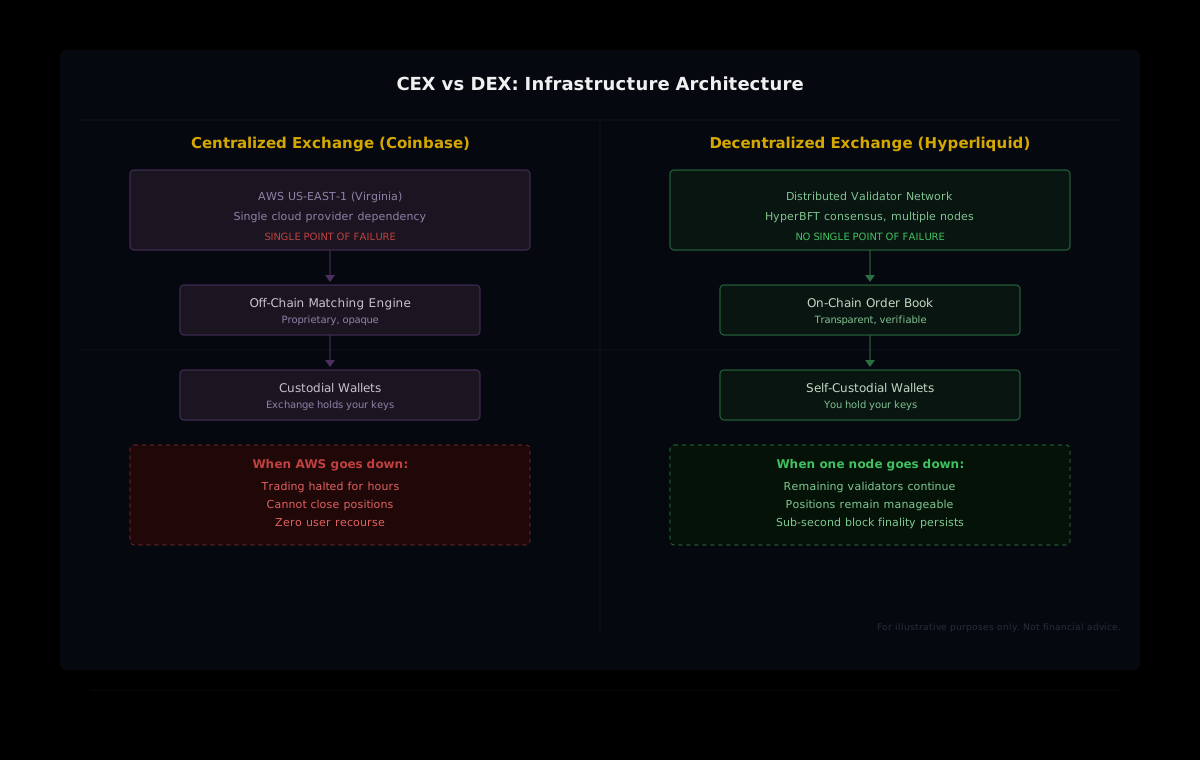
For a perpetual futures trader, an exchange outage is not just an inconvenience. It is a risk event. If you are holding a leveraged position when the exchange goes offline, you cannot adjust your margin, cannot set a stop loss, cannot close the trade. The market continues to move, and you are locked out. In October 2025, a crypto market crash saw $19.3 billion in leveraged positions liquidated in 24 hours, affecting 1.6 million trader accounts. When an exchange outage overlaps with that kind of volatility, the consequences compound.
How decentralized perps avoid this
Hyperliquid's architecture takes a fundamentally different approach. Its order book lives on-chain, maintained by a distributed set of validators running HyperBFT consensus (adapted from Meta's LibraBFT). Blocks finalize in about 0.2 seconds on median, and the chain supports 200,000 orders per second. There is no single cloud provider whose failure can halt trading.
The difference is architectural, and it matters precisely when things go wrong. A thermal event at a Virginia data center is irrelevant to a network running on distributed validators across multiple geographies. No single server room, no single ISP, no single hardware rack can take the system offline, because the consensus mechanism is designed to tolerate individual node failures.
This is not theoretical. When Coinbase went dark on May 7, Hyperliquid continued processing trades without interruption. Traders on the platform could open positions, close positions, and manage their risk normally while Coinbase users were locked out.
Honest about the tradeoffs
Decentralized infrastructure is not without its own challenges. Hyperliquid experienced a 37-minute API outage in July 2025 when a traffic spike overwhelmed its API servers. The blockchain itself, including consensus and block production, continued operating normally during that incident, but users could not submit orders through the API. Hyperliquid reimbursed affected users $1.99 million in USDC.
Centralized front-ends remain a vulnerability even for decentralized protocols. The distinction is that Hyperliquid's core matching engine and order book continued running on-chain during its API incident, while Coinbase's core trading infrastructure was itself offline during the AWS failure. The failure mode is different in kind: degraded access versus total halt.
What smart money does when exchanges go dark
Exchange outages create interesting market dynamics. When a major venue goes offline, liquidity fragments. Traders who can still access alternative venues have a structural advantage over those who are locked out.
This is exactly the kind of scenario where behavioral cohort analytics become valuable. Our data classifies every wallet on Hyperliquid into one of 16 behavioral cohorts: eight by wallet size (from Shrimp at $0-$250 up to Leviathan at $5M+) and eight by all-time PnL (from Giga-Rekt to Money Printer). When a centralized exchange goes down and capital flows shift, those cohort positioning changes show up in our API within minutes.
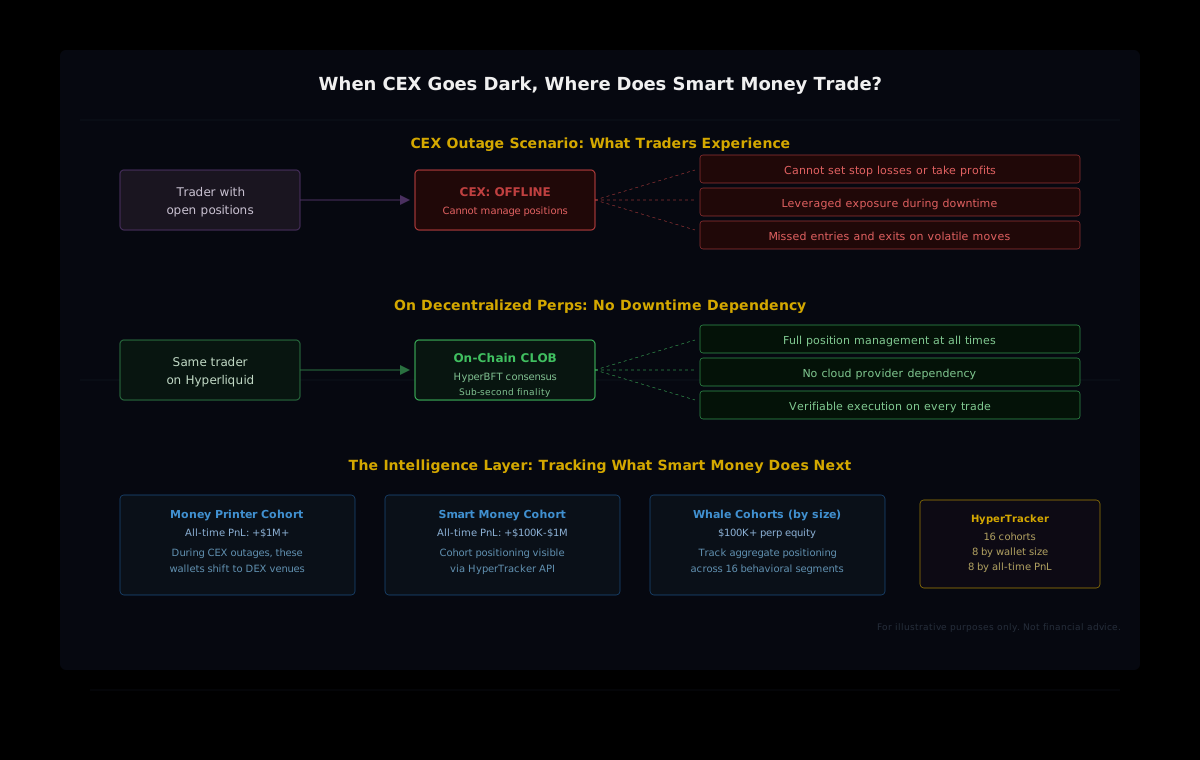
Consider what happens when Coinbase goes offline. Sophisticated traders with capital on both centralized and decentralized venues can still execute on Hyperliquid. Retail traders locked into Coinbase cannot. The resulting asymmetry, where informed capital can act while uninformed capital is frozen, is exactly the kind of market dynamic that cohort-level analytics capture.
The Money Printer cohort (all-time PnL above $1M) and Smart Money cohort ($100K-$1M) tend to be the fastest to react to market dislocations, because they typically maintain positions across multiple venues. Tracking their aggregate positioning through our API gives builders and traders a window into how the most profitable wallets are responding to events like exchange outages, in near-real-time rather than after the fact.
Building for resilience
If you are building trading tools, bots, or dashboards, the Coinbase outage is a useful design constraint to think through. What happens to your system when a data source goes offline? What happens to your users' open positions?
Builders on Hyperliquid have a structural advantage here. Because the order book is on-chain and the API is independent of any single cloud provider, a tool built on Hyperliquid's infrastructure inherits the protocol's resilience properties. An alert system that monitors cohort positioning through HyperTracker's API does not go dark because AWS Virginia overheated.
The practical implications for builders include:
- Multi-venue execution: Design bots to execute across centralized and decentralized venues. When one goes down, the other keeps processing. The CEX outage pattern is now frequent enough to justify the engineering investment.
- Cohort-aware risk management: Use our cohort positioning data to detect when smart money is repositioning during market stress events. The 16 behavioral segments give you granularity that raw price feeds cannot, especially during liquidity dislocations.
- On-chain verifiability: Every trade on Hyperliquid is verifiable on-chain. For compliance-sensitive builders, this is becoming a meaningful differentiator versus opaque centralized matching engines.
- Push-based alerting: With HyperTracker's webhook and push delivery, your system receives position updates without polling. During high-volatility events triggered by exchange outages, the difference between push delivery and polling can mean the difference between catching a move and missing it.
Track Smart Money When Others Go Dark
HyperTracker's API gives you 16 behavioral cohorts, order flow analytics, and liquidation risk scoring on Hyperliquid. When centralized exchanges go offline, our data keeps flowing. Start building with the free tier (100 requests/day) or go deeper with Pulse at $179/mo.
The pattern is the point
One outage is an incident. Two in seven months is a pattern. Coinbase is the largest publicly traded crypto exchange in the United States, and it has now been taken offline twice by the same cloud provider's infrastructure failures. CME Group, the world's largest derivatives marketplace, also experienced disruptions linked to the same AWS event.
The argument for decentralized infrastructure was always about censorship resistance and trustlessness. But the practical case is simpler than that: distributed systems are harder to take offline. A blockchain that runs on dozens of validators across multiple geographies does not have a single data center whose overheating can halt the entire network.
For traders, the calculus is straightforward. Every hour you cannot access your positions is an hour of unmanaged risk. For builders, the calculus is equally clear. Every tool you build on single-provider infrastructure inherits that provider's failure modes.
Coinbase went down for nearly seven hours because a building in Virginia got too hot. Hyperliquid kept processing trades. The architecture is the argument.