138 Million AI Payments Settled on Base. Perp Trading Infrastructure Isn't Ready.
By CMM Team - 14-Oct-2026
138 Million AI Payments Settled on Base. Perp Trading Infrastructure Isn't Ready.
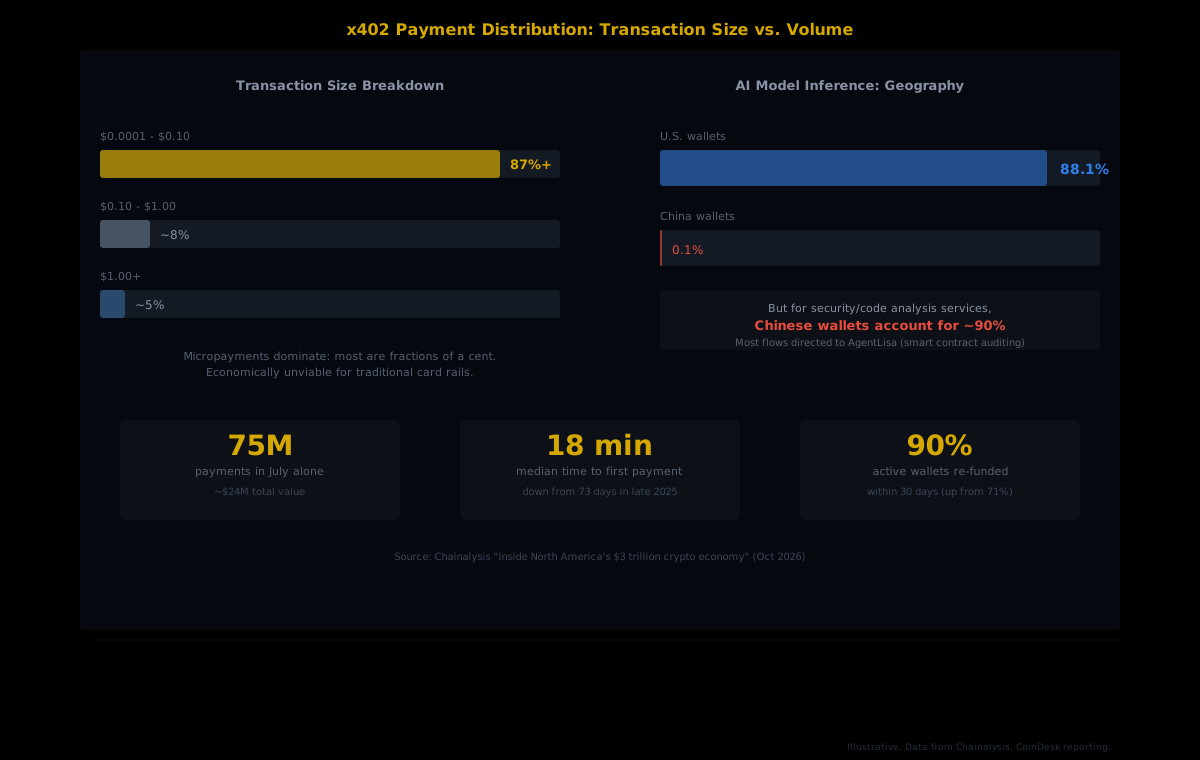
An AI agent spins up a wallet, deposits USDC, and makes its first payment within 18 minutes. No KYC form. No bank approval. Just a private key and a stablecoin balance. According to Chainalysis, this is now the median onboarding time for agent wallets using the x402 protocol on Base, down from 73 days in late 2025.
That speed captures something bigger than a protocol milestone. The payments layer for autonomous software is already built, battle-tested by over 138 million cumulative transactions. But payments are just the plumbing. When those same agents try to do something harder, like evaluate a perpetual futures position, check whether smart money is crowding into a trade, or score liquidation risk before sizing an order, the infrastructure disappears. The intelligence layer that would let agents trade perps the way they already buy API calls simply does not exist at most venues.
This is the gap worth watching, and worth building for.
The x402 Protocol Changed How Machines Pay
Coinbase introduced the x402 protocol in May 2025, resurrecting the long-dormant HTTP 402 status code ("Payment Required") as a machine-readable payment negotiation layer. The idea was straightforward: let servers charge clients, including AI agents, for API calls using stablecoins. No accounts. No human approval at each transaction. Just an HTTP response that says "this costs $0.003 in USDC" and a wallet that can settle it programmatically.
Fifteen months later, the numbers speak for themselves.
Those transaction sizes matter. Over 87% of x402 payments fall between $0.0001 and $0.10, a range that is economically unviable on traditional card rails. Visa and Mastercard cannot profitably process a fraction-of-a-cent charge. Stablecoins can, which is why the entire architecture runs on USDC settled on Base.
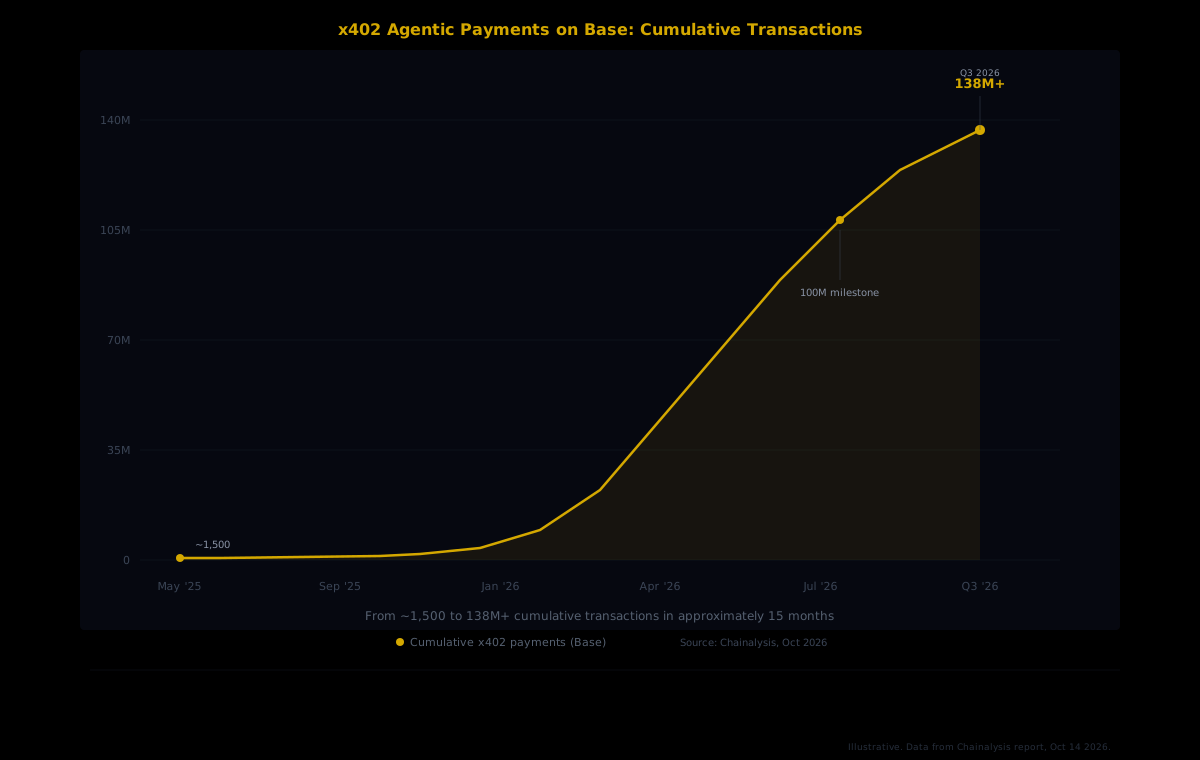
The foundation behind x402 now counts 40 members, including Visa, Mastercard, Stripe, and AWS. Coinbase has begun allowing enterprise clients to accept AI agent payments directly. This is production infrastructure being used by real agents at real scale.
Where Agents Are Spending (and Where They Are Not)
Chainalysis published the data in its report titled "Inside North America's $3 trillion crypto economy: Agentic commerce accelerates." The geographic breakdown reveals a clear pattern. For AI model inference, purchasing compute and data, U.S.-linked wallets accounted for 88.1% of geographically identifiable payments. Chinese-linked wallets made up just 0.1%.
The dynamic flips for security and code-analysis services. Chinese-associated wallets account for roughly 90% of identified payments in that category, with most flows directed to AgentLisa, an AI smart contract auditing platform. Chainalysis research director Eric Jardine explained that Chinese developers favor open-weight models like DeepSeek and Qwen, reducing their need for pay-per-use inference.
The takeaway: agents are already buying compute, data, and security audits autonomously. But look at what is missing from the spending categories. Trading intelligence. Market data. Cohort analytics. Liquidation risk feeds. The tools an agent would need to evaluate a leveraged position before opening it are largely absent from the agentic commerce stack today.
Why Perp Trading Is the Natural Next Step
Perpetual futures are the most actively traded instruments in crypto. They are also the most dangerous for unsupervised execution. A 10x long on ETH means a 1% adverse move produces a 10% loss. Liquidation cascades are real, frequent, and destructive. An agent executing perp trades without pre-trade intelligence is flying blind with leverage.
The major exchanges recognize this. In March 2026, Binance launched AI Agent Skills with modules for futures trading execution and wallet analysis. OKX shipped its Agent Trade Kit the same week. Robinhood announced AI-powered trading agents alongside its U.S. perpetual futures launch at its HOOD Summit. Each platform is building agent-friendly wrappers around their own venue.
But here is the problem: venue-specific agent tools only work on that venue. Binance's agent skills work on Binance. OKX's Agent Trade Kit works on OKX. An agent trying to evaluate where to open a position across multiple venues, based on which cohort of traders is accumulating or where liquidation risk is thinnest, needs a data layer that sits above any single exchange.
The Intelligence Gap for Autonomous Perp Trading
Consider what an agent needs before it opens a leveraged position. It needs to know who else is in the trade. Is the position crowded? Are the wallets building this position historically profitable, or are they the segment that tends to get liquidated? Where are the liquidation clusters sitting, and would a stop run at the current price level trigger a cascade?
Raw exchange APIs provide none of this. They give you price, volume, open interest, and individual fills. Useful for basic execution. Useless for evaluating whether a trade is a good idea.
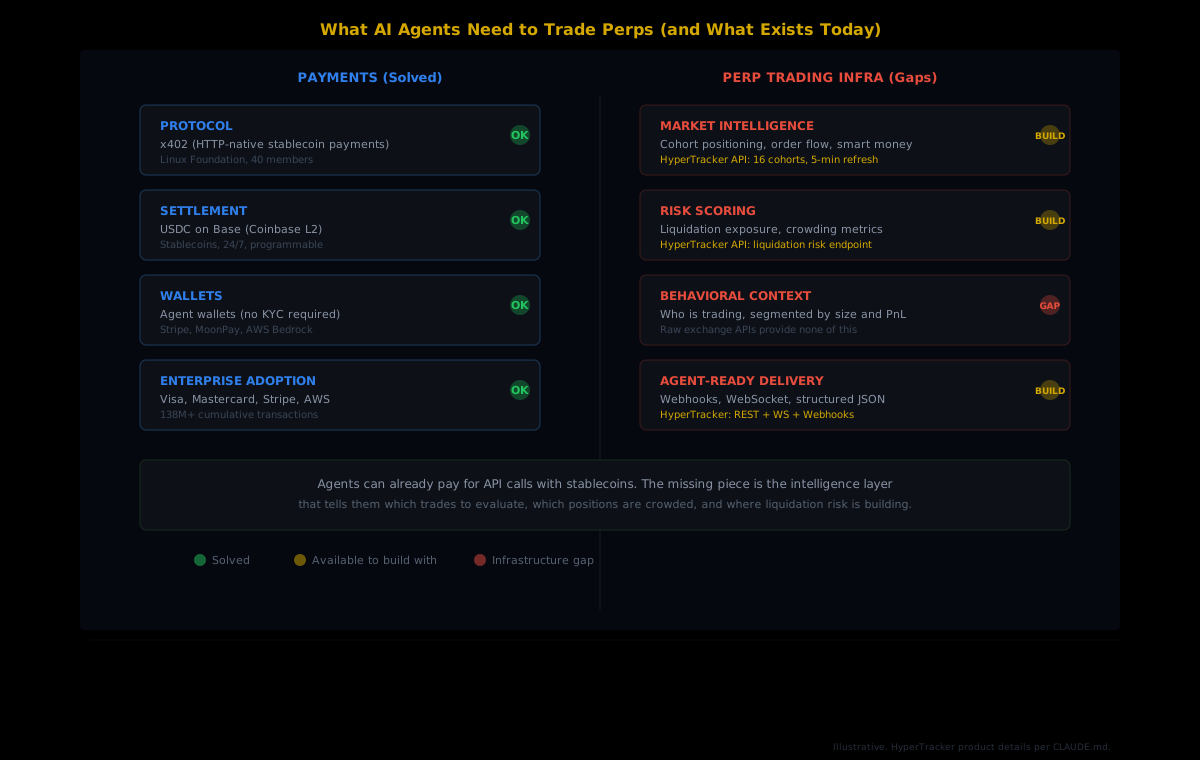
The stack an agent actually needs looks like this:
- Behavioral segmentation: Classify the market by who is trading, segmented by account size and profitability track record. Know whether the current flow is driven by consistently profitable wallets or by accounts that historically exit at a loss.
- Position crowding: Measure how concentrated a given side of a trade is across different wallet segments. A 70/30 long bias driven by profitable accounts is a different signal than a 70/30 long bias driven by accounts that have been wrong most of the time.
- Liquidation risk scoring: Map where liquidation exposure is building at the asset level, so the agent can avoid sizing into a position that sits directly on top of a cluster.
- Structured delivery: All of this needs to arrive as structured JSON via REST, WebSocket, or webhook. Not a dashboard screenshot. Not a chart. Machine-readable data that the agent can parse and act on without human interpretation.
Payments Solved, Intelligence Missing
The x402 protocol solved the payment problem elegantly. An agent that needs to buy an API call can do it in under a second, settling in USDC, with no human in the loop. Roughly two-thirds of new wallets now make a payment within an hour of receiving funds. About 90% of qualifying active wallets received another deposit within 30 days, up from roughly 71% a year earlier. The behavioral pattern is clear: agents that start paying keep paying.
So the wallet infrastructure works. The settlement layer works. The protocol governance works (40 members, Linux Foundation stewardship). What does not work yet is the layer that gives agents enough context to make intelligent decisions about leveraged trades.
This is where trading infrastructure providers come in. The agent does not need another exchange wrapper. It needs pre-computed market intelligence delivered in a format it can consume programmatically.
Building for the Agent Economy
HyperTracker's API was designed for builders, which increasingly means building for agents. The architecture maps cleanly to what an autonomous trading system needs:
- 16 behavioral cohorts classify every wallet on Hyperliquid by account size and all-time PnL. Eight size-based segments (from Shrimp under $250 to Leviathan above $5M) and eight PnL-based segments (from Money Printer above +$1M to Giga-Rekt below -$1M). One API call returns what the profitable segment is doing versus the segment that historically loses.
- Liquidation risk endpoints score asset-level liquidation exposure, so an agent can evaluate whether the current position landscape makes a trade more or less risky before committing capital.
- Order flow snapshots deliver rolling 5-minute windows of trade flow, including stop and take-profit visibility. An agent can detect whether incoming flow is predominantly closing positions or opening new ones.
- Delivery via REST, WebSocket, and Webhooks means the agent does not need to poll. It can subscribe to push updates and react to changes in cohort positioning as they happen.
At $179/month for the Pulse tier, this is a fraction of the cost of building equivalent infrastructure from scratch. Processing raw blockchain data into behavioral cohorts requires ingestion pipelines, classification logic, refresh scheduling, and ongoing maintenance. That is the kind of work that costs $10,000+/month in engineering time, which is exactly the wrong thing for an agent to spend resources on when it could just make an API call.
Build Smarter Agents with Cohort Intelligence
HyperTracker's API gives your autonomous systems the behavioral context they need to evaluate perp trades. 16 cohorts, liquidation risk scoring, order flow analysis. Start with the free tier (100 calls/day) and scale when your agent does.
What Comes Next
The 138 million transaction milestone is a proof of concept for agentic commerce. But the real question is not whether agents can pay for things. That is settled. The question is what they will pay for next, and how good the intelligence layer behind their decisions will be.
For perpetual futures, the infrastructure stack has a clear gap between execution capability and decision quality. Agents can already open positions, manage margin, and close trades. They cannot yet evaluate whether a trade is crowded, whether smart money is on the same side, or whether the liquidation landscape makes their position dangerous. That is the intelligence layer, and it is the next piece of infrastructure that the agent economy will demand.
The payment rails are built. The wallets are funded. The agents are spending. Now they need something worth buying before they start trading with leverage.