
$24B in Prediction Volume and Hyperliquid Wants Its Cut
By CMM Team - 18-Oct-2026
$24B in Prediction Volume and Hyperliquid Wants Its Cut
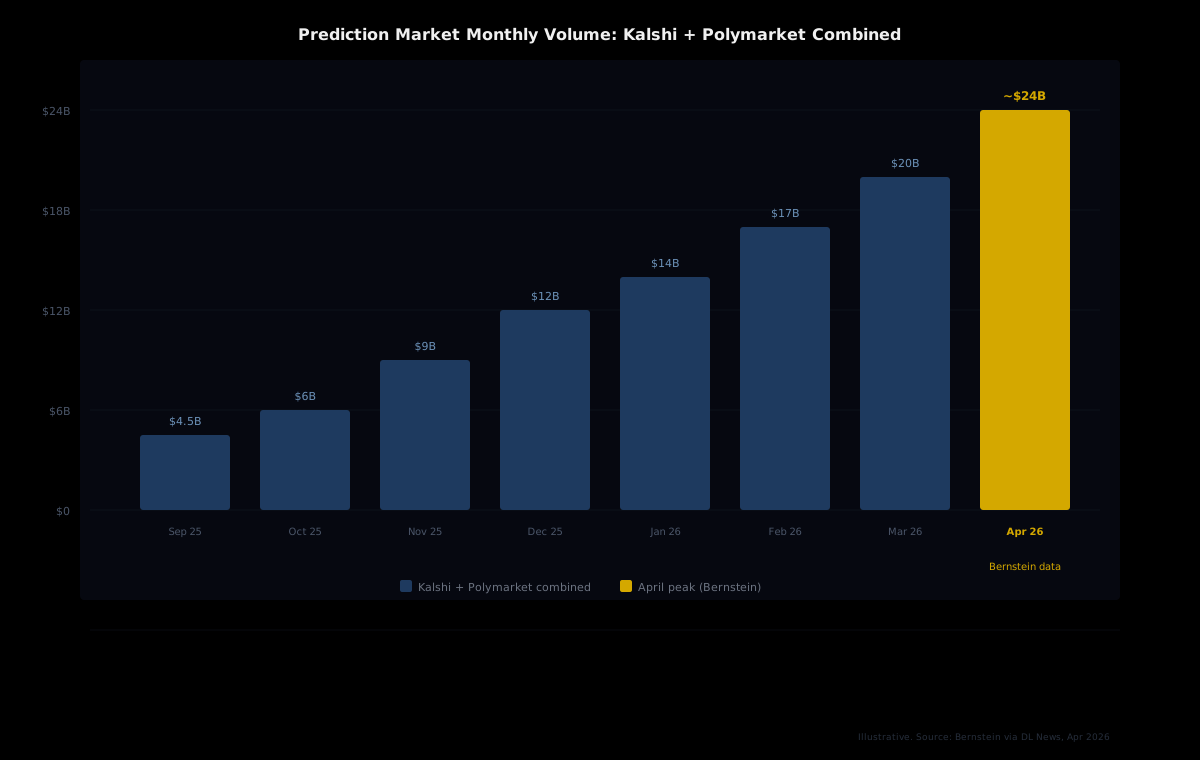
Prediction markets pushed nearly $24 billion in combined monthly volume across Polymarket and Kalshi back in April. By October, Hyperliquid's own outcome markets had been live for five months, quietly accumulating about $317 million in cumulative trades. Those numbers sit roughly four orders of magnitude apart, which is exactly the kind of gap that draws builders into a market.
What makes HIP-4 interesting for perp builders is the structural difference. Hyperliquid is the only venue where a single margin account covers perps, spot, tokenized equities, and prediction markets. That means every wallet trading an outcome contract already has a perp history, a cohort classification, and an on-chain PnL footprint. For analytics tools built on top of this data, prediction volume creates a new signal layer without requiring a separate data pipeline.
The Prediction Market Boom in Numbers
The growth trajectory is hard to ignore. Combined monthly trading volume on Kalshi and Polymarket jumped from roughly $4.5 billion in September 2025 to nearly $24 billion by April 2026, according to Bernstein data. Kalshi now commands a 62% market share, up from 55% in January, with sports betting driving roughly 72% of its volume.
Bernstein has extended its digital assets research coverage to include prediction markets as one of three trends it tracks alongside tokenization and stablecoins. When a Wall Street research desk allocates analyst headcount to a category, it signals institutional capital is paying attention. That matters for builders thinking about where to deploy their next product.
How HIP-4 Works Under the Hood
HIP-4 launched on Hyperliquid mainnet on May 2, 2026, introducing binary outcome contracts that settle to 0 or 1. The contracts are fully collateralized, which means the money to cover every possible outcome is locked in from the start. No leverage, no liquidation risk on the prediction leg itself.
The first markets were daily Bitcoin mark-price binaries, settling each day at 06:00 UTC. Since then, the market mix has broadened considerably. Soccer contributed $89.5 million, or 28% of cumulative volume, while crypto-price markets represented 42% of recent 30-day activity.
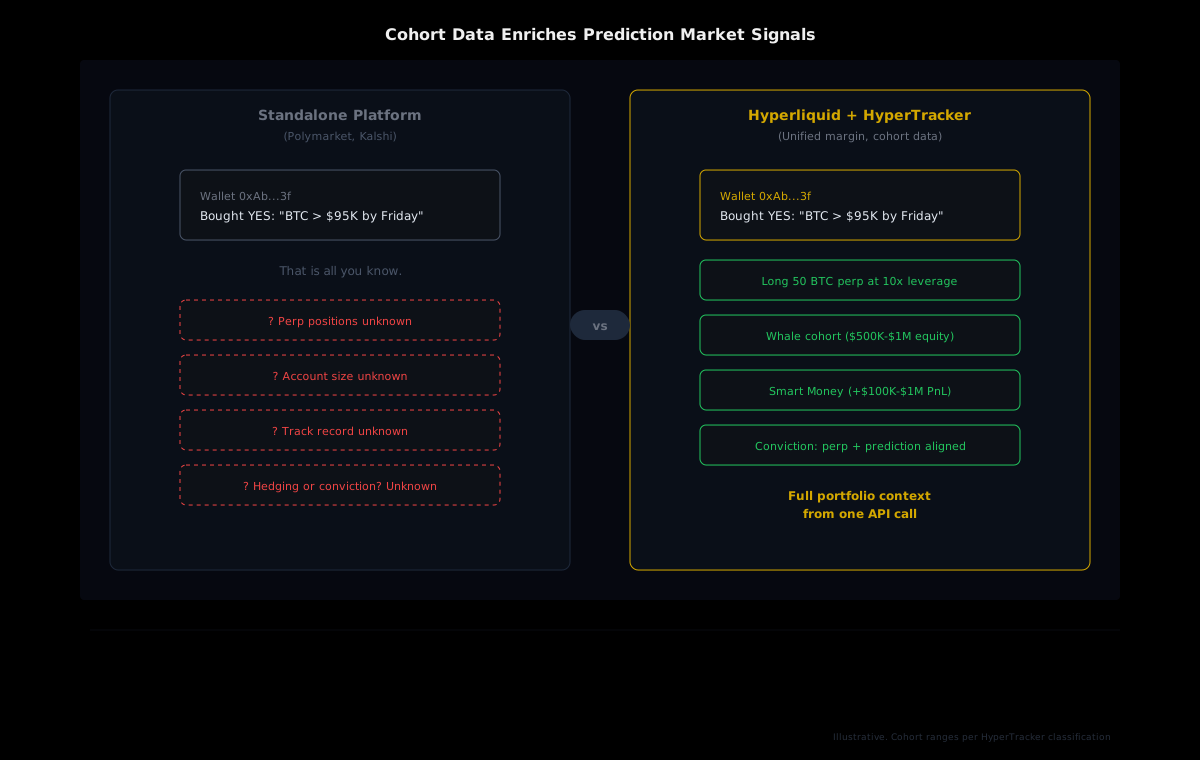
The structural difference that matters most for builders: a trader can hold spot positions, perpetual contracts, and outcome markets all within the same account, against the same collateral pool. Neither Polymarket nor Kalshi offers this. When a whale buys a prediction contract on Hyperliquid, you can see their entire portfolio context: perps, spot, PnL history, and cohort classification. On standalone prediction platforms, you only see the prediction bet itself.
The Permissionless Phase: 500K HYPE to Build
Hyperliquid opened permissionless prediction market creation during the summer. Any builder meeting the staking requirement can deploy without approval, as long as they stake 500,000 HYPE. That stake is slashable if validators catch a builder manipulating the oracle or pushing an invalid settlement.
The economics are straightforward: builders pick the events, run the oracle, and keep up to half the trading fees their markets generate. At HIP-4's recent pace, the system generated about $480,000 in annualized fees. Small numbers for now, but the incentive structure is clear: bring liquidity and volume, capture half the fee revenue.
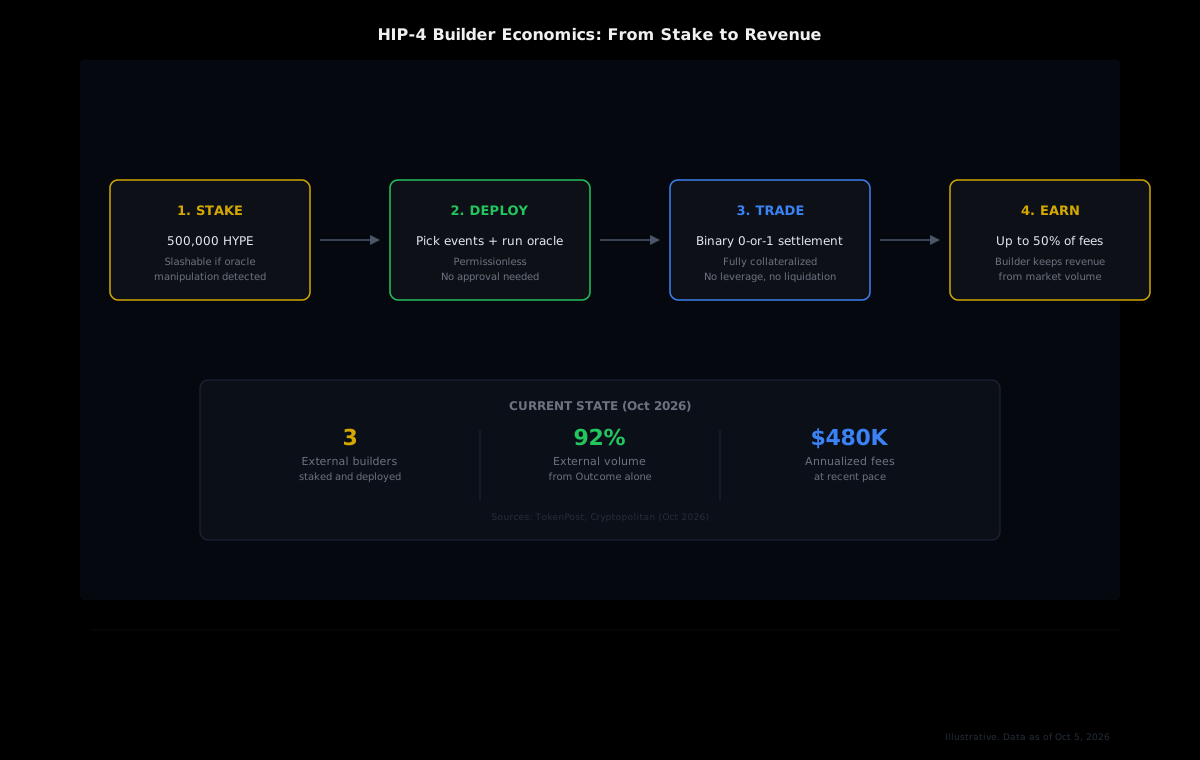
By October 5, only three external venues had staked and deployed. Outcome, the first permissionless builder, accounted for 92% of external-venue volume since August 29. Its $1 million rewards program had paid $273,409 to 2,487 wallets by that same date. Early days, but the pattern is familiar: one builder dominates, more follow once the economics prove out.
Volume Reality Check: $317M vs. The Competition
Honesty matters here. HIP-4 generated about $51 million in September and averaged roughly $1.25 million in daily volume during the first five days of October. The $317 million cumulative total over five months is a volume that larger rivals process in hours.
The liquidity is still thin. The median bid-ask spread across the 25 most active HIP-4 order books sat at 0.29 cents. For context, Hyperliquid's perp markets routinely offer sub-penny spreads on major pairs. Prediction market liquidity has not caught up.
But comparing HIP-4 to Kalshi or Polymarket misses the point for builders. The value is not in the prediction volume itself. It is in the cross-product data that only Hyperliquid generates. When a Money Printer cohort wallet (all-time PnL above +$1M) opens a prediction position alongside their existing perp exposure, that is a signal you cannot extract from any standalone prediction platform.
Why This Matters for Cohort Analytics
HyperTracker classifies every Hyperliquid wallet into one of 16 behavioral cohorts: eight by account size (Shrimp through Leviathan) and eight by all-time PnL (Money Printer through Giga-Rekt). These classifications follow wallets across every product on the exchange, including prediction markets.
This creates three new analytical angles for builders:
Cross-product conviction signals. A Whale cohort wallet ($500K-$1M in perp equity) that simultaneously holds a large BTC long and buys YES on a "BTC above $95K by Friday" outcome contract is expressing layered conviction. Our data surfaces both positions through the same API, letting builders construct composite confidence scores that blend perp exposure with prediction bets.
Cohort migration patterns. As prediction markets grow, some traders will shift capital from perps to outcomes (or vice versa). Tracking whether Smart Money wallets (all-time PnL +$100K to +$1M) are rotating into prediction markets or treating them as a hedge alongside perp positions tells you something about market regime. A pure prediction platform cannot show you this rotation.
Builder-level analytics. Each permissionless prediction market deployer on HIP-4 is a builder with a code, just like perp builders. Our builder analytics endpoints track users, volume, and PnL per builder code. As more prediction market deployers enter, the builder leaderboard becomes a way to evaluate which prediction venues attract the sharpest traders.
Builder tip: Query our cohort metrics endpoint for any asset, including prediction market tickers, to see how each of the 16 cohorts is positioned. When Smart Money and Money Printer cohorts load up on the same outcome, that convergence is worth tracking.
Building on Top of Prediction + Perp Data
If you are already pulling cohort data from HyperTracker's API, prediction market positions add context without extra infrastructure. The same endpoints that return perp positioning by cohort work for any Hyperliquid asset. A few practical applications:
Sentiment dashboards. Combine prediction market YES/NO ratios with perp long/short ratios by cohort. When the Leviathan cohort ($5M+ in perp equity) is net long BTC perps and simultaneously buying YES on a "BTC new ATH this month" contract, the signal compounds. When they disagree (long perps but buying NO on the outcome), that divergence is a story worth surfacing to users.
Alert triggers. Set webhook alerts when cohort positioning in prediction markets diverges from perp positioning. A builder running a copy-trading system, for example, might pause mirroring a wallet if that wallet starts hedging its perp exposure through prediction market NO contracts.
Historical analysis. HyperTracker stores position history going back months. As prediction markets accumulate data, builders can backtest whether prediction market activity from specific cohorts had predictive value for subsequent perp price action. Did Smart Money wallets buying YES on outcome contracts precede directional moves in the underlying perp? With unified data, you can actually answer that question.
Track Every Cohort Across Perps and Predictions
HyperTracker's API classifies every Hyperliquid wallet into 16 behavioral cohorts. One API call gives you positioning data across perps, spot, and prediction markets.
The Bigger Picture: Hyperliquid as a Market Platform
Step back from the prediction market specifics and look at the trajectory. Hyperliquid started as a perps exchange. It added spot trading. Then tokenized equities via HIP-3. Now prediction markets via HIP-4. The platform processes $5 billion to $6 billion in daily perp volume across 1.4 million users.
Each new product primitive does the same thing: it generates a new data layer from the same set of wallets, against the same margin pool, on the same chain. For builders, this is compounding utility. You build one analytics pipeline, and every new product that launches on Hyperliquid becomes another data source flowing through it.
The $317 million in prediction volume is early and thin. But the infrastructure is permanent. Every prediction bet is an on-chain transaction from a wallet that already has perp history, cohort membership, and PnL records. As volume grows, the data becomes richer without builders needing to integrate a new exchange or bridge a new data source.
The venue that wins is the one where a single wallet tells you everything: how someone trades perps, what equities they hold, and which outcomes they are betting on. Hyperliquid is the only chain building that unified view.
Prediction markets pushed nearly $24 billion in a single month. Hyperliquid has captured a fraction of that so far, but the structural advantage is clear: unified data from a unified margin engine. For builders already shipping on Hyperliquid, the question is not whether to add prediction market support. It is how fast you can start extracting signal from wallets that trade everything in one place.