
$30M to Deploy a Prediction Market: Hyperliquid's Builder Bet
By CMM Team - 08-Aug-2026
$30M to Deploy a Prediction Market: Hyperliquid's Builder Bet
Hyperliquid just priced the cost of building a prediction market. The answer: 500,000 HYPE tokens, locked for six months. At recent prices near $60 per token, that works out to roughly $30 million in capital committed before a single outcome contract goes live.
That is a feature, not a bug. And it tells you exactly who Hyperliquid wants building its next product vertical.
The permissionless HIP-4 upgrade opens prediction market deployment to any builder willing to meet the capital threshold. Combined monthly volumes across Polymarket and Kalshi hit nearly $24 billion in April, and Hyperliquid wants to route a growing share of that volume through its own infrastructure. But rather than lowering the barrier, the protocol chose to raise it, betting that well-capitalized operators will produce better markets than an open free-for-all.
This article breaks down the economics of builder-deployed prediction markets, what the staking gate filters for, how fee sharing creates a new revenue stream for builder code operators, and why the builder code leaderboard reveals who is best positioned to deploy first.
The staking gate: what $30M filters for
Permissionless does not mean free. Each deployer must lock 500,000 HYPE for six months. Validators can vote to slash part or all of that stake if a deployer records an incorrect result, fails to settle a contract within one week, or launches a market with ambiguous terms.
This design mirrors what worked for HIP-3, Hyperliquid's builder-deployed perpetual futures framework. Builder-deployed contracts started at roughly 2% of daily perps volume when they launched in October 2025. By mid-2026, that figure climbed toward 50% of daily volume. The playbook: start gated, prove the model works, then scale.
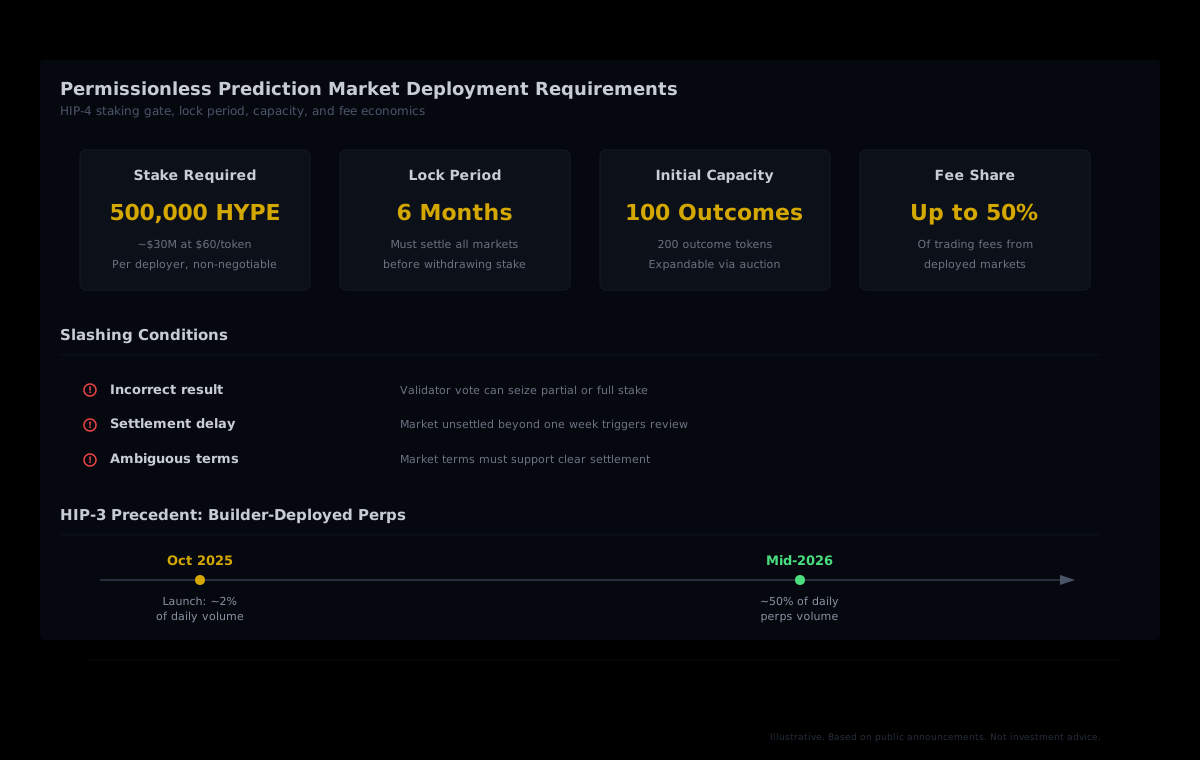
Each deployer starts with capacity for 100 outcomes, representable as up to 200 tradable outcome tokens. Future upgrades will expand this limit through an auction mechanism. The intent is clear: start small, build a track record, expand capacity based on performance.
The fee-sharing economics
Deployers can earn up to 50% of trading fees generated by their markets. This is the carrot alongside the stick. For a builder already operating on Hyperliquid, prediction market deployment becomes a second revenue stream on top of existing builder code fees from perps and spot.
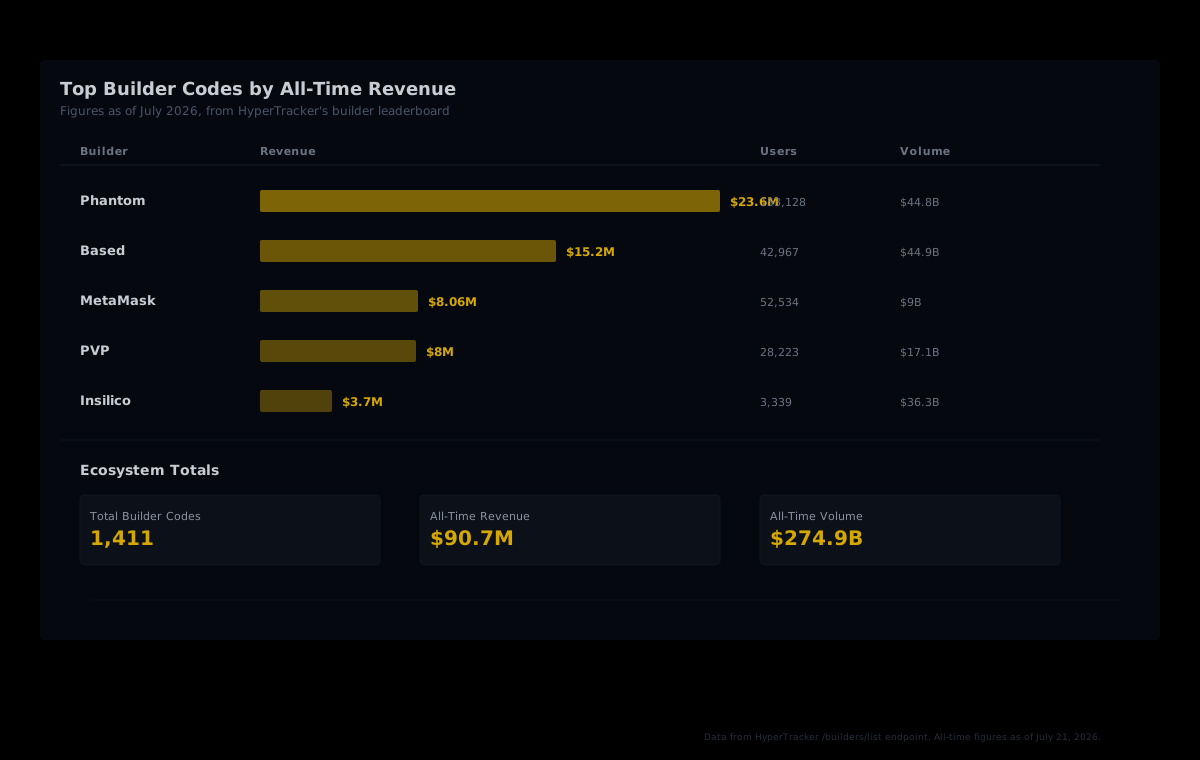
Builder codes on Hyperliquid already function as an on-chain fee attribution mechanism. Any application routing orders through the exchange can attach and collect a fee. Figures as of July 2026, from HyperTracker's builder leaderboard: the ecosystem currently tracks over 1,400 active builder codes generating over $90 million in all-time revenue across more than $274 billion in volume.
The top builder codes are already substantial businesses. Phantom leads with over $23.6 million in all-time revenue across 153,128 users. Based follows at $15.2 million with nearly 43,000 users, and MetaMask sits third with $8 million across 52,534 users.
For these operators, staking 500,000 HYPE to access prediction market fee sharing is a capital allocation decision, not an existential risk. Their builder code revenue already covers the opportunity cost of the staked capital many times over.
Who deploys first? The builder leaderboard tells you
The $30 million staking requirement acts as a natural filter. Independent developers building side projects cannot meet it. But the top builder code operators, the ones already generating millions in fees from perps volume, can afford it. More importantly, they already have the user base to generate prediction market volume from day one.
| Builder Code | All-Time Revenue | Users | Volume | | --- | --- | --- | --- | | Phantom | $23.6M | 153,128 | $44.8B | | Based | $15.2M | 42,967 | $44.9B | | MetaMask | $8.06M | 52,534 | $9B | | PVP | $8M | 28,223 | $17.1B | | Insilico | $3.7M | 3,339 | $36.3B |
Consider the unit economics. A builder code operator with 50,000+ active users can route a fraction of those users into prediction markets. Even capturing a small slice of the volume that currently flows to Polymarket and Kalshi creates a meaningful fee stream. With up to 50% of trading fees flowing back to the deployer, the math works quickly for well-capitalized operators with existing distribution.
The prediction market opportunity Hyperliquid is chasing
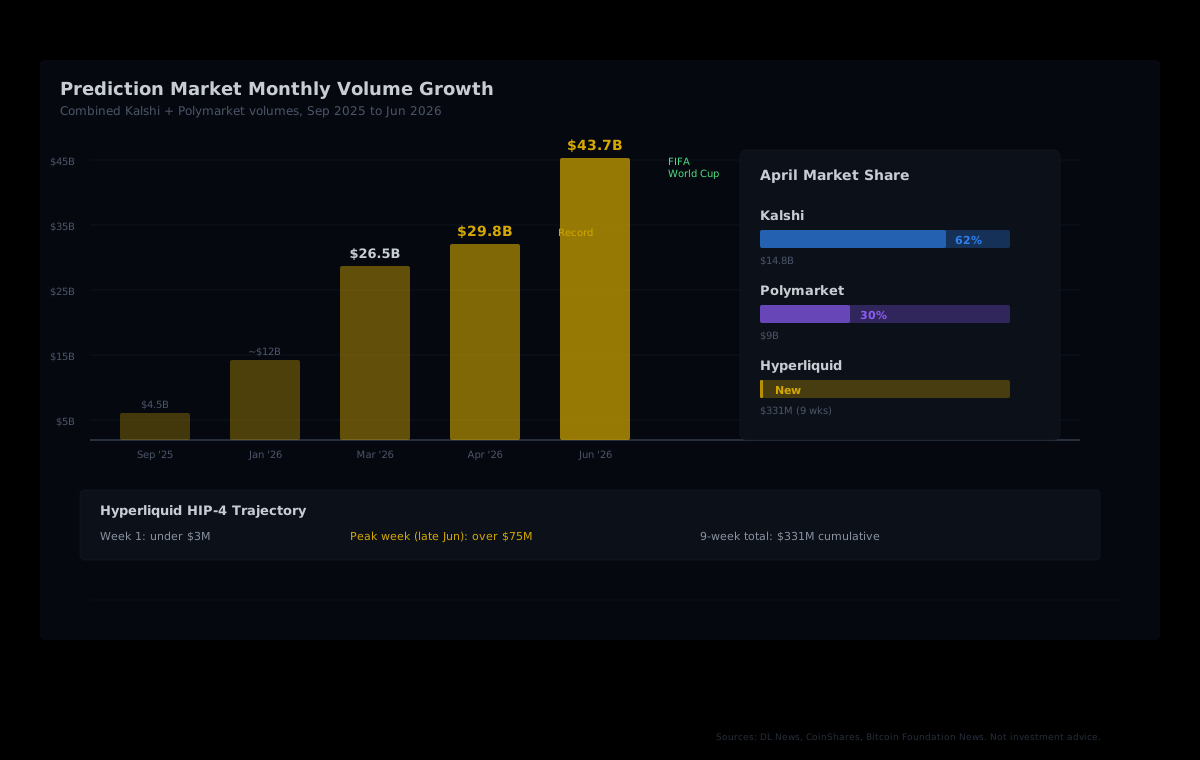
Combined monthly volumes across Polymarket and Kalshi rose from $4.5 billion in September 2025 to $43.7 billion in June 2026. That June spike was driven partly by the opening weeks of the 2026 FIFA World Cup, which has drawn more than $50 billion in bets.
In April, total prediction market volume across all platforms hit a record $29.8 billion, up from $26.5 billion in March. Kalshi leads with a 62% market share, driven by sports betting, which accounts for roughly 72% of its volume.
Hyperliquid's first-week prediction volume in May was modest by comparison. But HIP-4 processed $331.1 million in cumulative notional volume across its first nine weeks, growing from under $3 million in its launch week to a weekly peak above $75 million in late June. The trajectory matters more than the absolute number at this stage.
Hyperliquid's structural advantage is unified margin. A trader can hold a BTC perp, a spot ETH position, and a binary outcome contract in the same margin account. One wallet, one view of total exposure. Polymarket and Kalshi cannot replicate this, because their prediction markets live on separate infrastructure from derivatives trading.
Unified margin is the moat builders care about
For prediction market deployers, unified margin solves the cold-start problem. The platform already processes around $6 billion in daily derivatives volume. Users are already on-chain, already funded, already active. A builder deploying a new outcome market does not need to acquire users from scratch. They are extending a product for an existing user base, which means their cost per first trade drops dramatically compared to launching on a greenfield prediction platform.
Open interest in RWA-linked contracts on Hyperliquid has reached a record $3.6 billion, while total open interest climbed to a 2026 high of $11 billion. This is the pool of capital that prediction market deployers can tap into. A trader who is already long oil perps via HIP-3 can hedge with a binary outcome contract on OPEC decisions. A trader short equities can buy YES on a recession call. The composability between perps, RWAs, and prediction markets within a single margin system is the feature that makes Hyperliquid's prediction market bet different from a standalone Polymarket competitor.
The HIP-3 playbook, applied to outcome markets
Hyperliquid has already run this experiment once. HIP-3 introduced builder-deployed perpetual futures contracts in October 2025, using a similar structure: stake tokens, deploy contracts within validator-approved parameters, earn fees. The result was an explosion in product diversity. Builders brought RWA-linked perps, commodity contracts, and exotic pairs to the exchange. Volume in builder-deployed contracts grew from 2% to roughly half of all daily perps volume within eight months.
The prediction market version follows the same logic. Validators will approve standardized outcome templates stored and enforced on-chain. Deployers create individual markets within those templates and remain responsible for defining settlement conditions and resolving them correctly. The structure gives deployers freedom within guardrails: they can create any market that fits an approved template, but they cannot launch ambiguous or unresolvable outcomes without risking their stake.
Hyperliquid has said it expects fewer than 10 validator-controlled prediction markets per year once permissionless deployment is available. The protocol is deliberately stepping back from direct market creation and handing the product surface to builders. This is not a platform running its own prediction markets with a side option for third parties. It is a protocol that provides the infrastructure and lets the ecosystem build the product layer.
What builder analytics reveal about prediction market readiness
Tracking who deploys prediction markets, how their users behave, and which outcome categories generate the most volume becomes critical once permissionless deployment goes live. Builder code analytics already answer many of these questions for perps: which builders are growing fastest, which user cohorts their codes attract, and where volume concentrates.
Our data extends that same visibility to prediction markets. Every trade on Hyperliquid carries a builder code attribution, and every wallet falls into one of 16 behavioral cohorts based on equity size and all-time PnL. When a Whale-class wallet with a Money Printer PnL track record starts placing prediction market bets through a specific builder code, that signal carries very different weight than the same dollar amount from a Shrimp wallet with an Exit Liquidity history.
For builders evaluating whether to stake 500,000 HYPE and deploy prediction markets, the first question is: do my existing users overlap with prediction market demand? The builder leaderboard provides the user count and volume data. Cohort analytics provide the behavioral depth. Together, they give a builder a pre-deployment viability assessment that no other analytics tool in the Hyperliquid ecosystem currently offers.
Track builder code performance and cohort analytics
HyperTracker's builder leaderboard tracks revenue, volume, and user counts across every builder code on Hyperliquid. Pair it with 16-cohort behavioral analytics to see which wallets drive the most value. Start with the free tier.
The bigger picture: infrastructure over application
Hyperliquid crossed $1 billion in cumulative protocol revenue, with 97% to 99% of fees used to buy back HYPE through the Assistance Fund. The prediction market expansion adds a new fee source without requiring the protocol to operate markets directly. Builders take the operational risk (staking, settlement, market design). The protocol collects its share of every trade.
This infrastructure-over-application approach is what separates Hyperliquid from Polymarket and Kalshi. Those platforms build and operate their own markets. Hyperliquid builds the rails and lets the ecosystem do the rest, taking a cut of every transaction regardless of who created the market or what it covers. It is the same model that turned HIP-3 from a niche feature into half the exchange's daily perps volume. Whether it works for prediction markets depends on whether well-capitalized builders see enough return on a $30 million lockup to justify the deployment.
The builder leaderboard suggests the answer is yes. The top five builder codes alone have generated over $58 million in all-time revenue. For operators at that scale, prediction markets aren't a gamble. They're just another revenue line.