
$6.3 Billion Gone in 20 Minutes: The Case for Trading Perps on a DEX
By CMM Team - 31-Oct-2026
$6.3 Billion Gone in 20 Minutes: The Case for Trading Perps on a DEX
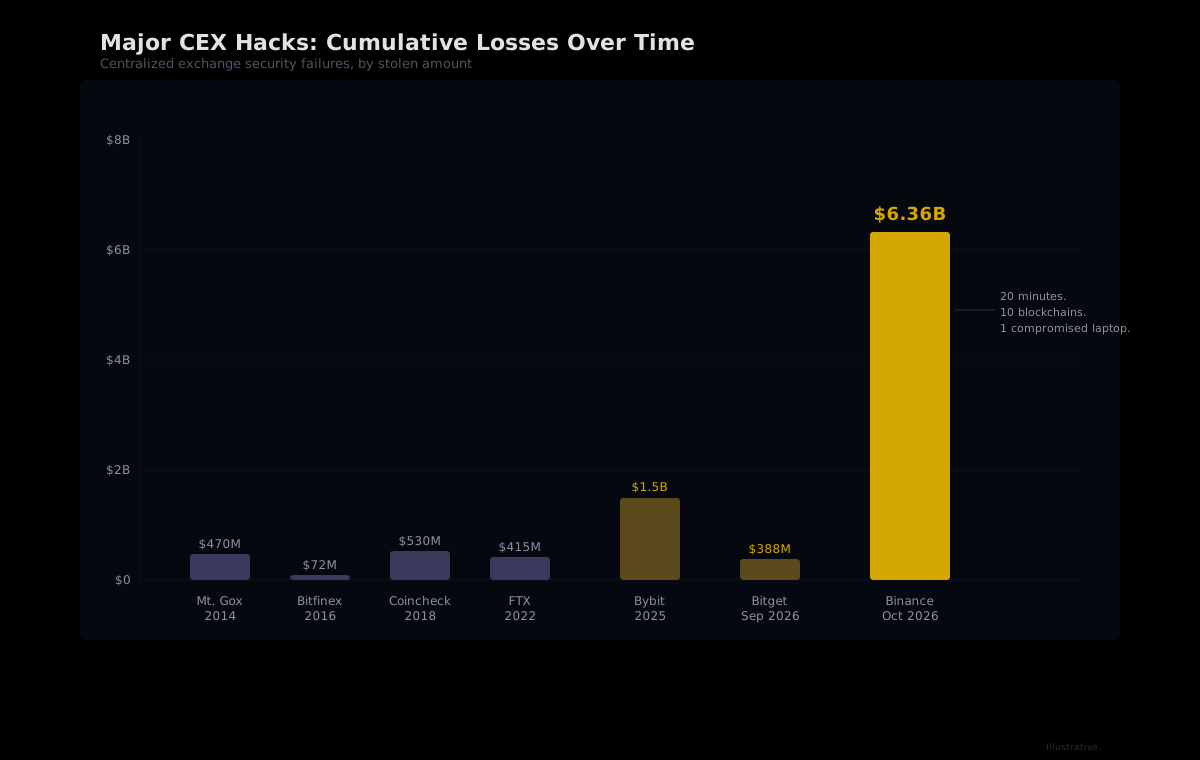
On October 29, an attacker drained $6.36 billion from Binance in roughly twenty minutes. The exploit started with a single compromised laptop, escalated through hot wallet signing infrastructure, and spread across ten blockchains. By the time stablecoin issuers froze roughly $3 billion, the damage was done. It is the largest crypto theft on record, roughly four times the $1.5 billion Bybit hack from February 2025.
Bitcoin dropped about 5%, briefly falling below $77,000. Fear and greed indexes flipped to levels last seen in August. Yet for traders using decentralized perpetual exchanges, the experience was different. Their funds never sat in a pooled hot wallet. Their positions never depended on one company's operational security. The Binance hack did not touch them.
This article breaks down what happened, why centralized exchange custody is the core vulnerability, and what perp DEX architecture offers as an alternative.
How One Laptop Became a $6 Billion Problem
TRM Labs attributed the attack with high confidence to TraderTraitor, North Korea's state-backed hacking unit. The same group was responsible for the $1.5 billion Bybit hack in 2025 and the KelpDAO exploit earlier in 2026.
The attack vector was not a smart contract bug or a protocol flaw. It was human infrastructure. A compromised DevOps engineer's laptop gave the attacker access to a service container, which led to unauthorized withdrawal transactions. From there, the attacker used an EIP-7702 delegation to gain execution authority over a hot wallet that bypassed normal approval controls.
The breach hit assets across Ethereum ($3.79 billion), Bitcoin ($1.47 billion), Tron ($628 million), the XRP Ledger ($296 million), Solana ($96 million), and five additional chains. The entire operation took about twenty minutes.
Think about that timeline. Twenty minutes to move more money than most nations' entire digital reserves. The speed was possible because centralized exchanges pool user deposits into hot wallets, and once signing authority is compromised, the attacker gets everything.
The Custody Problem at the Heart of Every CEX Hack
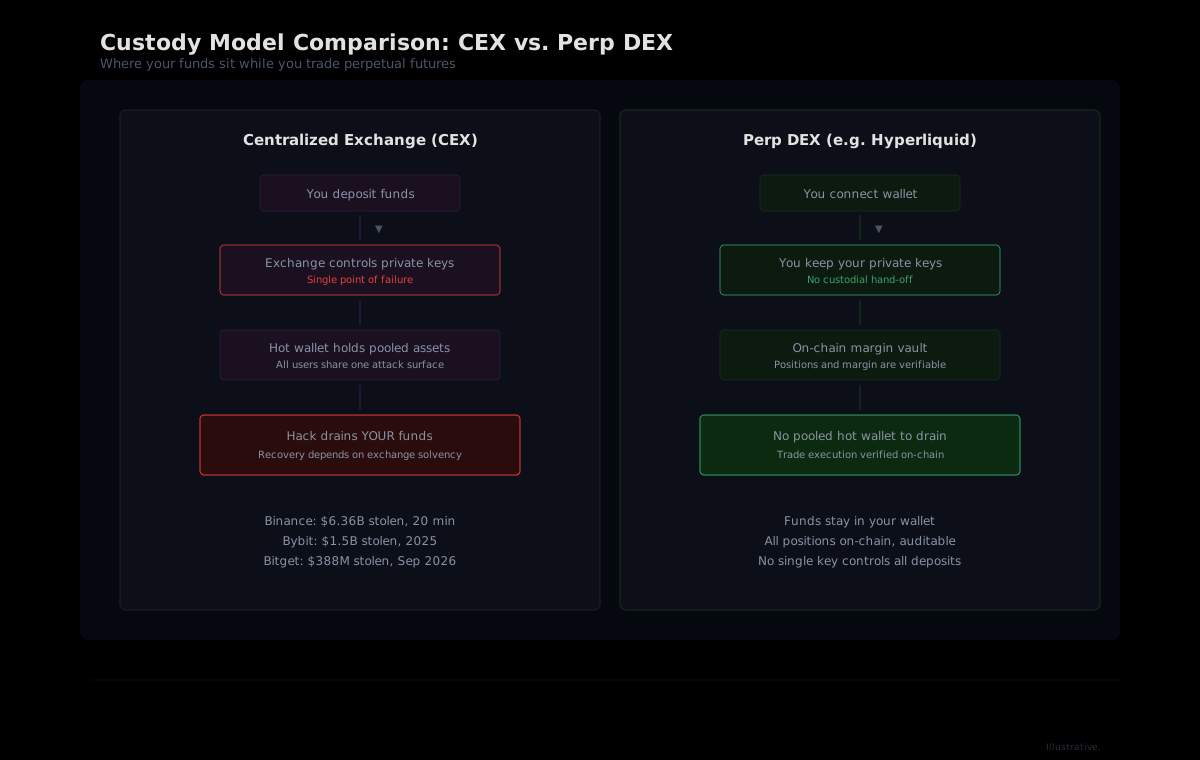
The mechanics vary from hack to hack, but the root cause is always the same: users hand custody of their assets to a third party, and that third party becomes a single point of failure.
As Macquarie University's Sean Foley put it: "Any assets held at a centralised exchange are only as safe as the exchange itself, and the larger the exchange's holdings, the larger a target it becomes."
Binance holds roughly $155 billion in user assets. Its SAFU emergency fund was worth approximately $1 billion at the time of the hack. That is a coverage ratio of less than 1% for a $6.36 billion loss. Binance says it will cover the shortfall from corporate funds, and the company almost certainly has the balance sheet to absorb it. But the structural problem remains: every dollar deposited to a CEX is a dollar you no longer control.
This is not a new pattern. Mt. Gox in 2014. Coincheck in 2018. FTX in 2022 (where the hack compounded an already catastrophic insolvency). Bybit in February 2025. Bitget in September 2026. Now Binance. The scale keeps growing, and the core vulnerability stays the same: pooled hot wallets controlled by a small number of humans.
How Perp DEX Custody Actually Works
On a decentralized perpetual exchange like Hyperliquid, the custody model is fundamentally different. You connect your wallet. You trade. But at no point do you transfer private key authority to the exchange itself.
Margin is posted to an on-chain vault. Positions are recorded on-chain. Liquidation thresholds are publicly visible and algorithmically enforced. There is no pooled hot wallet sitting behind a VPN, guarded by the operational security of one engineering team. The attack surface that enabled the Binance hack simply does not exist in this architecture.
That does not mean perp DEXs are risk-free. Smart contract risk is real. Oracle manipulation has hit DeFi protocols before. Bridge exploits have cost billions. But the custodial risk that defines CEX hacks, where one compromised employee can drain the entire platform, is structurally absent.
On-chain verification changes the trust model
When Binance was hacked, users had to wait for the company to disclose the extent of losses. Proof-of-reserves reports were promised for the following Monday. Withdrawals were suspended while the team overhauled security systems.
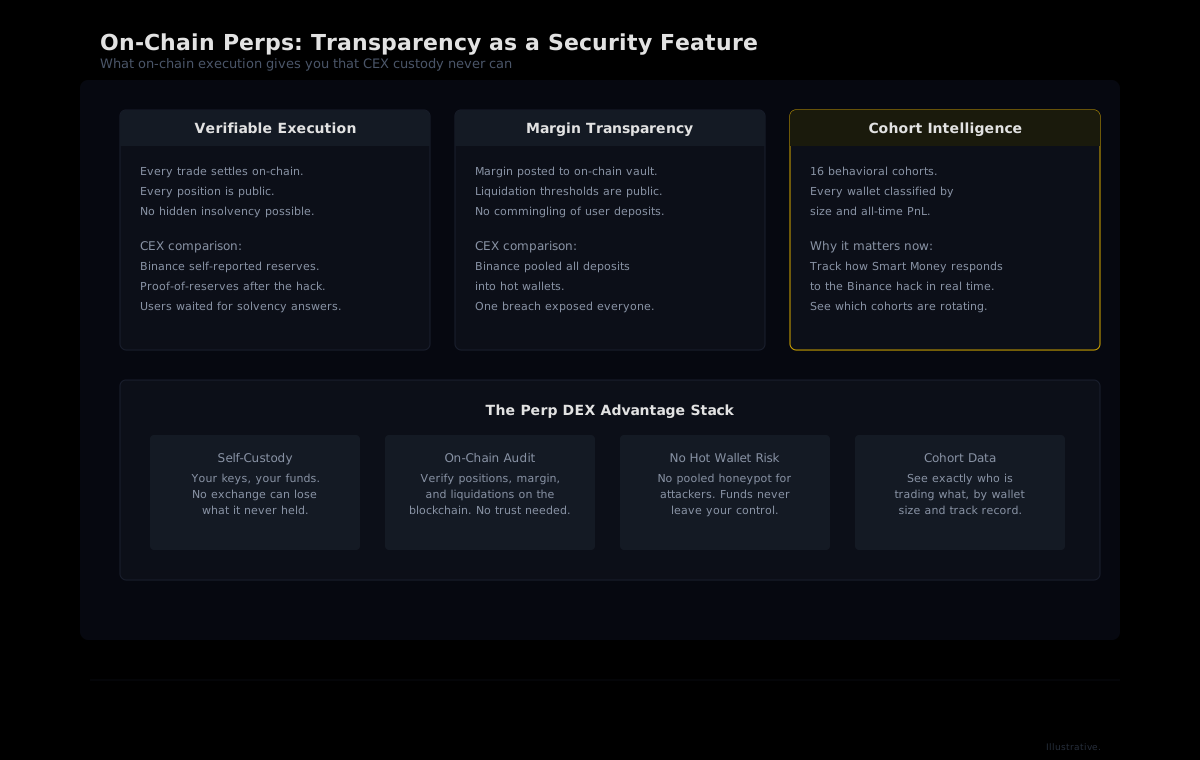
On a perp DEX, none of that applies. Positions are visible to anyone with a block explorer. Margin balances are on-chain. If something goes wrong, you can verify in real time rather than waiting for a corporate disclosure cycle. The verification is built into the protocol.
The Centralization Paradox
Here is the uncomfortable nuance: centralization also helped contain the damage. Tether froze over $1.5 billion in USDT. Circle froze $800 million in USDC. Those stablecoin issuers could act because USDT and USDC have centralized blacklist functions baked into their smart contracts. Native BTC and ETH do not have that ability.
So the frozen $3 billion was recovered precisely because of centralized control over stablecoins. As one CoinDesk analysis framed it, centralization made the hack possible, but also saved billions in the aftermath.
For perp traders, the lesson is layered. Self-custody removes the risk of exchange insolvency, but the assets you custody still carry their own properties. USDC can be frozen by Circle. Native ETH cannot. The choice of collateral matters as much as the choice of venue.
What Smart Money Does After a Major CEX Breach
After every major exchange hack, capital rotates. Some flows to hardware wallets. Some moves to competitors perceived as safer. And increasingly, some migrates to decentralized trading venues where custody never changes hands. Analysts at major banks have noted that events like the Binance hack could accelerate a structural shift in trading volume from centralized to decentralized platforms.
For perpetual futures specifically, on-chain venues have matured considerably. Hyperliquid processes billions in daily perp volume with on-chain settlement, 234 perpetual markets, and sub-second execution. The trading experience is increasingly comparable to centralized alternatives, without the custodial hand-off.
The question serious traders should ask after a week like this: are you comfortable with the custody model you are using? And can you verify, on-chain, where your margin actually sits?
Trading Perps on a DEX Without Flying Blind
Custody is the first half of the equation. Intelligence is the second. One of the persistent advantages of centralized exchanges has been their analytics dashboards, showing you order flow, liquidation levels, and large-trader activity. Moving to a DEX historically meant giving that up.
That trade-off no longer holds. Because every position on Hyperliquid settles on-chain, the raw data is public. What is hard is turning that data into actionable intelligence, and that is exactly what HyperTracker does.
Our data classifies every wallet on Hyperliquid into one of 16 behavioral cohorts, eight by size (from Shrimp under $250 to Leviathan above $5 million) and eight by all-time PnL (from Giga-Rekt below negative $1 million to Money Printer above positive $1 million). One API call returns the positioning of any cohort, on any asset, at any time.
After a market shock like the Binance hack, the interesting signal is not price. It is who is doing what. Are Money Printers (the wallets with the best track records) adding to positions while the market panics? Are smaller cohorts cutting exposure? Is open interest dropping because of liquidations or voluntary de-risking? Our cohort data answers those questions.
On-chain perps + cohort analytics = the full picture. You keep your keys, verify your positions, and see exactly how different trader cohorts respond to market events. That combination simply does not exist on a centralized exchange.
Practical Steps for Perp Traders After the Hack
The Binance hack is not a reason to panic. It is a reason to audit your setup. Here is a straightforward checklist:
- Audit your custody exposure. How much capital do you have sitting on centralized exchanges right now? If a Binance-scale hack hit your primary venue, what would your recovery path look like?
- Consider venue diversification. Splitting execution across CEX and DEX reduces single-platform risk. You do not have to go 100% on-chain overnight, but having a DEX position is a hedge against custodial failure.
- Verify on-chain. If you trade on a perp DEX, use a block explorer to confirm your positions and margin balances periodically. The whole point of on-chain settlement is that you can verify it. Actually do it.
- Think about collateral choice. USDC and USDT can be frozen by their issuers, which helped with recovery here but also means a centralized party controls your collateral. Native assets do not carry that risk (or that recovery mechanism).
- Layer intelligence on top. If you are trading perps on Hyperliquid, tools like HyperTracker's API let you track cohort positioning, liquidation risk, and order flow without sacrificing the intelligence advantage that CEXs used to monopolize.
Track How Smart Money Responds to Market Shocks
HyperTracker classifies every Hyperliquid wallet into 16 behavioral cohorts. See which groups are accumulating during the dip and which are cutting exposure. Free tier available.
The Bigger Picture
The Binance hack will be investigated, funds will be partially recovered, and the exchange will almost certainly survive. But the pattern is clear. Every major CEX breach exposes the same vulnerability: custodial concentration. A single compromise can drain billions because the architecture requires users to hand over control of their assets.
Perp DEXs do not eliminate all risk. Smart contracts can have bugs. Oracles can be manipulated. Bridges remain a persistent weak point. But the specific failure mode that cost Binance $6.36 billion, a compromised employee's laptop granting access to pooled hot wallets, is structurally impossible when users retain custody of their own keys.
Twenty minutes. Ten blockchains. One laptop. The cost of centralized custody has never been more visible. For perpetual futures traders, the alternative has never been more mature.