
$90M in Revenue: The Builders Winning on Hyperliquid
By CMM Team - 05-Sep-2026
$90M in Revenue: The Builders Winning on Hyperliquid
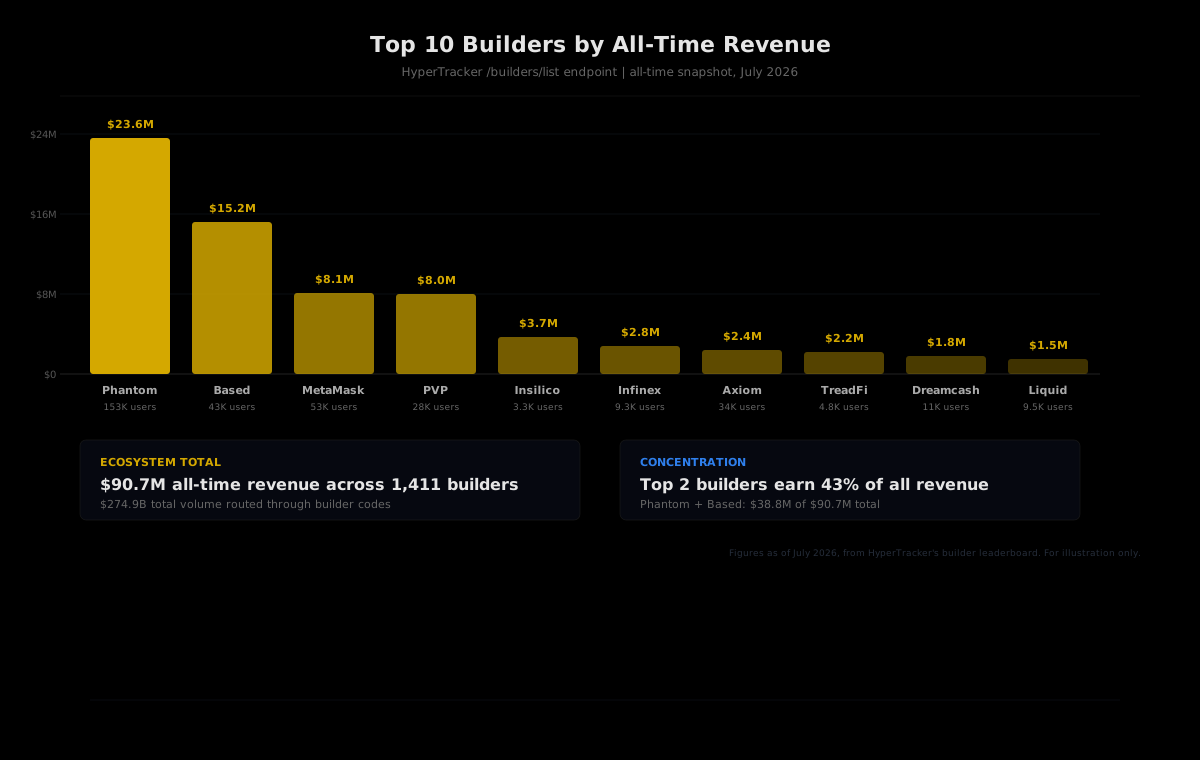
Hyperliquid did not build a front end to rule them all. It built an engine and let everyone else fight over the steering wheel. The result, one year into the builder code program, is an ecosystem where 1,411 builders have collectively routed $274.9 billion in trading volume and earned over $90.7 million in fees. Those are not protocol fees. They are fees that went directly to the wallets, terminals, bots, and apps that brought users to the order book.
Figures as of July 2026, from HyperTracker's builder leaderboard.
The leaderboard tells a story about who is winning the front-end wars, where distribution advantages live, and why raw volume and revenue per dollar traded are surprisingly different races. This article breaks down the top builders, explains how the fee mechanics work, and shows what the numbers reveal about building a business on top of a perps exchange.
The leaderboard: who leads and why it matters
Two names dominate the top. Phantom sits at number one with $23.6 million in all-time builder code revenue across 153,128 users and $44.8 billion in routed volume. Based follows at $15.2 million from 42,967 users and nearly identical volume ($44.9 billion). Together, those two accounts earn about 43% of all builder code revenue on Hyperliquid.
Behind them, the race is tighter than most people assume. MetaMask and PVP are effectively tied at $8.1 million and $8.0 million respectively, but their profiles look completely different. MetaMask has 52,534 users and $9.0 billion in volume. PVP has 28,223 users but nearly double the volume at $17.1 billion. Same revenue, different machines underneath.
Then there is the long tail. Insilico has routed a staggering $36.3 billion in volume with just 3,339 users, which means a small group of extremely active traders are running serious size through that interface. Infinex, Axiom, TreadFi, Dreamcash, and Liquid round out the top ten, each in the $1.5M to $2.8M revenue range. Below them, 1,400+ builders share the remaining revenue, most earning modest sums but collectively forming the distribution layer that Hyperliquid itself does not operate.
How builder code fees actually work
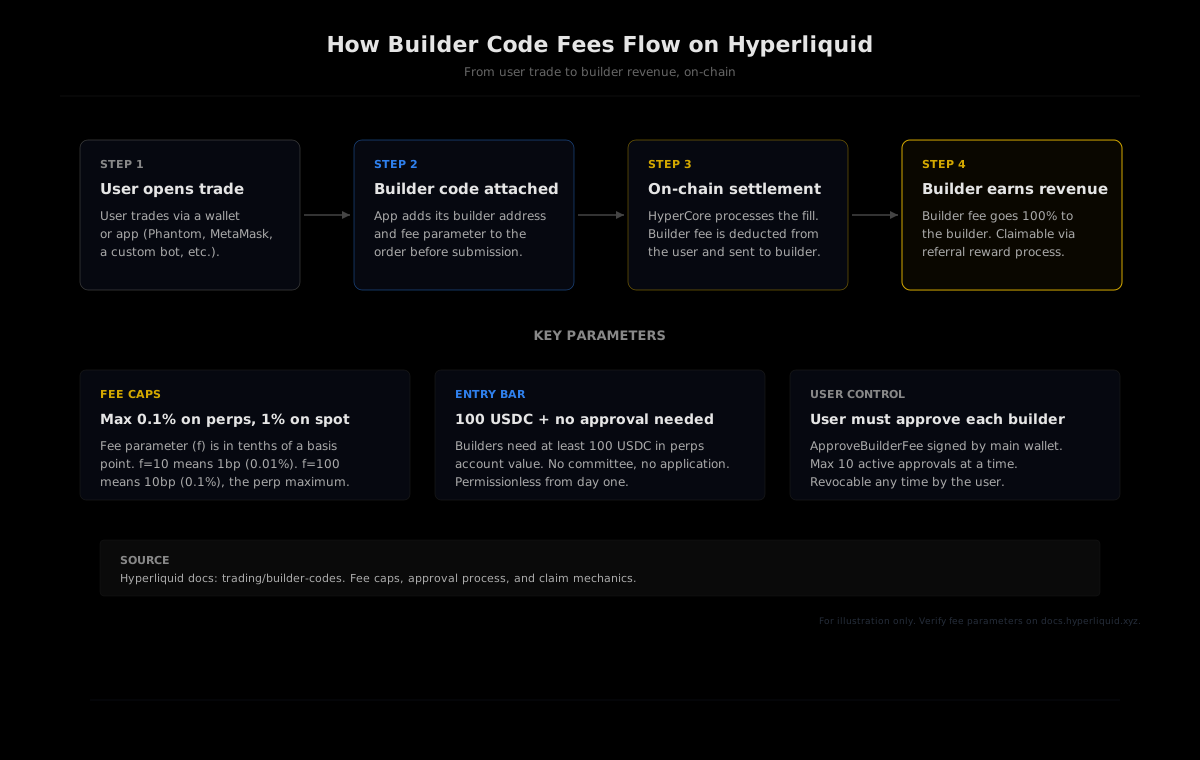
Builder codes are simpler than most DeFi fee mechanisms. When a user trades through a third-party app, the app attaches its builder address and a fee parameter to the order. The fee is charged on the fill, processed entirely on-chain, and goes 100% to the builder. The protocol takes nothing from the builder fee. It earns its own fee separately.
The fee parameter uses tenths of a basis point as its unit. A value of f: 10 means 1 basis point (0.01%), and f: 100 means 10 basis points (0.1%), which is the protocol-enforced cap on perpetuals. On spot trades, the cap is 1%. These limits are hardcoded. No builder can charge more.
The user side has safeguards. Every builder requires explicit approval via the ApproveBuilderFee action, which must be signed by the user's main wallet. A user can approve a maximum of 10 builders at a time and revoke any approval instantly. The fee cap the user approves is a ceiling, so even if a builder tries to submit a higher fee on a given order, the system rejects it.
Becoming a builder requires 100 USDC in perps account value. There is no application process, no committee review, no partnership negotiation. That low barrier is what pushed the builder count to 1,411 and created the competitive landscape we see today.
Volume versus revenue: the efficiency gap
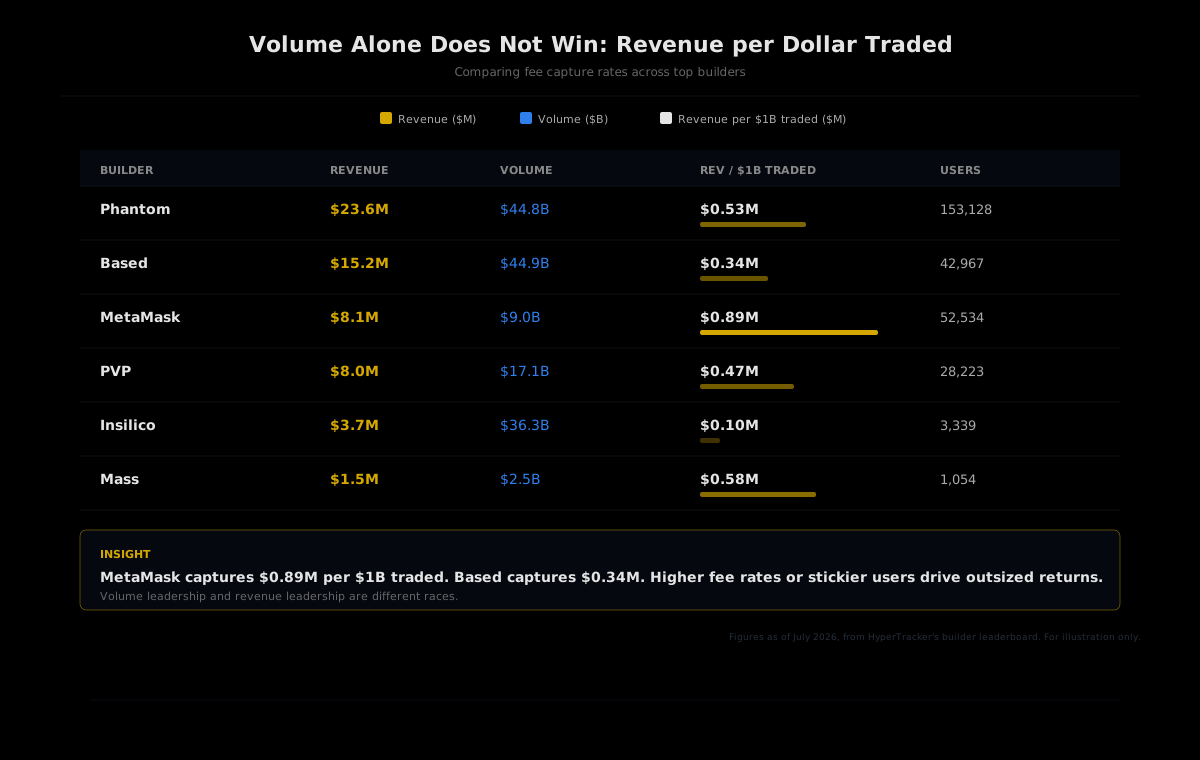
The leaderboard data reveals something counterintuitive. Volume leadership and revenue leadership are different races, because fee capture rates vary enormously across builders.
For every $1 billion in routed volume, MetaMask extracts roughly $0.89M in revenue. Based extracts about $0.34M. Insilico, despite moving $36.3 billion, captures just $0.10M. Same exchange, same instruments, wildly different economics.
The spread matters because it reflects different business models. A wallet like MetaMask sets its builder fee at a level its users will tolerate in exchange for the convenience of native perp trading inside a wallet they already use daily. Its users are paying for the integration, so the fee rate can be higher. Insilico's numbers suggest a very different profile: low-fee, high-frequency traders who would move elsewhere if the fee ticked up a single basis point. Both models generate millions of dollars, but the revenue-per-volume metric separates the sticky distribution advantage from the mercenary flow.
Mass is the outlier that proves the point. With only 1,054 users and $2.5 billion in volume, it generates $1.47 million in revenue. That is $0.58M per billion traded, from a tiny user base moving real size. Small audience, high engagement, strong monetization. The opposite of Insilico's approach, and arguably more durable.
The front-end wars in context
Builder codes have turned Hyperliquid into an exchange that does not need its own front end to grow. Every wallet that integrates becomes a distribution channel. Every terminal that routes orders adds volume without Hyperliquid spending a dollar on acquisition. The $984 million single-day volume record set on August 21, 2026 came entirely from third-party interfaces.
That record day also generated approximately $782,000 in combined builder revenue. MetaMask contributed roughly $143,000 and Phantom about $114,000 of that, meaning two wallets accounted for nearly a third of all builder revenue in a single session.
The competitive implications run deeper than raw numbers. Phantom's integration, which launched in July 2025, reportedly reached $20 million in builder code revenue in under a year, processing $37 billion in volume along the way. That trajectory demonstrated to the rest of the wallet market that perp trading via builder codes is a real revenue line, which pulled MetaMask, Rabby, Infinex, and dozens of smaller wallets into the ecosystem.
For builders evaluating the opportunity today, the data points to a market that is still expanding. Only Phantom and Based have cracked $10 million in lifetime revenue. The number three and four spots are occupied by MetaMask and PVP at roughly $8 million each. Below that, the drop-off is steep. That gap suggests the leaderboard is far from settled, and a well-integrated wallet or trading terminal with real distribution could still climb into the top five.
What the leaderboard does not show (and how to fill the gap)
The raw leaderboard numbers, revenue, volume, and user count, tell you who is winning but not why. Understanding the "why" requires a different layer of data: what kind of traders each builder attracts, how those traders behave, and whether the volume is sticky or mercenary.
This is where cohort-level analytics add context. Our data classifies every wallet on Hyperliquid into one of 16 behavioral cohorts: 8 by account size (from Shrimp at $0-$250 up to Leviathan at $5M+) and 8 by all-time PnL (from Money Printer at +$1M+ down to Giga-Rekt at below -$1M). When you overlay cohort data on builder analytics, you can see patterns the leaderboard alone cannot surface.
A builder whose volume comes primarily from Smart Money and Whale cohorts is running a fundamentally different business than one whose volume comes from Shrimp and Exit Liquidity. The first has sticky, high-value users who generate consistent volume. The second has churn risk built into the user base, because small losing traders stop trading. Revenue per user, average position size, and PnL distribution by builder are the metrics that turn the leaderboard from a scoreboard into an actionable signal.
Our builder analytics endpoints expose per-builder user counts, PnL tracking, and volume data through the same API that powers cohort metrics. If you are building on Hyperliquid and want to understand which builders route the highest-quality flow, the data is queryable.
Track every builder on Hyperliquid
HyperTracker's API gives you the builder leaderboard, per-builder user counts, volume, and PnL data alongside 16 trader cohorts, order flow snapshots, and liquidation risk scoring. Free tier available (100 requests/day, no credit card).
Building a business on builder codes
For developers and wallet teams evaluating the economics, the data supports a few conclusions.
First, user distribution matters more than fee rate. Phantom and Based both sit near the maximum 0.1% perp fee cap, but Phantom earns 55% more revenue because it has 3.5x the user base. Getting users to approve your builder code is the bottleneck, which is why wallet integrations, where the user already trusts the interface, have dominated the leaderboard.
Second, fee efficiency varies more than you would expect. MetaMask generates $0.89M in revenue per billion traded while Insilico generates $0.10M. If you are building a trading terminal, your fee rate decision shapes whether you run a high-margin, lower-volume business or a razor-thin-margin, high-throughput one. Both can work. But you should choose deliberately, because the leaderboard shows both models coexisting at the top.
Third, the staking referral program (currently under re-evaluation for mainnet) would add another revenue layer for builders who stake HYPE. Under the proposed design, builders could retain up to 40% of referred users' trading fees based on staking tier, and share up to 50% of that back with the user. That creates a new competitive axis: builders who can offer deeper fee discounts to users gain a distribution edge.
Finally, the low barrier to entry (100 USDC, no approval process) means the builder count will keep growing. The 1,411 active builders today are competing over a $274.9 billion volume pool. As Hyperliquid's HIP-3 program adds more tradable assets and the perp catalog expands, the total pie grows, but so does the fight for each user's builder approval slot. Remember: users can only approve 10 builders at a time.
The leaderboard is the scoreboard, not the strategy
Builder codes turned distribution into an on-chain, permissionless, auditable game. The numbers are public. Revenue is verifiable. Every builder's trade data ships as compressed CSV files from Hyperliquid's stats endpoint. That transparency is unusual in crypto, where most revenue-sharing programs run behind closed doors with self-reported figures.
The builders winning today are the ones who solved distribution first and fee optimization second. Phantom did not out-engineer anyone on the trading interface. It had 10 million wallet users and turned them into a perps audience with a single integration. MetaMask followed the same playbook with its existing EVM user base. The lesson is not about building a better order entry screen. It is about meeting traders where they already are.
$90.7 million in builder revenue, 1,411 builders, $274.9 billion in volume. The front-end wars are real, the data is public, and the leaderboard still has room at the top.