
$90M Split 1,411 Ways: Hyperliquid's Builder Code Leaderboard
By CMM Team - 19-Aug-2026
$90M Split 1,411 Ways: Hyperliquid's Builder Code Leaderboard
Hyperliquid's builder code system has paid out $90.7M to application developers since launch. That money went to 1,411 registered builders, ranging from solo Telegram bot operators to publicly traded wallet companies. And the distribution is wildly uneven.
Figures as of July 2026, from HyperTracker's builder leaderboard.
The top 10 builders captured roughly 76% of all revenue. Phantom alone took more than a quarter. Yet the builders who generate the most revenue per user are not the ones with the biggest user bases. The leaderboard tells a story about different monetization strategies, and our data is more interesting than just a ranked list.
Builder codes are an on-chain fee mechanism that lets any application developer earn up to 0.1% on perpetual trades routed through their interface. No application process, no partnership deal. You need 100 USDC in a perps account and a working integration.
The full top 10
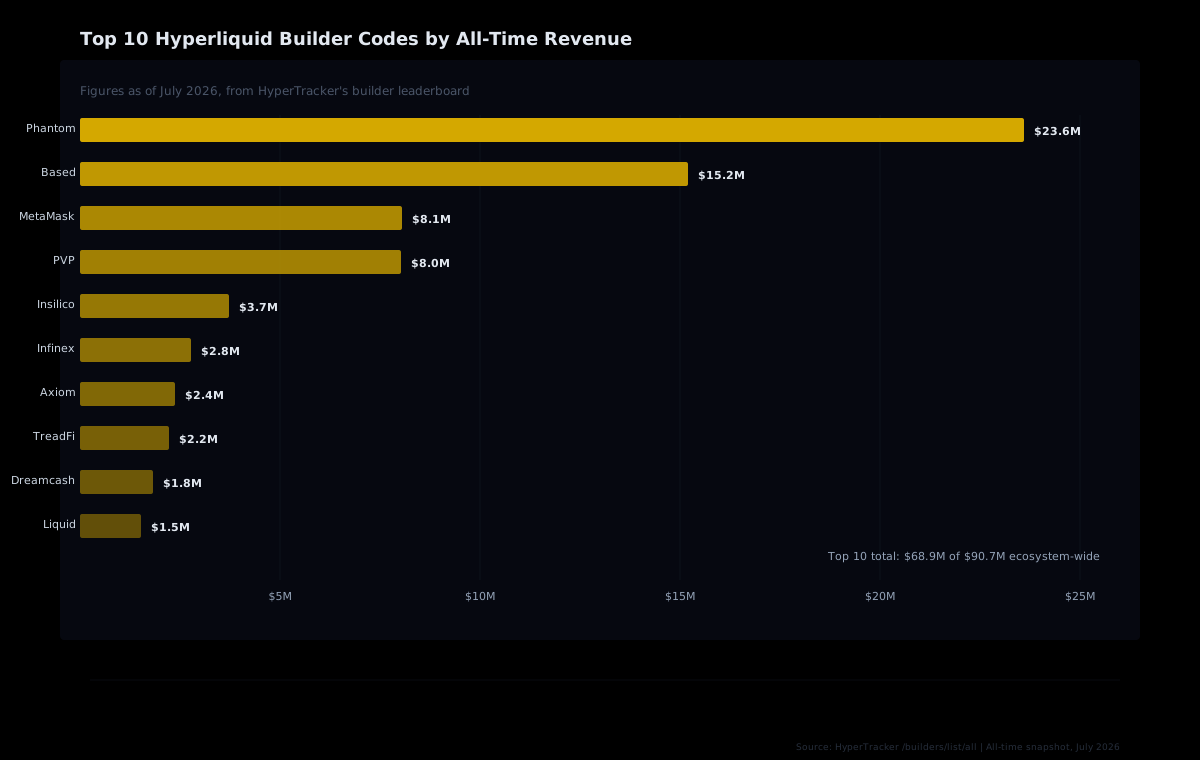
Here is the all-time builder code revenue leaderboard, pulled from our /builders/list endpoint:
| Rank | Builder | Revenue | Users | Volume | | --- | --- | --- | --- | --- | | 1 | Phantom | $23.6M | 153,128 | $44.8B | | 2 | Based | $15.2M | 42,967 | $44.9B | | 3 | MetaMask | $8.1M | 52,534 | $9.0B | | 4 | PVP | $8.0M | 28,223 | $17.1B | | 5 | Insilico | $3.7M | 3,339 | $36.3B | | 6 | Infinex | $2.8M | 9,283 | $5.2B | | 7 | Axiom | $2.4M | 34,093 | $23.0B | | 8 | TreadFi | $2.2M | 4,835 | $11.1B | | 9 | Dreamcash | $1.8M | 11,215 | $7.6B | | 10 | Liquid | $1.5M | 9,499 | $3.2B |
The top 10 account for roughly $69.4M of the $90.7M ecosystem total. That leaves about $21.3M distributed across the remaining 1,401 builders, most of whom earn modest amounts from niche integrations and smaller user bases.
What the revenue-per-user numbers reveal
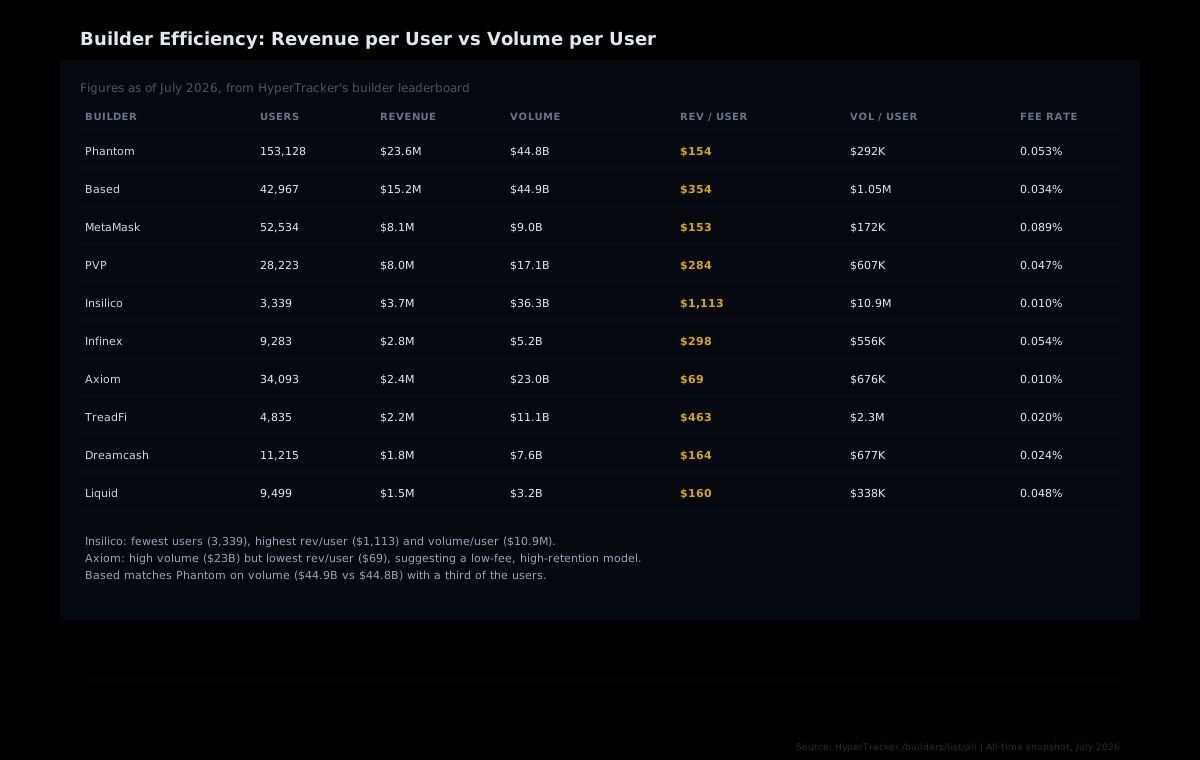
Raw revenue totals only tell part of the story. When you divide revenue by unique users, the ranking reshuffles completely, and each builder's monetization strategy comes into focus.
Insilico has 3,339 users and $3.7M in revenue, which translates to roughly $1,113 per user. That is the highest revenue efficiency in the top 10 by a wide margin. Insilico's users route $10.9M in volume per user on average, which suggests professional or algorithmic traders who execute high-frequency strategies and generate outsized volume relative to their headcount. The fee rate (revenue divided by volume) sits around 0.01%, meaning Insilico charges a minimal fee but makes it up on sheer throughput per account.
Based matches Phantom's volume ($44.9B versus $44.8B) with roughly a third of the users. Revenue per user: $354. This points to a power-user base that trades more actively than Phantom's broader audience.
Phantom leads on total revenue because it has 153,128 users, which is more than the next three builders combined. Revenue per user is $154. The wallet's strength is distribution: Phantom already had millions of users before integrating Hyperliquid, so the perp trading feature piggybacked on an existing install base rather than acquiring users from scratch.
Axiom is the efficiency outlier in the other direction. With 34,093 users and $23.0B in volume, Axiom's users are active. But revenue per user is just $69, suggesting a very low fee rate (around 0.01%). That is a deliberate growth strategy: keep fees negligible to acquire users, then monetize later or through other channels.
Three monetization models on the leaderboard
The builder code system caps perp fees at 0.1%, but where builders set their actual fee within that range creates distinctly different businesses.
High-fee wallet plays
Phantom and MetaMask charge closer to 0.05% on trades. Their value proposition is convenience: you already have the wallet open, the trading interface is integrated, and the fee is low enough relative to position sizes that most users do not bother switching to the native Hyperliquid UI. MetaMask's effective fee rate is closer to 0.089%, which is higher than most competitors, but MetaMask's brand recognition and install base mean users accept it. These builders optimize for user count and ride the long tail of casual traders.
Low-fee volume machines
Insilico and Axiom charge around 0.01%, the lowest implied rates in the top 10. They attract different user profiles through different means. Insilico's users are clearly algorithmic: 3,339 accounts generating $36.3B in volume means each account routes over $10M on average. Axiom's 34,093 users with $23.0B in volume suggest a mix of active retail and semi-professional traders. Both builders bet on volume rather than margin per trade.
Mid-fee specialists
PVP, TreadFi, and Dreamcash sit in the middle ground. PVP, a Telegram trading bot, charges around 0.047% and generates $284 per user in lifetime revenue. TreadFi lands at $463 per user with a 0.02% implied fee. These builders serve specific niches: copy trading, DeFi strategies, and social trading communities that generate sticky, repeated engagement from smaller but more active user bases.
How builder codes actually work
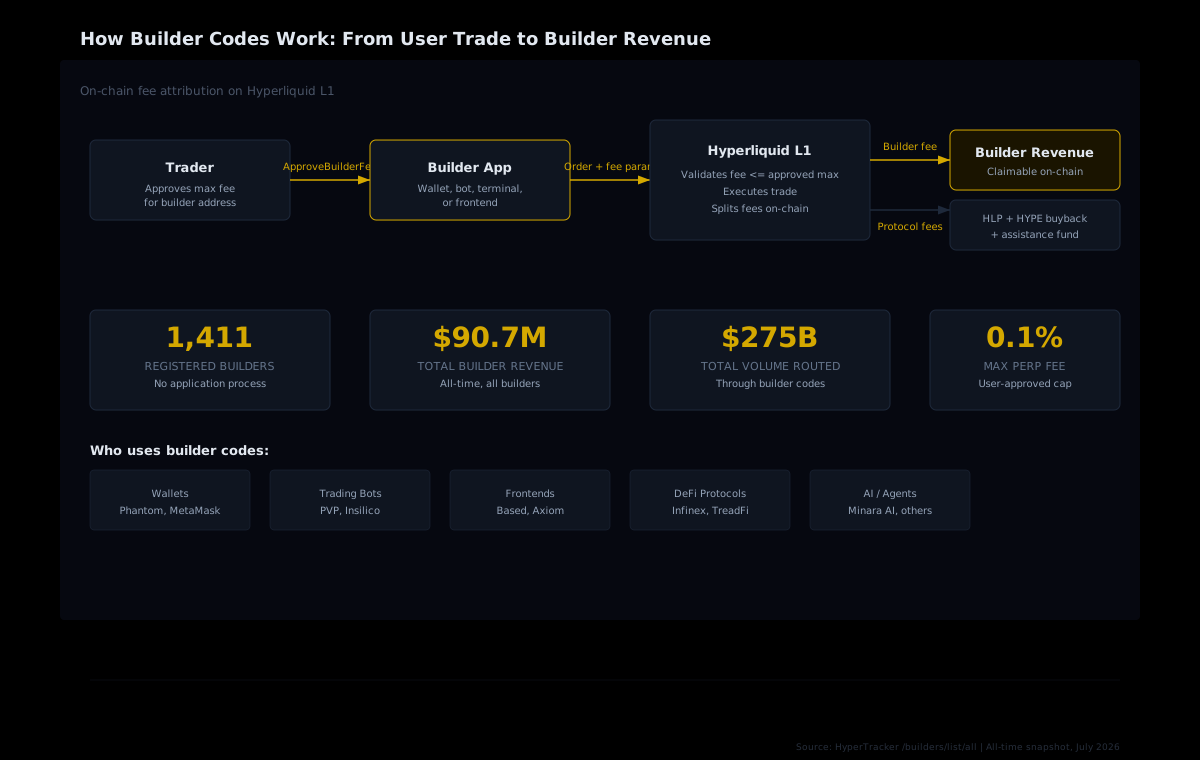
For builders evaluating whether to integrate, the mechanics are straightforward. Builder codes are processed entirely on-chain as part of Hyperliquid's L1 fee logic. There is no off-chain settlement, no custody risk, and no trust assumption beyond the protocol itself.
The flow works like this:
- User approves: the trader signs an
ApproveBuilderFeeaction that sets a maximum fee rate for a specific builder address. This must be signed by their main wallet. The approval is revocable at any time. - Builder attaches fee: when the builder's application routes an order, it includes a fee parameter (
f) in tenths of basis points. A value off: 50equals 5 basis points (0.05%). The on-chain logic rejects any fee that exceeds the user's approved maximum. - L1 splits fees: Hyperliquid's matching engine executes the trade and simultaneously credits the builder's account with the fee. Protocol fees flow separately to HLP and the HYPE assistance fund.
- Builder claims: accumulated fees are claimable through Hyperliquid's referral reward system. All trades with builder codes are published daily in compressed LZ4 format for transparency.
The barrier to entry is low: 100 USDC in a perps account, standard account abstraction mode, and a working integration. No application review, no partnership negotiation. The system deliberately reduces friction so that the market, through user adoption, picks winners.
What the long tail looks like
Beyond the top 10, the leaderboard thins out fast. Positions 11 through 15 include Rabby ($1.5M), Mass ($1.5M), Okto ($790K), Defiapp ($780K), and Minara AI ($775K). These builders have generated meaningful revenue, but they are an order of magnitude behind the top 5.
Mass is a standout in this tier: just 1,054 users producing $1.5M in revenue and $2.5B in volume. That is over $1,400 in revenue per user, the highest efficiency on the entire leaderboard. Whatever Mass's user base is doing, each account is routing significant volume through the platform.
Minara AI is worth noting as an early example of AI-agent-driven trading integrations. Launched in late 2025, it has already attracted 4,933 users and $2.6B in volume. AI agents routing trades through builder codes is a trend worth watching as autonomous trading tools mature.
Tracking the leaderboard with our builder analytics
All of the data in this article comes from HyperTracker's /builders/list endpoint, which returns the full builder code leaderboard including revenue, volume, user counts, and join dates. Our data refreshes every 5 minutes, so you can track builder performance changes in near-real-time rather than relying on daily snapshots.
If you are building on Hyperliquid and want to benchmark your builder code performance against the field, or if you are running a fund that wants to understand which frontends are capturing order flow, the builder analytics endpoints give you the raw numbers to work with.
A single API call returns the full ranked list:
curl -H "Authorization: Bearer $TOKEN" \
  "https://ht-api.coinmarketman.com/api/external/builders/list?timeframe=all"
Combined with our cohort analytics (16 behavioral segments across size and all-time PnL), you can cross-reference which cohorts are trading through which builders. Are Money Printer wallets routing through Insilico? Are Shrimp accounts clustered on Phantom? Those patterns matter if you are trying to understand where smart money executes and where retail concentrates.
Track builder code performance with HyperTracker's API
Builder leaderboard, cohort analytics, order flow, and liquidation risk scoring. 16 behavioral cohorts. 21 endpoints. Starting at $179/month.
Start building with HyperTracker
The builder code thesis, validated
$90.7M in cumulative builder revenue across $275B in routed volume is not an experiment. It is a functioning economy. Phantom, Based, MetaMask, and PVP have built sustainable businesses on top of Hyperliquid without launching tokens, raising venture capital, or charging subscription fees. They shipped useful trading interfaces, attached a fee, and let on-chain settlement handle the rest.
The leaderboard will keep shifting. New wallets will integrate. AI agents will route more volume. Some of today's top 10 will fade as competitors undercut on fees or offer better execution UX. But the mechanism itself has proven something that most DeFi protocols still struggle to deliver: a way for third-party builders to earn real, recurring revenue from the infrastructure they build on.
That is the story $90.7M tells.