
Bitget Lost $388M. Here's What Perp Traders Should Actually Worry About.
By CMM Team - 28-Sep-2026
Bitget Lost $388M. Here's What Perp Traders Should Actually Worry About.
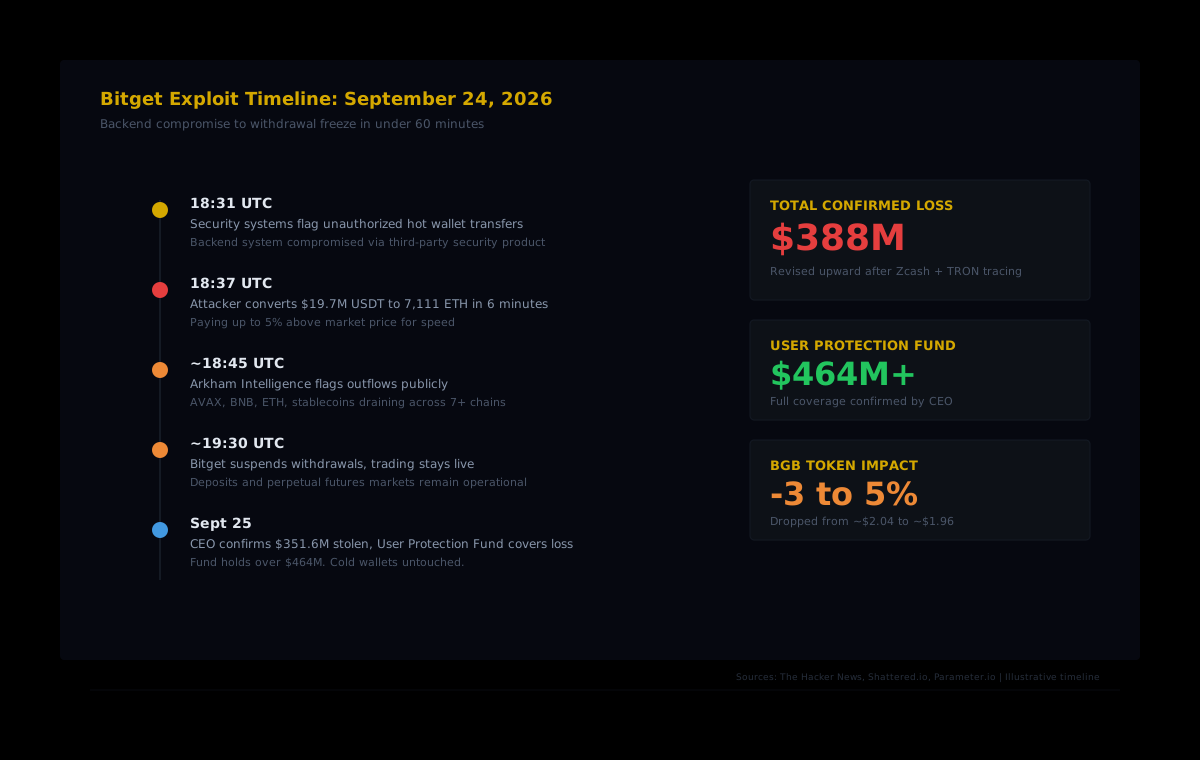
On September 24, at 18:31 UTC, Bitget's security systems flagged unauthorized transfers draining its hot wallets. Within hours, the confirmed loss stood at $351.6 million. Days later, after tracing additional stolen assets across Zcash and TRON, the total climbed to $388 million.
Every post-mortem so far has focused on the same questions: who did it (North Korea's TraderTraitor group is the leading suspect), how they got in (a compromised third-party security product gave access to backend credentials), and whether users will be made whole (Bitget's User Protection Fund holds over $464 million).
Those are important details. But for anyone running leveraged perpetual positions on a centralized exchange, they miss the question that actually matters: what happens to your open trades when an exchange freezes withdrawals?
What Actually Happened at Bitget
The attackers never stole private keys. Instead, they compromised a backend system used to process wallet transactions, spoofed transfer data, and tricked Bitget's internal approval process into authorizing the withdrawals. CEO Gracy Chen confirmed that the hackers "did not steal private keys" but rather "tricked Bitget's internal approval system into authorizing the transfers."
The speed was striking. Within six minutes, the attacker converted $19.7 million in USDT into 7,111 ETH, paying up to 5% above market price to move fast. Blockchain analytics firm Arkham Intelligence flagged the outflows publicly within minutes, spotting large movements of AVAX, BNB, ETH, and stablecoins draining across seven chains.
Bitget suspended withdrawals almost immediately but kept deposits and trading operational. BGB, the exchange's native token, dropped from the $2.02-$2.06 range to about $1.96.
The Perp Trader's Real Problem: Frozen Margin
Here's what most coverage overlooks. Bitget ranks among the top five derivatives exchanges globally by volume. That means thousands of traders had open perpetual positions when the withdrawal freeze hit. Trading continued, but money could not leave.
Why does that matter? Because leveraged positions require margin management. If a trade moves against you, you need the ability to either add collateral or withdraw remaining capital to reduce exposure. A withdrawal freeze removes both options. You are locked into whatever position you held when the door closed, with no ability to add margin if the market moves against you.
Consider the worst-case scenario: you are long BTC at 10x leverage on Bitget when the hack hits. The market sells off on the news. You want to close your position and move funds somewhere safer, but you cannot withdraw. If the sell-off is sharp enough to approach your liquidation price, you are watching your capital evaporate with no exit ramp.
Bitget's perpetual futures market stayed open, so closing a position was still possible. But the inability to move funds off the exchange created a kind of captive liquidity. Traders were stuck.
Why CEX Post-Mortems Ignore Perp Traders
Security post-mortems follow a predictable formula. They cover the attack vector, the stolen amount, the investigation timeline, and the compensation plan. What they rarely discuss is the second-order impact on traders who had active leverage when the incident began.
This is a pattern. Bybit's roughly $1.5 billion hack in February 2025 generated thousands of articles about the Lazarus Group's methods, but almost none analyzed how the withdrawal freeze affected open derivative positions. The Liquid Network's $319 million exploit earlier this September followed the same template.
The reason is structural: post-mortems are written by security researchers, exchange PR teams, and general crypto journalists. Derivative traders are a specific audience with specific concerns, and those concerns, margin management, funding rate exposure, cross-exchange hedging, and forced liquidation risk, do not fit neatly into a "who hacked what" narrative.
The On-Chain Alternative and Its Tradeoffs
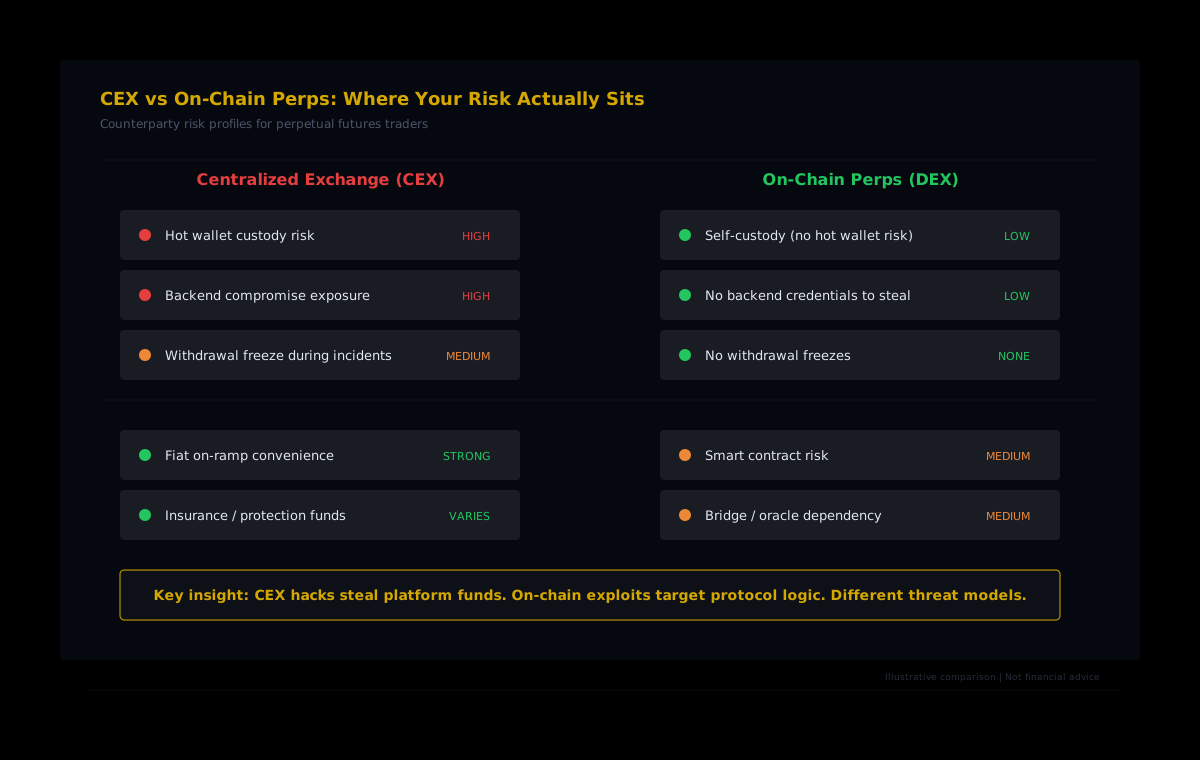
Every CEX hack renews the "not your keys, not your coins" argument. For spot holders, the logic is straightforward: move to self-custody. But for perp traders, the calculus is more nuanced, because on-chain perpetual platforms like Hyperliquid change the risk profile rather than eliminating risk entirely.
On a centralized exchange, your counterparty risk is the exchange itself. If their hot wallet infrastructure gets compromised, your trading capital is caught in the blast radius even though you did nothing wrong. On an on-chain perps platform, there is no hot wallet to drain because you trade from your own wallet. Nobody can freeze your withdrawals because there is no central custodian to flip that switch.
The tradeoff is a different set of risks. Smart contract bugs, oracle manipulation, and bridge vulnerabilities are the on-chain equivalents of a CEX backend compromise. But the key difference is transparency: on-chain risk is auditable. Every position, every liquidation, every trade settles on a public ledger. When something goes wrong, you can see exactly what happened on-chain, in real time.
Hyperliquid's Model
Hyperliquid takes this further with a fully on-chain order book. Every trade settles on its own L1, which means the matching engine itself is verifiable. There is no backend system to compromise because the backend is the chain. Traders deposit to their own vaults and maintain custody throughout.
That architectural difference matters most in exactly the scenario Bitget faced: when something breaks. On a CEX, "something broke" means frozen withdrawals, unclear timelines, and hope that the protection fund is sufficient. On Hyperliquid, your margin is in your vault, your positions are on-chain, and the protocol keeps running regardless of what happens to any single participant.
What Smart Money Does After a Major Exchange Hack
Exchange hacks are market-moving events that create temporary dislocations in funding rates, open interest, and cross-venue liquidity. Experienced traders, the wallets that sit in our Money Printer and Smart Money cohorts, tend to treat these incidents as information rather than panic triggers.
The typical pattern after a major CEX breach follows a few predictable stages. First, there is an immediate sell-off in the exchange's native token, which in Bitget's case meant BGB dropping several percent. Second, there is a brief spike in short-side open interest across other venues as traders hedge or speculate on contagion. Third, funding rates on major pairs often dip negative as the market briefly skews bearish. And fourth, within a few days, experienced traders start repositioning once the withdrawal timeline becomes clear.
The traders who profit from these moments watch cohort data to see which segments are adding to positions and which are reducing exposure. When Money Printer wallets (those with over one million in all-time profits) start accumulating during a panic, that is a signal worth paying attention to.
Building a Post-Hack Playbook
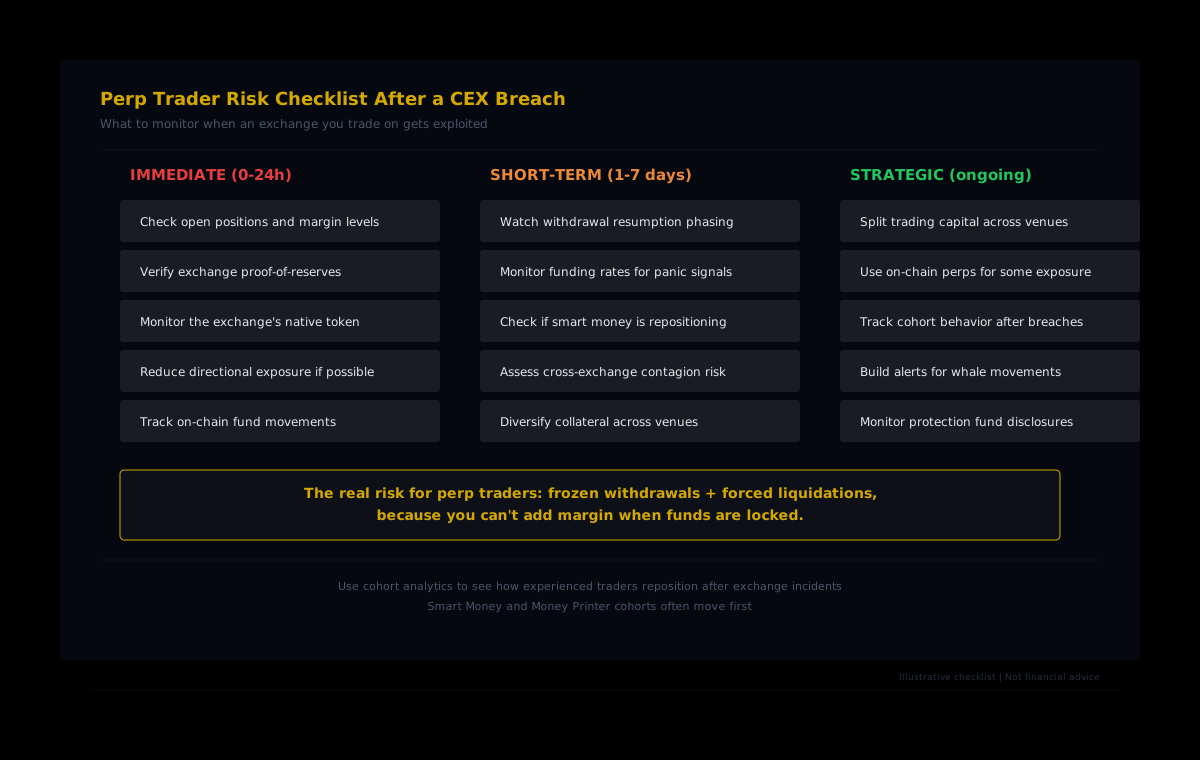
Rather than reacting emotionally to the next exchange hack (because there will be a next one), perp traders can build a systematic response into their risk management framework.
Venue diversification
Spreading trading capital across multiple platforms is the most basic mitigation. If one exchange freezes withdrawals, positions on other venues remain fully manageable. This applies to both centralized and on-chain platforms. A mix of CEX and on-chain perps gives you the liquidity depth of centralized venues with the self-custody guarantees of on-chain execution.
Margin buffer for frozen scenarios
Traders who use maximum leverage on a single exchange are most exposed during a withdrawal freeze. Maintaining a margin buffer, keeping leverage conservative enough that a multi-day freeze will not trigger liquidation, is the simplest way to survive the scenario Bitget traders faced last week.
Monitoring the right signals
The announcement of a hack is always the last signal to arrive. On-chain analytics tools can flag unusual exchange wallet outflows before the press release lands. Arkham Intelligence flagged Bitget's outflows within minutes of the first unauthorized transfer. Traders who monitor these signals can reduce exposure before the news hits mainstream feeds.
Similarly, watching how experienced traders reposition after a hack tells you more than the hack's post-mortem itself. Our cohort analytics classify every Hyperliquid wallet into 16 behavioral segments, 8 by size (from Shrimp under $250 to Leviathan above $5M) and 8 by all-time PnL (from Money Printer above +$1M to Giga-Rekt below -$1M). When an exchange hack hits the market, tracking how each segment responds reveals whether smart money views the event as a buying opportunity or a reason to de-risk.
Track How Smart Money Responds to Market Events
HyperTracker's API gives you cohort-level positioning data across 16 behavioral segments. See which wallets are buying the dip and which are reducing exposure, updated every 5 minutes.
Bitget's Withdrawal Timeline and Recovery
As of September 28, Bitget has begun resuming withdrawals in phases. BTC withdrawals reopened at 08:00 UTC on September 28. ETH withdrawals across Ethereum, BSC, Arbitrum, Base, and Optimism are scheduled for September 29. USDT across Ethereum, BSC, Solana, and TRON follows on September 30, with all remaining assets, fiat, and P2P transactions targeted for full restoration by October 2.
Circle and Tether moved to freeze funds linked to the exploiter. The immobilized assets totaled approximately $318,000, a fraction of the total stolen amount. Mandiant and SlowMist are leading the forensic investigation.
The incident now ranks as the largest single exchange breach of 2026 and the biggest suspected North Korean crypto theft of the year, following a pattern that has seen DPRK-linked hackers steal an estimated $2 billion in cryptocurrency during 2025 alone.
The Lesson Perp Traders Keep Having to Relearn
Bitget's $388 million exploit will follow the same arc as every major exchange hack before it. The security researchers will publish their analysis. The exchange will compensate affected users. The industry will move on.
But for perp traders, the real takeaway is about the structural vulnerability of trading leveraged derivatives on any platform where a single entity controls custody, execution, and withdrawal access. When that entity gets compromised, you lose control of your margin at exactly the moment you need it most.
The traders who came through last week unscathed had something better than luck. They were diversified across venues, held conservative margin buffers, and had the on-chain monitoring in place to act before the headline dropped. Call it what it is: a playbook.