
The Wallets Copying Hyperliquid's Top 10 (And How to Spot Them)
By CMM Team - 26-Sep-2026
The Wallets Copying Hyperliquid's Top 10 (And How to Spot Them)
Open Hyperliquid's leaderboard and you will see wallets with seven-figure PnL profiles sitting at the top. Impressive, until you realize a meaningful number of the wallets clustered just below them are not trading independently at all. They are copying the top 10, entering identical positions seconds to minutes after the originals, riding the same direction on the same asset with nearly the same timing. On a transparent chain where every position is public, this is inevitable. The leaderboard creates a gravity well, and copycats orbit around it.
The problem is not that copy trading exists. It is that copying a copycat is worse than useless. You inherit every entry delay, every sizing mismatch, and every exit you cannot see, compounded by an additional layer of latency. If you are going to track wallets on Hyperliquid, you need to separate the signal sources from the signal followers. This guide shows you how.
Why the leaderboard attracts copycats
Hyperliquid is fully onchain. Every position, every fill, every account balance is transparent and queryable without an API key. This makes the leaderboard the single most visible signal source on any perp exchange. A wallet that climbs to the top 10 by all-time PnL is automatically broadcasting its trades to anyone watching.
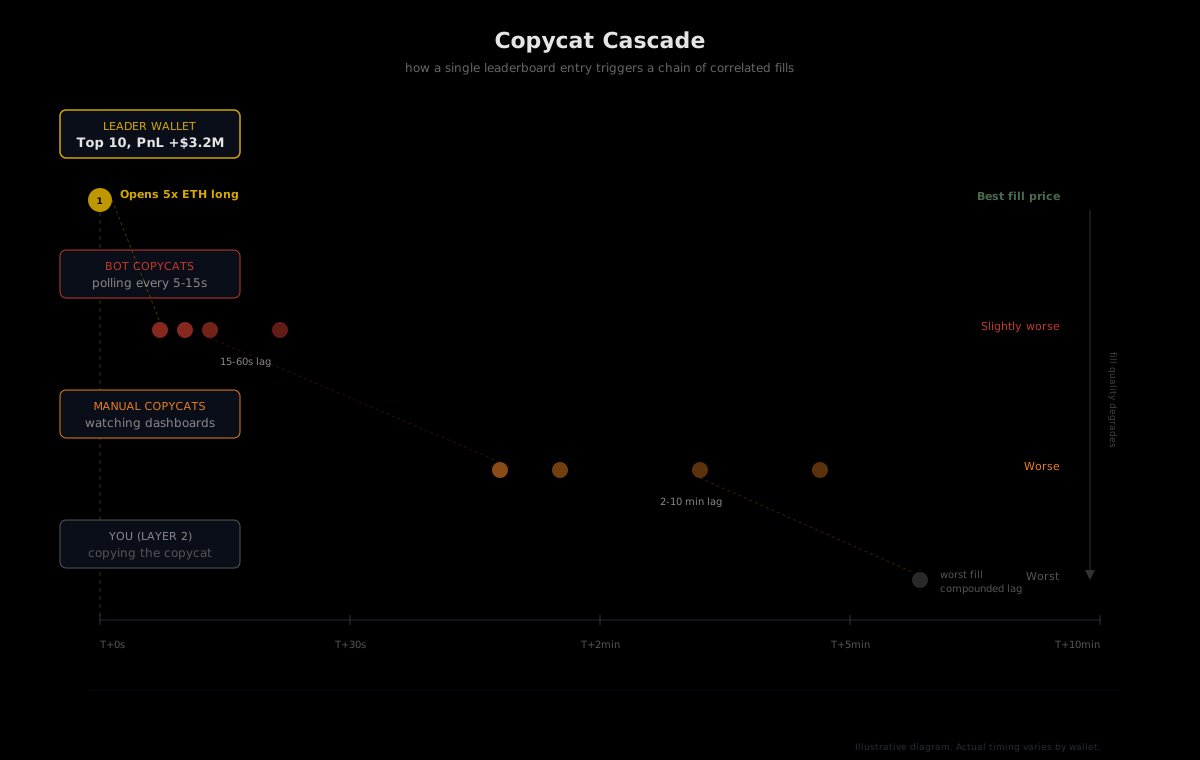
The mechanics are simple. A leaderboard wallet opens a 5x ETH long. Within minutes, a cluster of smaller wallets opens the same direction on the same asset. Some are running bots that poll the leaderboard wallet's positions every few seconds. Others are manually watching dashboards and clicking the moment they see movement. Either way, the result is a cascade of correlated entries that trails behind the original.
This creates a specific problem for anyone trying to find wallets worth following. When you sort the leaderboard by recent PnL, the copycats show up alongside the originals. Their returns look strong because the original wallet they are tracking did well. But strip away the leader and the copycat has no edge of its own. Worse, the copycat's returns are systematically lower than the original's because of entry delay, slippage from crowded entries, and exit timing gaps where the original closes before the copycat's polling loop catches up.
Three signals that reveal a copycat wallet
Detecting copycats is not guesswork. On a fully transparent chain, the behavioral fingerprints are clear if you know what to look for.
Timing correlation
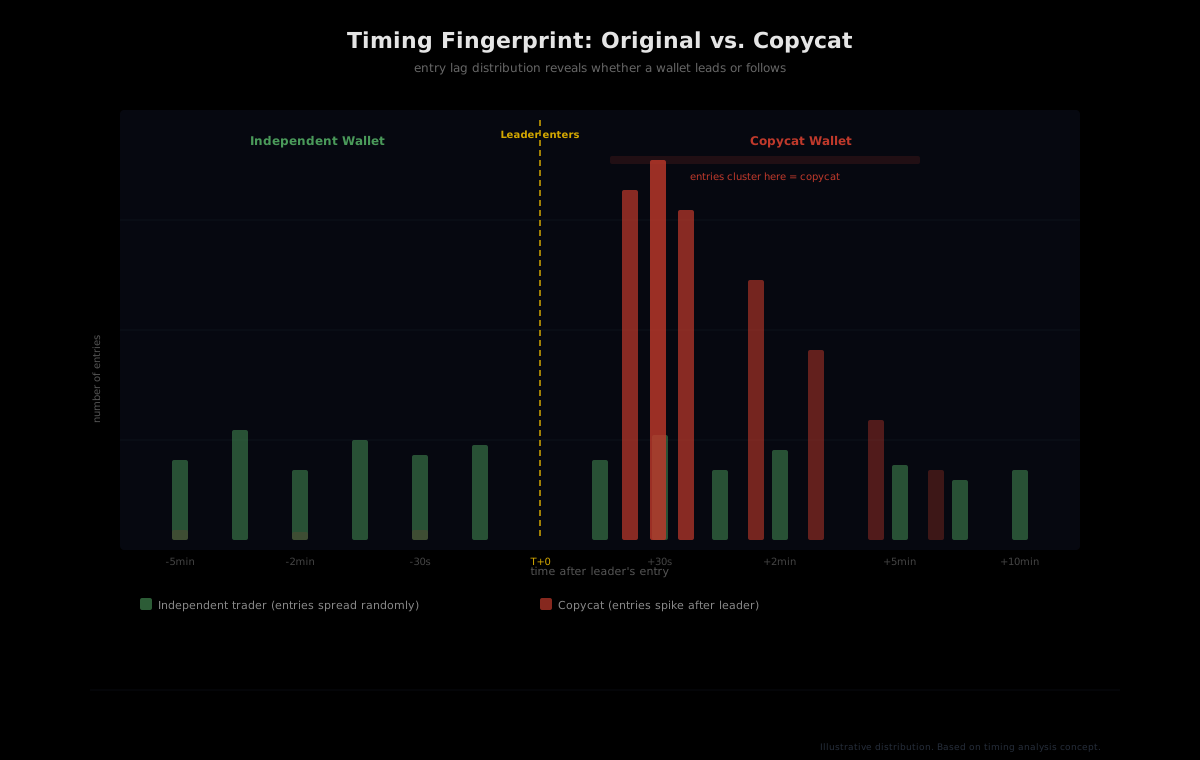
The strongest signal. Pull the fills for a suspected copycat and compare them against the leaderboard wallet's fills on the same asset. If the copycat consistently enters positions within a narrow window after the leader, commonly somewhere between 30 seconds and 5 minutes on the same asset in the same direction, that is not coincidence. Genuine independent traders do not enter identical trades on the same asset within this kind of repeating window across dozens of occurrences. Bots often show tighter clustering (sometimes under a minute), while manual copiers tend to spread across a wider range.
Asset overlap
A copycat's position history mirrors the leader's asset selection, including unusual ones. If a leaderboard wallet opens a position on a low-volume HIP-3 asset and the suspected copycat opens the same asset within minutes, that is a strong tell. Independent traders do not randomly converge on illiquid assets at the same time. Check whether the suspected copycat ever trades assets the leader does not. If the asset overlap is near-total, you are looking at a follower.
No thesis of their own
The subtler check. A genuine trader with a seven-figure PnL profile will occasionally go against the consensus, hold positions through drawdowns, or take trades on assets where nobody else is active. A copycat's trade history is entirely reactive. They never lead. They never diverge. Their position changes always follow someone else's. You can see this by looking at whether the wallet ever holds a position that the top 10 wallets do not hold simultaneously.
Using cohort data to filter out followers
Timing analysis works for checking individual wallets, but it does not scale. You cannot manually compare fills for hundreds of addresses. This is where cohort filtering becomes practical.
HyperTracker classifies every wallet on Hyperliquid into one of 16 behavioral cohorts, split across two axes: account size (8 cohorts from Shrimp at $0-$250 to Leviathan at $5M+) and all-time PnL (8 cohorts from Giga-Rekt below -$1M to Money Printer above +$1M). A wallet's cohort tells you something about its history that the leaderboard alone cannot.
Consider the Money Printer cohort (ID 8, all-time PnL above $1M). These wallets have demonstrated sustained profitability over time. A copycat can have strong recent returns if the wallet they are following had a good month, but sustaining $1M+ in cumulative PnL while copying someone else is structurally difficult. The entry delays, slippage, and exit timing gaps compound over hundreds of trades, eating into the returns that the original wallet captured cleanly. A wallet that reaches Money Printer status through copying would need its source wallet to massively outperform just to cover the friction.
The practical filter: query the leaderboard for wallets in the Money Printer or Smart Money (ID 9, PnL $100K to $1M) cohorts, then cross-reference their fills against the top 10 wallets. Originals will show independent entry timing. Copycats will show the characteristic trailing pattern.
The API workflow
Start with the leaderboard endpoint to get the current top 10 by all-time PnL:
GET /api/external/leaderboards/perp-pnl?orderBy=pnlAllTime&limit=10
This returns ranked wallets with their PnL across all timeframes. Save these addresses as your "leader set." Next, pull wallets from the Smart Money and Money Printer cohorts that have open positions:
GET /api/external/wallets?segmentIds=8,9&hasOpenPositions=true&orderBy=perpPnl&order=desc
For each wallet in this result set, compare their recent fills against the leader set's fills on the same assets. A wallet whose fills consistently trail a specific leader by a narrow, repeating time window is a copycat. A wallet whose entries show no timing correlation with any leader is trading independently.
Why copying a copycat compounds the problem
Imagine you find a wallet with strong cumulative PnL and impressive recent returns. You decide to follow it. What you do not realize is that this wallet is copying a top 10 address. Now you are two layers removed from the original signal.
The original wallet enters a position. The copycat enters 90 seconds later with slightly worse fill prices because other copycats are crowding the same entry. You enter 90 seconds after the copycat, which puts you 3 minutes behind the original. By this point, the trade might already be moving, and your entry is at a worse price than both the original and the first-layer copycat.
Exits are even more punishing. The original wallet starts scaling out of a position. The first-layer copycat detects the exit on its next polling interval and begins closing. You detect the copycat's exit on your polling interval and begin closing. By the time your exit executes, the original might be fully closed and the price move might be reversing. The layered delays turn a winning trade into a mediocre one, or a breakeven trade into a loss.
This is why detecting copycats is not academic. If you are going to follow any wallet, you need to verify it is an independent signal source.
Building a detection pipeline
Here is a concrete approach for identifying which wallets in your watchlist are originals versus followers.
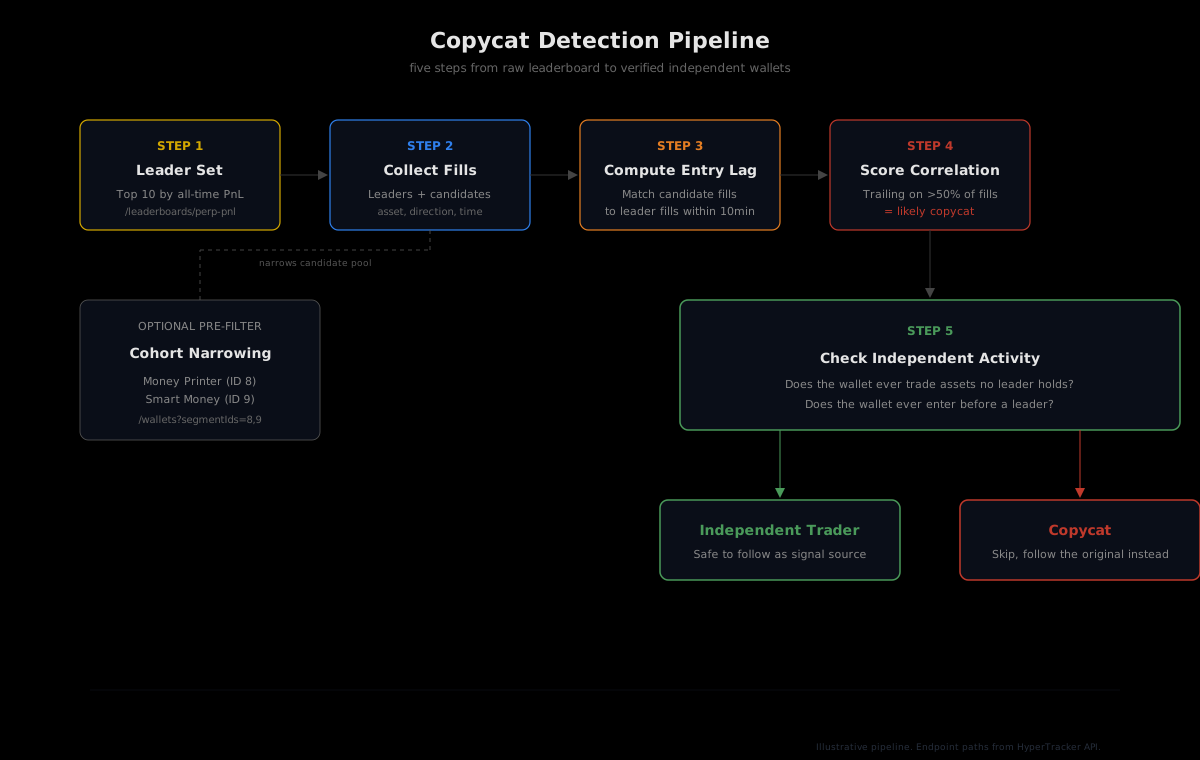
- Establish the leader set. Pull the top 10 leaderboard wallets by all-time PnL. These are the most-watched addresses on Hyperliquid and the most likely sources being copied.
- Collect fills for both sets. For each leader and each candidate wallet, pull recent fills using the fills endpoint. You need asset, direction, timestamp, and size.
- Compute entry lag. For every candidate fill, check whether any leader opened a position on the same asset in the same direction within a reasonable lookback window (for example, 10 minutes). If yes, record the time difference.
- Score the correlation. A wallet that shows trailing entries on a significant share of its positions relative to a single leader is almost certainly copying. One or two coincidences happen. Consistent trailing across dozens of trades does not.
- Check for independent activity. Does the candidate ever take a position that no leader holds? Does the candidate ever enter before a leader? Independent activity dilutes the copycat signal. A wallet with some correlated and some independent entries might be using the leaderboard as one input among many, which is a different (and more defensible) strategy than blind mirroring.
Cohort signals as an alternative to wallet-level following
The entire copycat problem disappears when you shift from tracking individual wallets to tracking cohort-level behavior. Our data aggregates hundreds of wallets within each cohort and reports their collective positioning. When the entire Smart Money cohort shifts net long on ETH, that is a consensus signal from a statistically meaningful sample, not one wallet's opinion that could be a hedge, a copy, or a mistake.
Cohort signals do not suffer from signal decay because there is no single address to crowd around. A copycat adds noise to wallet-level tracking but has near-zero impact on the aggregate cohort metric because the cohort contains hundreds of wallets and one additional copycat barely moves the needle. The signal stays clean regardless of how many people are watching it.
Query cohort positioning using the cohort metrics endpoint:
GET /api/external/cohorts/metrics?segmentId=8&coin=ETH
This returns aggregate positioning for the Money Printer cohort on a specific asset, including long/short ratios and net exposure. When the highest-performing cohort leans directionally on an asset, that carries more weight than any single wallet's position because it represents the consensus of every wallet that has earned $1M+ trading on Hyperliquid.
Track the leaders, filter out the followers
HyperTracker's API gives you the leaderboard, wallet-level fills, and cohort positioning in a single platform. Query the top wallets, cross-reference timing, and shift to cohort signals when individual wallet tracking gets noisy. Start with the free tier to explore the endpoints.
The real edge is knowing who leads and who follows
Hyperliquid's transparency is a double-edged quality. It makes every wallet's activity visible, which enables copy trading. But it also means the leaderboard is crowded with copycats whose returns are borrowed from someone else's edge. If you blindly follow a wallet with strong recent PnL, you might be two layers deep in a copy chain, inheriting compounded delays and shrinking returns.
The fix is straightforward. Use timing analysis to verify independence, use cohort filters to narrow the pool to wallets with track records that are structurally hard to achieve through copying, and consider cohort-level signals as a more robust alternative to any single wallet. The traders who outperform on Hyperliquid are not the ones who found the best wallet to copy. They are the ones who learned to read the cohort consensus and act on it before the copycats pile in.