What Bitget's $352M Hack Means for Perp Traders Who Still Trust CEXes
By CMM Team - 25-Sep-2026
What Bitget's $352M Hack Means for Perp Traders Who Still Trust CEXes
At 18:31 UTC on September 24, 2026, attackers drained $351.6 million from Bitget's hot and warm wallets in what is already the second-largest centralized exchange breach of the year. Withdrawals are frozen. The CEO says North Korean hackers are "very likely" responsible. And millions of traders who thought their funds were safe behind a login screen are now watching a blockchain forensics team chase stolen ETH through Tornado Cash.
This is the same playbook that hit Bybit in February 2025, when $1.46 billion vanished through a compromised signing interface. And it is the same class of attack that on-chain perpetual futures exchanges are structurally immune to, because there are no hot wallets to drain, no backend authorization layers to spoof, and no single entity that can freeze your withdrawal.
If you trade perps on centralized exchanges, this matters. If you build trading infrastructure that depends on CEX APIs, it matters even more. Here is what happened, why it keeps happening, and what the smart money actually does when an exchange gets breached.
How the Bitget Hack Worked
The attack was not a smart contract exploit. It was not a private key theft. CEO Gracy Chen confirmed that "the attacker compromised a critical backend system within our wallet infrastructure, used it to spoof transaction data, and triggered our authorization process to move funds out." In plain terms: the hackers broke into the server that approves internal transfers, fed it fake requests, and the system authorized real withdrawals to attacker-controlled wallets.
Chen explicitly ruled out private key compromise, which narrows the attack vector to the software layer between Bitget's hot wallets and its signing infrastructure. This is the exact same category of vulnerability that enabled the Bybit hack seven months earlier, where attackers injected malicious JavaScript into Safe{Wallet}'s frontend to manipulate multi-signature transaction approvals.
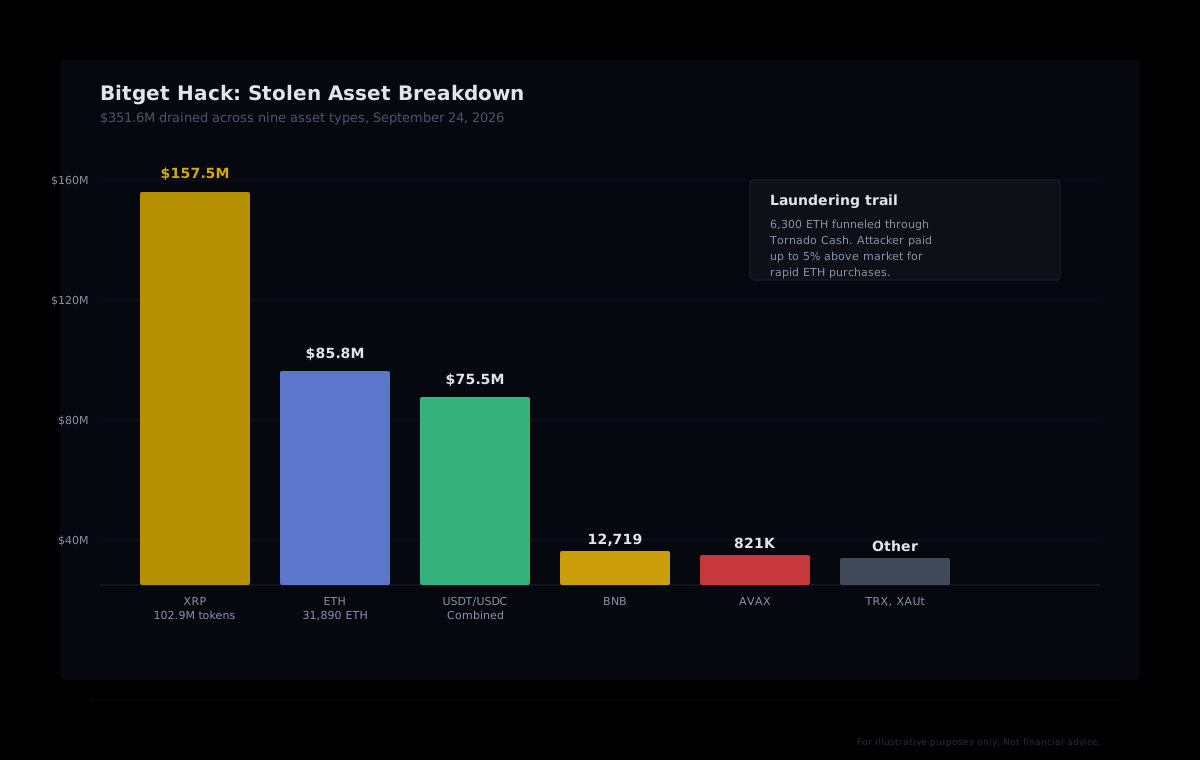
The stolen assets tell a story about what the attackers targeted: 102.93 million XRP (roughly $157.5 million), 31,890 ETH ($85.8 million), and approximately $75.5 million in combined USDT, USDC, and USDT0. XRP alone accounted for nearly half the total. The remaining assets included BNB, AVAX, XAUt (tokenized gold), and TRX.
The Laundering Trail
Blockchain analysts tracked the attackers converting stolen tokens into ETH at speed, paying up to 5% above market rates to execute rapid purchases. At least 6,300 ETH (roughly $19.4 million) was funneled through Tornado Cash within the first day. The attacker also withdrew 1,000 ETH (approximately $3.24 million) from Aave and laundered that as well.
This conversion strategy mirrors the Bybit hackers' approach in February 2025, when at least $160 million was laundered within the first 48 hours. The playbook is consistent: steal multi-asset, convert to ETH, mix through Tornado Cash, scatter across wallets. The speed matters because every hour of delay increases the chance of address blacklisting.
Why This Keeps Happening to Centralized Exchanges
Bitget is not an outlier. It is the latest data point in a pattern. In Q1 2025, crypto platforms lost $1.64 billion to hacks, the worst quarter on record. North Korean state-sponsored groups alone accounted for $2.02 billion in theft during 2025, representing 76% of all service-level compromises that year.
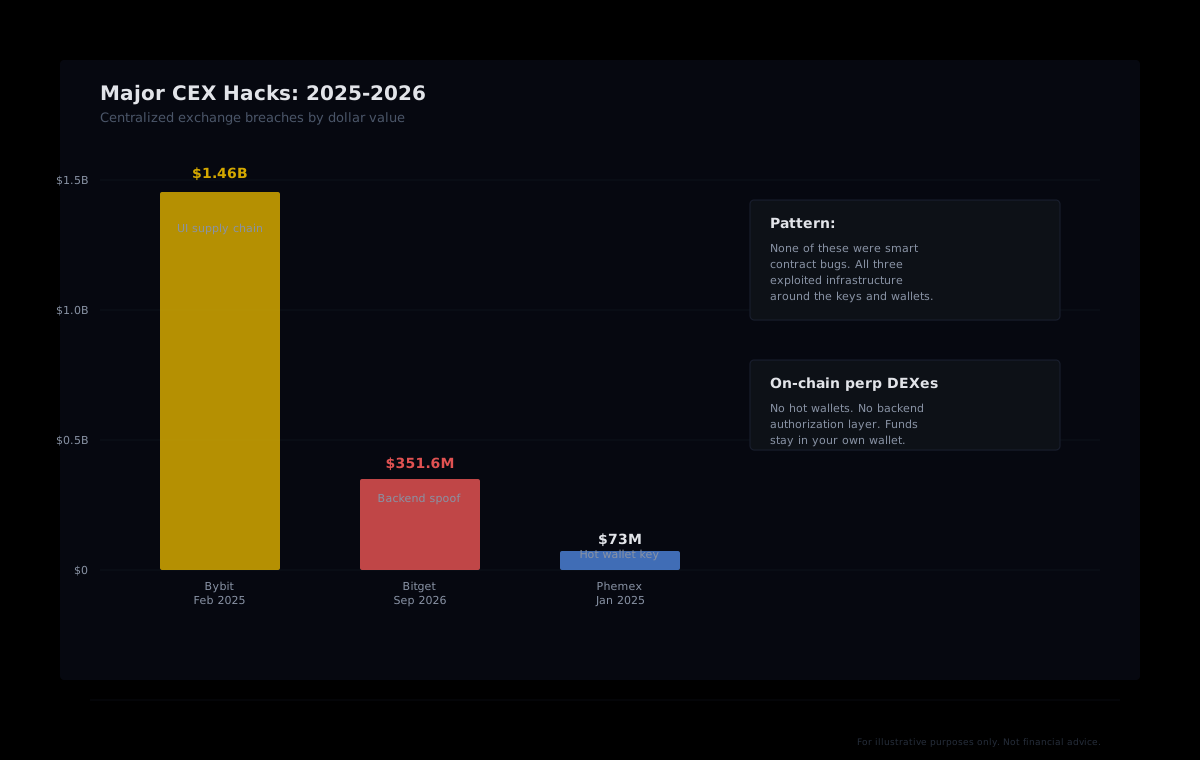
The critical pattern: none of the major 2025-2026 CEX breaches were smart contract exploits. Bybit was a UI supply chain attack against the signing interface. Phemex lost $73 million to hot wallet private key theft. Bitget's backend was spoofed to authorize fake transfers. Every single one exploited the infrastructure surrounding the keys, which is the layer that only exists because centralized exchanges must custody your funds to let you trade.
The custody tax
When you deposit funds on a CEX to trade perps, you are outsourcing custody to a company. That company runs hot wallets, warm wallets, cold storage, backend authorization servers, multi-sig signing interfaces, and employee access controls. Each of those layers is an attack surface. You are trusting that every employee, every contractor, every third-party integration, and every piece of signing infrastructure is secure, because a single compromise in any of them can drain your funds.
Bitget's User Protection Fund of over $464 million should cover the $351.6 million loss after assessment. But coverage does not equal access. Withdrawals remain frozen with no announced timeline, and Chen stated that Bitget "will not commit to a window we cannot guarantee." Your funds might be "safe" in the accounting sense while remaining completely inaccessible.
Why On-Chain Perp DEXes Avoid This Class of Attack
On-chain perpetual futures exchanges like Hyperliquid operate on a fundamentally different custody model. Your funds stay in your own wallet. When you open a position, the trade settles on-chain through smart contracts that are publicly auditable. There is no hot wallet to drain because the exchange never takes custody of your funds in the first place. There is no backend authorization server to spoof because trade execution is handled by on-chain logic.
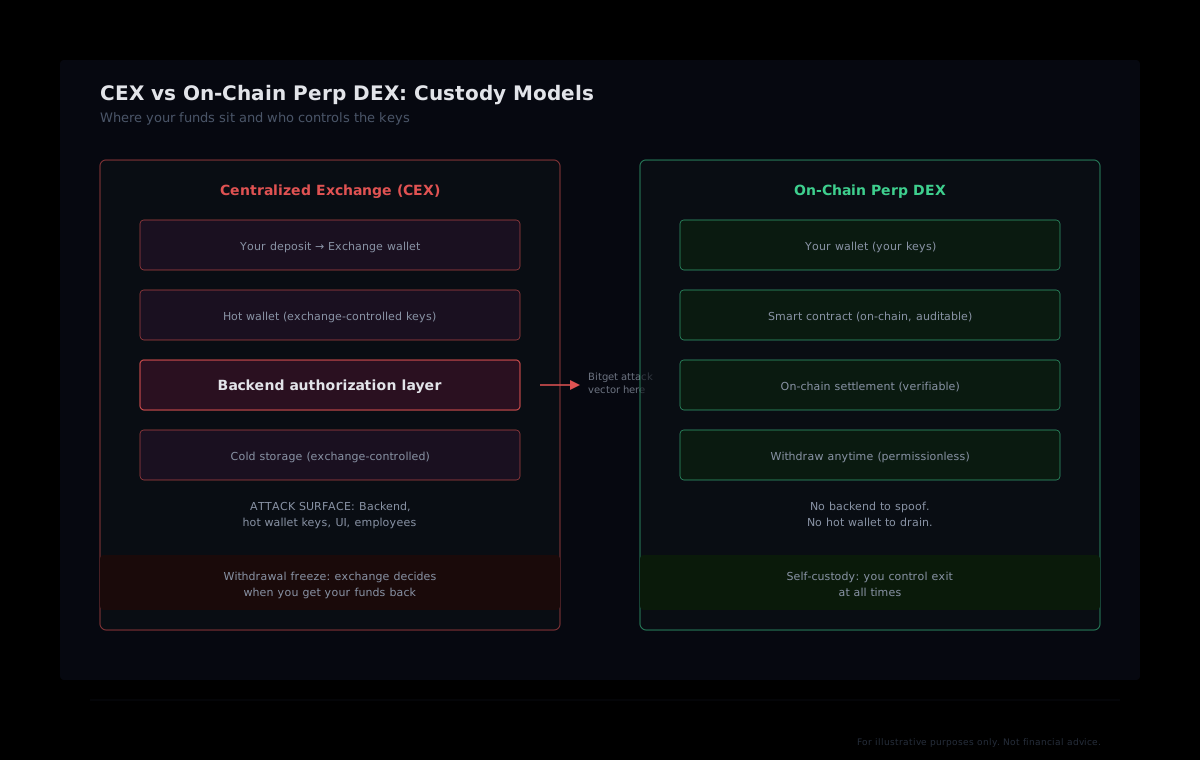
This does not mean DEXes are risk-free. Smart contract bugs remain a real threat: Drift Protocol lost $285 million to an admin key seizure in April 2026. But the attack surface is categorically different. A CEX hack can drain every user's funds simultaneously because custody is pooled. A smart contract exploit requires finding a bug in audited, public code. One scales through social engineering and infrastructure compromise. The other requires technical vulnerability in transparent, verifiable logic.
For perp traders specifically, the self-custody model means you can always withdraw. No freeze. No "pending security review." No waiting for a CEO to announce a timeline. Your positions, your margin, your collateral: all visible on-chain, all under your control.
What Smart Money Does After a Major Breach
Exchange hacks do not just destroy value for the victims. They reshape positioning across the entire perp market, because large traders reassess counterparty risk and rotate capital in predictable patterns.
After the Bybit hack in February 2025, on-chain data showed a measurable shift: experienced traders moved capital from centralized exchanges to on-chain venues. Hyperliquid's volume increased in the weeks following the breach as traders diversified their execution venues. The logic is straightforward. If one CEX can lose $1.46 billion through a signing interface compromise, every CEX running similar infrastructure carries similar risk.
The pattern repeats with every major breach. Deposits slow on the hacked exchange, obviously. But they also slow on competing CEXes as traders reassess whether any centralized custody is worth the convenience. Smart money does not wait for the post-mortem. It moves first and reads the forensic report later.
Tracking the rotation with cohort data
This is where cohort analytics become valuable. Our data classifies every wallet on Hyperliquid into 16 behavioral cohorts, eight by account size (from Shrimp at $0-$250 up to Leviathan at $5M+) and eight by all-time PnL (from Money Printer at +$1M+ down to Giga-Rekt at below -$1M). When a major exchange breach happens, you can track how each cohort responds in near real-time through our API.
Do the Money Printers increase their Hyperliquid positions after a CEX hack, because they see the self-custody advantage? Do the Whales and Tidal Whales rotate stablecoin margin onto on-chain venues? Do the smaller cohorts panic and deleverage everywhere? These are answerable questions when you have behavioral segmentation across the entire market.
One API call to our cohort positioning endpoint tells you what each segment is doing with their capital. During a breach event, that signal is more useful than any Twitter thread or Discord rumor, because it reflects actual on-chain positioning rather than speculation.
Risk Layers Every Perp Trader Should Evaluate
Whether you trade on a CEX or a DEX, the Bitget breach highlights five risk layers that most traders ignore until it is too late:
- Custody risk: Who holds your funds? On a CEX, the exchange does. On an on-chain DEX, you do. The Bitget hack is a custody-layer failure.
- Infrastructure risk: What systems sit between your deposit and the exchange's execution engine? Backend authorization servers, signing interfaces, and hot wallet management are all infrastructure risks unique to CEXes.
- Withdrawal risk: Can you access your funds at any time? Bitget froze withdrawals "as a precautionary measure." On-chain DEXes cannot freeze withdrawals because the smart contract does not have that function.
- Counterparty risk: Does the exchange have reserves to cover a catastrophic loss? Bitget's $464M+ protection fund covers this specific breach. But not every exchange carries that buffer, and the fund itself consumed roughly three-quarters of the total after assessment.
- Concentration risk: How much of your trading capital sits on a single venue? Diversifying across exchanges and on-chain venues reduces the impact of any single breach.
Evaluating these layers is not paranoia. It is risk management. The same discipline that makes you set stop-losses and manage position size should extend to where you keep your capital.
Track How Smart Money Responds to Exchange Breaches
HyperTracker's API classifies every Hyperliquid wallet into 16 behavioral cohorts by size and track record. When a CEX hack reshapes market positioning, our data shows you which cohorts are rotating capital onto on-chain venues, in near real-time. One API call, 16 segments, every wallet classified.
The Bigger Picture for Builders
If you are building trading infrastructure, the Bitget breach carries an additional lesson. Every bot, dashboard, or analytics tool that depends on CEX APIs inherits that exchange's infrastructure risk. When Bitget froze withdrawals, every automated trading system connected to their API lost access to its capital. No amount of code quality on your side can protect against a counterparty failure on theirs.
Building on on-chain infrastructure changes the risk profile. Hyperliquid's on-chain execution means your bot's trades settle verifiably. Your user's funds stay in their wallets. And the analytics layer you build on top can pull from on-chain data that nobody can freeze, falsify, or withhold.
For builders who want to integrate cohort intelligence, our API provides position metrics, order flow data, and behavioral segmentation for every wallet on Hyperliquid, starting at $179/month for the Pulse tier. You get the intelligence layer without the custody risk.
The CEX Trust Deficit Is Growing
Between January 2025 and mid-2026, crypto platforms lost over $3.63 billion across 245 documented hacking incidents. The top ten largest attacks accounted for over 72.5% of the total value stolen. Recovery rates collapsed to 0.4% in Q1 2025, down from 21.2% in Q1 2024.
These numbers paint a clear picture. The attacks are getting larger, more sophisticated, and harder to recover from. The attackers are state-sponsored teams with years of operational experience. And the attack vector that keeps working is not code exploits, it is infrastructure compromise around custody and signing.
For perp traders, the question is not whether another CEX will get hacked. The pattern makes that a near certainty. The question is whether your funds, your positions, and your trading infrastructure will be affected when it happens. On-chain perp DEXes do not eliminate all risk. But they eliminate this specific class of risk, the one that has produced the largest and most damaging breaches in crypto history.
Bitget's $351.6 million is the tuition. The lesson is that custody is a feature, and whoever holds your keys holds your risk.