
BlackRock's Bitcoin Buffer ETF Changes the Perp Playbook
By CMM Team - 20-Oct-2026
BlackRock's Bitcoin Buffer ETF Changes the Perp Playbook
BlackRock just filed for its third Bitcoin ETF. This one does not give you full exposure to BTC. It trades upside for a cushion on the way down, using an options overlay on IBIT to buffer roughly the first 10% of losses in exchange for capping your gains. The product is called the iShares Bitcoin Managed Protection ETF, ticker PBIT, and it landed with the SEC on October 19, 2026.
A filing is not an approval. PBIT could sit in regulatory review for months. But the filing itself tells you something important about where institutional Bitcoin demand is headed, and that directional shift has consequences for anyone trading perps. When the biggest asset manager on the planet starts engineering downside protection into a BTC wrapper, it signals a new class of capital entering the market. Capital that behaves differently from the spot accumulators who have been driving IBIT inflows, and differently from the leverage traders who dominate on-chain perp markets.
The mechanics: how PBIT works
Buffer ETFs (also called defined-outcome ETFs) are not new in TradFi. Calamos, First Trust, and Innovator already offer them on equities. BlackRock's entry into Bitcoin buffers is the signal. The structure is straightforward.
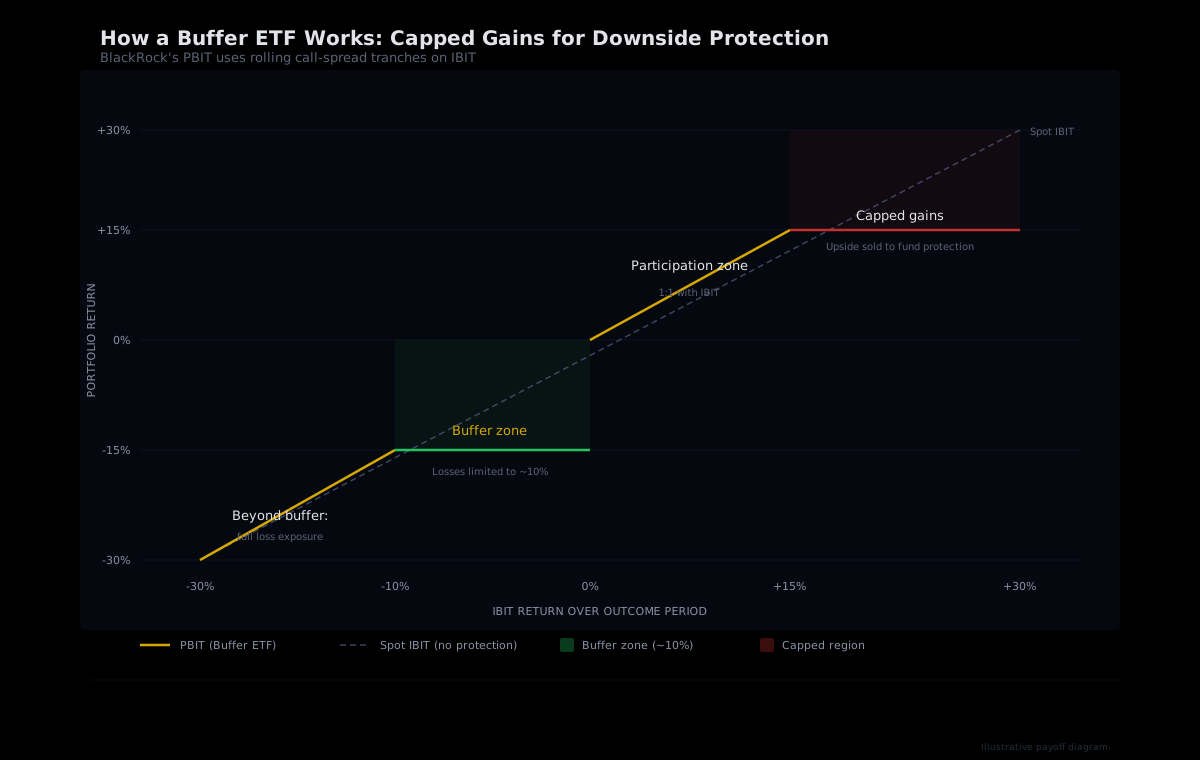
PBIT holds call options on IBIT (or comparable Bitcoin exposure) rather than holding Bitcoin directly. It buys calls struck below the reference price and sells calls struck above it, creating a call spread. The premium from selling the higher-strike calls funds the downside protection. The fund runs three overlapping tranches with staggered monthly start dates, so one tranche rolls off and a fresh one begins each month.
Each tranche targets protection starting at about 90% of the reference asset's value. That means if IBIT drops 8% over an outcome period, the buffer absorbs it. If IBIT drops 25%, you eat the losses beyond that initial buffer. On the upside, a cap (set by market conditions when each tranche starts) limits how much you can gain. Bloomberg Intelligence analyst James Seyffart noted that investors will give up some upside to get that protection.
Why perp traders should care about a risk-off product
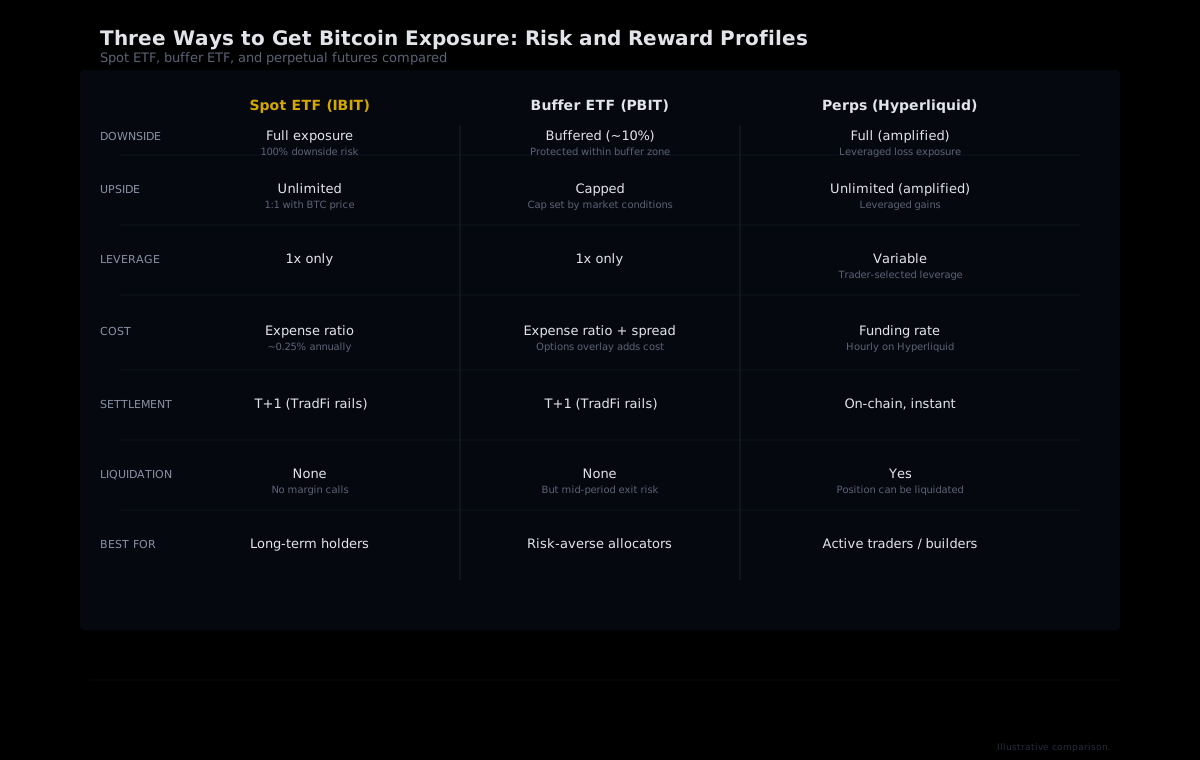
PBIT is designed for investors who want Bitcoin exposure without stomach-churning drawdowns: pensions, advisors with conservative mandates, and corporate treasuries. These are not the people placing leveraged longs on Hyperliquid. So why should perp traders pay attention?
Because the options overlay that makes PBIT work does not live in a vacuum. It interacts with the same derivatives infrastructure that perp pricing depends on.
Options flow spills into the funding rate
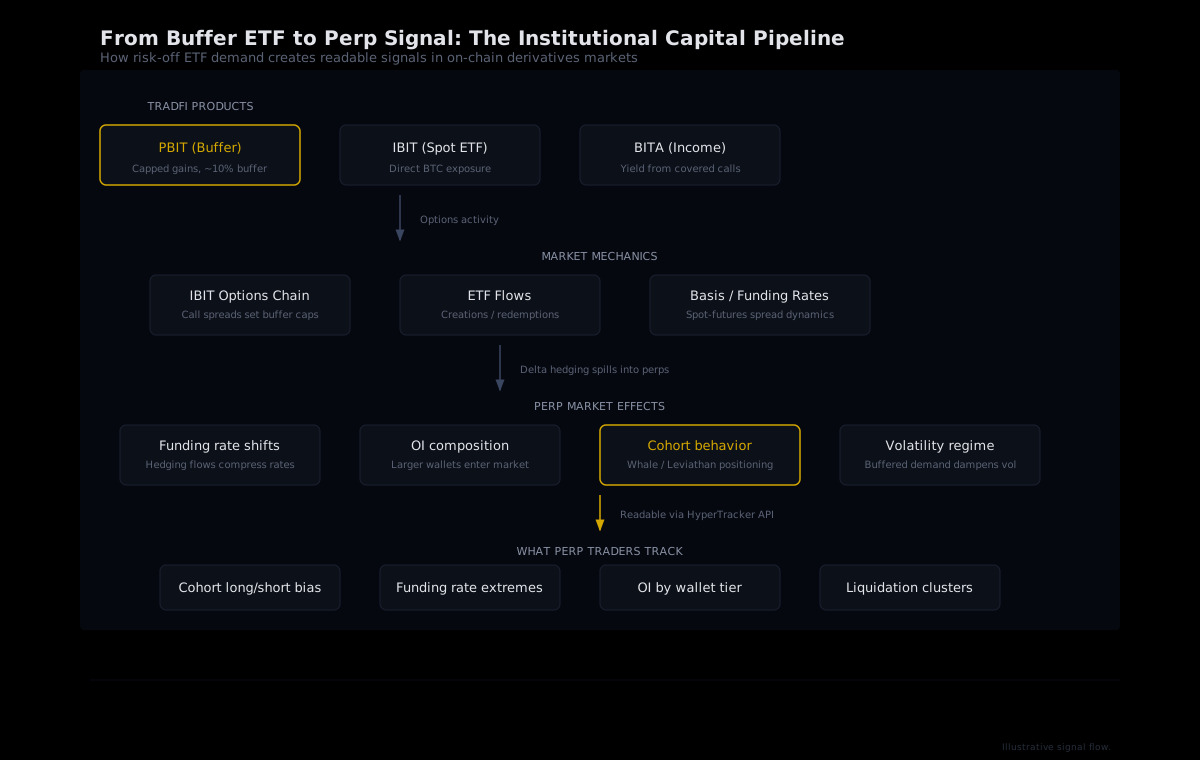
PBIT buys call spreads on IBIT. That means institutional market makers on the other side of those trades need to hedge. When a market maker sells calls, they typically buy the underlying (or futures) to stay delta-neutral. When they buy puts or sell covered calls, they may short futures. This hedging activity flows into the CME Bitcoin futures market and, from there, into the funding rate dynamics that perp traders monitor.
Structured product hedging creates predictable, rhythmic flow in the options and futures markets. Because PBIT uses three monthly rolling tranches, there will be consistent options flow at tranche boundaries. For perp traders, this adds a new source of non-speculative flow that can compress or expand the basis between spot and futures, and by extension influence funding rates on venues like Hyperliquid where funding is calculated hourly.
Basis trade mechanics shift
The cash-and-carry basis trade (long spot Bitcoin, short futures to capture the premium) has been a staple institutional strategy since spot ETFs launched. Buffer ETFs add complexity. The options overlay introduces gamma exposure for market makers, which means their hedging is dynamic: they buy more as prices rise, sell more as prices fall. This can amplify short-term price moves around tranche expiration dates and compress the futures basis during calm periods when gamma hedging is minimal.
For perp traders, the takeaway is that funding rate behavior may become more regime-dependent. Calm periods could see lower funding (basis compressed by hedging flows), while volatility spikes near tranche rollovers could create brief funding rate dislocations worth monitoring.
The institutional demand signal
IBIT pulled in $665.2 million in net inflows on the same day BlackRock filed for PBIT. That is the largest single-session haul since October 2025. The dual signal matters: conviction buyers poured capital into spot IBIT while BlackRock simultaneously filed a risk-off product for allocators who need a compliance wrapper before they can touch Bitcoin at all.
PBIT is BlackRock's third Bitcoin ETF filing. The first was IBIT itself, which launched in January 2024 and now holds $66.37 billion in net assets. The second was BITA, the iShares Bitcoin Premium Income ETF, which launched in June 2026 and generates yield through covered call writing. PBIT completes a product suite: pure exposure (IBIT), yield (BITA), protection (PBIT).
The progression tells you something about the maturation of Bitcoin as an institutional asset class. First came the simple spot wrapper. Then the yield product. Now the risk-managed wrapper. Each step brings in a new tranche of institutional capital that was previously on the sidelines because the available products did not match their mandate. And each incremental pool of institutional capital changes the composition of participants in the broader Bitcoin market, including its derivatives.
Reading the perp market through the institutional lens
When a new class of capital enters Bitcoin, it shows up in the data if you know where to look. Institutional flows through ETFs and structured products tend to follow patterns: they concentrate around market open and close times, they respond to macro events on predictable timelines, and they create hedging flow that is systematic rather than discretionary.
On-chain perp markets reflect these shifts with a lag. As institutional Bitcoin exposure grows through products like PBIT, the downstream effects ripple into perp positioning in a few observable ways:
- Funding rate regime shifts: Hedging from structured products adds non-speculative short flow into the futures market, which can pull funding rates lower during accumulation phases. When perp funding rates decouple from spot momentum, it can signal that institutional hedging is dominating the flow.
- Open interest composition changes: Larger, more conservative wallets showing up in perp markets tend to hold positions longer and use lower leverage. Our data on Hyperliquid's 16 behavioral cohorts (eight by account size, eight by all-time PnL) can surface these compositional shifts. Growth in the Whale ($500K-$1M), Tidal Whale ($1M-$5M), or Leviathan ($5M+) cohorts alongside declining average leverage would be a fingerprint of institutional-adjacent capital arriving on-chain.
- Volatility dampening: Buffer products, by design, reduce demand for Bitcoin at extreme prices (capped on the upside, protected on the downside). The options hedging from PBIT-style products adds a stabilizing force at the margins. For perp traders, this could mean that large directional moves require more genuine spot demand to sustain, because structured product hedging works against momentum at the extremes.
The competitive landscape: buffer ETFs are not just BlackRock
BlackRock is the biggest name filing, but the buffer ETF space for Bitcoin already has early entrants. Calamos launched CBOJ, a Bitcoin buffer ETF offering 100% downside protection with a cap on upside, and Innovator and First Trust have their own defined-outcome products tied to Bitcoin.
Seyffart pointed out that BlackRock "tends to make a big splash" when entering these spaces. If PBIT pulls significant assets (and BlackRock's distribution network makes that likely), the options flow from buffer products could become a structural feature of the Bitcoin derivatives landscape rather than a niche footnote.
The management fee for PBIT has not been disclosed, and the SEC still needs to review the filing. Unchained Crypto estimates the fund could become effective around early January 2027, roughly 75 days after filing. But the market starts pricing in the implications long before a product actually launches.
Practical takeaways for perp traders
You do not need to trade PBIT or even have an opinion on whether buffer ETFs are good products. What matters is understanding the second-order effects on the derivatives market you trade in.
- Watch IBIT options OI around tranche dates. PBIT's three monthly rolling tranches mean consistent options flow. When you see spikes in IBIT put/call open interest around month-end dates, that is structured product flow, and it will spill into futures and funding rates.
- Track funding rate divergence from spot trend. If Bitcoin is trending up but funding rates stay flat or go negative, one explanation is that hedging flow from buffer and income products is absorbing the speculative premium. Our data on Hyperliquid's cohort positioning can help you determine whether the muted funding is coming from institutional hedging or from genuine retail bearishness.
- Monitor cohort composition for wallet-tier shifts. Institutional capital entering on-chain derivatives tends to cluster in larger wallet tiers with lower leverage and longer holding periods. Our 16 behavioral cohorts on Hyperliquid can flag when Whale and Leviathan cohorts start building positions in ways that diverge from their historical patterns.
Track how institutional flows reshape Hyperliquid positioning
HyperTracker classifies every wallet on Hyperliquid into 16 behavioral cohorts by account size and all-time PnL. When ETF-driven capital starts changing the composition of on-chain perp markets, you can see it in the positioning data before it shows up anywhere else.
The filing is the signal
PBIT is not live. It may not be approved for months. But BlackRock does not file paperwork casually. The same week IBIT posted its largest single-day inflow in a year, the firm told the SEC it wants to offer Bitcoin with training wheels for the institutions that still cannot justify raw spot exposure on their balance sheets.
For perp traders, the message is simple: the participant mix in Bitcoin markets is about to get more layered. Spot ETF buyers, yield seekers, and now buffered allocators, each with their own risk profiles, hedging needs, and behavioral patterns. The options overlay from products like PBIT adds a new structural flow into the derivatives stack that did not exist two years ago. If you are trading perps without watching how TradFi product design shapes the market you trade in, you are missing part of the picture.