
CEX Perp Volume Is Cratering. Hyperliquid Keeps Growing.
By CMM Team - 07-Aug-2026
CEX Perp Volume Is Cratering. Hyperliquid Keeps Growing.
Centralized exchange perpetual futures volume averaged $4.69 trillion per month through the first four months of 2026. That is down 34% from the 2025 average of $7.11 trillion. Meanwhile, Hyperliquid just posted $106 million in August revenue, its highest month ever. Active traders hit an all-time high of 263,666.
Two data points moving in opposite directions. One market is contracting while the other is breaking records, and the divergence tells you more about where crypto derivatives are headed than any conference keynote could.
This article breaks down the numbers behind the CEX perp volume decline, explains why Hyperliquid is gaining share during the drawdown, and explores what the shift means for builders who need reliable analytics on trader behavior.
The Scale of the CEX Perp Drawdown
The numbers are stark. According to a CoinGecko analysis, the top 11 centralized perpetual exchanges averaged $7.11 trillion in monthly volume throughout 2025. By the first four months of 2026, that figure had dropped to $4.69 trillion.
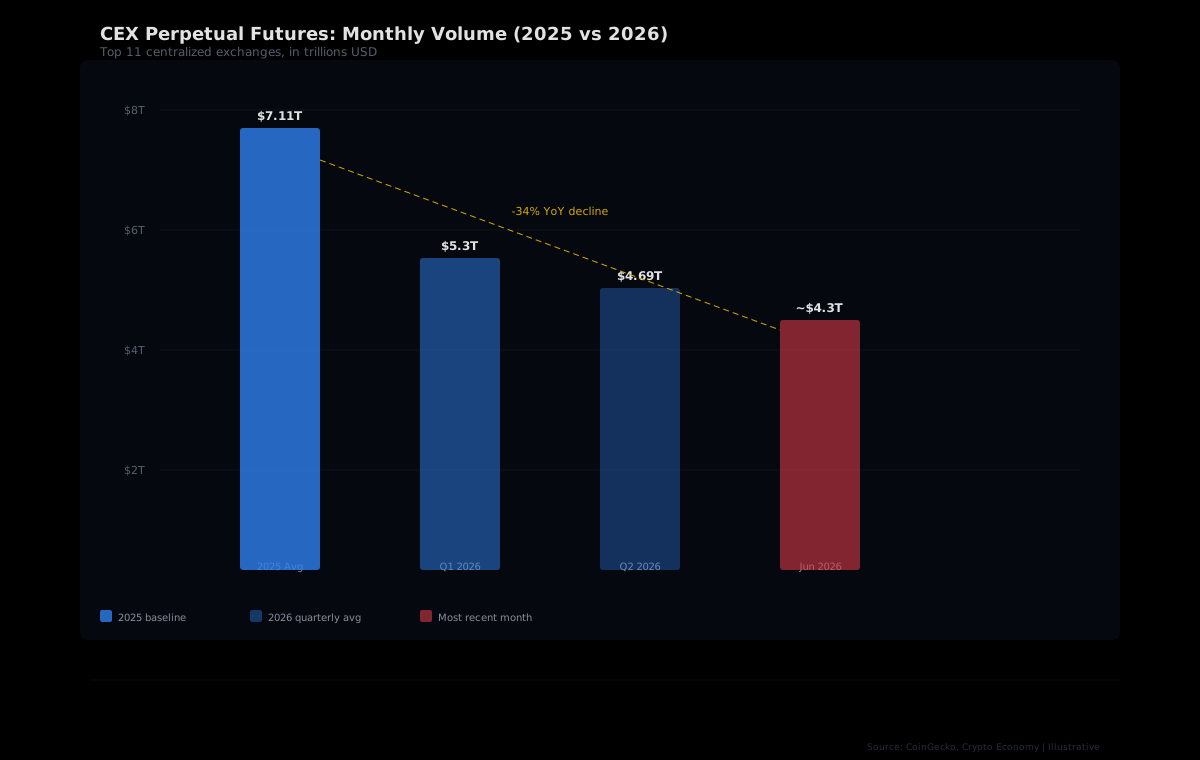
The decline accelerated through Q2 2026. CryptoRank's exchange recap showed total futures quarterly volume falling to $15.7 trillion, down 11% from Q1's $17.6 trillion. Meanwhile, spot trading volumes on centralized exchanges dropped to $3.0 trillion for the quarter, a decline of nearly 19% from Q1.
Despite the drawdown, perpetual futures still dominate CEX activity. Perps represent over 70% of total centralized exchange volume, roughly 4x the entire spot market. So even though absolute volume is falling, perps remain the beating heart of crypto trading infrastructure.
Market share is concentrating
Inside the shrinking pie, the biggest players are absorbing displaced volume. Binance holds roughly 40% of perpetual futures market share. OKX sits at 15%, Bybit rounds out the top three. Between them, the three exchanges control the overwhelming majority of CEX perp activity. Smaller exchanges are getting squeezed harder, with Bitget's average monthly perpetual volume dropping 61% from $740.62 billion to $287.08 billion.
This is the natural cycle of bear-market consolidation in derivatives. Volume compresses, liquidity concentrates around whichever venues have the deepest books, and marginal exchanges either differentiate or slowly bleed out.
Hyperliquid's Counter-Trend: Records During a Drawdown
While centralized exchanges shed trillions in monthly volume, Hyperliquid went the other direction. The protocol generated $106 million in fees during August from nearly $400 billion in perpetual trading volume. That is a 23% increase over July's $86.6 million.
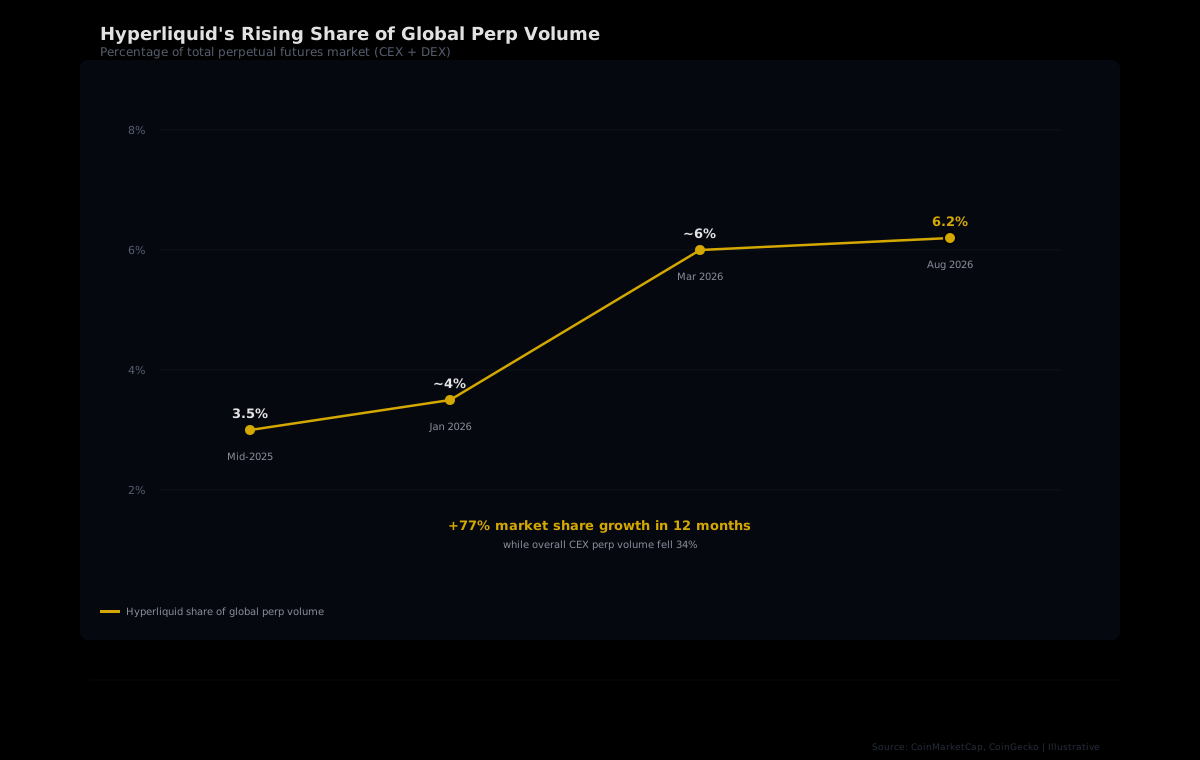
The market share trajectory is just as telling. Hyperliquid held just under 6% of total global perpetual futures volume by March, up from around 3.5% a year earlier. By August, that share had grown further as the protocol's volume expanded against a shrinking overall market.
On August 6, Hyperliquid recorded 263,666 active perpetual traders, a new all-time high. Open interest stood at $10.75 billion, and the platform tracked 329,951 total open positions.
The HIP-3 segment, which covers tokenized real-world assets like equities and commodities, has grown substantially. Open interest in HIP-3 contracts exceeded $4 billion for the first time, reaching $4.12 billion across 117 assets. That segment alone now rivals the total open interest of most mid-tier centralized exchanges.
Why Volume Is Migrating to On-Chain Perps
The CEX drawdown is cyclical. Crypto derivatives volume drops when speculation cools, leverage gets flushed, and retail retreats. That pattern has repeated after every major bull run peak. But this time there is something structural underneath the cyclical noise: a growing fraction of derivatives activity is settling on-chain rather than returning to centralized venues when the next cycle ramps up.
The perp DEX-to-CEX volume ratio tells the story. CryptoRank's Q2 2026 report showed perpetual DEX quarterly volume at $1.83 trillion, which gives DEX perps roughly 9.2% of total derivatives trading volume by June. That is up from single digits a year prior, and Hyperliquid accounts for the majority of that share.
Three structural forces are driving this migration:
- On-chain verifiability. Every position, every fill, every liquidation on Hyperliquid is recorded on its custom L1. Builders and analysts can verify volume independently, which is something centralized exchanges cannot offer. In a market where wash trading concerns persist, verifiable volume has real value.
- Self-custody by default. Traders on Hyperliquid retain custody of their assets. After years of exchange failures and frozen withdrawals, the security model matters. The 263,666 active traders choosing on-chain perps over CEX alternatives signal that self-custody is a feature many traders now prioritize.
- Product velocity. HIP-3 brought tokenized equities and commodities to Hyperliquid's order book, expanding the addressable market beyond crypto-native assets. HIP-4 added prediction markets. The protocol ships new products faster than most centralized exchanges, because it does not need regulatory approval for each listing.
What Builders See That Traders Miss
The volume migration from CEX to on-chain perps is not just a trader story. It is fundamentally a builder story, because the data environment changes completely when trading moves on-chain.
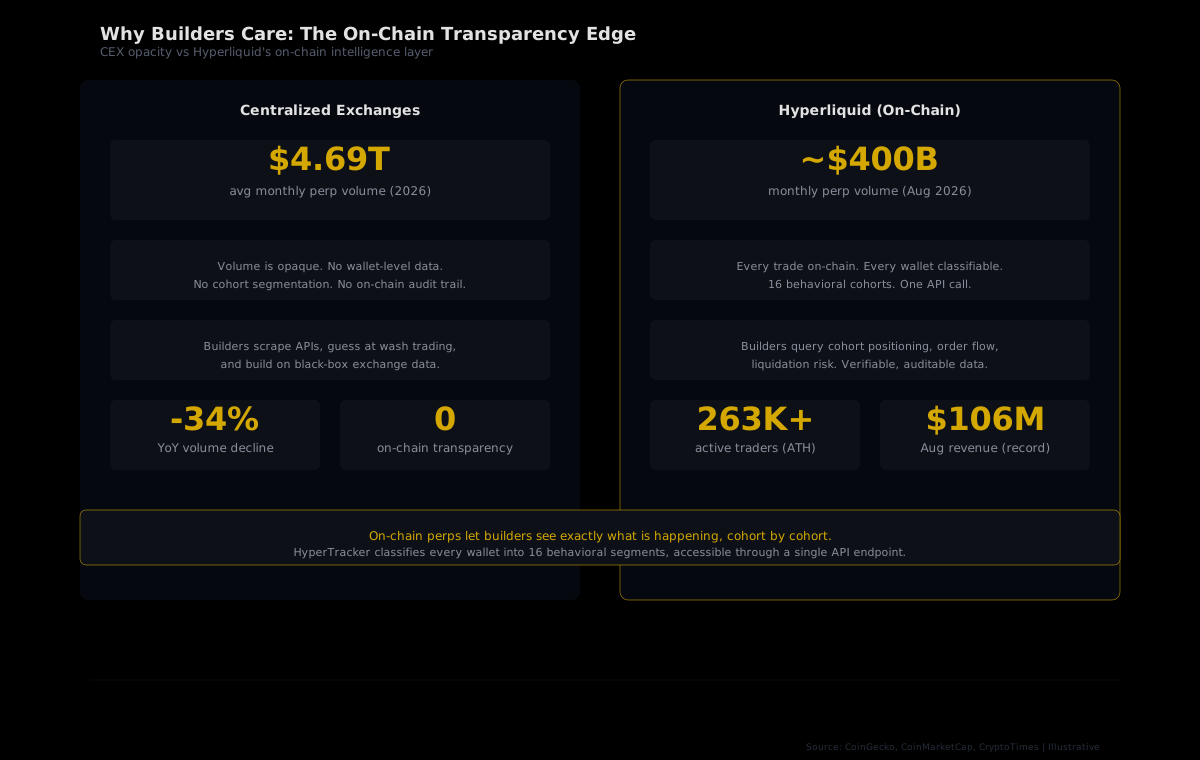
On a centralized exchange, builders work with whatever API the exchange exposes. Market data, order books, trade history. But the underlying participant behavior is a black box. You cannot see wallet-level positioning, you cannot segment traders by performance history, and you cannot verify whether the volume data you are consuming is genuine.
On Hyperliquid, every trade is on-chain. That means you can classify wallets, track cohort behavior, and build analytics that would be impossible on centralized infrastructure. Our data classifies every Hyperliquid wallet into 16 behavioral cohorts, eight by size (from Shrimp at $0-$250 to Leviathan at $5M+) and eight by all-time PnL (from Giga-Rekt to Money Printer). A single API call returns segment-level positioning for any asset.
Why this matters for builders: When CEX volume contracts, the traders who remain are typically the most sophisticated. They use better tools, demand better data, and build more complex strategies. On-chain perps give builders the transparency to serve exactly that audience, because every wallet's history is auditable.
Reading the Rotation Through Cohort Data
The CEX-to-DEX volume rotation is not uniform across all participant types. Different cohorts are migrating at different rates, and tracking these patterns gives builders a structural edge in understanding where the market is heading.
Consider the cohort dynamics visible in Hyperliquid's on-chain data. The Money Printer cohort (wallets with over $1M in all-time profits) and Smart Money cohort (+$100K to $1M PnL) tend to be the first movers in structural shifts. When these segments increase their positioning on Hyperliquid while CEX volumes are declining, it signals a deliberate migration by the most profitable participants.
Meanwhile, the size-based cohorts tell a different story. Whale wallets ($500K-$1M in equity) and Tidal Whales ($1M-$5M) bring substantial liquidity when they arrive. But the fastest-growing segment by active wallet count has been the Dolphin tier ($10K-$50K), which represents the mid-market traders who are increasingly comfortable with on-chain execution.
This granularity is exactly what centralized exchanges cannot provide. You can see total volume on Binance go down, but you cannot see which types of traders are leaving, where they are going, or whether the remaining volume is becoming more or less sophisticated. On-chain perp analytics make those questions answerable.
The Binance Concentration Risk
One underappreciated dimension of the CEX volume decline is the concentration risk it creates. As total volume shrinks, the remaining activity pools around fewer venues. Binance's 40% share of perpetual futures was already dominant. In a contracting market, that concentration accelerates.
For builders, this creates a fragility problem. If your analytics product depends on Binance API data and Binance changes rate limits, adds KYC requirements, or restricts API access (all of which have happened with other exchanges), your entire data pipeline breaks. Building on top of a single centralized exchange is a dependency risk that grows as concentration increases.
Hyperliquid's on-chain architecture removes that dependency. The data is on a public blockchain. There is no API key revocation, no exchange-specific terms of service governing data access, and no risk of a sudden policy change cutting off your data source. For builders designing analytics products with multi-year horizons, the infrastructure reliability of on-chain data is a competitive moat.
Building Analytics on a Growing Market
The practical question for builders is straightforward: where should you invest your development time? Building analytics for a market that is growing, or one that is contracting?
CEX perpetual futures will remain the larger market in absolute terms for some time. Centralized exchanges still process over $3 trillion per month in perp volume, dwarfing any single DEX. But the growth trajectory points to on-chain. Hyperliquid's share of global perp volume has roughly doubled in twelve months, and the platform's expansion into tokenized equities, commodities, and prediction markets keeps widening the addressable market.
For builders who want to analyze trader behavior at a granular level, the tools already exist. Our API provides access to cohort positioning, order flow snapshots, liquidation risk scores, and leaderboard rankings. Starting at $179/mo for the Pulse tier, it replaces the kind of proprietary data infrastructure that would cost $10,000+ per month to build from raw on-chain data.
Track What Smart Money Is Doing on Hyperliquid
16 behavioral cohorts. Order flow snapshots. Liquidation risk scoring. One API, starting at $179/mo.
Where This Goes Next
The CEX perp volume drawdown is cyclical, and volumes will eventually recover when the next wave of speculation arrives. But the structural share shift toward on-chain perps is unlikely to reverse. Each cycle, a larger fraction of derivatives activity settles on-chain, because the benefits of transparency, self-custody, and composability compound over time.
For Hyperliquid specifically, the trajectory is clear: record revenue, record active traders, and an expanding product surface with HIP-3 and HIP-4. The protocol is not just surviving the drawdown. It is gaining share during it, which is the strongest possible signal that the migration is structural rather than speculative.
CEX perps are not dying. But they are losing ground to a venue where every trade is verifiable, every wallet is classifiable, and every builder can access the analytics that centralized exchanges keep locked behind opaque APIs. The data tells the story. The question is whether you are building on the side of the market that is growing, or the one that is contracting.