
Citadel Bet $400M on a CEX. Here's Why Perp DEX Builders Should Care.
By CMM Team - 17-Jul-2026
Citadel Bet $400M on a CEX. Here's Why Perp DEX Builders Should Care.
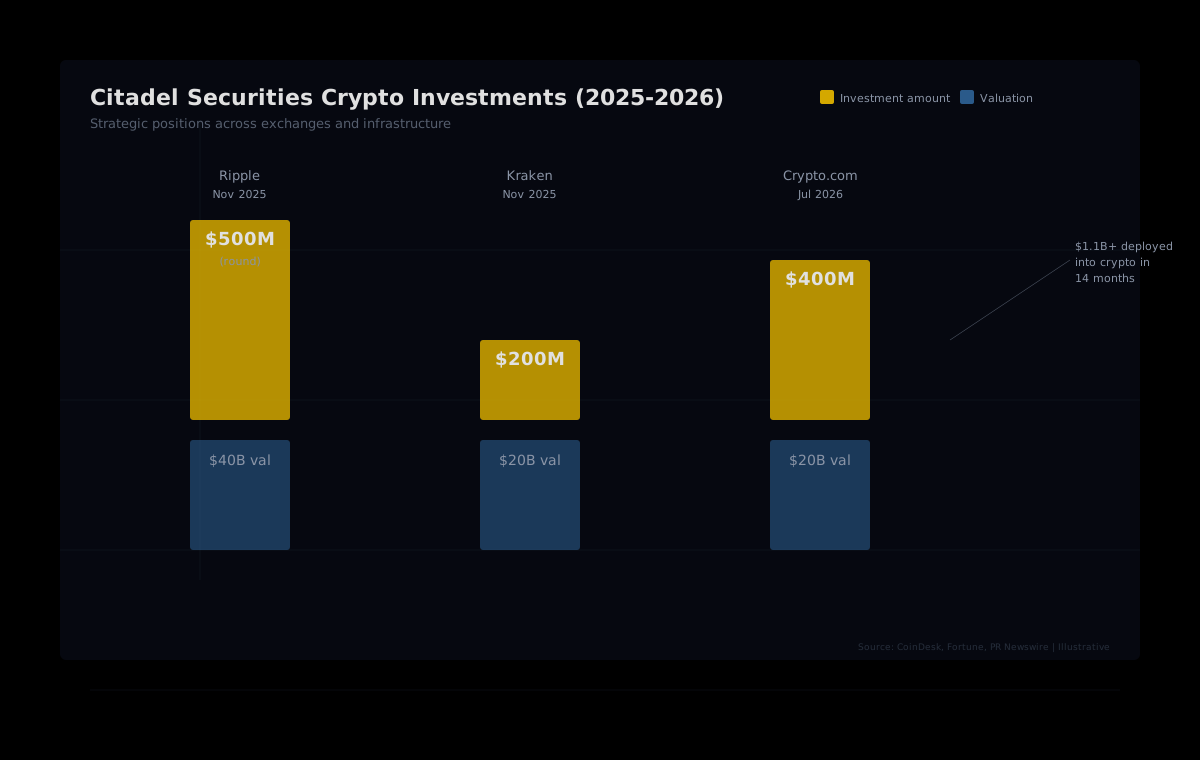
Citadel Securities just wrote a $400 million check to Crypto.com, valuing the exchange at $20 billion. This comes eight months after the same firm invested $200 million in Kraken at an identical $20 billion valuation. Combined with its participation in Ripple's funding round, Citadel Securities has deployed over $1 billion into centralized crypto infrastructure in roughly 14 months.
If you build on decentralized perp exchanges, that number might seem irrelevant. Citadel is backing centralized venues, reinforcing the old guard. But here is the twist that matters for every DEX builder reading this: institutional capital flowing into CEXes actually makes on-chain intelligence more valuable, because the traders who eventually show up on-chain leave a trail that CEX order books will never reveal.
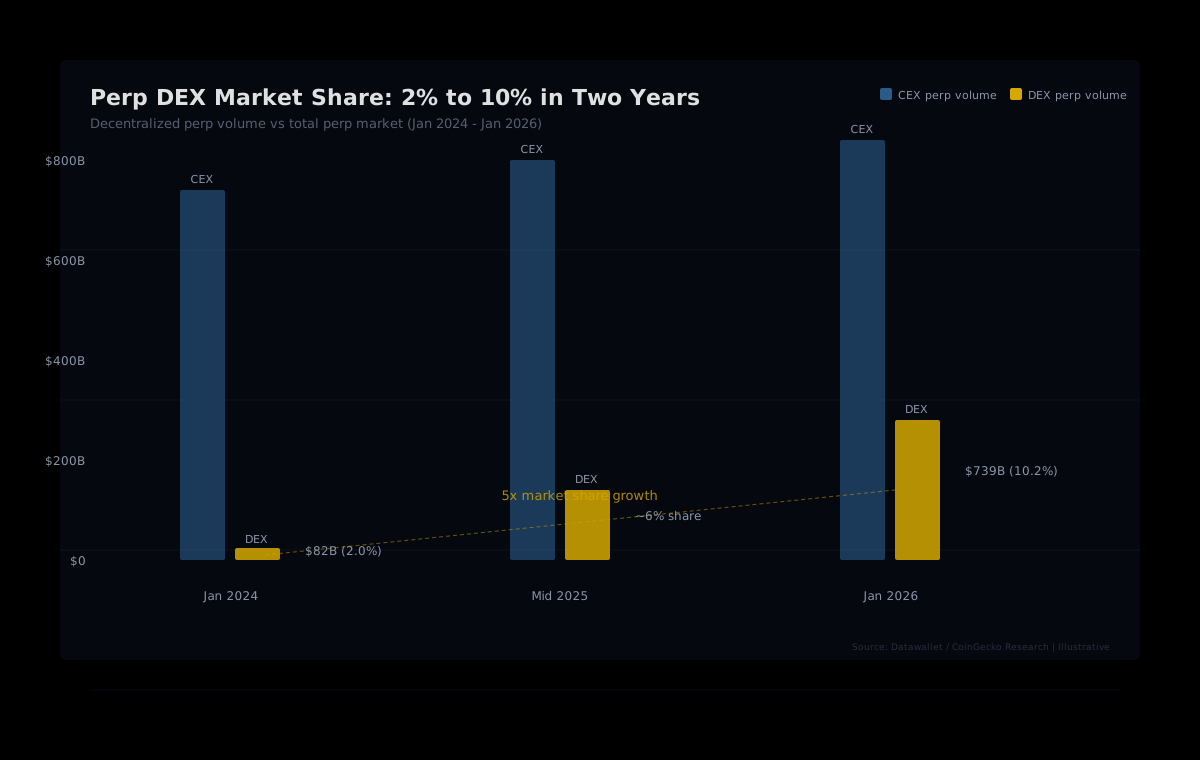
The perp DEX slice of the derivatives market grew from 2.0% to 10.2% of total perp trading volume in two years. That growth is accelerating, and the builders who can read the on-chain flow have a structural advantage over anyone trading blind on centralized rails.
What Citadel Actually Bought
On July 16, 2026, Crypto.com announced the $400 million investment. This is the exchange's first institutional funding round in its decade-long history. CEO Kris Marszalek described the opportunity as "staggering, as crypto increasingly becomes the rails for finance."
Citadel Securities President Jim Esposito framed the investment around convergence: "The convergence of traditional financial markets and digital asset infrastructure is an exciting evolution with the potential to further improve market efficiency."
The capital is earmarked for tokenized securities, derivatives expansion, and bridging traditional finance with digital assets. Crypto.com plans to launch tokenized stocks within its core app, offering exposure to U.S. equities and ETFs.
The Pattern: Citadel Is Building a CEX Portfolio
This is not a one-off bet. Citadel Securities invested $200 million in Kraken in November 2025, part of an $800 million round that positioned Kraken for its eventual IPO. The firm also participated in Ripple's $500 million funding round at a $40 billion valuation.
The thesis is clear: Citadel wants infrastructure positions across regulated crypto venues. As the world's largest market maker by volume in U.S. equities, the firm sees crypto exchanges as the next venue layer where its market-making expertise and capital reserves create a competitive moat. Deeper order books, tighter spreads, and institutional-grade execution flow from that playbook.
For centralized exchanges, this is a net positive. More institutional liquidity means better fills, more product types, and a faster path to regulatory approval. Crypto.com explicitly tied the investment to its derivatives expansion and tokenized securities roadmap.
Why CEX Capital Makes DEX Intelligence More Valuable
Here is where the story gets interesting for DEX builders. Institutional capital flowing into CEXes does not stay inside those walls. Traders who discover opportunities through institutional-grade CEX execution often hedge, speculate, or build on-chain. When they do, every position, trade, and liquidation becomes publicly auditable.
On a centralized exchange, Citadel's market-making activity is invisible. You cannot see who is providing liquidity, which direction the smart money is leaning, or how large wallets are positioning before a move. The order book is a black box to everyone except the exchange operator and its preferred partners.
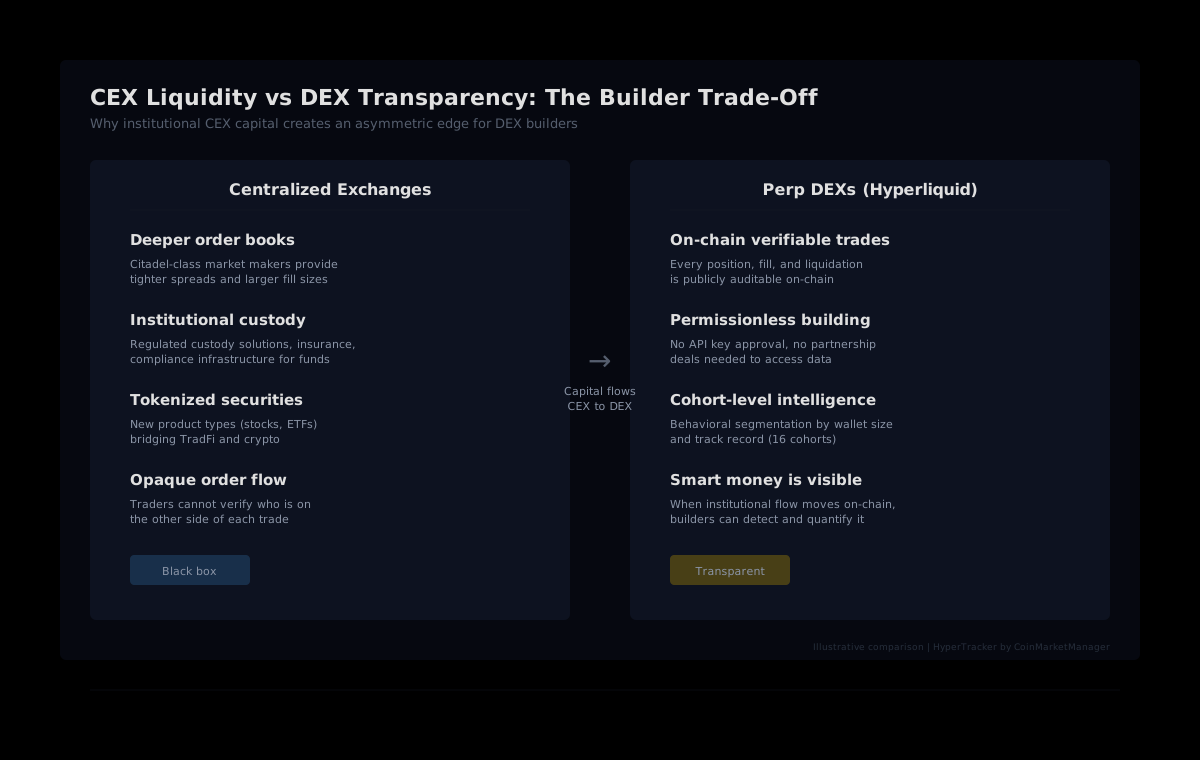
On Hyperliquid, that dynamic inverts. Every wallet's positions are on-chain. Behavioral classification is possible because the data is open. Our cohort analytics classify every wallet across 16 behavioral segments, grouped by size (Shrimp through Leviathan) and by all-time PnL (Money Printer through Giga-Rekt). When institutional-caliber flow migrates on-chain, builders who can read those signals get advance notice that CEX traders will never have.
The asymmetry: CEX capital improves execution quality for everyone. DEX transparency lets builders quantify exactly how smart that capital is, and whether it is accumulating or unwinding.
Perp DEX Growth: The Numbers That Frame This Trade
The broader context explains why this matters now. Decentralized perpetual futures volume surged from $81.74 billion in January 2024 to $739.48 billion in January 2026. That is roughly an 8x increase in absolute volume, and it pushed DEX market share from 2.0% to 10.2% of total perpetual futures trading.
Hyperliquid processed $619.46 billion in perpetual DEX volume during Q1 2026 alone, accounting for the majority of on-chain derivatives activity. Total open interest across the platform sits at $9.167 billion, and cumulative lifetime volume has crossed $4.4 trillion. The protocol generated $214.95 million in gross revenue during Q1 2026, retaining 89% as gross profit.
These are not niche numbers. Hyperliquid entered the global top 10 across all exchanges by volume between August 2025 and January 2026, processing $1.6 trillion in that window, surpassing several major centralized perp venues. When Citadel invests in Crypto.com's derivatives expansion, the competitive context includes a fully on-chain exchange that already handles more volume than most CEXes.
What Institutional CEX Capital Means for On-Chain Signals
When institutions trade on CEXes, their activity is hidden behind API keys and matching engines. When that same capital eventually touches on-chain markets, it becomes readable. The gap between these two states is where the opportunity lives for builders.
Consider a scenario: a fund uses Crypto.com's forthcoming derivatives products to take a directional bet on a token. That position is invisible to everyone outside Crypto.com. But if the same fund hedges on Hyperliquid, or if a second fund takes the opposite side of the trade on-chain, both positions are visible in our cohort data. You can see whether Money Printers (wallets with over $1M in all-time profits) are accumulating long exposure while Giga-Rekt wallets (those with over $1M in losses) are piling into shorts. That divergence is a signal.
Institutional CEX adoption does not reduce the value of on-chain analytics. It amplifies it, because the more sophisticated the capital entering crypto, the more meaningful the on-chain footprint becomes when any fraction of that flow touches decentralized venues.
The builder's edge
Anyone building trading tools, alert systems, or copy-trading infrastructure on Hyperliquid can query our API to see exactly how each cohort is positioned. Sixteen behavioral segments, refreshed every five minutes, delivered via REST, WebSocket, or Webhooks. The cost starts at $179/mo for the Pulse tier, which is dramatically less than building the ingestion, classification, and storage infrastructure from scratch.
What This Does Not Mean
A few clarifications to keep this analysis grounded:
Citadel is not abandoning traditional markets. The firm remains the dominant U.S. equities market maker. Crypto investments represent a portfolio diversification into adjacent infrastructure, following the same convergence thesis that drove BlackRock into spot Bitcoin ETFs.
CEX and DEX are not zero-sum. The total derivatives market is growing. CEXes getting more institutional liquidity does not shrink the DEX opportunity. Both can expand simultaneously, and the data suggests they are: CEX perp volumes rose substantially over the same period that DEX market share quintupled.
On-chain transparency is not guaranteed forever. Privacy-preserving execution layers, dark pools on L2s, and encrypted mempools could eventually reduce the visibility that makes on-chain analytics valuable. Builders should treat the current transparency window as an edge with a shelf life, and build for it accordingly.
Building With Cohort Intelligence in the Institutional Era
For builders on Hyperliquid, the practical takeaway is this: as institutional capital raises the sophistication of market participants across all venues, the ability to classify and monitor on-chain behavior by wallet cohort becomes more, not less, valuable.
Our API gives you access to 16 behavioral cohorts (8 by wallet size, 8 by all-time PnL), order flow analytics including stop/TP visibility, liquidation risk scoring at the asset level, and leaderboard data ranking traders by performance across multiple timeframes. The data refreshes every five minutes, with rolling five-minute order snapshots capturing granular flow.
A few concrete use cases in the context of growing institutional participation:
- Smart money divergence alerts: Build a system that fires when Money Printer and Smart Money cohorts take opposing positions to the broader market. When institutional-caliber wallets on-chain disagree with the crowd, that is a signal worth tracking.
- Cohort-weighted sentiment dashboards: Weight positioning data by cohort quality (higher weight for wallets with strong track records) to build sentiment indicators that separate noise from signal.
- Liquidation cluster monitoring: As larger positions move on-chain, liquidation clusters become more consequential. Track where concentrated leverage sits across cohorts to identify potential cascade points.
Build with on-chain intelligence
HyperTracker's API delivers 16 behavioral cohorts, order flow analytics, and liquidation risk scoring. Start with the free tier, or unlock full cohort data at $179/mo.
The Bigger Picture
Citadel's $400 million bet on Crypto.com is a signal about where traditional finance sees crypto heading: toward regulated, institutional-grade infrastructure that bridges securities, derivatives, and digital assets. That is one trajectory.
The parallel trajectory, the one that matters for every builder reading this, is that on-chain perpetual exchanges now handle over 10% of global derivatives volume, and that share is climbing. The capital entering through CEX on-ramps eventually creates on-chain signals. The builders who can read those signals, classify the wallets, and quantify the behavior have an edge that no amount of CEX market-making infrastructure can replicate.
Citadel is building the pipes. You should be building the instruments that read what flows through them.