Coinbase Got a US Perps License. Copy Trading Rules Just Changed.
By CMM Team - 30-May-2026
Coinbase Got a US Perps License. Copy Trading Rules Just Changed.
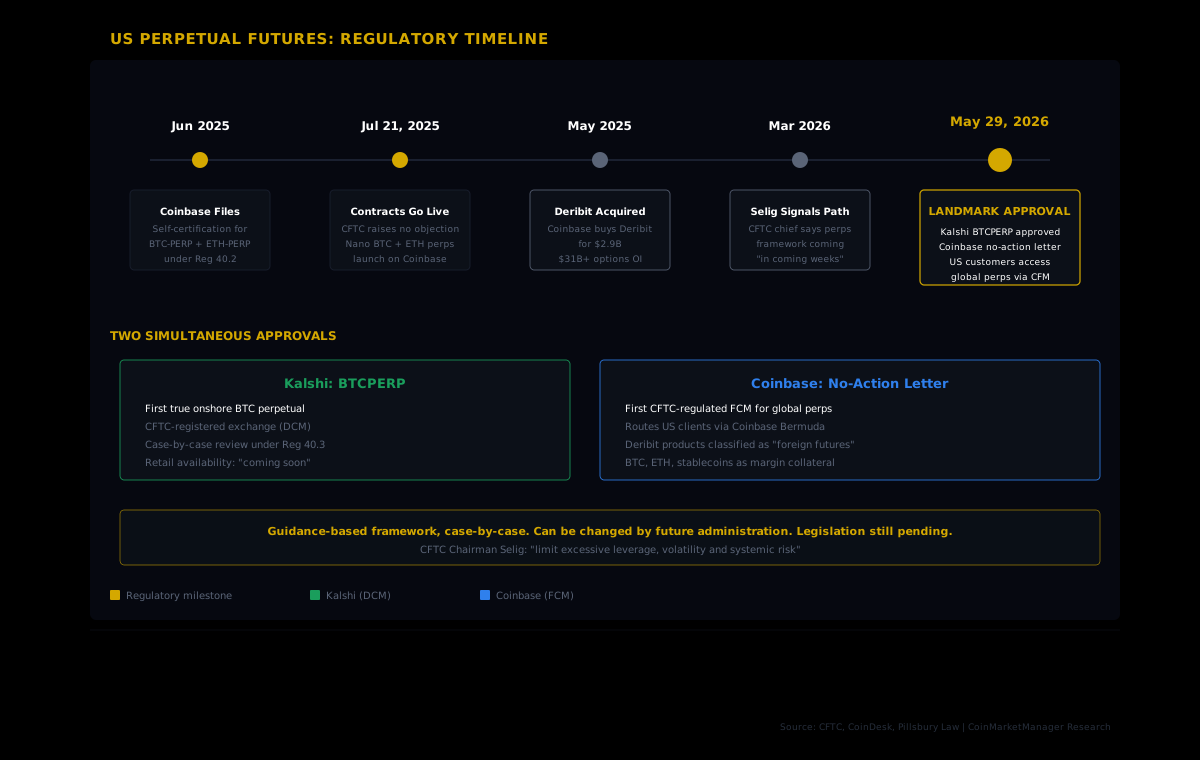
On May 29, the CFTC approved the first regulated Bitcoin perpetual futures contract in the United States and issued a no-action letter that lets Coinbase Financial Markets route American customers into global perps and options. Coinbase's chief legal officer Paul Grewal called it "a massive first for the industry."
For builders and traders running copy trading strategies on perpetual futures, this is the most consequential regulatory shift since perps went mainstream offshore. Regulated venues mean regulated rules: leverage caps, margin requirements, and, critically, registration obligations that could turn your copy trading bot into a commodity pool overnight. If you mirror wallets on Hyperliquid or any other perp DEX, the implications are worth understanding now, before enforcement catches up.
What the CFTC Actually Approved
Two things happened on the same day, and they work in tandem.
First, the CFTC approved KalshiEX's BTCPERP contract, a spot BTC-linked perpetual futures product with no fixed expiration date. This is the first "true" onshore perpetual contract on a CFTC-registered exchange. CFTC Chairman Mike Selig framed it as delivering on "President Trump's goal of cementing America as the crypto capital of the world."
Second, the CFTC issued a no-action letter to Coinbase Financial Markets (CFM), the exchange's CFTC-regulated futures commission merchant subsidiary. The letter classifies perpetual futures on Deribit FZE (which Coinbase acquired for $2.9 billion) as "foreign futures" and permits CFM to connect eligible US customers to those markets through Coinbase Bermuda. Customers can post BTC, ETH, and stablecoins as margin collateral.
Coinbase CEO Brian Armstrong put the scale in perspective: "US users have been locked out of around 80% of global crypto markets." That 80% figure refers to perpetual futures and options volume, which dwarfs spot trading globally. Deribit alone holds over $31 billion in Bitcoin options open interest.
Regulated Perps Come with Regulated Leverage
This is where the rubber meets the road for traders accustomed to offshore conditions. Coinbase's existing regulated perpetual futures are capped at roughly 3x to 10x leverage. Compare that to offshore CEXs and perp DEXs where 50x or even 100x is routine. CFTC Chairman Selig made the agency's position clear: the framework aims to "limit excessive leverage, volatility and systemic risk."
For copy traders, this leverage constraint reshapes the entire calculus. When you mirror a whale's position on an offshore platform running 20x, and the regulated equivalent caps you at 10x, the same trade produces half the PnL in both directions. Your stop distances change. Your liquidation math changes. The strategy you copy-paste from a Hyperliquid Money Printer wallet may not even make sense at regulated leverage.
The CPO and CTA Trap for Copy Trading
This is the part most copy trading operators are not thinking about, and it is the part that matters most.
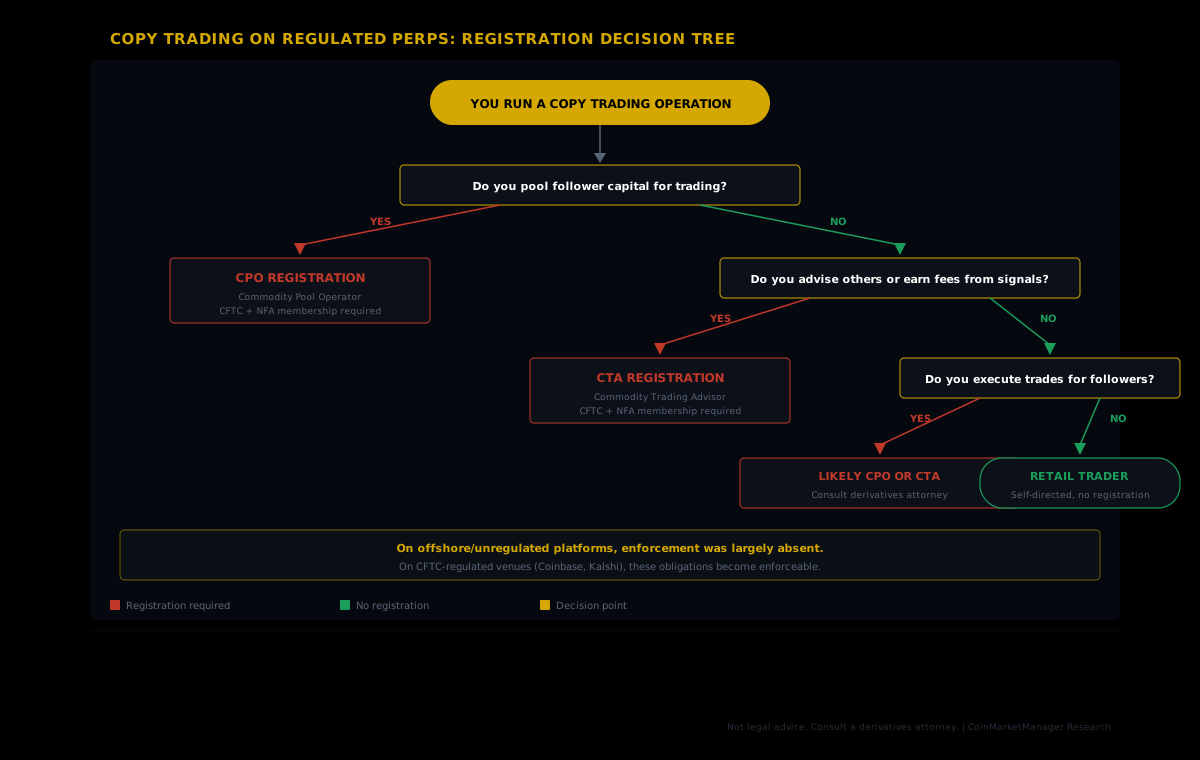
Under CFTC rules, a Commodity Pool Operator (CPO) is any entity that combines funds from multiple people for the purpose of trading futures, options on futures, or swaps. A Commodity Trading Advisor (CTA) is anyone who, for compensation, advises others on trading commodity interests. Both require registration with the CFTC and membership in the National Futures Association (NFA).
Now consider how most copy trading works: a leader wallet trades. Followers mirror those trades, often through a platform that facilitates the connection. If the platform pools follower capital or executes trades on their behalf, it starts looking like a commodity pool. If the leader receives performance fees or subscription revenue, they start looking like a CTA.
On offshore, unregulated platforms, these designations were largely academic. Nobody was enforcing CPO registration against a pseudonymous copy trading bot on an exchange domiciled in the Seychelles. But the moment perpetual futures move onto CFTC-regulated venues, every participant in the chain, from the platform operator to the signal provider, falls under the agency's jurisdictional reach.
Who Is at Risk?
| Actor | Potential Classification | Registration Required? | | --- | --- | --- | | Copy trading platform (pools funds) | Commodity Pool Operator | Yes, unless exempt | | Signal provider (earns fees) | Commodity Trading Advisor | Yes, unless exempt | | Individual mirroring wallets (self-directed) | Retail trader | No | | Bot operator routing follower trades | CPO or CTA (fact-dependent) | Likely yes |
The critical variable is whether the copy trading is self-directed or intermediated. If you build your own bot, monitor your own wallets, and execute your own trades based on signals you interpret yourself, you are a retail trader. The moment someone else manages the execution or pools capital, the CFTC framework kicks in. The CFTC's 2026 enforcement priorities explicitly include retail fraud and willful violations of registration requirements, which means unregistered operators are a named target.
What This Means for Decentralized Perp DEXs
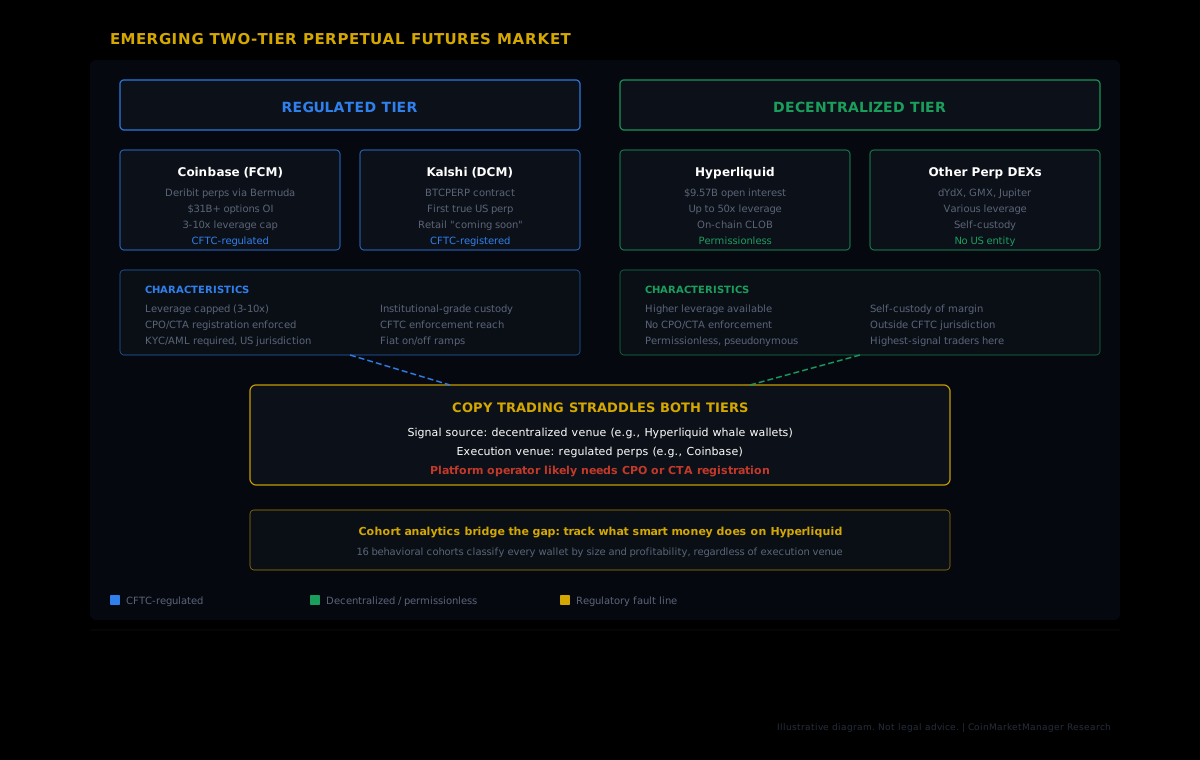
Hyperliquid, which commands roughly $9.57 billion in open interest and processes more volume than Coinbase International did in all of 2025, operates outside the CFTC's direct jurisdiction. The platform has no US entity, no FCM registration, and no leverage caps. That is precisely why high-leverage retail traders gravitate toward it.
But the existence of regulated onshore alternatives creates a two-tier dynamic. Institutional capital and compliance-conscious funds will migrate to venues like Coinbase and Kalshi because they need the regulatory wrapper. Retail traders who prioritize self-custody, permissionless access, and higher leverage will stay on decentralized platforms. Copy trading straddles both worlds, which makes it a regulatory fault line.
Consider the scenario: a US-based copy trading platform mirrors signals from a Hyperliquid whale wallet but executes the follower's trades on Coinbase's regulated perps. The signal source is offshore and unregulated. The execution venue is CFTC-regulated. The platform operator, who connects the two, almost certainly needs CPO or CTA registration. The regulatory arbitrage that made copy trading easy to launch in crypto is getting harder to sustain.
Cohort Data in a Split Market
A two-tier perps market creates a specific analytical challenge: the whales you want to copy may be trading on a different venue than the one you execute on. If the most profitable wallets on Hyperliquid (our Money Printer cohort, which tracks wallets with over $1 million in cumulative perp PnL) are positioning in one direction, but the regulated venue's price and funding rate tell a different story because institutional flow dominates there, you are looking at a divergence that matters.
Our data on Hyperliquid classifies every wallet into 16 behavioral cohorts, 8 by perp equity size and 8 by all-time PnL. That classification is unique to our API and covers the entire exchange. When regulated venues siphon institutional flow away from decentralized platforms, cohort analytics become more valuable because they isolate what is happening on the specific venue where the highest-signal traders actually operate.
The practical takeaway: if you are building a copy trading system that sources signals from Hyperliquid's best-performing wallets, you need analytics that tell you whether those wallets are actually active, whether their sizing is meaningful relative to their equity, and whether the broader cohort confirms the direction. A single wallet going long is noise. An entire profitability tier shifting exposure is signal.
What Copy Traders Should Do Now
The CFTC approval does not ban copy trading. It changes the compliance surface. Here is what matters in practice:
- Audit your setup for CPO/CTA exposure. If you run a platform that pools follower capital or earns fees from signal provision on regulated perps, consult a derivatives attorney about registration requirements. The NFA has streamlined its process for virtual currency activities, but the compliance burden is real.
- Understand the leverage mismatch. Strategies designed for 20x or 50x leverage do not translate to venues capped at 3x to 10x. If you source signals from high-leverage platforms and execute on regulated ones, the PnL profile changes fundamentally.
- Monitor venue divergence. As institutional flow migrates to regulated platforms, funding rates and open interest may diverge between venues. A funding rate on Coinbase's BTC perp may tell a different story than the same rate on Hyperliquid, because the participant mix is different.
- Use cohort-level analytics over single-wallet mirroring. Copying one wallet is fragile. It depends on that wallet staying active, staying profitable, and trading on a venue you can access. Cohort-level positioning from our API aggregates across hundreds or thousands of wallets in the same profitability tier, which gives you a more robust signal that survives venue migration.
Build Smarter Copy Trading with Cohort Data
HyperTracker's API classifies every wallet on Hyperliquid into 16 behavioral cohorts by size and profitability. Instead of mirroring one wallet, track what the entire Money Printer cohort is doing. One API call. Starting at $179/mo.
The Bigger Picture
The CFTC's move to bring perpetual futures onshore is the most significant structural change in US crypto derivatives since CME launched Bitcoin futures in 2017. Chairman Selig's framework explicitly favors case-by-case review for perpetual contracts across different asset classes, which signals that BTC and ETH perps are the beginning, not the ceiling.
For copy traders, the implications cascade. More regulated venues mean more compliance scrutiny on intermediaries. Leverage caps on regulated platforms create a structural wedge between the onshore and offshore trading experience. And the CPO/CTA registration framework, which has existed for decades in traditional futures, is now being applied to a crypto-native trading pattern that most participants never expected to be regulated.
The wallets worth copying have never cared about regulatory convenience. They trade where the edge is sharpest. Right now, that is still Hyperliquid, where the permissionless market structure and the full spectrum of leverage remain intact. The question for copy traders is whether you are building analytics infrastructure that works across both worlds, or betting everything on one side of the split.